%20Trends%20-%20Blog%20Image%20(1).avif)
Blog Post
6 Cyber Risk Quantification (CRQ) Trends That Will Define 2026
January 20, 2026
TL;DR
- Cyber risk quantification (CRQ) will shape how enterprises utilize risk registers, prioritize investments, and align cybersecurity with financial decision-making in 2026.
- Regulated industries will accelerate CRQ implementation to meet compliance demands, model materiality thresholds, and prove operational resilience at scale.
- CTEM platforms will embed CRQ to prioritize alerts based on business impact, not technical severity or arbitrary scoring.
- AI risk quantification will borrow from CRQ infrastructure to simulate loss scenarios and evaluate model misuse, leakage, and system compromise.
Quantification Has Reshaped Enterprise Risk Management
Cyber risk quantification (CRQ), the process of modeling cyber threats and forecasting loss outcomes, is becoming foundational to how organizations govern and respond to cyber exposure. What began as a specialized function is now shaping the priorities of security operations and enterprise risk management as a whole. Internal and external market players alike are driving this shift, demanding defensible, scenario-specific analyses of an enterprise's risk environment and clear explanations of why risk mitigation plans evolved the way they did.
Furthermore, as regulatory scrutiny increases and technologies like GenAI introduce new forms of operational risk, quantification provides the structure and clarity necessary for definitively prioritizing such actions and allocating resources. The most advanced risk management programs treat CRQ as a continuous tool that’s embedded into risk registers and threat exposure platforms, leveraging insights to align cybersecurity decisions with strategic outcomes. In 2026, the CRQ market overall will specialize and mature, both rapidly and irreversibly.
1. CRQ Market Expansion Continues Quickly
Global demand is rising for CRQ solutions as organizations across industries seek defensible, financially grounded insights into cyber exposure. According to a recent Business Research Insights report, the CRQ market is projected to reach $900 million by 2033, up from $340 million in 2024, marking a compound annual growth rate of 12%. This expansion reflects a broader shift that cybersecurity leaders and other security and risk managers (SRMs) are investing in CRQ platforms that can automate analysis, simulate losses, and integrate across workflows.
In parallel, enterprise buyers are raising expectations, prioritizing the quantification tools that can offer more than basic outputs or standalone reports saturated in technical metrics. They are increasingly looking for embedded capabilities across the cyber GRC lifecycle, such as risk register integration and real-time calibration, to support strategic and operational decisions that are made in the boardroom. As adoption scales, CRQ will become a core requirement for stakeholders at all levels of the market, each of whom expects cyber risk to be measured with the same rigor as financial risk.
2. CRQ Adoption Surges Exponentially in Highly Regulated Sectors
The most rapid adoption of cyber risk quantification is occurring within industries that are under heavy regulatory pressure. Financial services, technology, manufacturing, healthcare, and telecommunication organizations, to name a few, are facing mounting pressure to demonstrate operational resilience and financial preparedness. Moreover, regulations such as DORA in the EU, CPS 230 in Australia, and the US SEC's cyber disclosure rules are driving these organizations to quantify exposure. For the enterprises now subject to these mandates, subjective, qualitative assessments are no longer sufficient.
Cyber incidents can have systemic consequences, serving as a major catalyst for the implementation of such quantification solutions. CRQ enables the organizations in these industries to model financial loss scenarios, define materiality thresholds, and prioritize mitigation based on business impact. As scrutiny intensifies, regulated enterprises will lead the charge in buying quantification platforms, not only to meet compliance standards but also to improve resilience and align cybersecurity strategy with broader ERM goals.
3. Risk Registers Powered by CRQ Become the New Standard
Cyber risk registers are deviating from being static documentation tools and moving toward being solutions that are automated. In fact, the next generation of cyber risk registers will be built to eliminate manual work, reduce subjectivity, and generate insights that are immediately actionable. In 2026, organizations will replace both spreadsheets and outdated platforms that rely on internal scoring methods, subjective likelihood estimates, and disconnected data inputs.
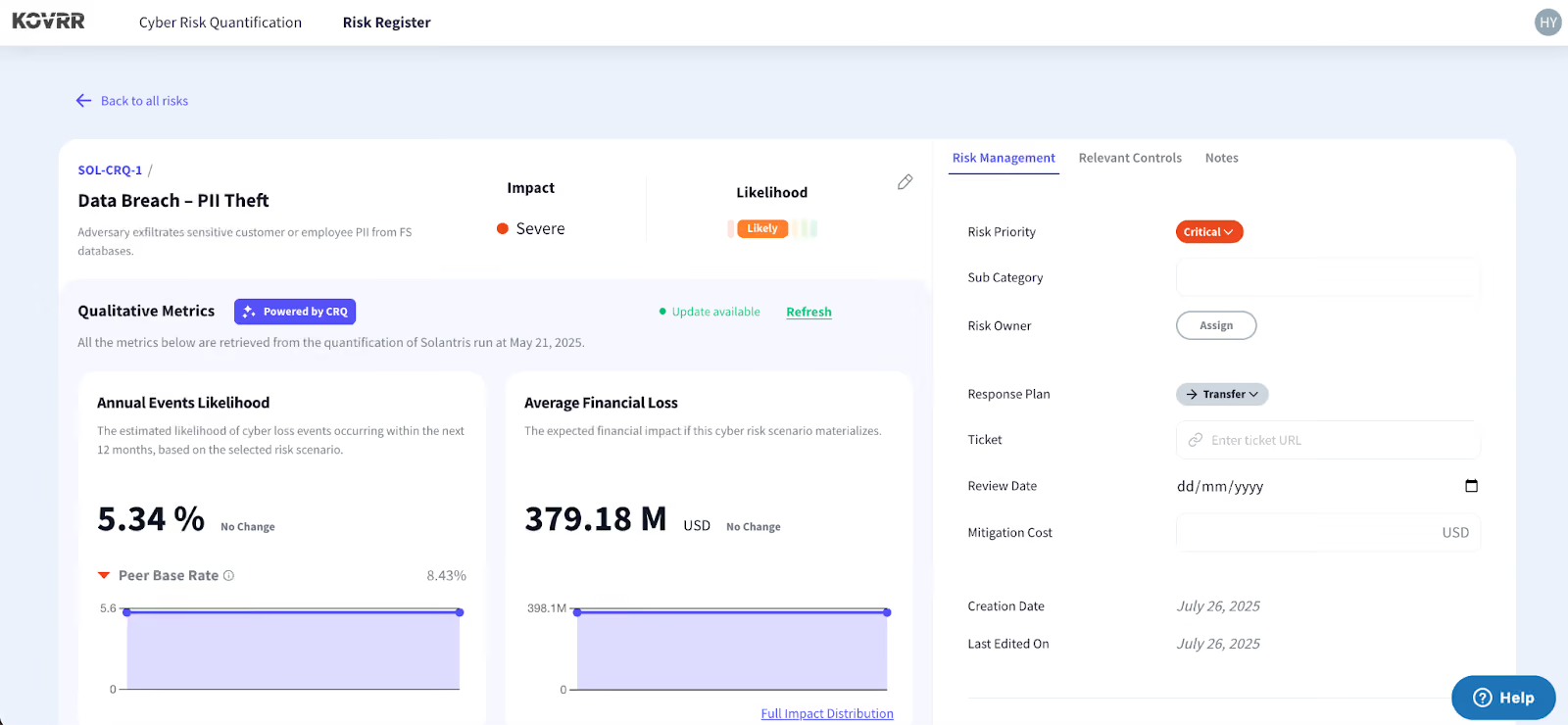
CRQ-powered platforms will become the standard. These innovative tools auto-populate registers with modeled loss forecasts, scenario-specific probabilities, and control effectiveness estimates based on external market intelligence, quantifying risk with precision and speed.
Scrutiny from auditors and executive stakeholders is increasing, and cyber risk teams are expected to justify how risks are evaluated and acted on. Manual inputs and subjective scoring won’t meet that expectation. Quantified systems will stand out for their ability to show where exposure comes from, what’s driving it, and which controls will make an impact. In 2026, the CRQ-powered risk register becomes a source of decision-making that leadership can trust.
4. CRQ Becomes the Cornerstone of CTEM Prioritization
Continuous Threat Exposure Management (CTEM) is gaining traction as organizations look to move from raw vulnerability data to actionable, risk-based prioritization. This shift helps teams gain visibility, but more than that, it helps them to discern what issues matter most, and why. In that endeavor, cyber risk quantification becomes foundational. As CTEM tools evolve, enterprises will embed CRQ directly into their workflows to rank exposures based on modeled financial impact rather than technical severity.
This trend will only intensify in 2026. The introduction of AI-related risks, increased misconfigurations, and growing infrastructure complexity will flood CTEM platforms with more alerts than teams can manage. CRQ provides the decision layer by simulating potential losses, evaluating control impact, and surfacing the exposures most likely to affect business operations. CTEM adoption is being driven by the demand for prioritization. CRQ is what makes that prioritization credible and fast enough to support real decisions.
5. AI Risk Quantification Builds on the Foundations of CRQ
As the AI risk landscape becomes more ominous, enterprises are facing growing pressure to quantify AI-related risks, such as model poisoning and data leakage. However, these risks can't simply be cut and pasted into existing cyber risk quantification frameworks. What carries over, then, is not the specific scenarios but the modeling infrastructure. The simulation engines and actuality modeling techniques, for instance, originally developed for other forms of risk management, can instead be the backbone of next-generation AI risk quantification.

These foundations will allow teams to more easily model complex, probabilistic outcomes in financial terms, applying the same rigor and defensibility that also made CRQ viable at scale. Rather than treating AI as an entirely new modeling challenge, organizations are adapting proven CRQ methodologies to build scenario-driven, financially grounded assessments of AI exposure. In the coming year, the most advanced enterprises will be quantifying it using the same approach that brought credibility to the cyber risk function.
6. CRQ Expands from Security Teams into Finance and ERM
This year, cyber risk quantification will cross the boundaries of security teams and become a standard tool for financial and enterprise risk management professionals. CRQ models are growing more explainable and scenario-driven, and, consequently, both CFOs and CROs will start relying on them to evaluate risk appetite and inform higher-level decisions on capital planning. Boards and regulators are already pushing for greater alignment between cyber risk and broader business exposure, demanding the financial context that only CRQ can provide.
Expressing risk in economic terms enables leaders to compare cybersecurity tradeoffs against other forms of operational risks, such as supply chain disruptions and regulatory penalties. In 2026, more organizations will embed CRQ into their ERM dashboards and board-facing materials, recognizing the value of the relative information. Rather than being confined to the cyber department, quantification will transform into a shared capability that plainly connects cybersecurity to enterprise value and elevates it as a core business function.
Quantification Is the Difference Between Planning and Guessing
Financial modeling is becoming inseparable from how cyber risk is managed, marking a structural change in how organizations make decisions. Security teams aren’t the only ones expected to respond to risk, though. Finance, audit, procurement, and business leadership are now all accountable for how it’s measured. As systems generate more exposure data, quantification is what will keep that data actionable.
The goal isn’t to predict every loss. It’s to build programs that can respond to cyber risk with control, consistency, and financial grounding. Quantification creates that baseline. In the next phase, it will be embedded not as a dashboard, but as an input to how organizations plan.
To prepare for the year ahead and see how quantification can support your cyber risk planning and overall enterprise risk management strategy, schedule a demo of Kovrr’s CRQ platform today.

.png)