
AI Governance and AI Risk Management Frequently Asked Questions


Everything to Know About AI Governance and AI Risk Management
AI governance and risk management have quickly become essential pillars of responsible enterprise innovation. As organizations adopt AI across business functions, oversight structures and measurable safeguards are critical for maintaining compliance and trust. This FAQ addresses the most common questions about AI governance and risk management, helping you understand how to structure and strengthen your organization’s AI oversight program.
How can quantification support ethical risk management?
Quantification allows ethical considerations to be evaluated in measurable, business-relevant terms. Kovrr’s AI Risk Quantification module links ethical exposures, such as bias-related outcomes or misuse of data, to financial impact. This helps organizations demonstrate that managing ethics isn’t just responsible but also vital for operational and reputational resilience.
Can AI governance address fairness and discrimination issues?
Yes. Strong governance structures help detect and prevent bias in AI systems by ensuring transparency in model design and data usage. Kovrr’s AI governance modules assess the effectiveness of these controls and provide quantifiable insights that show how ethical risk management strengthens both compliance and trust.
How can transparency be measured in AI systems?
Transparency can be evaluated through explainability metrics, documentation quality, and access controls. Kovrr’s AI Risk Assessment module provides measurable scoring across these areas, helping organizations understand where explainability gaps exist and how improving transparency directly contributes to stronger governance and reduced reputational exposure.
What frameworks help mitigate ethical AI risks?
Frameworks such as NIST AI RMF, OECD AI Principles, and ISO/IEC 42001 outline processes for ensuring fairness, transparency, and human oversight. Kovrr’s AI Risk Assessment module aligns with these frameworks, allowing organizations to evaluate ethical safeguards and demonstrate that they’ve integrated responsible AI practices into governance operations.
How can I demonstrate AI accountability to regulators?
Accountability requires evidence that AI systems are well-documented, monitored, and regularly assessed. Kovrr’s AI governance modules make this possible by centralizing system inventories, control testing, and quantification results into audit-ready outputs that show regulators and stakeholders how AI oversight is actively managed and continuously improved.
Are there frameworks that combine AI governance and privacy controls?
Yes. Frameworks like ISO/IEC 42001 and the NIST AI Risk Management Framework integrate both governance and privacy considerations. Kovrr’s AI Risk Assessment module benchmarks safeguard maturity across these frameworks, ensuring organizations manage data privacy, fairness, and accountability in one unified, measurable governance structure.
How can risk quantification support AI compliance reporting?
Quantification adds measurable context to compliance reporting by translating exposures into financial and operational terms. Kovrr’s AI Risk Quantification module provides the evidence organizations need to demonstrate accountability, showing regulators and executives how current safeguards mitigate potential losses and where additional investments can further reduce risk.
What happens if AI systems violate data protection laws?
AI systems that mishandle data or fail to comply with privacy regulations can expose organizations to fines, investigations, and reputational damage. Kovrr’s AI Risk Assessment module helps companies identify and correct weaknesses in data governance before violations occur, while AI Risk Quantification measures the potential financial exposure if they do.
How can organizations prepare for AI audits or regulatory reviews?
Preparation begins with clear documentation of AI systems, their safeguards, and their associated risk evaluations. Kovrr’s AI Risk Assessment module streamlines this process, generating audit-ready outputs that summarize model inventories, maturity benchmarks, and quantifiable exposure data to help organizations present verifiable evidence during regulatory reviews.
What’s the difference between compliance and governance in AI?
Compliance ensures adherence to specific rules and regulations, while governance establishes the internal structures that make ongoing compliance sustainable. Kovrr’s AI governance modules connect these layers, linking governance maturity assessments with quantifiable metrics to demonstrate accountability, readiness, and operational control across the entire AI ecosystem.
How do the EU AI Act and ISO 42001 affect AI governance?
The EU AI Act introduces risk-based oversight requirements, while ISO/IEC 42001 provides a management framework for responsible AI operations. Kovrr’s AI Risk Assessment helps organizations align with both, evaluating safeguard maturity and quantifying where additional governance controls are needed to meet regulatory expectations.
Which AI regulations should global companies be aware of?
Global companies must account for regulations like the EU AI Act, the U.S. AI Executive Order, and ISO/IEC 42001, all of which set expectations for transparency, fairness, and accountability. Kovrr’s AI Risk Assessment aligns with these standards, enabling enterprises to evaluate readiness and demonstrate compliance through measurable evidence.
How does AI governance support data protection compliance?
AI governance ensures that data used by AI systems is handled in accordance with privacy laws and internal security policies. Kovrr’s AI Risk Assessment module benchmarks data governance maturity against frameworks such as ISO/IEC 42001 and NIST AI RMF, helping organizations prove responsible data handling and reduce compliance exposure.
How does AI visibility impact overall risk posture?
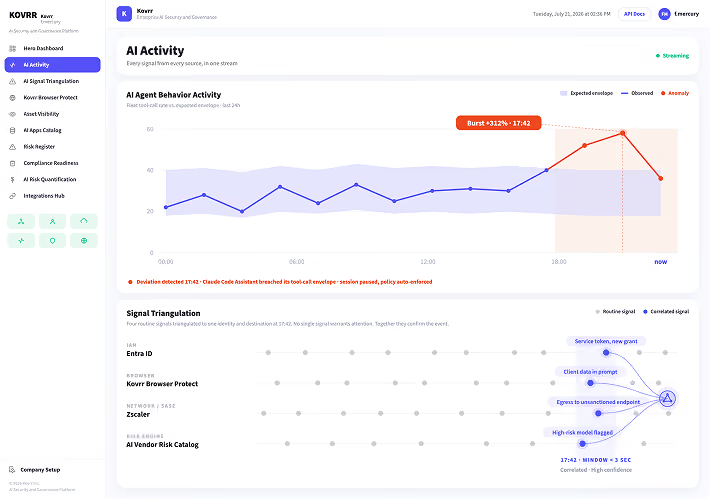
Limited visibility leads to unmanaged exposures, while structured visibility allows leaders to make informed decisions. Kovrr’s AI governance modules integrate visibility findings with quantifiable risk data, helping organizations track how unmonitored AI affects operational integrity, compliance confidence, and long-term resilience across business functions.
How can Kovrr help increase visibility into shadow AI?
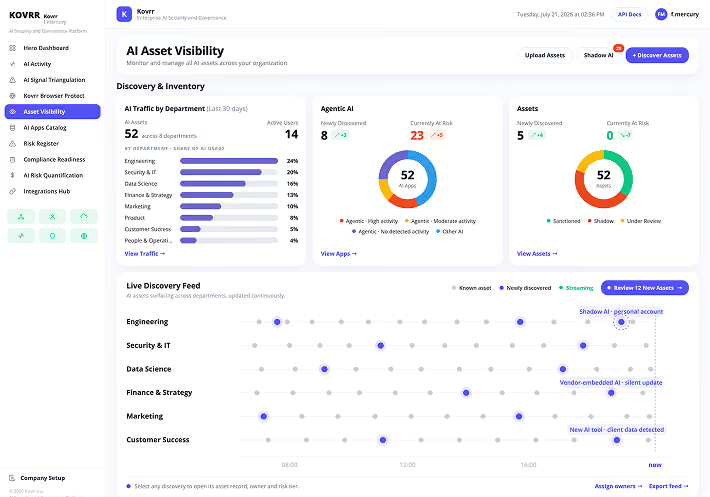
Kovrr enhances AI visibility by combining structured assessment and quantification within a single platform. Through the AI governance modules, organizations can identify unmonitored AI usage, evaluate policy alignment, and measure potential financial and operational impact, turning shadow AI from an unknown variable into a managed component of governance.
Can AI visibility assessments identify shadow AI risks?
Yes. AI visibility assessments highlight areas where models or tools are used without oversight. Kovrr’s AI Risk Assessment module maps these activities and quantifies the associated exposure. This helps governance teams understand how unsanctioned AI use affects compliance, data privacy, and the organization’s overall risk posture.
What steps can organizations take to bring shadow AI under control?
Organizations should establish clear policies for AI use, implement access controls, and continuously evaluate data-sharing practices. Kovrr’s AI governance modules support this process by assessing safeguard maturity and providing actionable recommendations to help enterprises bring shadow AI activity into compliance with corporate governance standards.
How can companies detect shadow AI use internally?
Detecting shadow AI requires visibility into where AI tools are deployed, who uses them, and what data they access. Kovrr’s AI Risk Assessment module identifies unsanctioned or unmonitored AI activity across the enterprise, providing a structured inventory that helps organizations close visibility gaps and reduce governance blind spots.
What is shadow AI, and why is it risky?
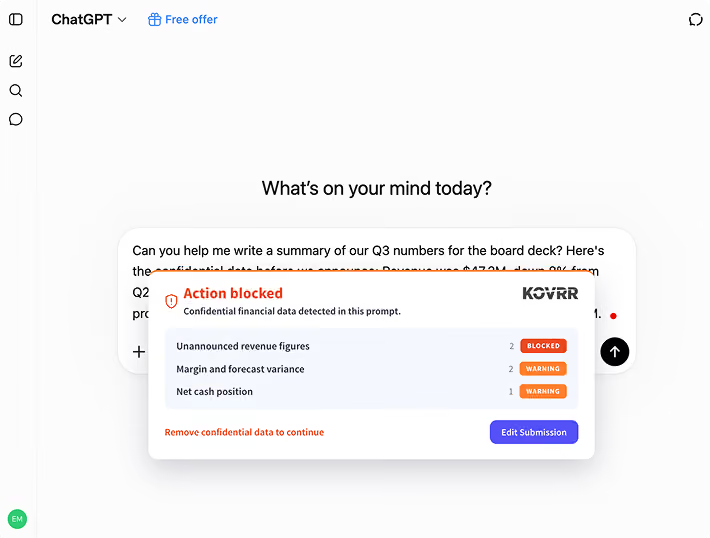
Shadow AI refers to the unsanctioned use of artificial intelligence tools by employees or departments outside governance oversight. This creates data privacy issues, compliance concerns, and visibility gaps. Kovrr’s AI Risk Assessment module helps stakeholders identify these untracked uses, helping the entire organization measure its associated exposure and bring it under formal governance.
How do you interpret the results of an AI risk quantification report?
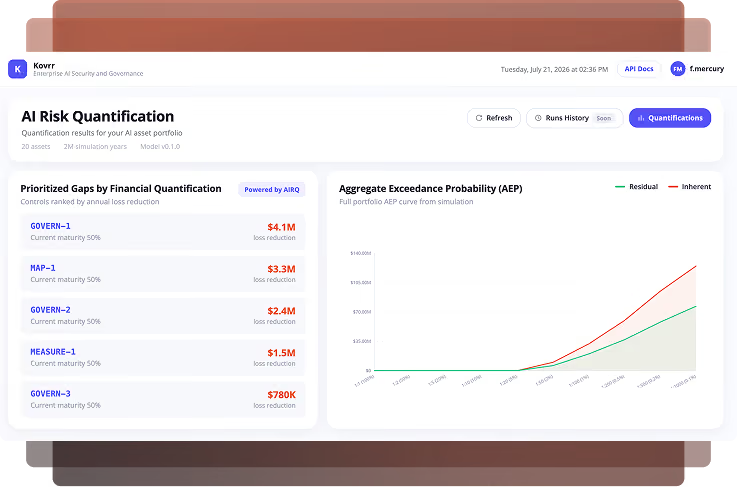
An AI Risk Quantification report translates exposures into probability-weighted loss metrics, identifying which risks carry the greatest potential impact. Kovrr’s report outputs include financial loss curves, expected annual losses, and control effectiveness analysis, giving executives and boards tangible insight into where AI-related resources should be allocated.
How long does an AI risk quantification process take?
With the right tools, AI Risk Quantification doesn’t need to be time-consuming. Kovrr’s platform, for instance, automates much of the process, using continuously updated data and integrated simulations. Most organizations can expect initial quantified results within an hour or so, followed by continuous recalibration as their AI environment and safeguards evolve.
What are the benefits of quantifying AI exposure?
Quantifying AI exposure turns subjective governance conversations into evidence-based strategy. By expressing potential risk in financial terms, organizations can justify mitigation investments, align with regulations, and demonstrate accountability. Kovrr’s AI Risk Quantification module provides these measurable results, empowering leaders to manage AI with precision and transparency.
How do simulations help forecast AI risk exposure?
Simulations enable organizations to forecast a range of possible outcomes instead of relying on static assumptions. Kovrr’s AI Risk Quantification module runs thousands of loss scenarios to calculate both frequency and impact, helping decision-makers visualize potential damage and determine which safeguards offer the greatest reduction in exposure.
What data do you need to quantify AI risk accurately?
Accurate AI quantification requires information about model usage, data sensitivity, safeguard maturity, and organizational dependencies. Kovrr’s AI Risk Quantification module integrates these inputs automatically from assessments or internal systems, applying calibrated models that reflect your firm’s size, sector, and governance posture for precise, tailored outputs.
How does Kovrr approach AI risk quantification?
Kovrr’s AI Risk Quantification combines real-world threat intelligence with probabilistic modeling to estimate loss severity and likelihood. The platform links assessment findings with financial forecasting to produce metrics such as annualized loss expectancy and exceedance curves, giving enterprises a clear, defensible picture of their AI exposure.
Which companies offer AI risk quantification solutions?
Few providers currently offer end-to-end AI Risk Quantification solutions. Kovrr leads this space with its integrated approach that combines governance, assessment, and quantification. Organizations use Kovrr’s AI Risk Quantification module to calculate financial exposure, simulate incidents, and tie oversight decisions directly to measurable business outcomes.
How can AI risk management improve decision-making?
When AI risks are evaluated in measurable terms, leaders can prioritize investments with confidence. Kovrr’s AI governance modules integrate assessment results and quantification data into clear business metrics, enabling executives to align mitigation plans, allocate resources efficiently, and maintain defensible oversight across AI initiatives.
Can AI-related risks be expressed in financial terms?
Yes. AI-related risks, such as compliance breaches, data exposure, or system failures, can be modeled using loss simulations and probability analysis. Kovrr’s AI Risk Quantification module converts technical findings into monetary values that executives understand, enabling more strategic planning and transparent communication between risk, finance, and governance leaders.
What does AI risk quantification mean?
AI risk quantification measures how artificial intelligence exposures translate into financial and operational impact. It connects governance and assessment results to data-driven models that estimate potential losses. Kovrr’s AI Risk Quantification module gives organizations a structured way to forecast outcomes, prioritize controls, and strengthen governance through measurable insight.
What’s the connection between AI governance and AI risk management?
AI governance defines the structure (roles, policies, and oversight) while AI risk management operationalizes it through assessment and quantification. Kovrr’s AI governance modules unify both functions, providing a cohesive system where governance policies drive measurable assessments and quantifiable insights that strengthen enterprise-wide decision-making.
How do you measure the effectiveness of AI safeguards?
Measuring safeguard effectiveness requires tracking both control maturity and the reduction in exposure that those controls achieve. Kovrr’s AI Risk Assessment module benchmarks safeguards against established frameworks, while its AI Risk Quantification module measures how improvements translate into reduced financial and operational risk. Together, they create measurable accountability.
What’s included in an AI risk assessment report?
An AI risk assessment report summarizes model inventories, safeguard maturity levels, governance responsibilities, and identified exposures. It often includes benchmarks against frameworks like NIST AI RMF and ISO/IEC 42001. Kovrr’s AI Risk Assessment module specifically, though, produces structured, report-ready outputs designed to support board discussions and regulatory reviews.
What are the steps in conducting an AI risk assessment?
An effective AI risk assessment starts with cataloging models and data sources, followed by evaluating safeguard maturity, governance accountability, and framework alignment. Kovrr’s AI Risk Assessment streamlines much of this process, guiding teams through control evaluation and translating results into metrics that support enterprise risk reporting.
Who provides AI risk management services for enterprises?
Several firms specialize in AI oversight, but few offer quantifiable insight. Kovrr stands out by combining governance structure, safeguard assessment, and financial modeling within a single platform. Through its AI governance modules, organizations gain both qualitative and quantitative visibility into how AI adoption affects their risk posture.
Can AI risk be quantified like cyber risk?
Yes. AI-related risks can be modeled for financial and operational impact using probabilistic simulations. Kovrr’s AI Risk Quantification module translates technical findings from assessments into measurable outcomes, producing financial metrics such as potential loss expectancy and exposure ranges that inform business and compliance strategies.
What’s the best way to assess AI risk across multiple business units?
A scalable assessment process is essential when AI use varies across departments. Organizations should apply standardized frameworks to ensure consistent scoring and reporting. Kovrr’s AI governance modules support multi-entity evaluations, allowing risk and compliance leaders to benchmark maturity across units and consolidate findings into a unified governance view.
How do organizations identify risks in their AI systems?
AI risks are uncovered through structured assessments that examine how data, models, and outputs interact across the organization. This includes evaluating model reliability, privacy controls, and operational dependencies. Kovrr’s AI Risk Assessment gives teams a systematic way to map exposures, measure safeguard maturity, and document areas needing oversight.
What is AI risk management, and how is it different from cybersecurity risk?
AI risk management focuses on identifying and addressing exposures created by artificial intelligence systems, ranging from data misuse to model bias or regulatory non-compliance. Cybersecurity risk, by contrast, centers on protecting infrastructure and data from external threats. Kovrr’s AI Risk Assessment module helps organizations evaluate AI-specific safeguards and governance gaps that traditional cybersecurity tools overlook.
Which frameworks guide responsible AI governance?
Key frameworks include the NIST AI Risk Management Framework, ISO/IEC 42001, and the OECD’s AI Principles. Each provides structure for aligning governance practices with global standards. Kovrr’s AI Risk Assessment references these frameworks, ensuring organizations can benchmark maturity and demonstrate alignment to regulators and stakeholders alike.
What are the biggest challenges in establishing AI oversight?
Common challenges include fragmented accountability, lack of visibility into model use, and rapidly evolving regulations. Many organizations struggle to connect technical risk with business impact. Kovrr addresses this gap through assessments and quantification models that unify governance, compliance, and financial perspectives in a single oversight structure.
How do you implement AI governance without slowing innovation?
Governance works best when it supports experimentation rather than limits it. Clear guidelines and automated assessments allow teams to innovate responsibly. Kovrr enables this balance by embedding structured oversight into normal workflows, giving organizations visibility into risk without impeding the pace of development or deployment.
Can AI governance help prevent compliance violations?
Yes. Robust AI governance aligns technology operations with existing regulations, reducing the chance of unintentional non-compliance. By enforcing data privacy standards and ethical guidelines, governance frameworks create verifiable audit trails. Kovrr’s platform helps organizations monitor compliance posture continuously and quantify potential exposure when gaps are identified.
How can companies create an effective AI governance framework?
An effective AI governance framework blends policy, accountability, and measurement. Organizations should define clear ownership for AI systems, establish data-handling standards, and create a review process for new AI deployments. Kovrr’s AI Risk Assessment module guides this process, benchmarking safeguard maturity and identifying where governance practices need reinforcement.
What are the main goals of AI governance programs?
AI governance aims to ensure fairness, reliability, transparency, and compliance. It helps organizations understand how AI affects operations, customers, and broader ethical standards. Kovrr’s AI Risk Assessment and AI Risk Quantification modules strengthen these efforts by mapping governance maturity, identifying weak controls, and quantifying the financial and operational impact of governance gaps.
What are the best AI governance tools available right now?
Effective tools offer structured visibility, control mapping, and quantification capabilities. Leading organizations use solutions that integrate with GRC systems and monitor safeguard maturity in real time. Kovrr’s AI governance modules, including an AI Risk Assessment and AI Risk Quantification, deliver this functionality and convert governance data into actionable business intelligence.
What is AI governance, and why does it matter for organizations?
AI governance is the structure that ensures artificial intelligence is developed, deployed, and managed responsibly. It defines who oversees AI systems, how decisions are documented, and how outcomes are measured. Strong governance helps organizations maintain transparency, accountability, and compliance while supporting innovation. Kovrr’s AI governance modules help organizations translate oversight into measurable, defensible processes.
How can I tell if my organization has good AI governance practices?
Strong AI governance is visible through consistent policies, documented accountability, and the ability to measure safeguard effectiveness. Regular assessments, framework alignment, and quantification of exposures demonstrate maturity. Kovrr’s AI governance modules provide these measurements, allowing organizations to evaluate progress and prioritize improvement initiatives with data-driven clarity.
Who is responsible for AI governance within an enterprise?
Responsibility for AI governance typically spans multiple roles: executive leadership for policy approval, compliance teams for monitoring, and technical staff for implementation. Many enterprises also appoint dedicated AI governance officers or committees. Kovrr supports these stakeholders by centralizing oversight data and linking governance activities to quantifiable business outcomes.


