
How Current Is Your Risk Assessment, Really? Continuous Control Monitoring (CCM), Powered by CRQ



Continuous Control Monitoring and CRQ
Speak to an Expert to Learn MoreWhat is continuous control monitoring in cybersecurity?
Continuous control monitoring, or CCM, is the practice of ingesting live security signals from controls and enterprise data lakes to maintain an ongoing, current view of control effectiveness. It replaces the point-in-time snapshot model, where an assessment captures posture on one day and then goes stale as settings drift. Instead of waiting for the next scheduled review to discover that an encryption setting changed or a cloud resource fell out of compliance, CCM surfaces those changes as they happen.
Why do point-in-time security assessments go stale?
Because control posture changes continuously and audits do not. A firewall rule can be modified, a cloud resource can be misconfigured, and a control can drift out of compliance within hours of an assessment being completed. None of it appears in the report, because the report reflects a single moment. The consequence is that material risks go undetected between review cycles, compliance gaps widen unnoticed, and the security strategy built on that data becomes obsolete without anyone realizing it.
How does continuous control monitoring work with cyber risk quantification?
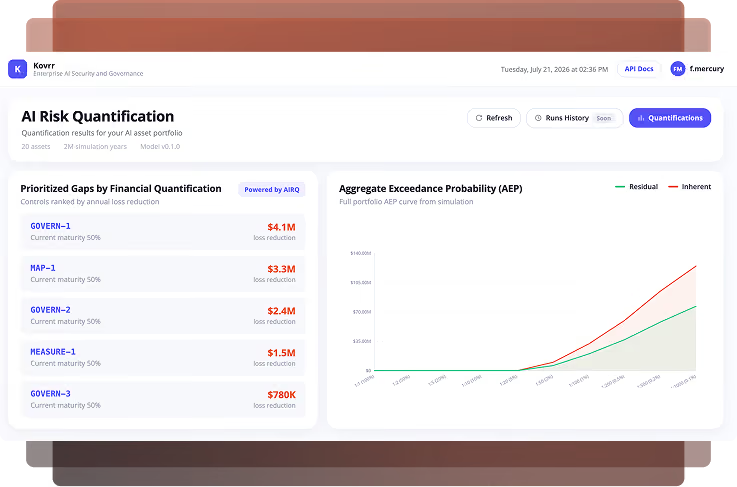
Live data on its own is still raw and uncontextualized. Pairing CCM with CRQ translates each control change into an updated financial exposure figure rather than another dashboard item. When a control state changes, the platform extracts the posture update and surrounding context through scoped API access, the CCM engine maps that change to the relevant financial loss scenarios, and exposure is recalculated in real time. The updated risk level appears in the CRQ dashboard within minutes, ready to act on.
How does continuous control monitoring support regulatory compliance?
Because quantification stays grounded in live posture data rather than a quarterly snapshot, the evidence produced reflects the current state of the environment. That supports alignment with SEC cyber disclosure rules, DORA, the NIS 2 Directive, ISO 27001, and CIS v8 controls. For GRC teams, the practical benefit is defensible, board-ready evidence available on demand, which matters most under disclosure regimes that expect an accurate view of exposure at the moment a decision or filing is made.
Which security tools and cloud platforms does continuous control monitoring integrate with?
Kovrr's CCM engine connects to Microsoft Defender for Cloud, AWS Security Hub, Google Cloud Asset Inventory, and Azure Resource Manager, along with SIEM and data lake connectors. Cloud access is scoped through native role-based access controls. Because the same recalculation flow runs regardless of source, a control change in any connected environment feeds the same real-time financial exposure update rather than sitting in a separate console.


