

How to Choose the Right Cyber Risk Quantification Model
Expert judgment, deterministic, probabilistic. Three model types, two dominant frameworks, and the questions that decide which one fits your organization.



Cyber Risk Quantification Models
Speak to an Expert to Learn MoreWhat is a cyber risk quantification model?
A cyber risk quantification model is the specific methodology used to convert cyber risk into numerical values, namely the likelihood that an organization experiences a cyber event and the financial impact if it does. The model is what turns "we might get breached" into a figure executives can act on. It gives organizations a structured, repeatable, and defensible way to assess their risk posture rather than relying on a color-coded matrix.
What are the three types of cyber risk quantification models?
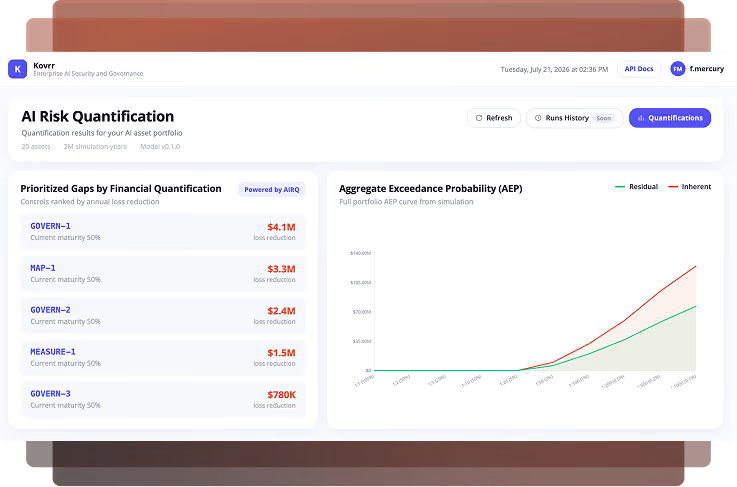
There are three broad types. Expert judgment models rely on the experience of security and risk professionals to estimate likelihood and impact, which adds useful context but produces results that are only as defensible as the person supplying the inputs. Deterministic models assign fixed values to known factors like controls and vulnerabilities and return a static score, which is simple to explain but cannot account for volatility. Probabilistic, or stochastic, models use statistical techniques such as Monte Carlo simulation to generate a full range of possible outcomes instead of a single number.
What is the difference between FAIR and a CRQ platform?
Both run on the same probabilistic engine, but they differ in how data gets in. FAIR relies on manual collection through interviews, research, and calibrated assumptions, which makes assessments slow, expensive to repeat, and exposed to the bias of whoever gathers the data. A CRQ platform pulls in external, objective sources instead: real-world loss intelligence, threat data, and large-scale insurance claims. It also integrates directly with GRC, SOAR, and EDR systems, so inputs stay consistent across runs rather than depending on someone's best estimate.
How do you choose the right cyber risk quantification model?
Start with the organization: its size and complexity, its industry, the maturity of the existing security program, and its risk appetite and tolerance. Then evaluate the model itself: which risks it can capture, how far users can drill into the contributing factors, and how well it scales, integrates, and delivers value quickly. There is no universal winner. The practical test is whether the model gives the CISO and leadership team what they need to make a data-driven call on where the next dollar of security budget goes.


