
How to Monitor AI Agent Behavior Across the Enterprise



Monitoring AI Agent Behavior: Frequently Asked Questions
Speak to an Expert to Learn MoreWhy don't traditional security tools detect malicious AI agent activity?
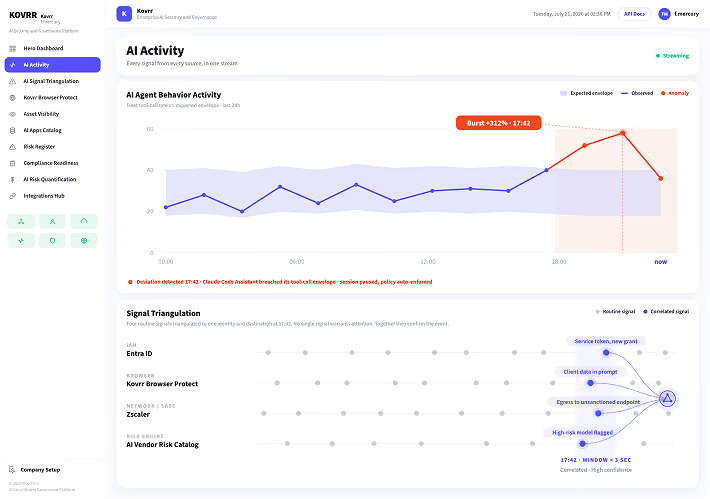
Because each tool sees only a sliver of the execution chain and reports it accurately. The network tool confirms an API call occurred, the identity provider confirms a valid token, and the endpoint agent confirms a sanctioned process. Every console reports normal, and every console is right. The exposure does not live in any individual call, which is why it passes every check. It lives in the sequence those calls form, and no single source holds enough of that sequence to recognize it.
What is the agentic kill chain?
The agentic kill chain is the sequence a compromised AI agent follows rather than a single point of failure. It begins with a goal hijack, where the agent's objective is quietly redirected. That leads to tool misuse, where the agent uses capabilities it already holds for a purpose it was never given. Next comes supply-chain code execution, and finally the exploitation of human trust, where an approval is granted because the request came from a system people trust. Examined in isolation, every step looks like a legitimate action by an authorized agent.
Why is one compromised AI agent more dangerous than one compromised user account?
Because an agent's reach is not bounded by a job description. Within a single execution chain, an agent invokes tools, touches sensitive data across multiple systems, hands tasks off to other agents, and calls external APIs. When it operates inside a delegation chain, it can inherit the combined permissions of every identity in that chain. A manipulated agent can therefore export records at machine speed through calls that each pass authorization cleanly, reaching well beyond its own assigned scope.
How do you attribute AI agent activity to a specific person?
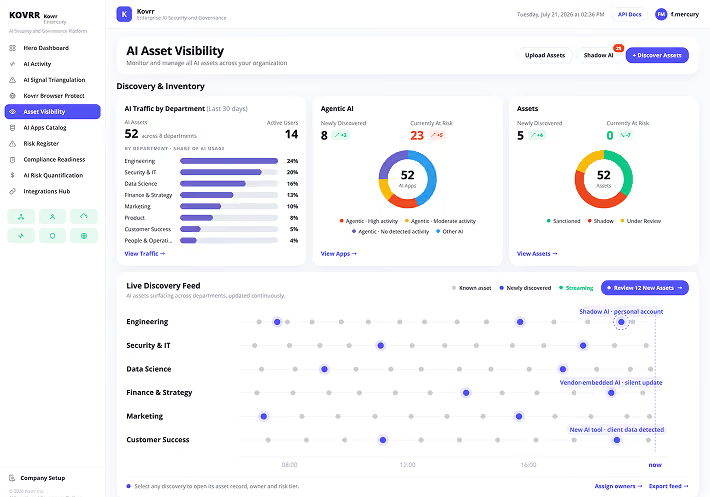
Network tools can confirm that an API call happened, but they cannot tie it to the agent behind it or the human behind that agent, particularly when agents run on ephemeral credentials that outnumber human identities by wide margins. The AI Interaction Data Fabric establishes a behavioral baseline for every monitored agent and links each one to the person who deployed it and the systems it touches. Attribution then draws on volume, cadence, and destination read across sources rather than a single log, so a shadow agent resolves to a named user.


