

The Cyber Risk Register, Reimagined With Quantification
Why spreadsheets can no longer keep up with modern cyber risk, and how a CRQ-powered register turns tracking into strategic action.



Cyber Risk Register FAQs
Speak to an Expert to Learn MoreWhat is a cyber risk register?
A cyber risk register is a centralized, continuously updated ledger that documents every cybersecurity risk an organization is tracking, along with the affected assets, existing controls, residual exposure, and named owner for each entry. It serves as the connective tissue between technical security data and executive decision-making, translating threat and control information into a form leadership can use to prioritize investments. Modern registers replace qualitative color-coded ratings with financial exposure figures tied to a cyber risk quantification (CRQ) engine, which is what makes the register directly comparable to other categories of enterprise risk.
Why are spreadsheet-based risk registers no longer enough?
Traditional spreadsheet registers were built for a simpler risk environment. As the threat landscape has expanded and regulatory expectations have tightened, manual tracking cannot keep pace with the volume, velocity, or complexity of modern cyber risk. Version control breaks down, financial context is missing, and there is no way to demonstrate to the board or a regulator that the register reflects reality rather than a static snapshot.
How does a CRQ-powered cyber risk register work?
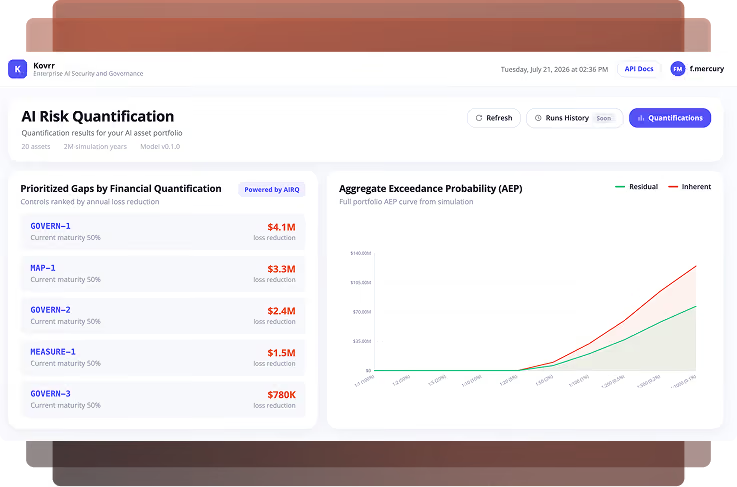
Kovrr's CRQ-powered cyber risk register integrates cyber risk quantification directly into scenario analysis. Each risk gets modeled from the bottom up based on the organization's environment, surfacing average annual loss, likelihood, impact ranges, and the security controls that would most reduce exposure. This turns the register from a documentation exercise into a decision-support tool.
How does a cyber risk register support GRC and compliance?
A structured register documents security control and policy gaps mapped to compliance requirements. When auditors arrive, the organization can present clear evidence of adherence to frameworks like NIST CSF 2.0, DORA, and NIS 2. Because the same register drives board reporting, compliance and executive communication run on the same underlying data.
How is a cyber risk register different from an enterprise risk register?
An enterprise risk register covers every category of organizational risk, from financial to operational to strategic. A cyber risk register focuses specifically on digital and technology-related threats, adds the technical control context those threats require, and integrates with the security tooling stack that generates the underlying data. In mature programs, cyber risk feeds up into the enterprise register in financial terms.
How often should a cyber risk register be updated?
Continuously. The threat landscape shifts too quickly for quarterly reviews to keep up. Kovrr's register updates as scenarios evolve, controls change, and new threat intelligence lands, so the numbers a CISO reports to the board reflect the environment as it exists today, not the environment as it looked at the last audit.

