
Blog Post
Agentic AI Has Shattered Network Paradigms. Governance Must Now Adapt.
September 2, 2026
Automated Traffic Passed Human Traffic in 2026
For most of the web's history, automated traffic was a small and largely legible minority. Cloudflare has put the pre-generative figure at roughly 20 percent, dominated by Google's crawler, with most of the remainder belonging to scammers and bad actors. That composition made a simple rule largely defensible. Automation that was not a recognized search crawler could be treated as unwanted by default, and a generation of security tooling was designed around that premise.
In June 2026, three and a half years after ChatGPT put LLMs in front of the general public, Cloudflare's traffic tracker recorded automated requests crossing 57.4% of all HTTP traffic worldwide, with human users falling to 42.6%. The company's CEO, Matthew Prince, noted publicly that the milestone arrived roughly eighteen months earlier than he had forecast. HUMAN Security's 2026 benchmark put the driver in sharper relief, measuring agentic AI traffic growth of 7,851 percent year over year, and automated traffic expanding eight times faster than human traffic.
Those numbers circulated widely, framed almost entirely around what they implied for websites and the businesses defending them. That framing is reasonable, since most of the measured traffic is inbound and commercial. However, the more consequential reading sits one layer down, in how quickly machine-generated activity became ordinary rather than exceptional, and in how completely that inverts the premise the tooling was designed around.
Automation and Volume Have Stopped Working as Signals
The first casualty of that inversion was the link between automation and intent. When a customer instructs an AI agent to compare products and complete a purchase, the session it produces is close to indistinguishable from a fraudulent one running stolen cards through the same checkout flow. HUMAN's Satori threat intelligence team documented that overlap directly, observing a carding pattern executed through an AI browser agent operating inside an authenticated session. The mechanics match on both sides. The difference is the person who dispatched the agent, a detail the traffic itself never carries.
The second loss is quieter and more difficult to instrument around. Anomaly detection depends on a stable baseline, and a sharp rise in machine requests used to be a reliable indicator of trouble. With automated traffic forming the majority of what Cloudflare measures, and agentic volumes growing at the rate HUMAN recorded, a surge in machine activity now describes an ordinary week. Detection logic tuned to flag deviation from a human-dominated norm is measuring against a norm that has already been replaced.
Both point at the same structural problem. Automation status and volume deviation were always proxies, serviceable only while machine traffic stayed rare and mostly hostile. Neither one ever described what an interaction contained or who authorized it. They were convenient because the correlation held, and in the era of AI, the correlation has broken. The result is a detection layer reading variables that no longer track what security teams need to determine.
The Same Growth Is Happening Inside the Enterprise
Every figure in those benchmarks describes traffic arriving at a website from outside. The equivalent expansion running in the opposite direction has no public tracker and no headline number. Employees query hosted models through browsers dozens of times a day, copilots embedded in sanctioned SaaS call model APIs on their behalf, internal agents reach tools and data through MCP servers, and engineering teams route production workloads to model endpoints. Every one of those interactions registers as outbound traffic from the corporate network.
The composition of that traffic is what separates it from the inbound problem. Requests arriving at a website originate outside the organization and ask it to do or provide something. Requests leaving an enterprise for a model endpoint carry the organization's own material outward, sometimes customer records, sometimes source code, sometimes regulated financial or health data. Where the inbound question is who is arriving and why, the outbound question is what left, who sent it, and whether that was authorized.
Three Questions Network Telemetry Cannot Answer
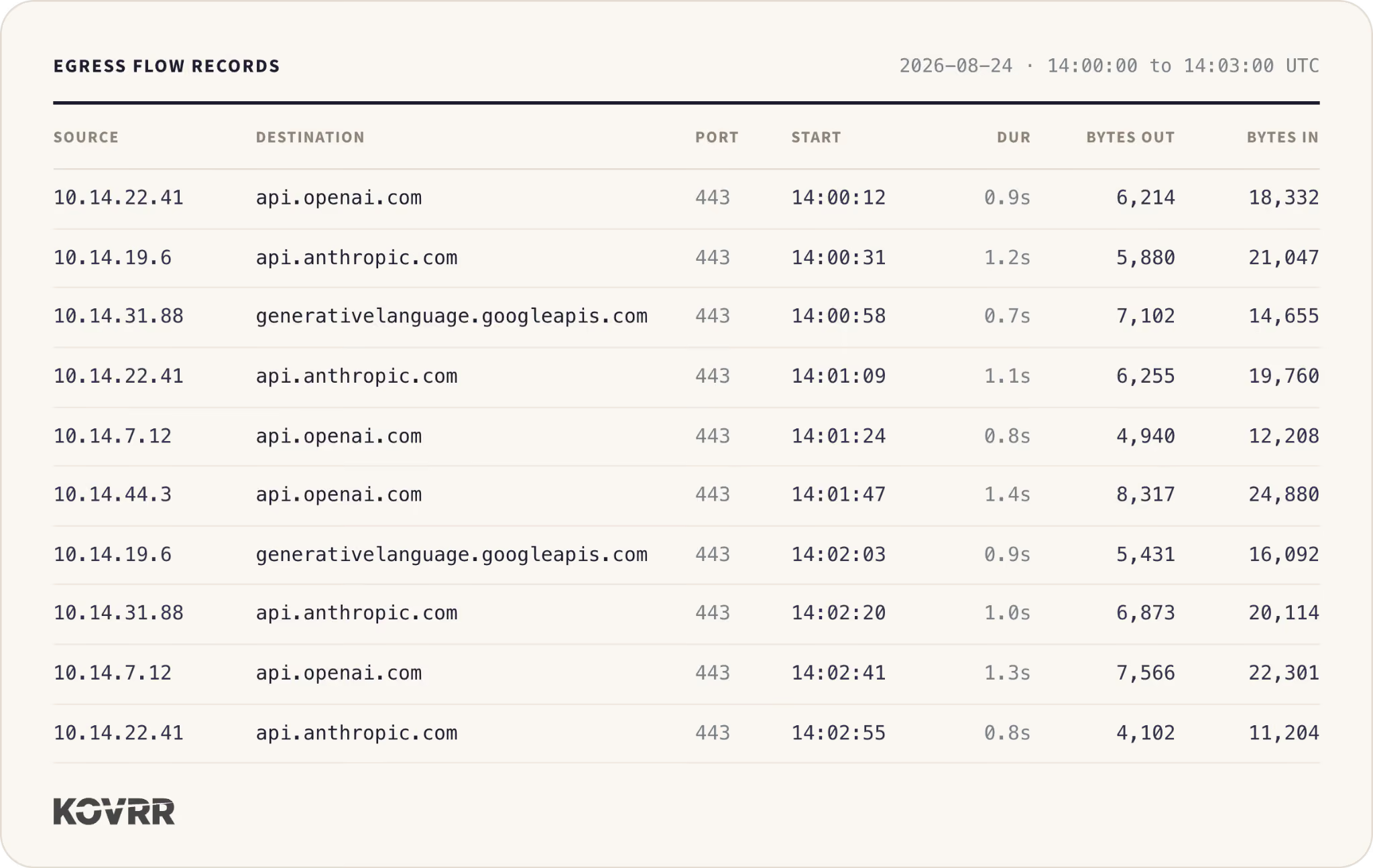
Network telemetry is precise and reliable about the things it was designed to record. A flow record establishes that a device at a particular address contacted a particular destination, at a known time, moving a known quantity of data. Transport encryption then keeps the payload opaque, so the record ends there. The resulting log confirms that an interaction with a model endpoint occurred, which is merely the start of a governance trail.
1. What Left the Organization?
A flow record measures volume, but volume says nothing about substance. An analyst pasting a client portfolio into a consumer chatbot generates a few kilobytes, the same order of magnitude as a question about spreadsheet formulas. Determining whether regulated material left the organization requires classifying the content of the interaction against defined data categories. That work happens at the point of interaction rather than on the wire.
2. Who Sent It?
Flow records identify network addresses, and addresses belong to devices, not to people. Shared egress points, VPN concentrators, and address translation compress many users into one apparent source. Agentic activity complicates the matter further, since an agent operating on behalf of an employee may authenticate with its own service credentials, leaving the human who initiated the task absent from the record entirely. Attribution requires joining the interaction to an identity provider.
3. Was It Authorized?
Identity and content together describe what happened, but authorization is a distinct determination, expressly depending on what the organization approved for a given identity, using a given system, with a given category of data. A marketing analyst summarizing published material in a sanctioned tool and the same analyst pasting unreleased financial results into that tool produce comparable traffic and sit on opposite sides of policy. Resolving the difference demands evaluating observed behavior against the approved envelope.
Internal AI Traffic Is Authorized by Default
These shortcomings invite an obvious comparison. Websites facing the open internet have been managing automated traffic for years, and they retain one advantage internal monitoring lacks. A site can still ask whether a visitor is human at all, and even with the answer growing less useful, the question stays available, with fingerprinting, challenge pages, and behavioral scoring. Internal AI traffic offers no equivalent, since every request originates from a managed device, carries valid corporate credentials, and terminates at a service the organization pays for.
The consequence is that intrusion detection has nothing to detect. Tooling built for the perimeter searches for events that fall outside approved patterns, and internal AI activity produces no such event. Risk enters through what the interaction contained and what the identity behind it was permitted to reach, and neither of those attributes registers as anomalous at the network layer. A security team can hold complete network visibility into every model endpoint the organization touches and still have no basis for judging whether a single interaction was safe.
Triangulated Telemetry Answers What Single Sources Cannot
Each shortcoming of network monitoring can be reduced to a single limitation. Judging whether an interaction was safe requires joining two facts that live in separate systems, and the network layer holds only one of them. Content classification sits at the point of interaction, identity sits with the identity provider, authorization sits in policy, and the fact that an interaction happened at all sits within network flow. No single collection point holds more than one of these facts, and thus none of them can produce a verdict.
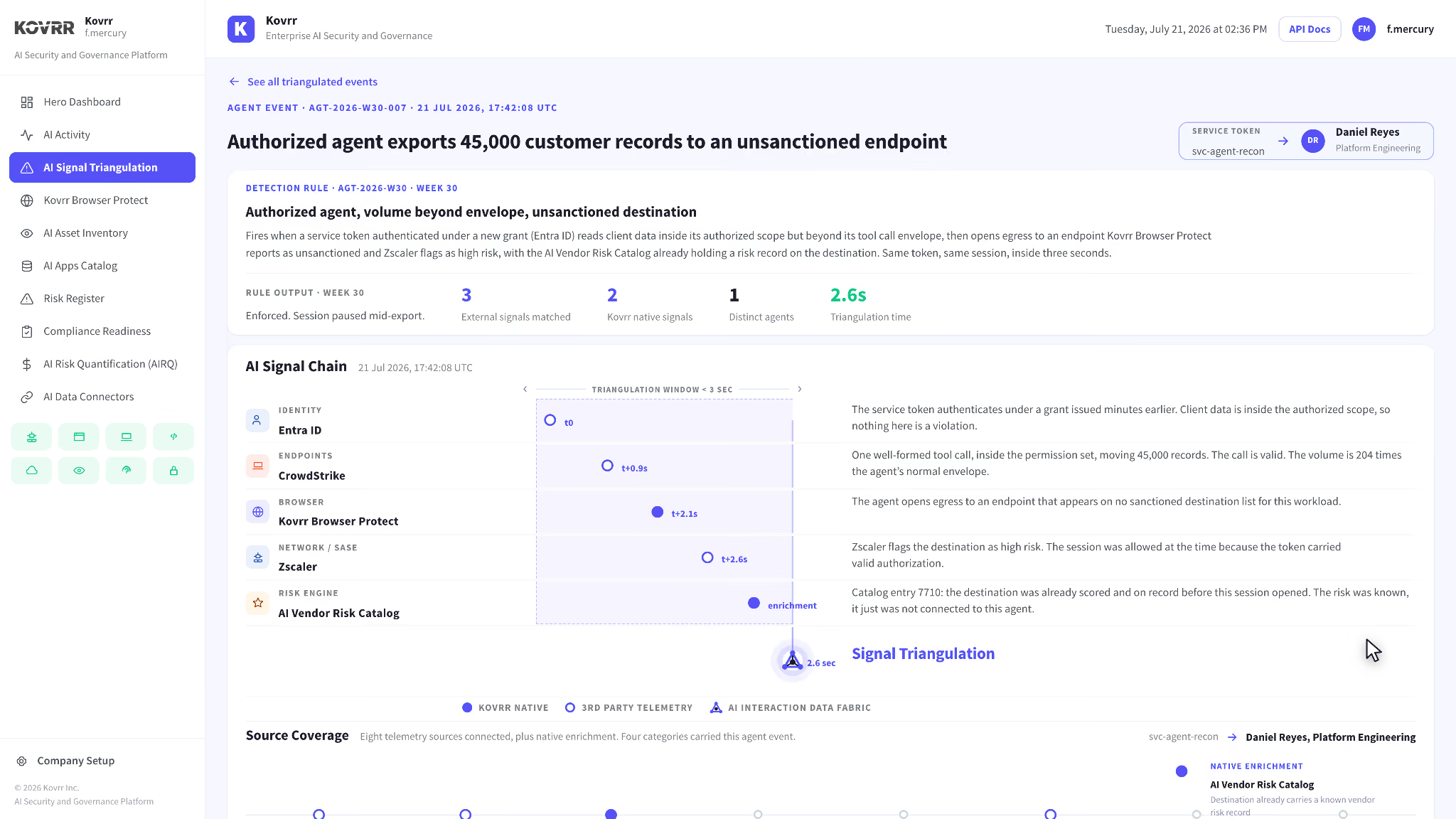
Kovrr's AI Security and Governance Platform builds those connections through its AI Interaction Data Fabric. Signals arrive from network flows, browser sessions, endpoints, agent activity, cloud environments, LLM APIs, identity providers, and DLP, with correlation rules determining which of those signals describe the same interaction before attaching the identity that initiated it, the data category it carried, and the policy outcome that applies. Network telemetry retains its place in that architecture as one collection point among several, contributing the fact that an interaction occurred while other sources supply everything else.
Governance decisions then rest on triangulated evidence instead of inference. An AI asset inventory built from correlated signals reflects systems in use rather than systems that were declared, policy enforcement acts on the identity and content behind an interaction instead of the destination alone, and AI risk quantification (AIRQ) prices exposure against interactions the organization can substantiate. Security teams are equipped to govern the environment in front of them, not the one their last audit described.
Governing What the Network Alone Cannot Reveal
The traffic numbers from Cloudflare and HUMAN describe an early stage of a transition still accelerating, and the ratio has no obvious reason to narrow. Automation stopped indicating hostility and volume stopped indicating anomaly, while the internal version of the same growth arrives wrapped in valid credentials from managed devices. Organizations that treat network visibility as sufficient coverage for AI activity are reading one variable and inferring everything else.
Correlation changes the outcome. An interaction triangulated across browser, identity, content, and policy supports a decision that a flow record alone cannot, giving security leaders a basis for directing attention and budget toward exposure they can substantiate. Whatever else AI activity produces, a shortage of telemetry will not be among them. The challenge organizations face is connecting those signals into a single account of what happened.
Kovrr's AI Security and Governance Platform was built to make that connection. Book a demo today to see how correlated signals resolve the questions single sources leave open.