Blog Post
The Best Cyber Risk Register Software in 2026
October 15, 2026
Most register comparisons rank products on fields, workflow and integrations. A more useful test is which decisions the register can settle, because a register that cannot settle a decision is a record of one made elsewhere.
Five decisions get asked of a register. Which risk to treat first, how much to spend treating it, whether to accept it, whether to transfer it, and whether the treatment worked. The three classes of product on the market support different subsets, and the differences follow from the unit each one stores.
Why Does the Unit Decide What a Register Can Do?
Because a decision compares two quantities, and quantities in different units cannot be compared.
The Ordinal Problem
A register holding high, medium and low holds an ordering. Ordering supports the first decision weakly and none of the other four, since a high risk and a four-hundred-thousand-dollar control budget are not expressible in a common term.
Where the Decision Gets Made
Outside the register, in a judgment somebody makes and then records. The register documents an outcome it had no part in reaching, which is why teams find their register accurate and unhelpful at the same time.
What Changes With Currency
An exposure figure is comparable to a control cost, to an appetite threshold and to an insurance limit, because all four are money. The same entry then supports prioritization, budgeting, acceptance and transfer without translation.
What Do the Three Classes Store?
Different objects, which explains why they behave differently rather than merely costing differently.
A Spreadsheet Row Is a Sentence
Text describing a risk, a score somebody assigned and an owner's name. Updating it means editing prose, and the quality of the register depends entirely on who last had time to think about it.
A Governance Module Entry Is a Record With State
The same content plus workflow position, approvals, review dates and linked tasks. Updating it means advancing a state, so the register tracks whether people did what they committed to.
A Quantified Entry Is a Model Instance
A scenario with parameters, drawing on asset values, control coverage and event likelihoods. Updating it means changing an input, after which the figure moves on its own.
What Happens Between Reviews?
The question that separates the classes most sharply, and the one buyer's guides rarely ask.
A Spreadsheet Does Nothing
Its contents are a snapshot of opinion as at the last review date. A control degrading the following week changes the risk and changes nothing in the file, so the register is most wrong immediately before the review that corrects it.
A Governance Module Runs Process
Reminders fire, tasks are assigned, attestations are collected. Valuable, and it records whether people acted rather than whether the exposure moved, which are different questions with different answers.
A Quantified Register Revalues
Where control coverage feeds the model, a degradation changes the figure without anybody opening the register. The entry is current because its inputs are current, and what a register does between reviews is the property that decides whether quarterly cadence is a reporting rhythm or a data limitation.
Which Products Sit in Each Class?
Three tiers, distinguished by where quantification sits rather than by size alone.
Connected Governance Suites
ServiceNow, MetricStream and Archer federate risk data across departments, linking register entries to assets through a configuration database. Quantification is native in some and added through partners in others. Strongest where cross-department aggregation and asset linkage matter, heaviest to implement.
Workflow-Led Platforms
Centraleyes, LogicGate and Hyperproof lead with configurable workflow and framework coverage, onboarding quickly and bridging compliance obligations to remediation pipelines. Strongest on time to a working process, with scoring that generally stays ordinal.
Quantification-Led Platforms
Safe Security, CyberSaint and Kovrr build the register on a loss model, feeding control and telemetry data into financial distributions. Strongest where a defensible figure is the deliverable, and they ask more of the data available.
What Should a Buyer Ask?
Six questions, and the answers separate products more reliably than a feature matrix does.
- The storage unit: Whether an entry holds an ordinal score or a figure in currency.
- The update trigger: Whether entries change on a human action or on an input changing.
- The decomposition: Whether a figure breaks into components a team can argue with.
The Other Three
Whether the register compares against a stated appetite threshold, since acceptance decisions need one. Whether it supports a before and after for a treatment, since otherwise effectiveness is asserted. Then which data sources populate it without manual entry, since a register requiring hand-population drifts at the rate nobody has time to correct.
Why Decomposition Matters More Than It Sounds
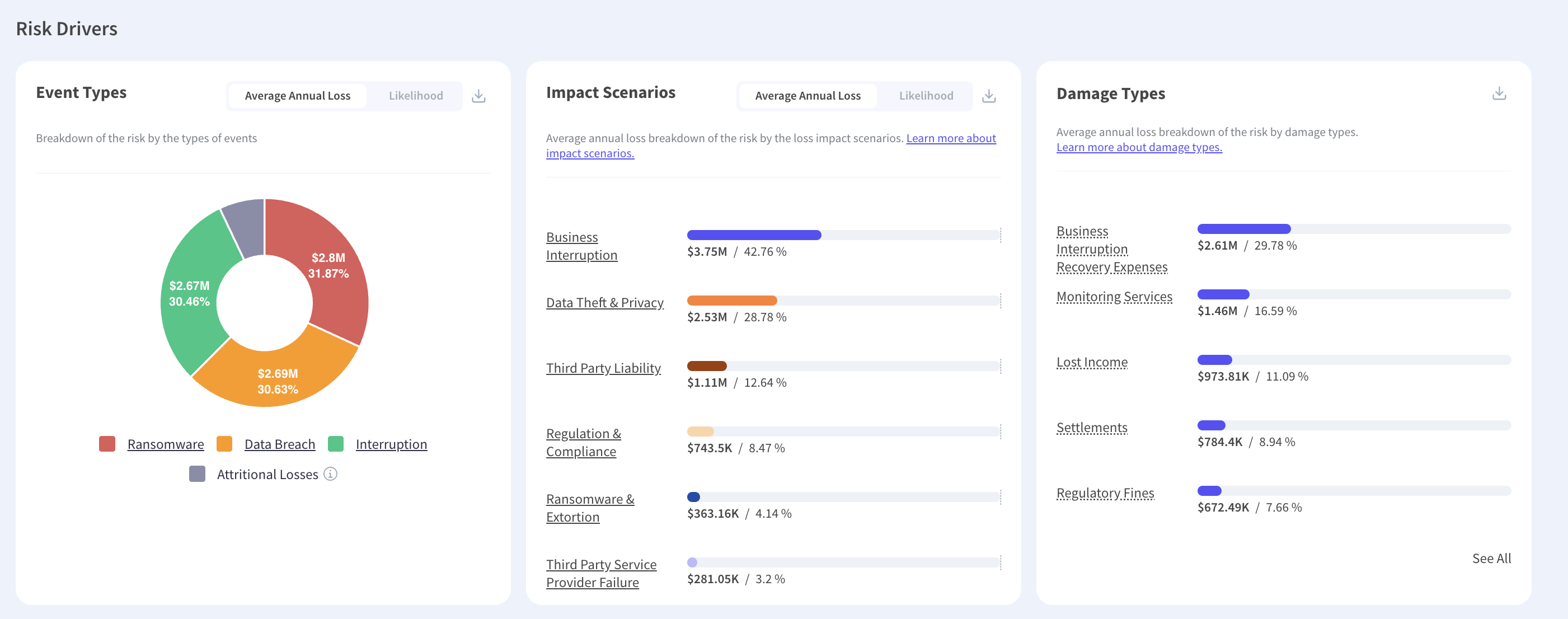
A single figure invites a binary reaction. A figure separating into event types, impact scenarios and damage types lets a reviewer disagree with one component while accepting the rest, which is how a number survives its first serious challenge.
When Is a Spreadsheet Still Correct?
More often than vendors suggest, and the cases deserve naming.
Where It Holds Up
A small estate, a handful of risks, one person maintaining it and no external party relying on the output. The overhead of a platform exceeds its benefit at that scale, and a well-kept file is better than a poorly adopted system.
Where It Stops
When somebody outside the team starts relying on it. A regulator, an insurer, an acquirer or a board committee asking how a figure was derived meets a file with no derivation, and the case for moving off spreadsheets covers the migration itself.
The Intermediate Trap
Replacing a spreadsheet with a workflow platform solves collaboration while leaving the unit unchanged. The register becomes easier to maintain and no more capable of settling a decision, which is an expensive way to arrive in the same place.
How Does This Map to Obligations?
Several regimes now expect the register to answer questions an ordinal scale cannot.
What Regulators Ask
Whether exposure sits within a stated tolerance, which needs a threshold and a current position in one unit. Whether a treatment reduced risk, which needs a comparable before and after. Both are register questions and neither is answerable from a severity label.
What a Board Asks
What the organization stands to lose and what the proposed spend removes. Board reporting drawn from the register only works where the register already holds the figures, since assembling them separately produces two numbers nobody can reconcile.
Where Does Kovrr Sit?
Kovrr builds the register on the quantification engine rather than attaching quantification to a workflow tool, so entries are model instances from the start.
What That Produces
Entries carrying a current figure that moves with control coverage, decomposed into event type, impact scenario and damage type. The quantified register and the underlying model share inputs, so the register and the board figure cannot diverge.
Who Should Look Elsewhere
Organizations whose primary requirement is multi-department workflow across operational, financial and vendor risk, where a connected governance suite covers more ground. Register structure and practice applies whichever class is chosen, and the quantification method is documented for anybody comparing approaches.
Buy the Unit, Not the Interface
A register is asked to settle five decisions, covering which risk to treat first, how much to spend, whether to accept, whether to transfer and whether treatment worked. Four of those compare a risk against money, so a register storing an ordinal score cannot settle them and instead records decisions reached elsewhere. The three product classes store different objects, since a spreadsheet row is a sentence, a governance entry is a record with workflow state, and a quantified entry is a model instance whose figure moves when its inputs move. The difference shows most sharply between reviews, where a spreadsheet does nothing, a workflow platform runs process, and a quantified register revalues. Replacing a spreadsheet with a workflow tool improves maintenance without changing what the register can decide.
To see a register whose entries move when control coverage moves, book a demo with our cyber risk experts.

Cyber Risk Register Software FAQs
Speak to an ExpertWhat decisions should a cyber risk register support?

What is the difference between a GRC module and a quantified risk register?
What does a cyber risk register do between quarterly reviews?
Which cyber risk register platforms are worth comparing?
Is a spreadsheet ever an acceptable cyber risk register?
What should a buyer ask when comparing risk register software?