Blog Post
The Best AI Governance Platforms for Mid-Market Companies
October 14, 2026
Enterprise AI governance guidance assumes a review board that meets monthly, an independent validation function, an impact assessment per system and somebody whose job title contains the words AI and compliance. A company of three hundred people has none of those and is governed by the same regulations.
The difference runs deeper than budget. Enterprise programs are assessment-led, which scales with headcount because every system needs an assessor. A mid-market program has to be observation-led, which scales with instrumentation and costs the same whether it covers ten systems or a hundred.
Why Does Enterprise Guidance Not Transfer?
Because its recommendations are staffing decisions wearing the costume of process decisions, and the staffing is the part that cannot be bought in a license.
The Committee
A cross-functional review board presumes several functions with spare capacity and a cadence somebody administers. In a company where legal is one person who also handles contracts, the board meets twice and then stops.
Independent Validation
A second line that can challenge a model's design needs people who understand the model well enough to disagree with it. A reviewer who cannot evaluate the work produces a signature rather than an assessment, and the signature is the thing an auditor discounts.
Assessment Per System
An impact assessment before every deployment is tractable at four systems a year and not at forty. Mid-market AI arrives through features switched on inside software already licensed, so the count rises without anybody deploying anything.
What Replaces Assessment?
Observation, with assessment reserved for the systems that warrant it.
What Observation Produces
Records of which identity reached which tool, what category of content went with it and what happened next, generated by systems operating rather than by people writing. The evidence accumulates whether or not anybody is available that week.
Where Assessment Still Belongs
Systems making decisions about people, systems touching regulated categories, and anything a regulation names as high risk. The population is small, which is what makes assessing it properly achievable.
The Ratio to Aim For
Most of the evidence produced automatically, with manual effort concentrated on the few systems where reasoning has to be recorded. Evidence that costs nothing to produce works through which obligations fall on each side of that line.
Why Does Visibility Have to Come Bundled?
Because a governance platform governs whatever inventory it is given, and a separately purchased inventory is a spreadsheet somebody maintains.
The Failure Mode
A platform is bought, a workflow is configured, and the inventory it operates on has to be populated by hand. The first population happens during onboarding, the second never happens, and the governance records describe an estate that stopped resembling the real one months ago.
Why It Hits Mid-Market Harder
An enterprise can assign the maintenance to somebody. A smaller team cannot, so a platform requiring a maintained inventory degrades silently rather than failing visibly, which is the worse of the two outcomes.
What to Ask
Whether the platform discovers AI systems itself or receives them, and if it discovers them, from which sources. Discovery that records its own sources is the version that survives nobody tending it.
What Does Time to Value Measure?
Time to first useful finding, a different number from the deployment date and the one vendors quote less often.
The Interval Between Them
A platform live in a week that produces nothing actionable for a quarter has delivered a login. The interval between those two moments is where a small team loses confidence, and it is rarely in a proposal.
What Compresses It
Connecting sources the organization already runs, since identity and network telemetry exist before any governance purchase. A platform reading those on day one has material to work with immediately, while one requiring new agents everywhere starts counting from whenever deployment finishes.
The Question for a Trial
How many findings the platform raised in the first two weeks, and how many of those needed more than one source. The second number separates a correlation layer from a collection of alerts.
Which Platforms Target This Segment?
Three approaches, each solving the staffing constraint differently and each conceding something.
Workspace-Native Platforms
First Recon AI places governance inside the workspace where employees already use assistants, so enforcement decisions leave evidence through normal daily work rather than through an administrative layer. Strong on friction, bounded by the assistants it wraps.
Pre-Configured Compliance Platforms
Govern365 ships framework templates and guided workflows so an operations or product person can run governance part-time. Strong on time to a documented position, weaker where the estate differs from what the templates assume.
Inline Boundary Platforms
Walled AI sits in the path and intercepts sensitive material before it reaches public assistants. Strong on prevention and on producing enforcement records, bounded like every in-path control by what routes through it.
What Should a Mid-Market Evaluation Produce?
Four answers, none of which requires a committee to interpret.
The Manual Burden Per Month
Hours a person has to spend for the platform to remain accurate. A number above a few hours is a number nobody will sustain, and the platform will be abandoned rather than renegotiated.
The Discovery Source Count
How many sources the platform reads without anything new being installed. Each existing source connected is coverage acquired at no deployment cost.
The Framework Position
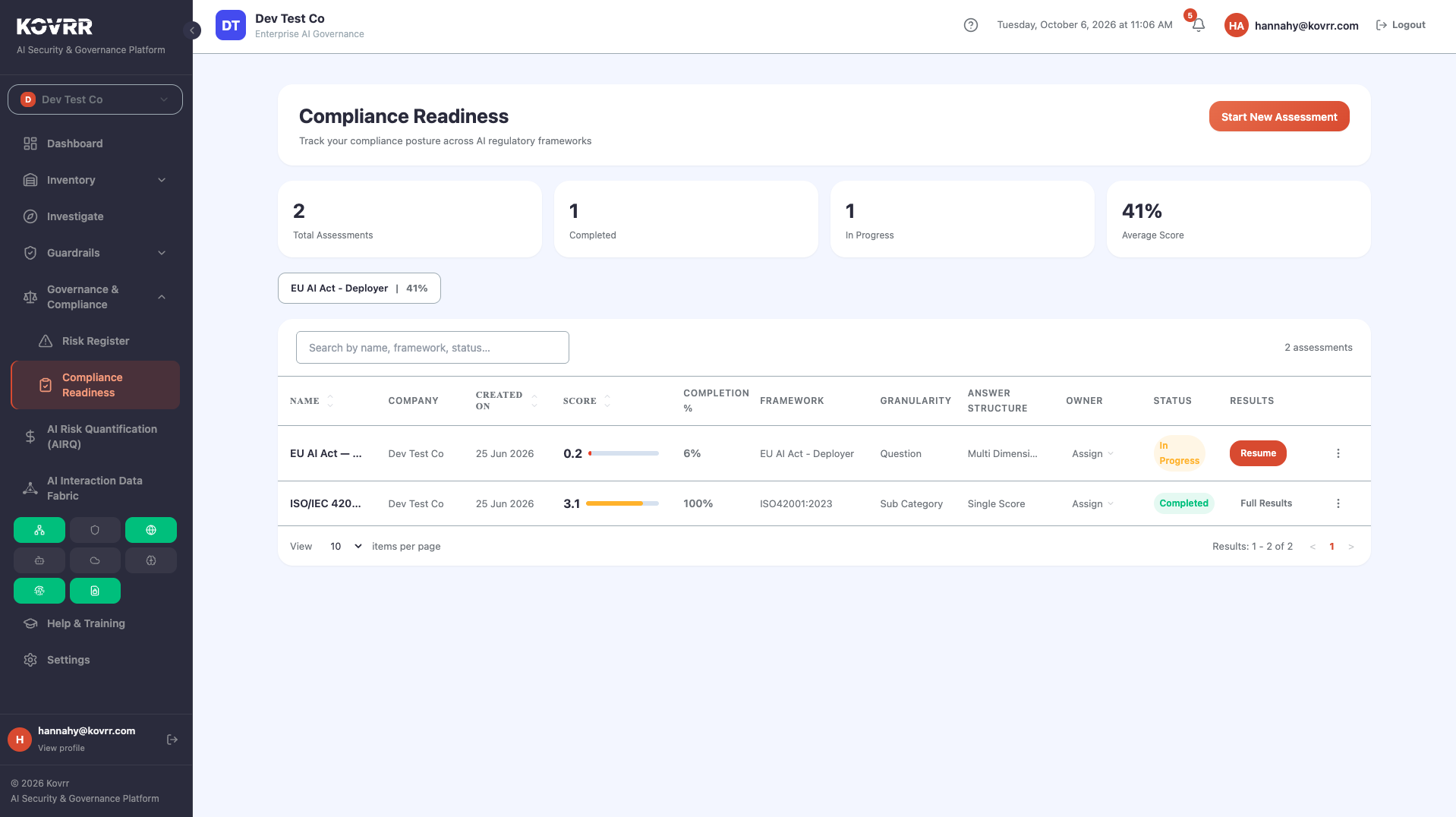
Whether readiness is tracked per regulation with a completion figure, so a small team can see which obligations are covered rather than inferring it. Readiness assessed per requirement is what makes that visible without an analyst assembling it.
Where Does Kovrr Sit?
Kovrr bundles discovery with governance rather than selling them separately, which is the arrangement that matters most to a team without maintenance capacity.
What That Looks Like
Assets discovered from sources the organization already runs, each recording which sources detected it, feeding readiness tracked per framework and AI risk quantification (AIRQ) that prices what the visibility reveals. The platform is organized so the evidence accrues rather than being assembled.
Who Should Look Elsewhere
Organizations whose primary need is model documentation for systems they build themselves, where a model lifecycle tool fits better. The wider platform comparison covers that end of the market.
Observation Scales, Assessment Does Not
Enterprise AI governance guidance recommends committees, independent validation and an assessment per system, all of which are staffing decisions rather than process ones. An assessment-led program scales with headcount while an observation-led program scales with instrumentation, which is why the enterprise model does not shrink to fit. Visibility has to arrive bundled with governance, because a platform operating on an inventory somebody maintains by hand degrades silently once nobody maintains it. Time to value means time to first useful finding rather than time to deployment, and connecting sources already running is what compresses the interval. Kovrr bundles discovery with governance so the evidence accrues without a team assembling it.
To see governance running on sources your organization already operates, book a demo mapped to your own estate.

.avif)
Mid-Market AI Governance FAQs
Speak to an ExpertWhy doesn't enterprise AI governance guidance work for mid-market companies?

What should replace per-system assessment in a smaller organization?
Why should AI visibility and governance be bought together?
What does time to value mean for an AI governance platform?
What should a mid-market AI governance evaluation measure?
Which AI governance platforms target mid-market companies?