Blog Post
The Top AI Governance Platforms in 2026: A Comparison Guide
August 13, 2026
The Verdict
AI governance became a named market on June 16, 2026, when Gartner published its inaugural Magic Quadrant for AI Governance Platforms with thirteen vendors assessed. Buyers now face a shortlist rather than a concept, and the category has split into distinct approaches that serve different problems. The right question is no longer "which platform is best" but "which shape of platform fits the problem the enterprise is actually solving."
Three buyer situations dominate 2026 evaluations. Enterprises that need a governance program of record for the EU AI Act, ISO 42001 and NIST AI RMF lean toward Credo AI, Holistic AI or IBM watsonx.governance. Enterprises that need runtime enforcement on agent behavior, gateway inspection or Copilot policy controls lean toward Zenity, Pillar Security, or Harmonic Security depending on where the enforcement point sits. Enterprises that need governance built on connected telemetry across every AI signal source, with a unified view of exposure that spans agent behavior, third-party AI usage, and enterprise-wide risk, are the ones evaluating Kovrr's AI Security and Governance Platform.
This guide compares twelve platforms across a consistent set of evaluation axes, with every capability claim traceable to the vendor's own documentation as of August 2026.
Why the AI Governance Category Split
Governance meant one thing in 2024 and something else in 2026. Early platforms were built around program management, treating AI as a portfolio of documented systems that needed intake questionnaires, risk assessments, and audit evidence. That work matters, and the leaders in that layer earned their positions honestly. Credo AI translates regulation into control sets with more depth than anyone in the category. Holistic AI grew a legitimate red-teaming practice inside a compliance workflow. IBM extended the SR 11-7 model-risk machinery banks already run into the AI era.
But governance programs mature. The question changes from "can we document our AI" to "can we see what our AI is actually doing, and act on it before something breaks." That shift produced two adjacent moves in 2026. One is toward runtime enforcement, where vendors like Zenity, Pillar and Harmonic operate in the request path or on the browser layer. The other is toward connected telemetry, where signals from browser, identity, network, and AI catalog fuse into a single view of enterprise exposure, and governance decisions draw from live data rather than periodic assessment.
The result is a category with real internal disagreement about what "governance platform" means. Buyers who understand which shape they need make materially better decisions than buyers comparing across shapes on generic feature lists.
How We Chose the Platforms
The twelve platforms in this guide were selected on four criteria.
- Documented capability: Vendor documentation as of August 9, 2026 rather than roadmap statements. Where a capability is roadmapped rather than shipped, the profile says so.
- Analyst validation or category traction: Position in the June 2026 Gartner Magic Quadrant for AI Governance Platforms, the Forrester Wave for AI Governance Solutions Q3 2025, Gartner's Market Guide for Guardian Agents (February 2026), or documented enterprise customer traction where analyst coverage is absent.
- Category coverage: Platforms that solve materially different pieces of the AI governance problem, spanning program management, runtime enforcement, observability, data protection, and connected-telemetry governance.
- Framework support: EU AI Act, NIST AI RMF, ISO/IEC 42001, and sector-specific coverage, judged on evidence quality rather than checkbox count.
The Platforms at a Glance
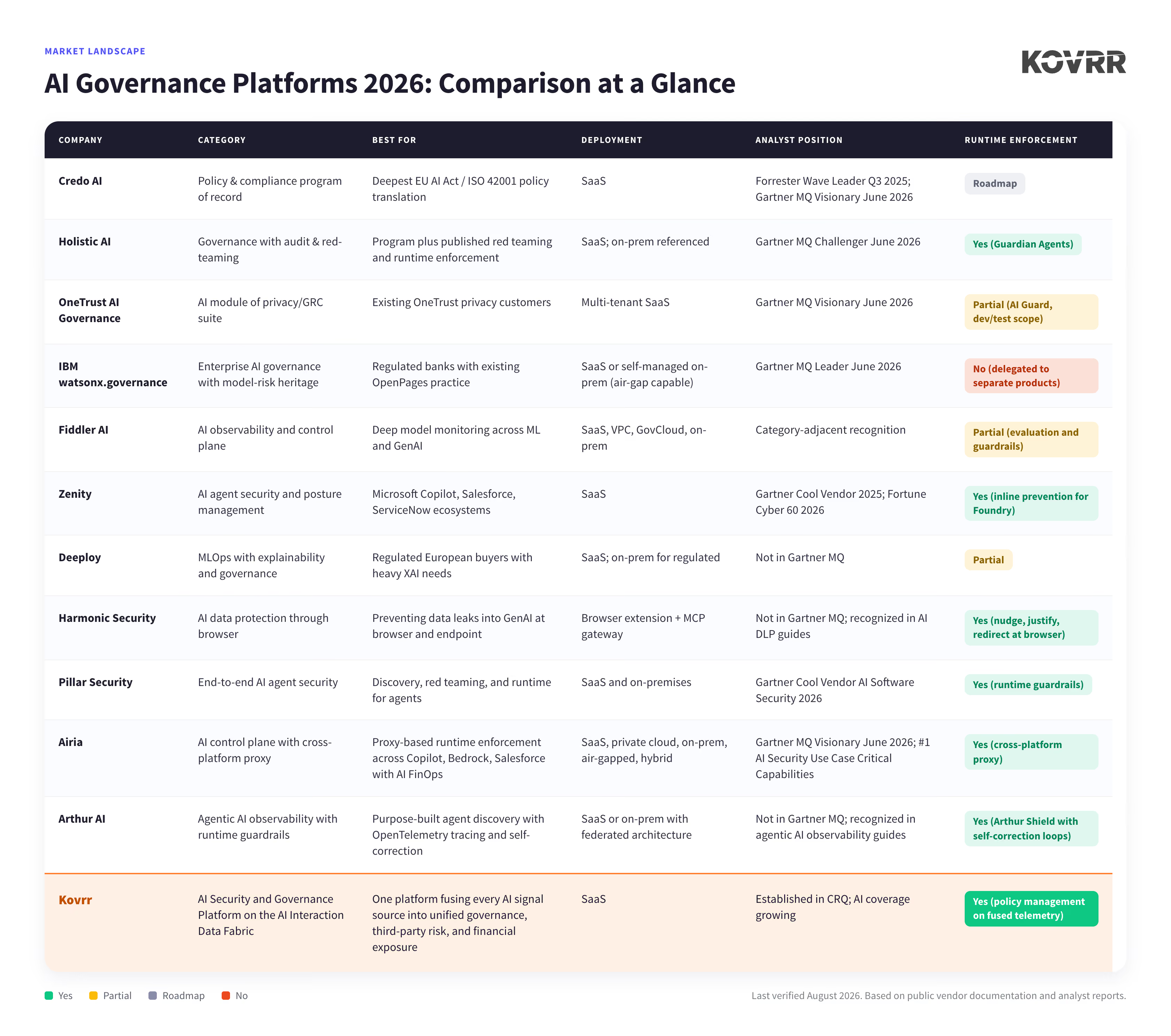
1. Credo AI vs. Kovrr
Category: Policy and compliance program of record
Credo AI helped define the AI governance category and remains the deepest expression of governance-as-program. Its Policy Packs translate the EU AI Act, NIST AI RMF, ISO 42001, SOC 2, and NYC Local Law 144 into concrete control sets and evidence requirements. Its AI Registry, Vendor Risk Assessment Portal, GenAI Vendor Registry, and Agent Registry (public preview since September 2025) cover systems, third-party AI, and agents in one inventory. GAIA, its AI governance assistant agent, reached general availability in May 2026. Fast Company named Credo AI number six in Applied AI on its 2026 Most Innovative Companies list.
Analyst validation is strong. Credo AI was named a Leader in The Forrester Wave: AI Governance Solutions, Q3 2025, with the highest possible scores in AI Policy Management and AI Regulatory Compliance Audit. Gartner named it a Visionary in the June 2026 Magic Quadrant. Notably, IBM resells Credo AI Policy Packs as a compliance accelerator add-on to watsonx.governance, which speaks to the depth of the underlying regulation-to-control library.
Where Credo AI Is Strong
- Regulation-to-control depth. Policy Packs and intake-based EU AI Act classification remain the category benchmark for policy program management, backed by the highest Forrester scores in that specific dimension.
- Vendor risk tooling. The Vendor Risk Assessment Portal and GenAI Vendor Registry are genuinely differentiated for procurement teams governing third-party AI at scale.
- Analyst recognition. Leader position in Forrester Wave Q3 2025, Visionary in Gartner MQ June 2026, and product IBM resells inside its own compliance stack.
Where Credo AI Falls Short
- No shipped runtime enforcement. Credo AI's own GAIA general availability announcement from May 2026 describes runtime governance and policy enforcement at the point of use as the next item on the roadmap, not a shipped capability. As of August 9, 2026, no gateway, in-line guardrails, or agent containment are documented.
- No self-hosted or air-gapped deployment. Credo AI is sold as SaaS through the AWS and Microsoft marketplaces, which limits its fit for defense, central bank, and data-residency-constrained buyers.
- No native browser or endpoint discovery. Discovery relies on registration workflows and integrations rather than telemetry from browser sessions or endpoint activity, which leaves shadow AI use less visible than platforms that observe the browser layer directly.
Deployment: Multi-tenant SaaS (AWS and Microsoft marketplaces); self-hosting not documented
Pricing: Enterprise quote only; no self-serve tier
Analyst position: Forrester Wave AI Governance Solutions Q3 2025 (Leader); Gartner MQ June 2026 (Visionary)
2. Holistic AI vs. Kovrr
Category: Governance program with audit and red-teaming depth
Holistic AI grew out of algorithm-audit work in London, starting with NYC Local Law 144 bias audits and EU Digital Services Act audit work, then extending into org-wide AI inventory, risk assessment, and EU AI Act / ISO 42001 compliance workflows. In 2026 it added a runtime enforcement layer through Guardian Agents, with Sentinel agents that observe and Operative agents that block, quarantine, revoke, and kill-switch autonomous AI actions. AI Safeguard filters inputs and outputs at runtime. Gartner named it a Challenger in the June 2026 Magic Quadrant for AI Governance Platforms and a Representative Vendor in the Market Guide for Guardian Agents published in February 2026.
What separates Holistic AI from most governance platforms is that it does real technical work rather than just orchestrating other tools. Its bias audit practice is recognized in the UK government's AI assurance portfolio, and its red team publishes documented jailbreak audits of frontier models including Claude 3.7 Sonnet and Grok-3.
Where Holistic AI Is Strong
- Runtime enforcement shipping today. AI Safeguard and Operative Guardian Agents can block, quarantine, and kill-switch autonomous AI actions in production, capabilities the top program-of-record platforms have not yet shipped.
- Credible testing practice. Published jailbreak audits of frontier models, an LLM Decision Hub for model selection, and an actively maintained open-source assessment library.
- On-premises option for regulated industries. References on-premises deployment for regulated buyers, unlike most SaaS-only competitors.
Where Holistic AI Falls Short
- No documented LLM gateway. As of August 9, 2026, no routing, model failover, budgets, or traffic-level RBAC. The runtime data path is limited to AI Safeguard input/output filtering and Guardian Agent interventions.
- Policy-pack depth trails Credo AI. For pure regulation-to-control translation and vendor-risk workflow, Credo AI's Policy Packs and Vendor Risk Assessment Portal remain the category benchmark.
- On-premises specifics undocumented. The vendor references on-premises options for regulated industries, but VPC and air-gap specifics are not publicly documented, and part of the offering is delivered as services rather than product.
Deployment: SaaS; on-premises referenced for regulated industries (specifics undocumented)
Pricing: Enterprise sales only; no public pricing
Analyst position: Gartner MQ June 2026 (Challenger); Representative Vendor in Gartner Market Guide for Guardian Agents February 2026
3. OneTrust AI Governance vs. Kovrr
Category: AI governance module of a privacy and GRC suite
OneTrust extended its privacy and GRC suite into AI governance, layering an AI-native inventory, assessment engine, and policy manager on top of the platform 14,000+ customers already run for DPIA/PIA workflows, third-party risk, and regulatory intelligence. The Spring '26 release brought Agent Detection & Inventory to general availability, with automated discovery connectors for AWS Bedrock, Azure AI Foundry, and Google Vertex AI. AI Guardrail Enforcement entered public preview in the same release. The AI Guard SDK, released under Apache-2.0, classifies prompts and responses with 300+ classifiers and can mask or block PII, secrets, and proprietary code. Gartner named OneTrust a Visionary in the June 2026 Magic Quadrant.
Where OneTrust Is Strong
- Platform gravity. AI governance inherits mature DPIA/PIA workflows, third-party risk management, and a regulatory intelligence engine spanning 300+ jurisdictions that no AI-native competitor can match on breadth.
- Automated agent discovery. Connectors for Bedrock, Azure AI Foundry, and Vertex AI reached general availability in Spring '26, providing automated agent inventory rather than registration-only workflows.
- Open-source runtime SDK. AI Guard SDK gives developers Apache-2.0 licensed runtime classification for prompts and responses, with 300+ pre-built classifiers.
Where OneTrust Falls Short
- AI Guard is scoped to dev and test. OneTrust itself scopes AI Guard to development and testing workloads. The AI Guard FAQ documents it as not recommended for the volumes of externally facing AI applications, so production-scale enforcement remains unshipped.
- AI governance is a module, not the design center. OneTrust's origin is privacy operations, and AI governance is one extension of that suite. Gartner and Forrester both rank AI-native competitors higher on AI-governance vision.
- SaaS-only deployment. Multi-tenant SaaS with no documented self-hosted or air-gapped option, which limits fit for defense and sovereignty-constrained buyers.
Deployment: Multi-tenant SaaS; self-hosting not documented
Pricing: Enterprise quote; AI Governance pricing not published
Analyst position: Gartner MQ June 2026 (Visionary)
4. IBM watsonx.governance vs. Kovrr
Category: Enterprise AI governance with model-risk heritage
IBM watsonx.governance is the incumbent's answer to AI governance. It inventories, documents through AI Factsheets, evaluates, and monitors ML, generative, and agentic AI across watsonx.ai, SageMaker, Bedrock, Vertex, and Azure, then wires the results into OpenPages model-risk workflows that regulated institutions already run. The evaluation stack (drift, quality, fairness, gen-AI metrics, Evaluation Studio, Model Risk Evaluation Engine) descends from Watson OpenScale and covers ground that most governance platforms orchestrate rather than own. Gartner named IBM a Leader in the June 2026 Magic Quadrant for AI Governance Platforms, one of only three Leaders in that inaugural report.
Where IBM Is Strong
- Deployment sovereignty. SaaS on IBM Cloud and AWS (including FedRAMP Moderate GovCloud since April 2026) or self-managed on-prem via Cloud Pak for Data with air-gapped installs. No AI-native competitor documents this range.
- Mature evaluation and monitoring. Drift, quality, fairness, generative AI metrics, Evaluation Studio, and the Model Risk Evaluation Engine produce evaluation evidence in-platform, while Credo AI and OneTrust collect evaluation results from tools like these.
- Bank-grade GRC lineage. OpenPages model-risk workflows extended to GenAI and agents, with SR 11-7 model-risk dialect that regulated institutions already speak.
Where IBM Falls Short
- No inline runtime enforcement. Enforcement is lifecycle workflows and threshold alerts, with runtime blocking delegated to separate products (watsonx.ai guardrails or watsonx Orchestrate). Unlike Holistic AI's Safeguard or Zenity's inline prevention, there is no gateway or containment shipped inside watsonx.governance itself.
- Packaging weight. Value fragments across watsonx.governance, OpenPages, Guardium AI Security, and watsonx Orchestrate, with Resource-Unit metering ($0.60 per RU on the Essentials plan) that can be hard to forecast at scale.
- Reseller admission on policy packs. IBM resells Credo AI Policy Packs as a compliance accelerator add-on, which is evidence that Credo AI's regulation-to-control library leads even inside IBM's ecosystem.
Deployment: SaaS (IBM Cloud, AWS incl. FedRAMP Moderate GovCloud) or self-managed on-prem via Cloud Pak for Data on OpenShift (air-gap capable)
Pricing: Free trial; usage-metered Essentials plan ($0.60 per Resource Unit); Standard and on-prem tiers by quote
Analyst position: Gartner MQ June 2026 (Leader)
5. Fiddler AI vs. Kovrr
Category: AI observability, monitoring, and control plane
Fiddler is the AI observability specialist, built around the Model Performance Management heritage that founder Krishna Gade brought from leading Facebook News Feed ranking. In 2026 it repositioned as the AI control plane for the enterprise agent workforce, covering continuous evaluation, monitoring, enforceable policy, and auditable governance for first-party and third-party agents. It raised a $32M Series C in January 2026, led by Insight Partners, and ships proprietary trust models (Fiddler's Centor Models) that run securely in-environment rather than relying on external LLM API calls for scoring and guardrail evaluation.
Where Fiddler Is Strong
- Deep model observability. Purpose-built for AI-specific observability with 100+ pre-defined metrics plus custom metrics, drift and quality monitoring, and root cause analysis that outperforms application observability tools repurposed for AI.
- In-environment trust models. Centor Models run securely in-environment for scoring, moderation, and guardrail checks, avoiding the risk gaps and cost overhead of external LLM API calls that most observability platforms use.
- Flexible deployment. SaaS, VPC, AWS GovCloud, and on-premises options, with usage-based pricing at $0.002 per trace on the Developer plan.
Where Fiddler Falls Short
- Not a governance program of record. Fiddler produces observability, evaluation, and runtime evidence, and it does not attempt to orchestrate the policy-and-audit workflow Credo AI or OneTrust anchor. Buyers who need EU AI Act policy management typically pair Fiddler with a program-of-record platform.
- Third-party AI vendor risk gaps. No documented Vendor Risk Assessment Portal, GenAI Vendor Registry, or AI Vendor Risk Catalog at the depth Credo AI, OneTrust, or Kovrr provide.
- No analyst position in Gartner MQ. As of August 9, 2026, Fiddler does not hold a position in the Gartner Magic Quadrant for AI Governance Platforms, though it is frequently cited in observability-adjacent buyer's guides.
Deployment: SaaS, VPC, AWS GovCloud, or on-premises
Pricing: Usage-based; Developer plan at $0.002 per trace; Enterprise by quote
Analyst position: Not in Gartner MQ for AI Governance Platforms; category-adjacent recognition
6. Zenity vs. Kovrr
Category: AI agent security and posture management
Zenity was founded in Tel Aviv in 2021 to address the security risks of AI and low-code adoption before most security vendors recognized the category. It grew into the leading platform for securing AI agents built on Microsoft Copilot, Salesforce Agentforce, and ServiceNow, extending in 2026 to custom agents on AWS Bedrock, Azure Foundry, and Google Vertex AI. Its architecture spans three integrated capabilities: Surface (continuous discovery and attack-path validation), Security Posture Management (AISPM), and AI Detection and Response (AIDR) for real-time threat detection. In March 2026, Zenity announced general availability of agent runtime security for Microsoft Foundry, building on inline prevention capabilities from November 2025. Norwest led a $125M Series C in August 2026, valuing the company well into the top tier of AI security vendors. Gartner named it a Cool Vendor in Agentic AI Trust, Risk and Security Management in 2025.
Where Zenity Is Strong
- Deepest Microsoft ecosystem integration. Native Copilot Studio integration with documented prevention, inline controls on tool invocation for MCP servers and CRM systems, and general availability of agent runtime security for Microsoft Foundry as of March 2026.
- Inline threat prevention. Deterministic allow, modify, or block decisions on agent actions before they execute, distinguishing legitimate work from manipulated behavior across Microsoft, Salesforce, and ServiceNow platforms.
- Shadow agent discovery. Automatic inventory of AI agents across low-code Copilot builders, SaaS agent platforms, and homegrown agents on cloud model services, including agents deployed outside IT authorization.
Where Zenity Falls Short
- Not a governance program of record. Zenity is a security platform, not a compliance program manager. Enterprises using it typically pair it with a governance platform for EU AI Act policy workflows and audit evidence generation.
- Narrower framework coverage. Maps findings to OWASP LLM Top 10 and MITRE ATLAS, but does not produce the framework-mapped audit evidence Credo AI, OneTrust, or Kovrr generate for EU AI Act, ISO 42001, or NIST AI RMF.
- Ecosystem depth varies. Deepest integration is Microsoft Foundry; documented enforcement for custom agents through AIDR is real but less mature than the Microsoft path.
Deployment: SaaS
Pricing: Enterprise quote; no public pricing
Analyst position: Gartner Cool Vendor in Agentic AI Trust, Risk and Security Management 2025; Fortune Cyber 60 2026
7. Deeploy vs. Kovrr
Category: MLOps platform with explainability and governance
Deeploy is a Netherlands-origin AI governance and MLOps platform focused on manageability, accountability, and explainability of AI/ML models in regulated European markets. It integrates explainable AI directly into the MLOps lifecycle, supporting SHAP, Anchors, Partial Dependence Plots, and MACE alongside tailored explainability methods for use cases like transaction monitoring. The platform serves financial services, healthcare, banking, insurance, and government sectors. It secured €2.5M in seed funding plus up to €7.5M in strategic financing from the EIC Accelerator, and it is running an EU Horizon research project on integrating real-time risk management, compliance, and explainability directly within the infrastructure where AI models run.
Where Deeploy Is Strong
- Deep explainability integration. Explainability is a first-class capability rather than an add-on, with multiple XAI frameworks integrated into the deployment and monitoring lifecycle.
- Regulated European fit. European provenance, EU AI Act focus, and use case depth in financial services and healthcare make it a natural fit for buyers with data sovereignty and regulatory documentation requirements specific to EU regulators.
- Human-in-the-loop feedback. The platform is built around human oversight and feedback loops, aligning with EU AI Act Article 14 human oversight requirements.
Where Deeploy Falls Short
- Small scale. A team of approximately 20 employees with seed-stage funding, which limits enterprise go-to-market and product breadth compared to Credo AI, Holistic AI, or IBM.
- No analyst quadrant position. Not present in the June 2026 Gartner Magic Quadrant for AI Governance Platforms.
- Limited agent and third-party AI coverage. The platform is built around ML/AI model governance rather than autonomous agent security or third-party AI vendor risk, so buyers dealing with those layers need to pair Deeploy with another platform.
Deployment: Enterprise SaaS; some documented on-premises capability for regulated European buyers
Pricing: Enterprise; specifics undisclosed
Analyst position: Not in Gartner MQ for AI Governance Platforms
8. Harmonic Security vs. Kovrr
Category: AI data protection through browser observability
Harmonic Security operates at a different layer than program-of-record governance platforms. Its Harmonic Protect browser extension monitors employee interactions with GenAI and embedded AI tools across 1,000+ web surfaces in real time, using pre-trained language models to assess data sensitivity before information leaves the organization. Rather than blocking AI use, Harmonic uses a "nudge, justify, redirect" approach that guides employees toward safer alternatives. Its MCP gateway extends coverage to Claude Desktop, ChatGPT Desktop, Cursor, custom MCP servers, and embedded AI in tools like Canva and Grammarly. ESG research documented that Harmonic Protect saves approximately 75% on deployment costs, resources, and time compared with standard DLP tools, and produces 96% fewer alerts, reflecting materially reduced false positive rates.
Where Harmonic Is Strong
- Lightweight deployment. Browser extension plus MCP gateway rolls out through Intune, JAMF, Kandji, or Group Policy in minutes, with no proxy redesign or certificate work required. Full AI tool inventory in days rather than weeks.
- Context-aware classification. Pre-trained language models classify prompts in under 200ms, understanding the meaning of the work rather than pattern-matching strings, which addresses the false positive problem that undermined traditional DLP for GenAI.
- Coverage where SASE fails. Extends to Claude Desktop, Cursor, personal devices, and local MCP servers that never touch the corporate network, which is exactly where SASE and network-based AI controls have no jurisdiction.
Where Harmonic Falls Short
- Not a governance program of record. Harmonic is a data protection platform, not a compliance program manager. Buyers who need EU AI Act policy workflows, vendor risk assessments, or AI risk register discipline pair Harmonic with a governance platform.
- Browser and endpoint layer only. Coverage is strong at the point of AI use, and it does not extend to model risk workflows, evaluation stacks, or third-party AI vendor risk assessment at the depth other platforms provide.
- Younger analyst footprint. Well-recognized in browser security and DLP-adjacent buyer's guides, and not present in the June 2026 Gartner Magic Quadrant for AI Governance Platforms as of August 9, 2026.
Deployment: Browser extension (all major browsers) plus MCP gateway (Windows, macOS, Linux)
Pricing: Enterprise; specifics not published
Analyst position: Not in Gartner MQ for AI Governance Platforms; recognized in AI DLP and browser security buyer's guides
9. Pillar Security vs. Kovrr
Category: End-to-end AI agent security across the software lifecycle
Pillar Security secures AI agents across the full software lifecycle, from discovery and posture management through red teaming, runtime guardrails, and governance. The platform is architected around the SAIL Framework (Secure AI Lifecycle), covering discovery, testing, protection, and compliance as one integrated system. Its RedGraph approach to offensive agentic AI security testing surfaces attack surface exposure across custom agents, MCP servers, coding agents, and embedded AI. Gartner named Pillar a Cool Vendor in AI Software Security in 2026, and the vendor was recognized in eight of the nine categories in OWASP's Agentic AI Security Landscape.
Where Pillar Is Strong
- Discovery-to-runtime integration. Discovery, red teaming, and runtime guardrails feed each other in a single platform, so security intelligence compounds across the lifecycle rather than existing as isolated point tools.
- On-premises deployment for regulated industries. Documents an on-premises option delivering the same discovery, monitoring, and runtime protection with complete data sovereignty, addressing the regulated-industry need for AI security tools that don't act as data sub-processors.
- Attack-surface depth. RedGraph offensive testing exposes vulnerabilities in tool definitions before they reach runtime, and pattern-based blocking prevents indirect injection pivots across tool chains.
Where Pillar Falls Short
- Not a governance program of record. Pillar produces security evidence and runtime enforcement; it does not orchestrate the audit workflow, vendor risk assessments, or policy program that Credo AI, OneTrust, or IBM anchor.
- Framework mapping depth trails GRC platforms. Governance and compliance module exists, and it is less mature than the regulation-to-control depth of Credo AI's Policy Packs or IBM's compliance accelerators for EU AI Act and ISO 42001 documentation.
- No analyst quadrant position. Recognized as Gartner Cool Vendor in AI Software Security 2026 and not yet in the June 2026 Magic Quadrant for AI Governance Platforms.
Deployment: SaaS and on-premises
Pricing: Enterprise quote; no public pricing
Analyst position: Gartner Cool Vendor in AI Software Security 2026
10. Airia vs. Kovrr
Category: AI control plane with cross-platform proxy architecture
Airia is the AI control plane for enterprise organizations, unifying discovery, security, governance, and cost optimization on a cross-platform proxy architecture. Founded in 2024 and based in Atlanta, Airia was named a Visionary in the June 2026 Gartner Magic Quadrant for AI Governance Platforms, positioned furthest on the Completeness of Vision axis of all vendors evaluated, and ranked first in the AI Security Use Case in the accompanying Gartner Critical Capabilities report. Airia was also included in Forrester's Agentic Control Plane Solutions Landscape Q2 2026 and won the 2026 Cybersecurity Stars Awards AI Governance Platform category.
Airia's cross-platform proxy intercepts AI agents regardless of where they were built (Microsoft Copilot, Amazon Bedrock, Salesforce, or native development) and applies runtime enforcement on agent autonomy, tool execution, and data access. Core capabilities include dynamic model routing with fallback, agent constraints and guardrails at the function call level, prompt injection defense, data leakage controls, and native AI FinOps for cost optimization.
Where Airia Is Strong
- Furthest Completeness of Vision in the Gartner MQ. Positioned further right on the Completeness of Vision axis than any other vendor evaluated in the June 2026 Magic Quadrant, and ranked first in the AI Security Use Case in the accompanying Critical Capabilities report.
- Cross-platform proxy with runtime enforcement. Intercepts agents across Microsoft Copilot, Bedrock, Salesforce, and n8n at the request layer, applying policy at the function call level rather than in documentation.
- Deployment flexibility across regulated environments. Documented support for SaaS, private cloud, on-premises, air-gapped, and hybrid environments, addressing sovereignty requirements that most AI-native competitors do not.
Where Airia Falls Short
- No documented AI risk quantification. Airia produces execution-level logs and AI FinOps reports; it does not translate exposure into projected financial loss the way Kovrr's AIRQ does. Buyers whose board reporting requires dollar-denominated risk output pair Airia with a quantification layer or evaluate alternatives.
- Third-party AI vendor catalog is not the primary discipline. Discovery focuses on agents built or consumed inside supported platforms rather than the third-party AI ecosystem breadth of Credo AI's Vendor Risk Assessment Portal or Kovrr's 15,000+ AI Vendor Risk Catalog with SBOM-level CVE data.
- Younger company. Founded in 2024, Airia is at an earlier stage than incumbents like IBM or OneTrust, so multi-year enterprise deployment history and reference depth are still accumulating.
Deployment: SaaS, private cloud, on-premises, air-gapped, or hybrid
Pricing: Enterprise quote; no public pricing
Analyst position: Gartner MQ June 2026 (Visionary, furthest Completeness of Vision); #1 in AI Security Use Case in Gartner Critical Capabilities; Forrester Agentic Control Plane Solutions Landscape Q2 2026
11. Arthur AI vs. Kovrr
Category: Agentic AI observability with runtime guardrails
Arthur AI positions as the industry's first Agent Discovery and Governance (ADG) platform, purpose-built for the agentic era rather than retrofitted from classic ML model monitoring. Launched in December 2025, Arthur combines automated agent discovery, OpenTelemetry-native tracing across tools and subagents, and native runtime guardrails through Arthur Shield. The June 2026 platform release added multi-tenant governance, cross-workspace policy views, and organization-scoped agent tools and LLM model governance. Arthur Bench (LLM evaluation) and Arthur Engine (monitoring and guardrails) are available as open-source projects.
Pre-LLM checks cover PII, sensitive data, and prompt injection. Post-LLM checks cover hallucination, toxicity, and output validation. Self-correction loops feed bad outputs back to the agent for revision before users see them. A federated data-plane and control-plane architecture keeps sensitive inference data inside the customer VPC.
Where Arthur AI Is Strong
- Purpose-built for agentic AI, not retrofitted. Discovery, tracing, and guardrails were designed for the agentic era rather than adapted from classic ML model monitoring, which shows up in OpenTelemetry-native trace depth across tools, subagents, RAG calls, and LLM interactions.
- Self-correction loops. Arthur Shield's runtime guardrails route bad outputs back to the agent for revision before users see them, which is a materially different runtime posture than platforms that only block or alert.
- Open-source tooling and VPC-local inference. Arthur Engine (monitoring and guardrails) and Arthur Bench (LLM evaluation) are open-source under permissive licenses, and the federated architecture keeps sensitive inference data inside the customer VPC rather than routing through the vendor.
Where Arthur AI Falls Short
- Not a governance program of record. Arthur produces agent observability, tracing, and guardrail evidence; it does not orchestrate the EU AI Act, ISO 42001, or NIST AI RMF policy workflow that Credo AI, OneTrust, or IBM anchor. Buyers needing framework-mapped audit workflows pair Arthur with a program-of-record platform.
- Coverage focused on agent traffic. Discovery centers on agents rather than the full AI environment, so embedded SaaS AI, shadow browser AI use, and third-party AI vendor risk that never touches an agent trace fall outside Arthur's primary scope.
- No analyst quadrant position. Not present in the June 2026 Gartner Magic Quadrant for AI Governance Platforms, though frequently cited in agentic-AI-adjacent buyer's guides.
Deployment: SaaS or on-premises with federated data-plane/control-plane architecture
Pricing: Enterprise; specifics not published
Analyst position: Not in Gartner MQ for AI Governance Platforms; recognized in agentic AI observability buyer's guides
12. Kovrr
Category: AI Security and Governance Platform built on fused telemetry
Kovrr is the AI Security and Governance Platform for enterprises that need governance built on connected telemetry rather than periodic assessment. The AI Interaction Data Fabric fuses signals from across the enterprise, including network, browser, endpoints, agents, cloud, LLMs, identity, and DLP, into a single source of truth, ingesting activity from SaaS AI, Desktop AI, LLM APIs, and tools. That unified view powers three functional pillars operating as one system: Detect & Monitor covers assets visibility and the 3rd Party Catalog of 10,000+ AI providers with SBOM-level CVE tracking; Assess & Prioritize covers risk prioritization and compliance readiness against NIST AI RMF, ISO 42001, and the EU AI Act; and Enforce & Report covers policy management and board reporting through AI Risk Quantification (AIRQ). AIRQ draws on Kovrr's decade of insurance-grade cyber risk quantification heritage, extending the same actuarial-grade modeling foundation into AI-specific exposure scenarios.
The architectural difference matters. Most platforms in this comparison solve one or two layers of the AI governance problem with high depth. Credo AI owns program-of-record documentation. Zenity owns Microsoft Copilot runtime enforcement. Harmonic owns browser data protection. Fiddler owns model observability. Enterprises that want the complete picture typically integrate three or four of these platforms and reconcile the outputs by hand. Kovrr's architecture starts from a different premise. Fuse every signal source into one fabric first, then let discovery, agent security, compliance evidence, third-party risk, and financial exposure all draw from the same continuously updated data. That is the operational difference between governing what one platform sees and governing what the enterprise actually does with AI.
Where Kovrr Is Strong
- The broadest signal fusion in the category. Network, browser, endpoints, agents, cloud, LLMs, identity, and DLP feed the AI Interaction Data Fabric together, ingesting activity from SaaS AI, Desktop AI, LLM APIs, and tools. No other platform in this comparison documents this breadth of signal fusion in a single unified architecture.
- Three governance pillars on shared telemetry. Detect & Monitor, Assess & Prioritize, and Enforce & Report all operate on the same underlying signal fabric, so a discovery finding, a compliance gap, and a financial exposure figure all trace to the same live data rather than reconciled outputs from separate platforms.
- Financial quantification built in, not integrated in. AIRQ translates AI exposure into projected loss impact using actuarial-grade modeling from Kovrr's cyber risk quantification heritage, giving boards and CFOs defensible dollar figures that most governance platforms produce only through third-party pairings.
- Third-party AI vendor breadth. The AI Vendor Risk Catalog covers 15,000+ providers with SBOM-level CVE tracking, materially deeper than most competitors document for vendor ecosystem coverage.
Where Kovrr Falls Short
- Not yet in Gartner MQ for AI Governance Platforms. As of August 9, 2026, Kovrr does not hold a position in the June 2026 Magic Quadrant. AI-specific analyst coverage is growing, and Kovrr holds established recognition in cyber risk quantification through prior Gartner Hype Cycle mentions.
- Policy-pack depth trails specialists. Credo AI's Policy Packs and IBM's compliance accelerators remain the deepest regulation-to-control libraries in the category. Kovrr's compliance readiness maps to NIST AI RMF, ISO 42001, and the EU AI Act, and buyers whose sole need is the deepest policy translation library may still evaluate Credo AI alongside.
Deployment: SaaS
Pricing: Enterprise; specifics via demo
Analyst position: Established recognition in cyber risk quantification; AI-specific analyst coverage growing
AI Vendor Decision Guide
Different buyers need different platforms. The twelve profiles above point to distinct shapes, and the routing below covers the most common buyer situations in enterprise AI governance evaluations.
You need the deepest regulation-to-control library and vendor-risk workflow → Credo AI. Policy Packs and the Vendor Risk Assessment Portal remain the benchmark. Pair with a runtime layer or a fused-telemetry platform for the enforcement Credo does not yet ship.
You need governance plus red teaming and bias audits from one vendor → Holistic AI. Audit heritage, published jailbreak testing, and Guardian Agents runtime enforcement.
Your privacy program already runs on OneTrust → OneTrust AI Governance. One inventory and assessment engine across privacy and AI, at the cost of AI-native depth.
You are a regulated bank with existing SR 11-7 or OpenPages practice → IBM watsonx.governance. Air-gap-capable deployment, mature evaluation stack, and bank-grade GRC lineage.
You need deep AI observability and model monitoring across ML and generative AI → Fiddler AI. In-environment trust models, comprehensive metrics, and flexible deployment.
You are heavily deployed on Microsoft Copilot, Salesforce Agentforce, or ServiceNow → Zenity. Deepest Copilot Studio integration and inline agent runtime security.
You have a European regulated program with heavy explainability requirements → Deeploy. Explainability as a first-class capability, EU provenance, and Horizon research heritage.
You need to stop sensitive data from leaking into GenAI at the browser and endpoint → Harmonic Security. Browser extension plus MCP gateway with context-aware classification.
You need end-to-end AI agent security with discovery, red teaming, and runtime enforcement → Pillar Security. SAIL Framework, RedGraph attack testing, on-premises option.
You need a proxy-based AI control plane with runtime enforcement, dynamic model routing, and cost optimization across deployment types including air-gapped → Airia. Gartner Visionary with furthest Completeness of Vision, first in AI Security Use Case Critical Capabilities, cross-platform proxy architecture.
You need deep agentic AI observability with OpenTelemetry-native tracing and runtime guardrails with self-correction → Arthur AI. Purpose-built Agent Discovery and Governance platform, federated architecture keeps inference data in customer VPC, open-source tooling available.
You need one platform that fuses telemetry across every AI signal source your enterprise generates, produces continuous governance evidence rather than periodic assessment, translates every finding into quantified financial exposure, and covers third-party AI risk across 15,000+ providers → Kovrr. Every other platform on this list solves one or two layers of the AI governance problem with real depth. Kovrr's AI Interaction Data Fabric is the architecture that fuses signals from network, browser, endpoints, agents, cloud, LLMs, identity, and DLP into a single source of truth, then powers detection, prioritization, and enforcement as one system. Buyers who want a governance program of record can buy Credo AI. Buyers who want Microsoft Copilot runtime enforcement can buy Zenity. Buyers who want browser-layer data protection can buy Harmonic Security. Buyers who want the complete picture built on connected telemetry rather than three vendors stitched together evaluate Kovrr.
Sources
- Credo AI GAIA general availability announcement (May 2026)
- Credo AI homepage
- Holistic AI Governance Platform
- Holistic AI Guardian Agents product page
- Gartner Market Guide for Guardian Agents recognition
- OneTrust AI Governance solution page
- OneTrust Spring '26 Release notes
- OneTrust AI Guard developer documentation
- OneTrust expands AI Governance for real-time AI (press release, March 9, 2026)
- IBM watsonx.governance product page
- IBM watsonx.governance pricing
- IBM named a Leader in Gartner MQ for AI Governance Platforms (June 2026)
- Fiddler AI homepage
- Fiddler AI pricing
- Zenity Platform overview
- Zenity Microsoft Copilot Studio integration announcement
- Zenity Series C announcement (August 2026)
- Deeploy homepage
- Deeploy Horizon Europe project
- Harmonic Security homepage
- Harmonic Protect product page
- ESG research on Harmonic Protect efficiency
- Pillar Security platform overview
- Pillar Security Gartner Cool Vendor recognition (2026)
- Airia named a Visionary in 2026 Gartner MQ for AI Governance Platforms
- Airia Forrester Agentic Control Plane Solutions Landscape Q2 2026
- Airia homepage
- Arthur AI Top AI Governance Platforms for Agentic AI 2026
- Arthur AI platform release June 2026
- Kovrr AI Security and Governance Platform
- Kovrr AI Risk Quantification (AIRQ)
- Kovrr AI Vendor Risk Catalog
To see how Kovrr's AI Interaction Data Fabric turns fused signals across network, browser, endpoints, agents, cloud, LLMs, identity, and DLP into one operational view of every AI system across your enterprise, book a demo tuned to your specific AI environment.
About this comparison. This page is published by Kovrr, which builds one of the platforms discussed. Every factual claim about another vendor links to that vendor's own documentation, product page, or a named third-party source. Where analyst positions are cited, dates and sources are named. Each profile states where the other platform wins. Last verified against public documentation in August 2026. Corrections welcome at [email protected].

.avif)
AI Governance Platform Buyer FAQs
Speak to an ExpertWhich AI governance platform is best in 2026?

What did Gartner include in the June 2026 Magic Quadrant for AI Governance Platforms?
How does AI governance differ from AI security?
What is the difference between a governance program of record and a runtime enforcement platform?
Do any of these platforms enforce policy on live AI traffic?
Can platforms in this list be used together?