.avif)
Blog Post
Implementing AI Governance to Identify and Mitigate Critical AI Risks
June 25, 2026
Artificial intelligence (AI) is transforming businesses worldwide, offering powerful tools to automate, analyze, and innovate. Yet, with this power comes significant risk. Organizations must implement AI governance frameworks that map, measure, and manage AI risks continuously.
This article explains how effective AI governance helps prioritize risks aligned with business goals, enabling companies to mitigate threats before they escalate. We will explore best practices for AI risk prioritization, the role of continuous oversight and compliance, and how Kovrr’s unified platform leads the way in delivering connected, data-driven AI risk management.
The Importance of AI Governance in Risk Mitigation
AI systems introduce new types of risks that span operational, ethical, security, and regulatory domains. Without governance, these risks can lead to data breaches, regulatory penalties, reputational damage, and financial loss. AI governance frameworks provide a structured approach to identify where AI risks lie, measure their potential impact, and manage them through controls and policies.
Effective AI governance is not a one-time project but a continuous process. Risks evolve as AI models change, new use cases emerge, and regulations develop. Organizations need tools and frameworks that provide ongoing visibility, quantification, and control enforcement to keep pace with this dynamic environment. AI governance is essential to ensure that risks are managed proactively and aligned with business objectives.
Mapping AI Risks: Building a Comprehensive AI Asset Inventory
The first step in AI governance is mapping AI assets across the organization. This means discovering and cataloging every AI system in use, whether sanctioned tools, shadow AI applications, internal models, or third-party embedded AI services. Kovrr’s AI Security and Governance Platform excels in this area by continuously collecting telemetry from browser extensions, endpoint agents, network monitoring, and enterprise integrations.
This multi-source visibility creates a live AI asset inventory that reflects the true AI landscape in real time. Without such comprehensive mapping, organizations risk blind spots where AI risks lurk unnoticed. Mapping enables the next crucial steps of measuring risk exposure and applying controls effectively.
Measuring AI Risks: Quantification for Informed Decision-Making
After mapping AI assets, organizations must measure the risks they pose. AI risk quantification (AIRQ) translates technical vulnerabilities and threat scenarios into financial terms. This approach helps prioritize mitigation efforts based on potential business impact rather than just technical severity.
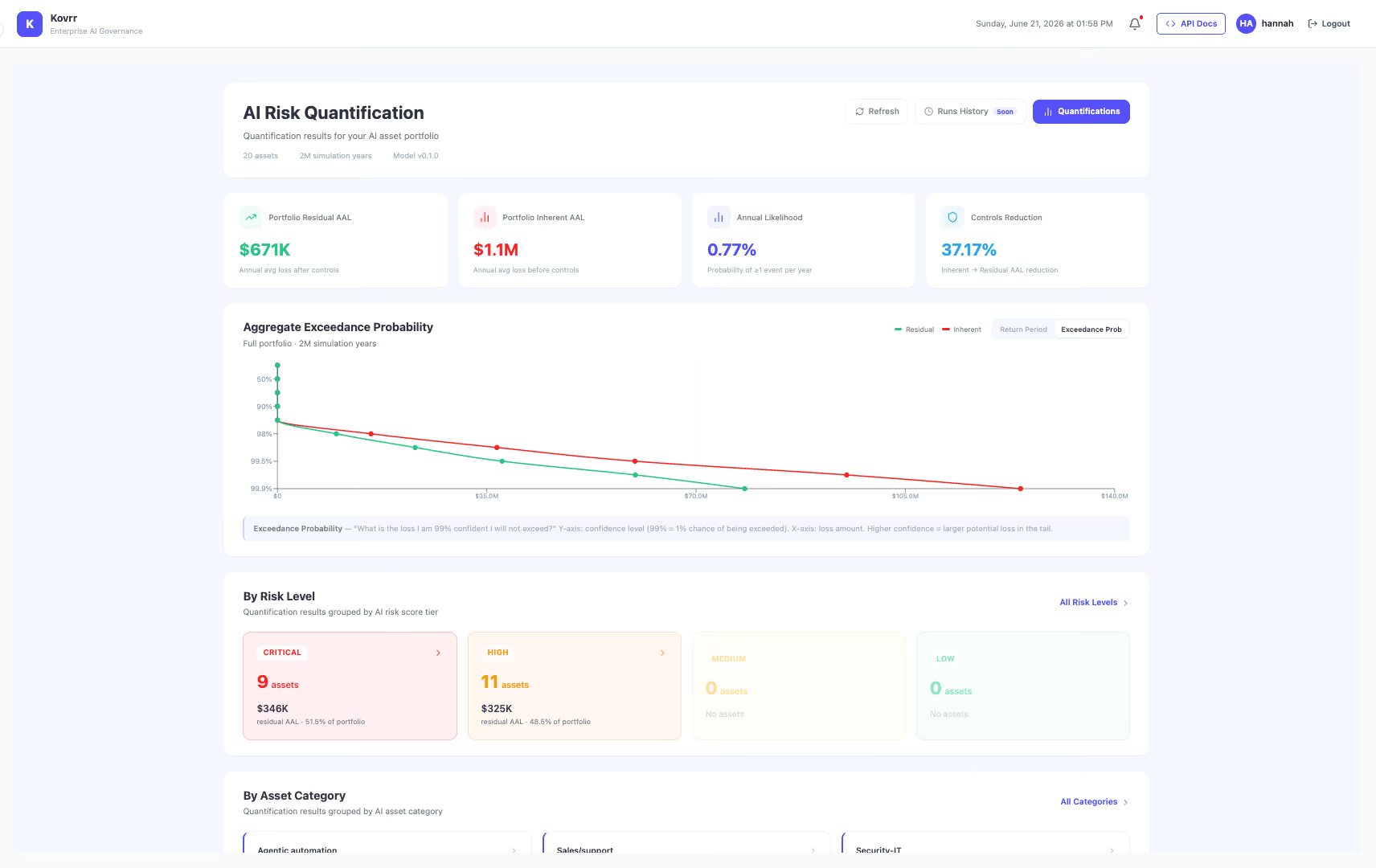
Kovrr applies insurance-grade modeling to AI-specific scenarios such as model failure, data loss, regulatory penalties, and third-party AI incidents. This produces clear metrics like average annual loss and worst-case loss figures, enabling leaders to understand how AI risks affect the bottom line.
This financial quantification bridges the gap between technical teams and executives, allowing risk prioritization that aligns with business objectives. It also supports board-level reporting with defensible, data-driven insights.
Other frameworks, like the NIST AI Risk Management Framework, emphasize mapping and measuring risks across the AI lifecycle to support organizations in identifying and prioritizing threats effectively.
Managing AI Risks: Continuous Oversight and Adaptive Controls
Risk management is an ongoing process requiring continuous monitoring and control adjustment. AI governance frameworks must embed human oversight, decision-making authority, and adaptive controls that respond to evolving AI risks. Kovrr’s platform integrates continuous control monitoring, feeding live security posture data into risk scenarios and quantification models. This ensures that improvements or degradations in controls immediately update the organization’s risk exposure.
Active enforcement modules like Kovrr Browser Protect and AI Agent Security provide real-time policy enforcement at the point of AI interaction. This mitigates risks such as unauthorized AI usage or agent privilege misuse before they escalate.
Continuous compliance readiness is another critical aspect. Kovrr automates assessments against major AI regulatory frameworks, including the EU AI Act and NIST AI RMF, providing clear remediation guidance and automated evidence collection. This reduces manual effort and keeps organizations audit-ready as regulations evolve.
Prioritizing AI Risks Aligned with Business Goals
Organizations often struggle with how to prioritize AI risk mitigation effectively. Immediate mitigation is necessary for high-impact risks, but resources are finite, and not all risks require equal attention. A top-down, data-driven approach helps align risk prioritization with business objectives. Kovrr’s platform supports this by combining scenario-based risk registers with quantitative exposure metrics and control effectiveness summaries. This enables risk teams to identify which AI risks pose the greatest financial threat and which controls will deliver the most significant risk reduction.
For example, a risk scenario involving third-party AI model failure might show a higher quantified exposure than a minor internal model bias issue. Prioritizing mitigation efforts on the former aligns risk management with protecting critical business functions.
Integrating AI Governance with Cyber Risk Programs
Most enterprises run AI and cyber risk programs on fragmented toolsets, creating siloed views and gaps in coverage. Kovrr’s unique strength lies in its unified platform that connects AI and cyber risk management. Telemetry from AI asset visibility informs the risk register, which feeds into quantification and compliance modules. Active enforcement points provide live signals that update the risk posture continuously.
This connected architecture eliminates manual reconciliation and delivers a single pane of glass for security, risk, and compliance teams. Moreover, the integration is crucial as AI-related risks increasingly intersect with cyber risks, such as data breaches caused by AI vulnerabilities or attack surface expansion through autonomous agents.
Leveraging Frameworks and Best Practices for AI Governance
Leading AI governance frameworks provide valuable guidance on managing AI risks:
- NIST AI Risk Management Framework offers a comprehensive approach to map, measure, and mitigate AI risks with a focus on trustworthiness and continuous improvement.
- MIT’s AI Risk Database categorizes mitigations into governance, technical, operational, and transparency controls, helping organizations build layered defenses.
- Palo Alto Networks stresses defining decision-making authority, human oversight, and continuous monitoring as pillars of effective AI governance.
- Insight Assurance recommends embedding risk checkpoints, assigning clear roles, and measuring performance to sustain AI risk programs.
Organizations benefit most by combining these frameworks with a platform like Kovrr that operationalizes continuous, connected AI risk management.
Comparing Kovrr with Other AI Governance Solutions
Several vendors offer AI governance tools, each with strengths and limitations:
- Credo AI and Holistic AI focus on compliance and ethical risk but often lack integrated financial quantification and active enforcement.
- IBM provides AI risk management guidance and lifecycle tools, but typically requires integration with multiple products for full coverage.
- OneTrust AI Governance emphasizes privacy and compliance, but may not deliver the unified risk quantification and active control enforcement that Kovrr offers.
- MetricStream and CyberSaint provide GRC frameworks that include AI modules but often lack the dynamic telemetry and insurance-grade modeling that Kovrr embeds.
Kovrr stands out by delivering a connected platform that unifies AI asset visibility, risk quantification, compliance readiness, and active enforcement with continuous telemetry. This holistic approach enables security, risk, and compliance teams to manage AI risks at scale with a clear line of sight from technical signals to business impact.
Steps for Organizations to Implement Effective AI Governance
- Establish Governance Structure: Define roles, responsibilities, and decision-making authority for AI risk management.
- Map AI Assets Continuously: Use tools like Kovrr’s AI Asset Visibility to discover all AI systems in use.
- Build an AI Risk Register: Catalog AI-specific risk scenarios with ownership, likelihood, and impact assessments.
- Quantify Risks Financially: Apply insurance-grade modeling to translate AI risks into dollar figures for prioritization.
- Implement Controls and Enforcement: Deploy active enforcement tools such as Kovrr Browser Protect and AI Agent Security to mitigate risks in real time.
- Automate Compliance Monitoring: Use framework-aligned modules to assess and remediate regulatory gaps continuously.
- Integrate AI and Cyber Risk Programs: Unify telemetry and risk data to maintain a holistic risk posture.
- Report to Executives and Boards: Provide clear, defensible insights on AI risk exposure, mitigation efforts, and compliance status.
Conclusion: A Holistic, End-to-End Approach to AI Governance
Implementing AI governance frameworks that map, measure, and manage AI risks continuously is essential for organizations embracing AI. Prioritizing AI risk mitigations based on financial impact and business objectives enables efficient resource allocation and stronger resilience.
Kovrr’s AI Security and Governance Platform exemplifies the future of AI risk management by providing a unified, connected view of AI risks from discovery to board reporting.
Its insurance-grade quantification, continuous control monitoring, active enforcement, and automated compliance readiness set a high standard in a fragmented market. By adopting such comprehensive platforms and following proven frameworks like NIST AI RMF, organizations can confidently navigate the complex AI risk landscape and safeguard their business in the agentic era.
For more information about Kovrr’s AI Security and Governance Platform and how it supports continuous, data-driven AI risk management, schedule a free demo today.

Implementing AI Governance FAQs
Speak to an ExpertWhat are the main types of AI risks organizations should monitor?

How can organizations prioritize AI risks effectively?
Why is continuous AI risk monitoring important?
How does Kovrr’s platform differ from other AI governance tools?
What role do regulatory frameworks play in AI governance?
Can AI governance be integrated with cyber risk management?