
Blog Post
AI Browser Security: What to Look For in Identity-Based Controls
August 10, 2026
Identity and access management secures the front door and stops watching. A single sign-on event confirms who logged into an AI tool, then produces no record of what they pasted into it, which document they uploaded, or whether the session belonged to a person at all. Every interaction after authentication happens outside the visibility of the system that authorized it.
Identity-based browser controls close that distance by attaching identity and role to the interaction rather than the login. The same prompt from two employees can produce two different verdicts, because the policy evaluates who is acting and in what capacity. What follows covers the capabilities that make that work, and where the approach breaks down.
Why Authentication Is Not Enforcement
Authentication answers a question once at the start of a session. Enforcement has to answer a different question repeatedly, since risk lives in the actions taken rather than the access granted. An approved user with legitimate credentials pasting a customer database into a public assistant is doing something no access control was designed to prevent.
Network and Endpoint Controls Miss the Same Thing
Traffic filtering resolves domains and cannot see inside an authorized TLS session. Endpoint agents watch files and processes while much AI use involves neither, since the interaction is text typed into a page. The result is a layer where AI data leakage occurs through channels every control in the stack has already permitted, which is the argument for treating the browser as the enforcement perimeter in the first place.
Identity Turns One Policy Into Many
A policy expressed as a data category applies uniformly and produces the wrong answer half the time. Source code pasted by a platform engineer into an approved coding assistant is normal work. The same code pasted by a contractor into a consumer chatbot is an incident. Without identity in the evaluation, an organization chooses between blocking both and permitting both.
What Identity-Based Control Requires
Three capabilities distinguish identity-aware enforcement from data-category filtering with a user name attached to the log.
- Identity Resolution: Policy bound to directory identity, group and role rather than to a device or browser profile.
- Action-Level Attribution: Each prompt, paste and upload recorded against a person rather than a session.
- Non-Human Attribution: Agents and automations distinguished from the people whose credentials they operate under.
Role Is the Useful Unit
Per-user policy does not scale and per-organization policy does not discriminate, so role sits where the work is. Engineering, legal, support and finance handle different data and need different verdicts on the same categories. Mapping sensitive data categories against roles rather than against the whole population produces a policy people can follow without filing exceptions weekly, and it gives an acceptable use policy something enforceable underneath it.
Non-Human Identity Is the Harder Half
An agent acting under a delegated credential appears in logs as the person who deployed it, which makes attribution meaningless at the moment it matters most. Distinguishing the two requires resolving the session to a machine identity and tracking what the agent was authorized to do separately from what its operator can do. Agent identity becomes a control requirement rather than an accounting detail once agents act in browsers on a user's behalf, and permission scoping has to be enforced at the point of action.
Graduated Response Instead of Allow or Block
Binary enforcement fails in both directions. Blocking drives the work to personal devices where nothing is visible, and permitting produces no control at all. Graduated response resolves it by varying the verdict with the sensitivity of the content and the role of the person.
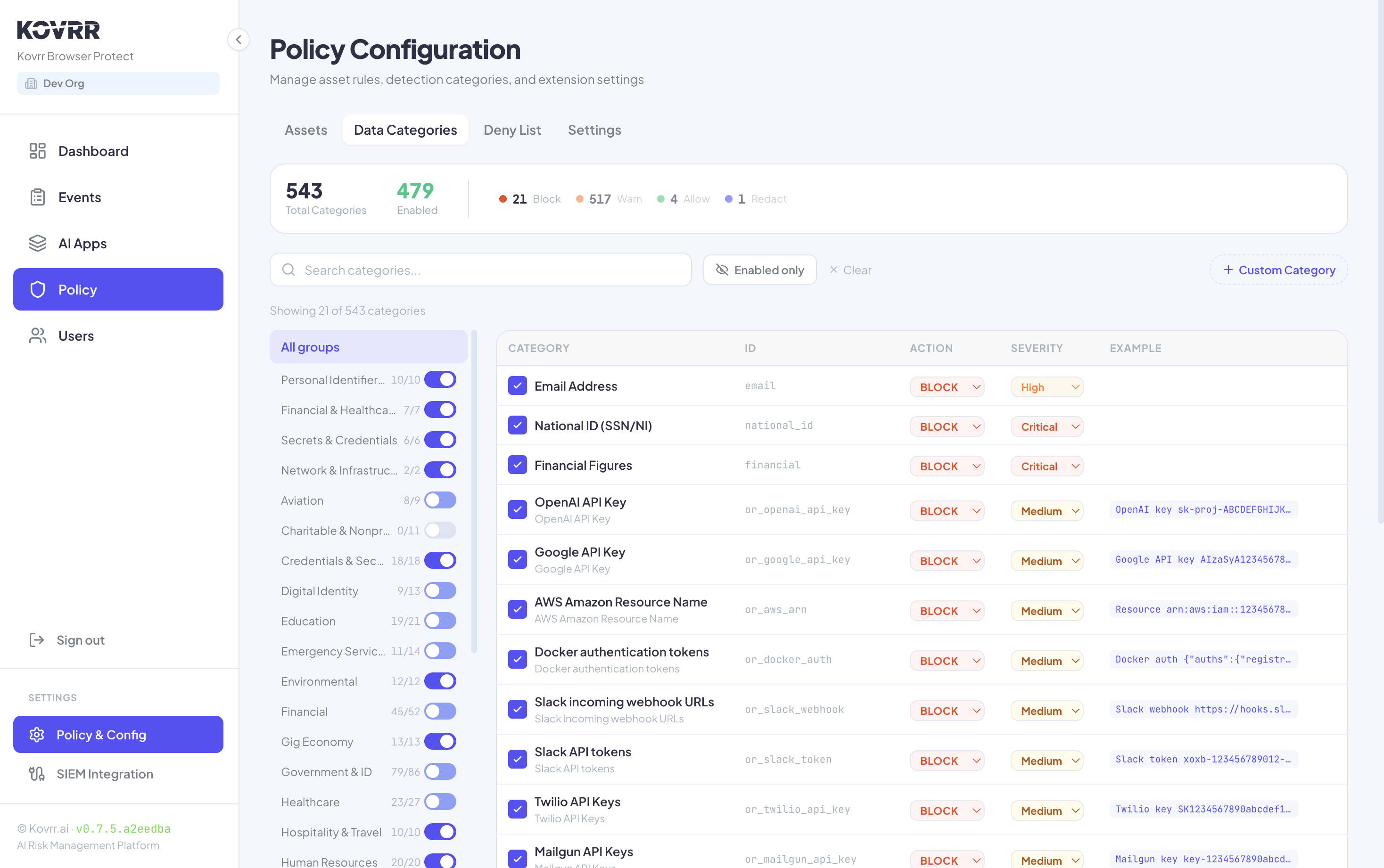
Four Verdicts Cover Most Situations
Blocking suits categories where no legitimate use exists, and credentials are the obvious case. Warning suits categories where the user is better placed to judge than the policy is, since a warning preserves the action while creating a record and a moment of thought. Redaction suits cases where the prompt is legitimate and the identifier inside it is not, stripping the customer name while letting the question through. Permitting suits everything else, and most categories should sit there.
Credentials Deserve Their Own Tier
API keys, tokens and connection strings pasted into a prompt leave the organization and enter a third-party log, where they outlive any rotation policy. Detection patterns for provider credentials are well defined enough to block with confidence, and the category is narrow enough that false positives stay rare. Treating secrets as a hard block while treating customer data as a warning reflects how differently the two behave once they leave.
What the Person Sees Matters
Enforcement that arrives as a silent denial produces a support ticket and a workaround. Showing the user which category triggered the decision, and what the permitted alternative is, converts an obstruction into guidance. Visibility also works in the organization's favor, since people who can see what is being recorded behave differently from people who cannot.
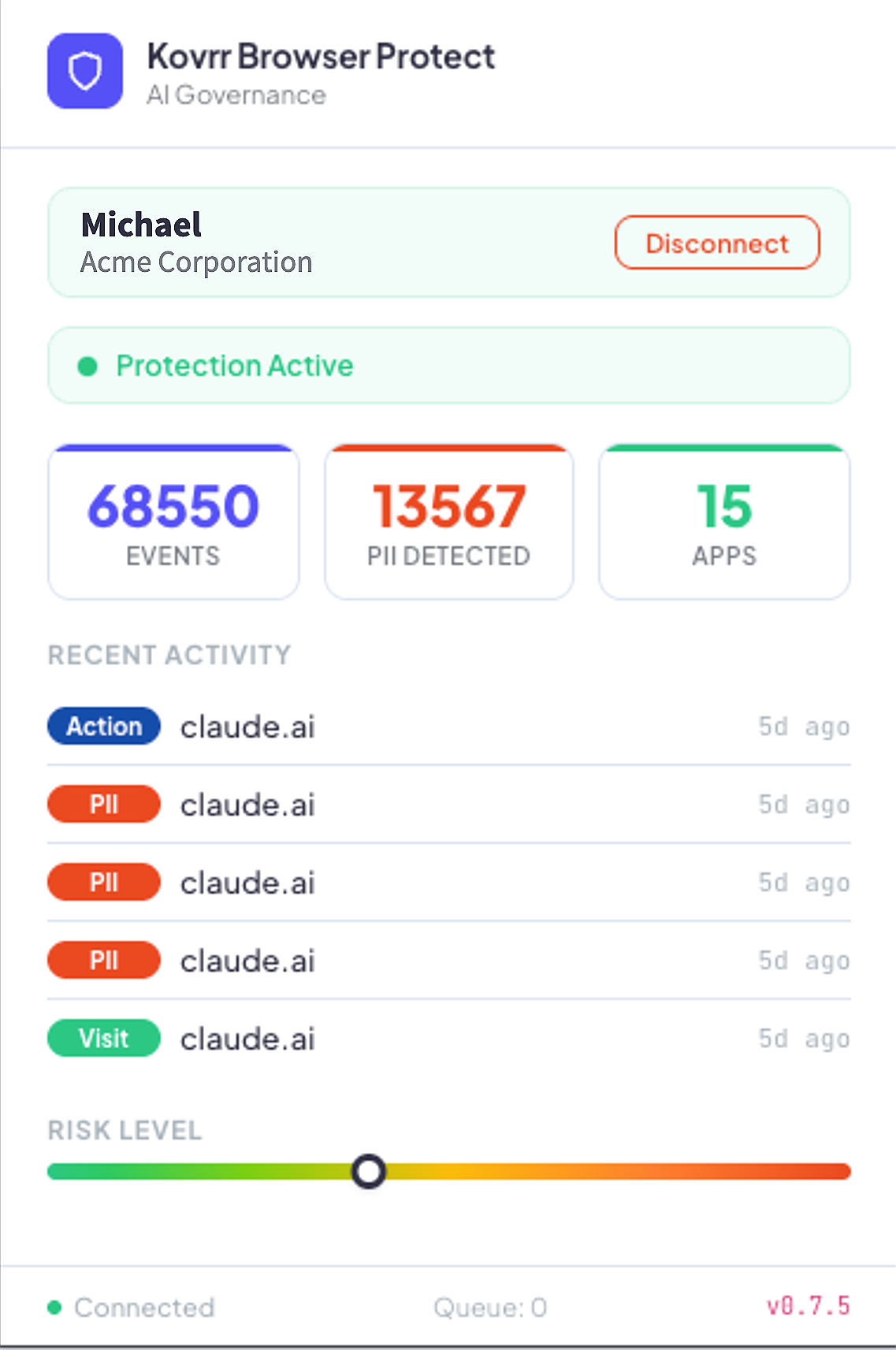
Per-User Records Make Incidents Investigable
An incident response that begins with a data category and no attribution starts from nothing. Behavioral baselines rely on the same records, and monitoring behavior in production needs per-identity history rather than aggregate counts. Records tying each detection to a person, an application and a timestamp answer the questions an investigation asks first, and the same trail supports identifying and managing AI-related incidents when a detection turns out to matter.
Where the Approach Breaks Down
Identity-based control assumes an identity to bind to, and several common situations violate that assumption.
- Unmanaged Devices: Personal laptops carry no extension, so the control depends on device management reaching every endpoint.
- Personal Browser Profiles: A second profile signed into a personal account sits outside managed policy on the same machine.
- Shared and Service Accounts: Attribution collapses when several people or processes operate under one credential.
None of these is a reason to skip the layer, and each one bounds what it can claim. An organization enforcing in the browser on managed devices should assume a residual channel exists and monitor for its consequences rather than assert coverage it does not have. Understanding where shadow AI hides helps size that residual accurately.
Prompt Injection Arrives From the Page, Not the Person
Identity controls govern what a user sends and say nothing about what a page sends back. Indirect prompt injection embeds instructions in content an assistant reads, so the malicious input carries no user identity at all. Browser-layer controls handling both directions inspect responses as well as prompts, and the same problem grows with agents connecting to external tools.
What to Ask a Vendor
Three questions separate identity-aware enforcement from logging with a name column.
- Show two verdicts: The same content submitted by two roles, producing different outcomes from one policy.
- Show an agent: A session attributed to a machine identity rather than to the person who deployed it.
- Show the export: Detection records reaching a SIEM in a form an analyst can query.
Coverage questions matter alongside capability. Ask which browsers are supported, what happens when the extension is disabled, and whether policy applies to embedded AI inside approved SaaS tools rather than only to recognized AI domains. Broader platform criteria sit in what to look for in an AI security platform, and the browser layer is one component of it.
Binding Policy to People Rather Than Pages
Domain lists and data categories describe what is being handled. Identity describes whether handling it is appropriate, and only the second question has a useful answer. Enforcement that knows the role, distinguishes a person from an agent, and offers something between blocking and permitting produces controls employees work within instead of around. Kovrr's AI Security and Governance Platform connects that browser-layer enforcement to the same inventory and risk register the rest of the program reports from.
To see identity-based enforcement applied to the AI your teams already use, book a demo mapped to your own roles and data categories.

AI Browser Security FAQs
Speak to an ExpertWhat are identity-based controls for AI browser security?

Why is authentication not enough to control AI use?
How should browser policy handle sensitive data differently by role?
Can browser controls attribute activity to AI agents rather than people?
What are the limits of browser-based AI enforcement?
Do browser controls stop prompt injection?