.jpg)
Blog Post
Building and Enforcing an AI Acceptable Use Policy
July 30, 2026
An AI acceptable use policy (AUP) is a formal set of rules that defines how employees can safely and responsibly use AI tools in the workplace. Its purpose is to encourage AI-driven productivity while protecting the organization from data leaks, intellectual property exposure, compliance violations, and the security vulnerabilities that unsanctioned AI usage introduces. Every organization deploying or permitting AI tools needs one.
The harder problem is not writing the policy. It is enforcing it. Most organizations that have an AI acceptable use policy in place today rely on employees to read it, understand it, and follow it voluntarily. That approach produces the same results it produces with every other security policy that lacks technical enforcement: partial compliance at best, widespread violation at worst, and no visibility into which outcome you are actually getting. A policy that employees can circumvent by opening a browser tab is a liability document, not a security control.
This guide covers what an AI acceptable use policy should include, why policies without enforcement fail, and how to build the technical infrastructure that turns a written document into an operational control that scales across the organization.
What an AI Acceptable Use Policy Should Include
A strong AI acceptable use policy should be practical, specific, and enforceable. Vague guidelines that tell employees to "use AI responsibly" without defining what responsible use looks like provide no actionable guidance and create no measurable accountability. The following components form the foundation of an effective policy.
Approved and Prohibited AI Tools
The policy should clearly list which AI platforms are authorized for use within the organization and which are explicitly prohibited. Approved tools should be enterprise-licensed versions with proper data handling agreements, security controls, and usage logging in place (for example, enterprise-tier ChatGPT, Microsoft Copilot, or other platforms vetted through the organization's security review process).
The prohibited list should include categories of tools rather than attempting to name every individual service, since new AI tools launch weekly. For example: "AI tools accessed through personal accounts," "AI browser extensions not approved by IT," and "free-tier AI services without enterprise data handling agreements" are category-level prohibitions that remain relevant as the market evolves.
The policy should also define the process for requesting approval of new AI tools, including who evaluates requests, what criteria are applied, and how long the evaluation typically takes. Without a clear request process, employees who need an AI tool for a legitimate purpose will adopt one without waiting for approval.
Data Classification Rules
The policy must specify which types of data employees can and cannot submit to AI tools. This requires aligning the AI policy with the organization's data classification framework. At minimum, the policy should address:
- Prohibited data types. Customer PII, employee records, financial data, source code, trade secrets, legal communications, and any data classified as confidential or restricted under the organization's data classification policy
- Permitted data types. Publicly available information, non-sensitive internal content, and data specifically approved for AI processing by the data owner
- Conditional data types. Data that can be processed through approved AI tools with specific controls in place but cannot be submitted to unapproved services
Data classification rules are the component most frequently violated because employees often do not recognize when the content they are pasting into an AI tool contains sensitive information. A paragraph from an internal strategy document, a snippet of customer feedback, or a section of code may not feel sensitive in the moment of use, but it may contain proprietary information that creates exposure when processed by a third-party AI service.
Human Review Requirements
The policy should define which AI-generated outputs require human review before they can be used in business decisions, customer communications, or official documents. High-stakes outputs, including anything that influences financial decisions, regulatory filings, customer-facing communications, or legal documents, should require verification by a qualified human reviewer.
This component addresses the "hallucination laundering" problem, where AI-generated content is accepted as fact because downstream consumers do not know it was AI-generated. The policy should require employees to disclose when AI tools were used to produce or substantially assist with work product in contexts where accuracy is critical.
Prohibited Activities
Beyond data restrictions, the policy should explicitly prohibit specific activities:
- Using AI to generate content that impersonates specific individuals
- Submitting proprietary or confidential data from third parties (customers, partners, vendors) to AI tools without contractual authorization
- Using AI tools for employment decisions, credit assessments, or other high-risk functions without governance review and approval
- Deploying AI agents that interact with enterprise systems without security team authorization
- Using AI-generated outputs in regulatory filings or legal documents without human verification
Incident Reporting Procedures
The policy should define how employees report AI-related security incidents, including accidental data exposure through AI tools, discovery of unauthorized AI usage by colleagues, and suspected compromise of AI systems. Clear reporting procedures reduce the time between incident occurrence and organizational response. The policy should also clarify that good-faith reporting of AI policy violations will not result in disciplinary action for the reporter.
Consequences for Violations
The policy should state the consequences for deliberate policy violations, which may range from additional training for minor first-time infractions to disciplinary action for repeated or severe violations. Consequences should be proportionate to the severity of the violation and consistent with the organization's broader HR and compliance policies.
Regular Review Cadence
AI capabilities and organizational AI usage evolve rapidly. The policy should specify a review cadence (quarterly or semi-annually at minimum) and assign ownership for maintaining the policy as the AI landscape, regulatory environment, and organizational needs change.
Why Policies Without Technical Enforcement Fail
Writing an AI acceptable use policy is the easy part. The challenge that most organizations have not solved is ensuring the policy is actually followed across thousands of employees, hundreds of AI tools, and the constant pressure to move faster with AI-assisted workflows.
Policies that rely exclusively on employee awareness and voluntary compliance fail for predictable reasons:
- Employees do not read policies. Research on security policy compliance consistently shows that a significant percentage of employees either do not read security policies or do not retain the details long enough to apply them in daily work.
- The policy does not cover what employees actually encounter. An employee who reads the policy in January may encounter an AI tool in June that does not clearly fall into the approved or prohibited categories. Without technical controls to guide the decision in real time, the employee makes a judgment call that may not align with organizational intent.
- Shadow AI is invisible to policy compliance. An employee using an unauthorized AI tool through a personal browser profile is violating the policy in a way that no manual compliance process can detect. The violation is invisible unless the organization has technical detection infrastructure in place. Read more about shadow AI, where it hides, and what it costs.
- Policies cannot respond to new tools in real time. Between policy review cycles, new AI tools enter the organization through employee adoption, vendor updates, and platform changes. A written policy that was comprehensive when published may have significant gaps within weeks.
The organizations that successfully enforce AI acceptable use policies are the ones that implement technical controls that make the policy self-enforcing. Rather than asking employees to remember and follow rules, they deploy infrastructure that applies the rules automatically at the point where employees interact with AI tools.
How to Technically Enforce an AI Acceptable Use Policy
Technical enforcement translates the written policy into automated controls that operate continuously without depending on employee compliance. The enforcement architecture should cover three layers.
Layer 1. Continuous Discovery and Visibility
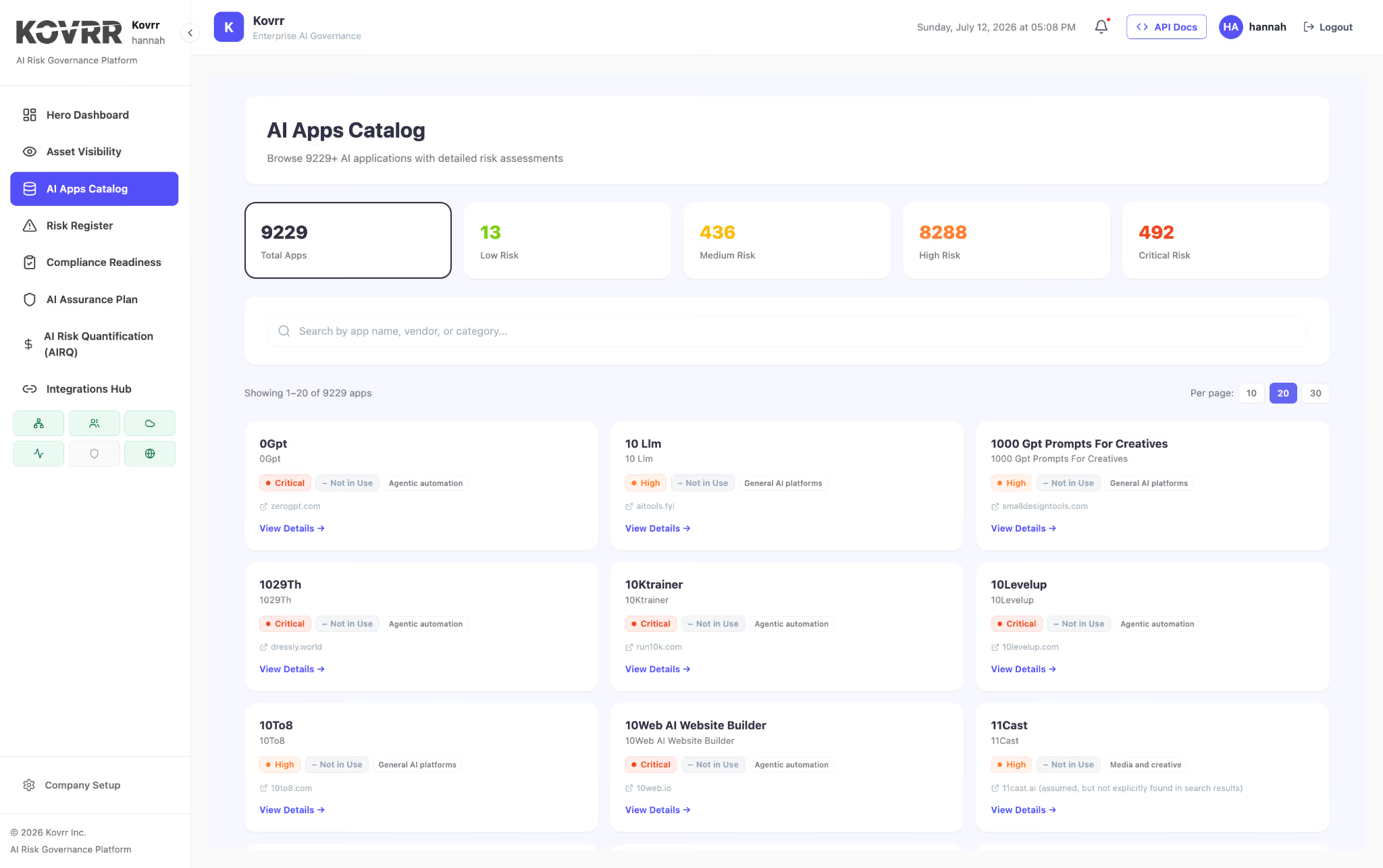
Enforcement starts with knowing what AI tools employees are actually using. The organization's AI asset inventory should continuously discover and catalog every AI tool in the environment, including shadow AI that employees adopted without approval. Without this visibility, enforcement can only cover the AI tools the organization already knows about, which is typically a fraction of actual usage.
Kovrr's platform provides this visibility through connected telemetry that discovers sanctioned, shadow, and third-party AI tools across the enterprise. The platform catalogs over 15,000 AI applications with pre-assessed risk profiles, so when a new tool appears in the environment, the governance response is informed by existing intelligence rather than starting from scratch. For more on how continuous discovery works, read what AI asset discovery is and why it matters for governance.
Layer 2. Data-Sensitive Policy Enforcement
The enforcement layer should apply policy rules based on data sensitivity at the point of interaction. This means:
- Blocking employees from submitting prohibited data types (PII, source code, financial data) to any AI tool, including approved ones where specific data types are restricted
- Blocking access to prohibited AI tools entirely while allowing approved tools to function normally
- Applying conditional controls to tools that are permitted for certain data types but restricted for others
- Logging all AI interactions for audit and compliance purposes without transmitting sensitive content to the governance platform
This layer implements the data classification rules from the written policy as automated controls. An employee who attempts to paste customer records into an AI tool is blocked in real time, regardless of whether they read the policy or remember its contents. The enforcement happens at the browser level because that is where the vast majority of AI interactions occur.
Layer 3. Connected Governance Response
When enforcement detects a policy violation, the response should flow through the governance architecture automatically. The violation should update the organization's risk register with the relevant risk scenario. The compliance readiness module should check whether the violation triggers regulatory obligations under frameworks like the EU AI Act. The risk quantification engine should recalculate the organization's exposure to reflect the violation data. The violation should surface in the reporting that reaches security leadership and the board.
This connected response is what transforms enforcement from a blocking mechanism into a governance input. Each policy violation generates data that improves risk models, informs policy updates, and provides evidence for compliance reporting.
Measuring Policy Effectiveness
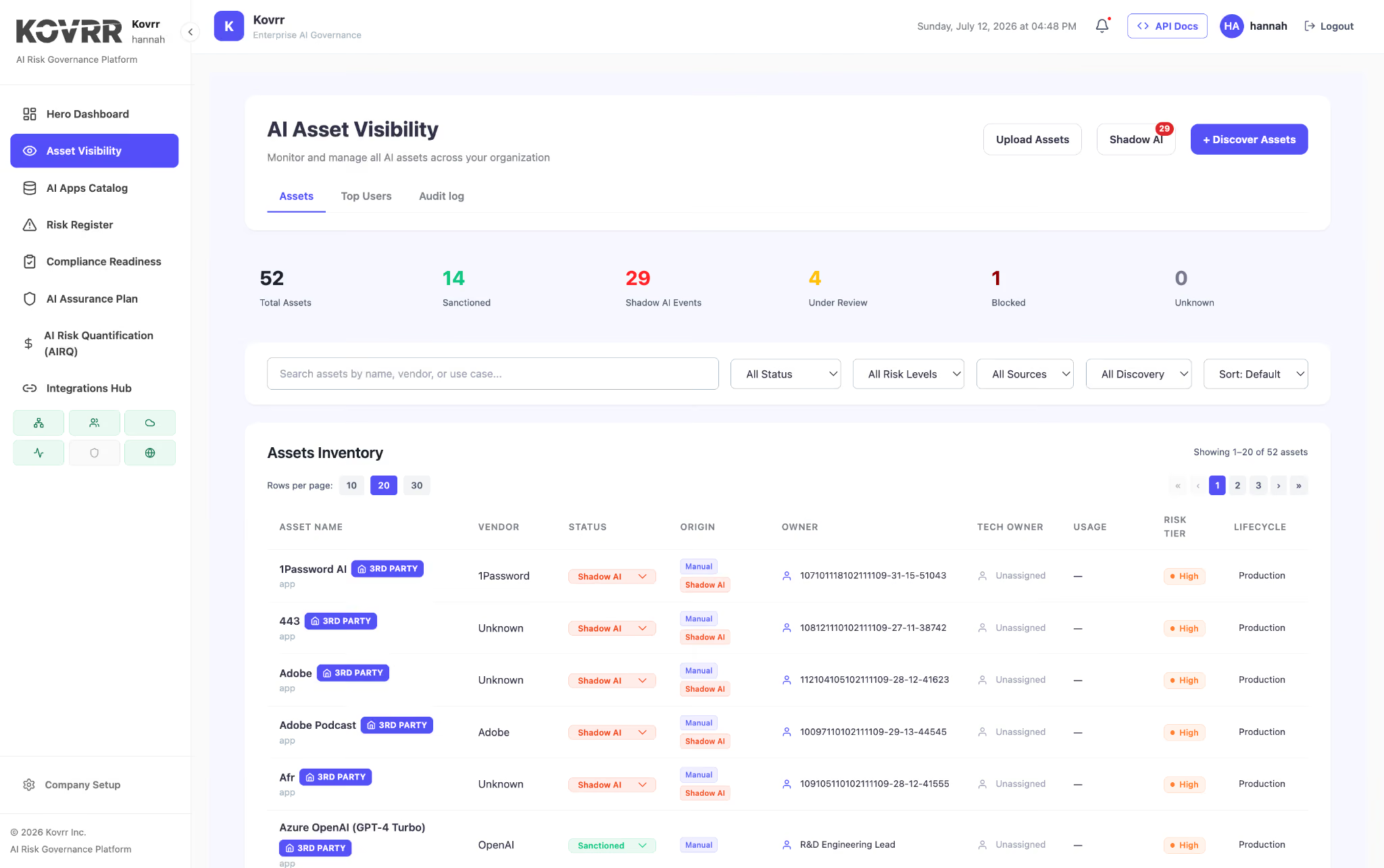
An enforced AI acceptable use policy generates data that allows the organization to measure its own effectiveness. Key metrics include:
- Policy violation rate. The number and severity of enforcement actions over time. A declining trend indicates that employees are adapting their behavior. A stable or increasing trend suggests the policy needs adjustment or the enforcement layer needs broader coverage.
- Shadow AI discovery rate. The number of new, unsanctioned AI tools discovered per period. A high discovery rate indicates that the policy is not preventing unauthorized adoption and may need stronger deterrence or better-provisioned alternatives.
- Sanctioned vs. unsanctioned usage ratio. The percentage of total AI usage that flows through approved, governed channels versus unsanctioned tools. This is the single most important metric for assessing whether the policy is working as intended.
- Data exposure incidents. The number of times enforcement blocked sensitive data from reaching an AI tool. Each blocked incident represents a prevented data exposure event that would have been invisible without technical enforcement.
- Time to policy update. How quickly the policy is updated when new AI tools, use cases, or regulatory requirements emerge. A policy that has not been updated in six months is likely out of date.
These metrics should be reported to security leadership on a regular cadence and included in board-level AI risk reporting alongside financial exposure data and compliance readiness status.
A Policy Is a Document. Enforcement Is a Capability.
Every organization needs an AI acceptable use policy. Fewer organizations have solved the enforcement problem. The policy defines what employees should do. Technical enforcement ensures they actually do it, continuously, across every browser session, every AI tool, and every data type, without depending on individual memory or goodwill.
The organizations with the strongest AI governance postures are those that treat the policy and the enforcement infrastructure as a single system. The policy informs the enforcement rules. The enforcement data informs policy updates. And the connected governance architecture ensures that every policy violation, every blocked data exposure, and every newly discovered shadow AI tool flows into the risk assessment, compliance mapping, and executive reporting that keeps the entire program current.
Schedule a demo to see how Kovrr's platform connects policy enforcement to continuous AI asset discovery, risk assessment, and compliance readiness.

AI Acceptable Use Policy FAQs
Speak to an ExpertWhat is an AI acceptable use policy?

What is the most important component of an AI acceptable use policy?
How often should an AI acceptable use policy be updated?
Can an AI acceptable use policy be enforced without technical controls?
How does an AI acceptable use policy relate to EU AI Act compliance?
What should you do if employees are ignoring the AI acceptable use policy?