.jpg)
Blog Post
What Is AI Asset Discovery (And Why It Matters for AI Governance)
June 30, 2026
Enterprise artificial intelligence adoption is scaling at a pace that manual inventory methods simply cannot match. This rapid proliferation has created a severe visibility chasm for security and risk teams: it is fundamentally impossible to govern, secure, or quantify what you do not know exists.
To bridge this gap, organizations are shifting away from point-in-time compliance audits and adopting continuous discovery. Implementing a technical, automated AI asset discovery framework is the critical first step toward real, defensible AI governance.
Defining the AI Visibility Chasm
AI asset discovery is the continuous, automated process of identifying, cataloging, and classifying every artificial intelligence model, application, autonomous agent, and third-party embedded AI capability interacting with an enterprise's networks, endpoints, or data layer.
Unlike traditional software tracking, AI asset discovery provides the live data foundation required for effective AI governance, which is the broader corporate framework of policies, ethical guidelines, and technical controls established to ensure AI deployments remain secure, compliant, and aligned with enterprise risk tolerances.
When an organization lacks an automated discovery mechanism, its governance program exists only on paper. Discovery transforms static policies into active, operational oversight.
Technical Realities: Why Traditional Discovery Misses AI
Most enterprises attempt to track AI using existing Cyber Asset Attack Surface Management (CAASM) or IT Asset Management (ITAM) tools. These legacy stacks fail because AI assets do not behave like traditional software executables or static endpoints.
AI proliferates across distinct, highly fluid operational layers:
- The Browser Edge (Shadow AI): Employees routinely input proprietary data into unsanctioned web-based LLMs and productivity extensions. Standard endpoint detection and response (EDR) tools see browser traffic but remain blind to the specific prompt data categories crossing the perimeter.
- Embedded Third-Party Stacks: Enterprise software vendors continuously inject generative features and predictive models into existing SaaS tools via background updates. This introduces unvetted third-party risk without IT's explicit knowledge.
- The Agentic Layer: Autonomous AI agents increasingly run cross-system workflows, auto-generating code, calling APIs, and manipulating files. These agents interact with system access points in ways that traditional Identity and Access Management (IAM) architectures are not configured to baseline or restrict.
Because these assets are API-driven, dynamic, and decentralized, tracking them requires a multi-source telemetry approach that monitors data at the exact point of interaction.
The Connected Lifecycle: How Discovery Powers Kovrr
Kovrr’s AI Security and Governance Platform is built on the reality that discovery alone is just raw data. True risk management requires turning those signals into evidence, compliance documentation, and financial clarity through a connected architecture.
[Edge Telemetry (Browser Protect)] ➔ [Live Visibility Inventory] ➔ [Scenario Risk Register] ➔ [AIRQ Financial Model] ➔ [Executive Reporting]
1. Active Endpoint Enforcement
The loop begins at the point of interaction. Kovrr Browser Protect deploys across an enterprise's managed browsers via MDM. Rather than flatly blocking productivity, it uses deterministic pattern matching locally on the endpoint to detect, warn, or intercept sensitive data categories before they leave the browser. Prompt content remains local, while categorical signals feed back to the central platform.
2. Live Inventory to Active Risk Register
Every signal captured via browser endpoints, network flows, or SaaS catalogs automatically populates Kovrr's AI Asset Visibility engine. If a team spins up an unsanctioned model or utilizes a high-risk vendor, the centralized inventory updates in real time. This automated update immediately synchronizes with the AI Risk Register, replacing the need for quarterly manual audits.
3. Financial AI Risk Quantification (AIRQ)
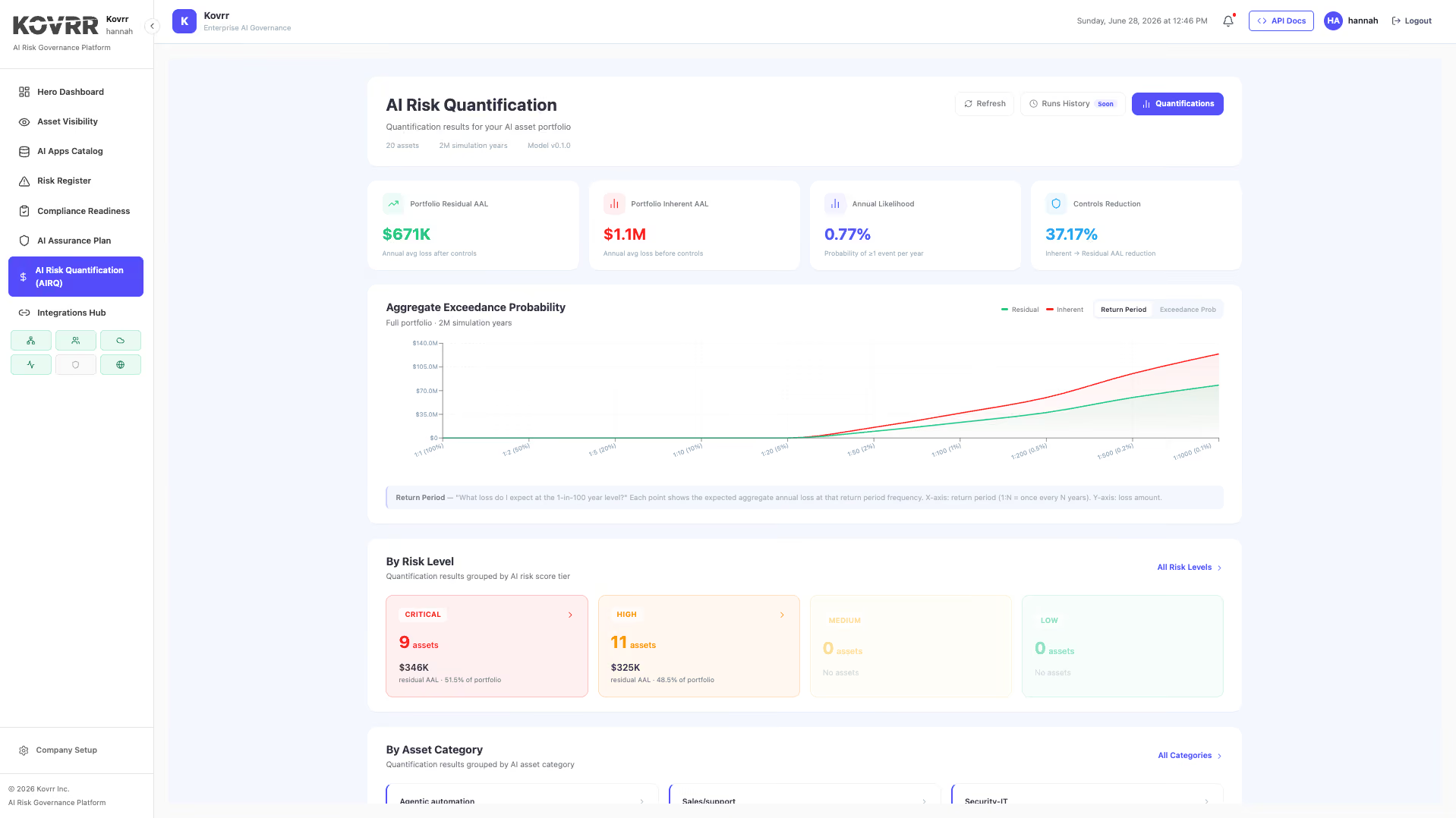
Once an asset is mapped to a scenario in the risk register, Kovrr's AI Risk Quantification (AIRQ) engine translates that technical exposure into financial terms. Leveraging insurance-grade loss models, AIRQ calculates hard business metrics, including expected annual loss, worst-case impact, and exceedance probability curves, for threats like third-party model failure or prompt injections. Security leaders can then prioritize compliance and control remediation based on actual financial weight.
Regulatory Alignment: Moving Beyond Manual Audits
Global regulations have turned continuous AI asset discovery from an internal best practice into a strict legal mandate. Manual spreadsheets are a liability under modern regulatory scrutiny.
- The EU AI Act: Following the adoption of the Digital Omnibus on AI, the compliance roadmap demands continuous operational readiness. Transparency and watermarking obligations under Article 50(2) take effect on December 2, 2026, while strict standalone high-risk system mandates (Annex III) apply starting on December 2, 2027. Kovrr’s EU AI Act compliance readiness feature automates this burden by pulling live discovery artifacts and mapping them directly to regulatory Articles, automatically compiling the formal Auditor Pack.
- NIST AI RMF & ISO/IEC 42001: Both frameworks explicitly dictate that a comprehensive, validated inventory of AI use cases, classifications, and data lineages is the mandatory baseline for establishing organizational risk tolerance and tracking control efficacy.
Implementing a Continuous Discovery Blueprint
Building a scalable AI asset discovery and governance function requires a structured, multi-step execution plan:
- Capture Edge Telemetry: Deploy lightweight browser-level controls to monitor employee interactions with web-based generative tools without routing traffic through heavy proxies.
- Centralize into a Live Inventory: Map all discovered apps, internal models, and autonomous workflows into a dynamic dashboard that replaces manual spreadsheets.
- Profile Vendor AI Usage: Use automated catalogs to score third-party software vendors based on how they embed and govern AI within their products.
- Enforce Contextual Policies: Utilize inline warn-and-proceed prompts to educate users and protect sensitive data categories in real time.
- Maintain a Scenario-Based Risk Register: Track specific AI threat vectors, such as data poisoning or privilege misuse, by continuously feeding them live inventory data.
- Quantify Exposure in Dollars: Apply financial risk modeling to compliance gaps to justify security spend and prioritize resource allocation.
- Automate Compliance Mapping: Link real-world telemetry directly to frameworks like the EU AI Act to maintain a continuous state of audit readiness.
From Policy to Connected Posture
AI asset discovery is not an isolated security exercise; it is the fundamental infrastructure upon which all modern AI governance stands. Attempting to manage regulatory compliance or mitigate model exposure without real-time operational visibility leaves organizations structurally exposed to data leaks, regulatory penalties, and blind operational risks.
By replacing static, spreadsheet-driven inventories with a connected architecture that unifies edge telemetry, dynamic risk tracking, and financial quantification, enterprises can confidently embrace the speed of AI innovation. Platforms like Kovrr bridge the gap between technical reality and executive decision-making, transforming raw discovery signals into a defensible, audit-ready governance strategy.
Request a personalized demo of Kovrr’s AI Security and Governance platform today to see how automated asset discovery and real-time edge protection work together within a single connected architecture.

AI Asset Discovery FAQs
Speak to an ExpertWhat is the difference between standard IT discovery and AI asset discovery?

Why do spreadsheets fail for AI asset inventories?
How does edge-level discovery protect enterprise data?
What are the upcoming EU AI Act deadlines for enterprise compliance?
How does Kovrr connect discovery to board reporting?