
Blog Post
Shadow AI Explained: What It Is, Where It Hides, and What It Costs
July 2, 2026
Shadow AI is the term for AI tools, models, and capabilities that operate within an organization without formal approval, oversight, or governance. It is the enterprise AI equivalent of shadow IT, which is the unauthorized software and cloud services that proliferated as employees found faster ways to get work done than waiting for IT procurement cycles.
The difference is that the consequences of unmanaged AI are considerably more significant than those of unmanaged software. Shadow AI touches sensitive data, influences consequential decisions, creates regulatory obligations, and introduces security vulnerabilities that organizations have no visibility into because they do not know the tools exist.
What Counts as Shadow AI?
Consumer AI Tools
The most obvious category is consumer AI tools like ChatGPT, Claude, Gemini, Perplexity, and similar platforms, which are accessed through personal or work accounts without organizational review. Employees use these tools for drafting, analysis, coding, research, and decision support, often without any awareness that doing so creates data handling, privacy, and regulatory exposure for the organization.
Embedded Shadow AI
Less obvious but equally significant is embedded shadow AI. These are AI capabilities that have been added to software the organization already uses and has formally approved. A SaaS platform that adds an AI writing assistant to its interface, a CRM that introduces AI-powered lead scoring, and a project management tool that enables AI-generated summaries. None of these generate new procurement events or identity system alerts, but all of them represent new AI capabilities operating on organizational data without governance review.
Developer and Research AI
Developer and research AI is a third category that governance programs frequently miss. Data scientists and engineers deploying open-source models, experimenting with API-connected foundation models, or building internal tools that incorporate AI capabilities often do so outside formal procurement channels. The tools may be technically sophisticated and genuinely valuable to the business, but if they were never assessed for data handling, security, or regulatory compliance, they carry the same governance exposure as any other shadow AI.
Vendor Embedded AI
Finally, vendor-embedded AI represents a growing category of shadow AI that originates entirely outside the organization. Third-party service providers increasingly incorporate AI capabilities into the services they deliver, which means the organization's exposure extends to AI systems it did not deploy, cannot directly monitor, and may not even know are processing its data.
Where Does Shadow AI Hide in the Enterprise?
Shadow AI concentrates within the parts of the organization that move fastest and have the most autonomy. Marketing teams use AI tools for content generation, campaign analysis, and customer segmentation. Sales teams use AI for prospecting, email drafting, and call analysis. Engineering and product teams use AI coding assistants, test generation tools, and documentation aids. Finance teams use AI for data analysis, forecasting, and report generation. HR teams use AI for job description writing, candidate screening, and onboarding content.
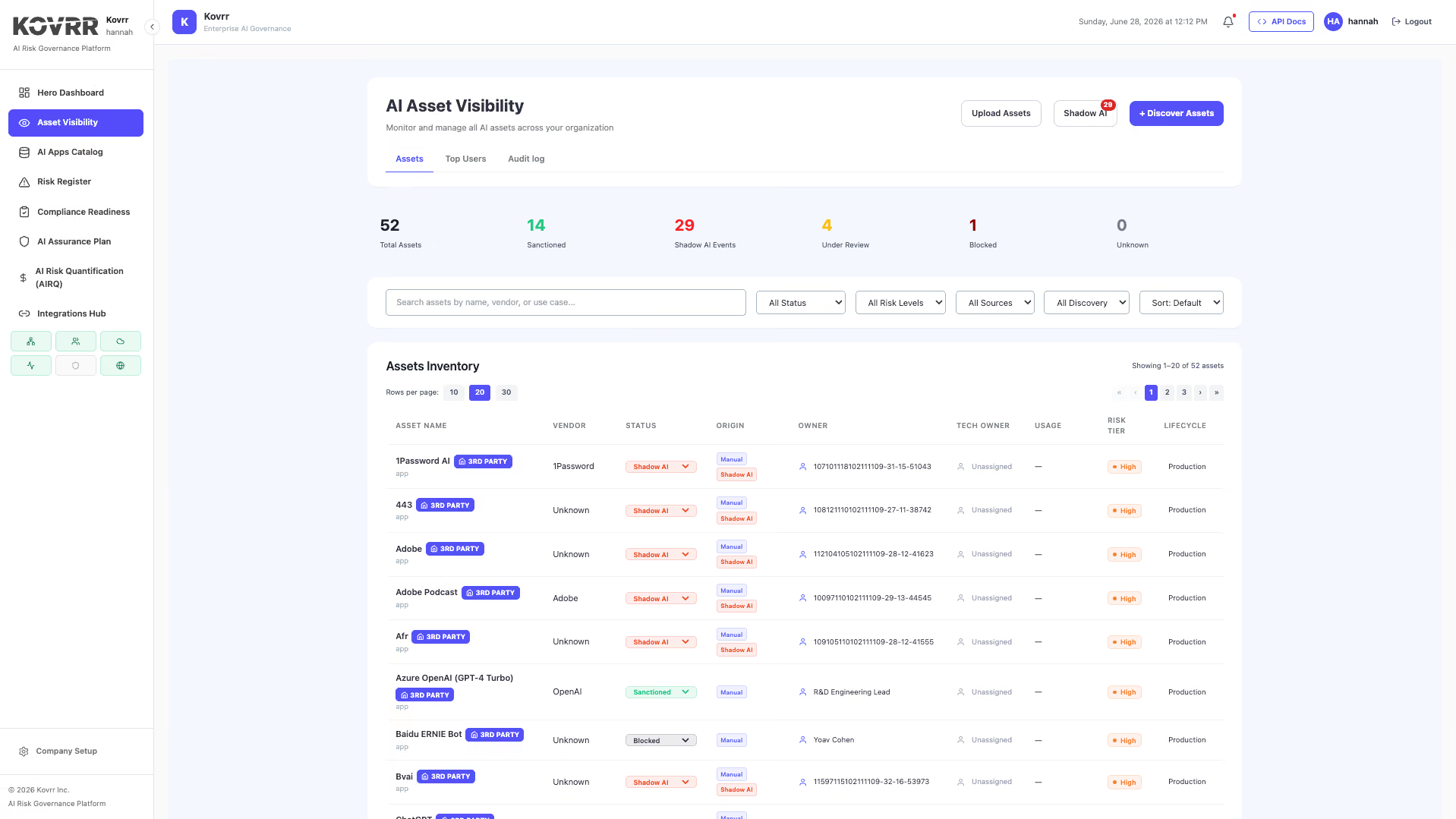
In each of these functions, the same dynamic plays out. An individual discovers a tool that makes them more productive. They start using it. Colleagues notice and start using it too. The tool becomes embedded in team workflows before anyone in governance, security, or compliance has ever evaluated it. By the time the tool surfaces in a governance review, if it ever does, it likely has been processing organizational data for months.
The technical hiding places are equally varied.
- Browser extensions operate within the user's browser session, making them invisible to network monitoring tools that watch for connections to external services.
- Mobile applications used on personal devices for work tasks fall entirely outside corporate device management.
- API integrations built by developers connect internal data to external AI services through programmatic channels that standard asset management tools were not designed to detect.
- Web-based tools accessed through personal accounts leave no corporate identity system footprint.
What Does Shadow AI Actually Cost Organizations?
The costs that shadow AI generates concentrate across four categories, and they rarely stay contained to one of them when an incident occurs.
Data and Privacy Costs
Data and privacy liability is typically the most immediate cost category. Shadow AI tools that process personal data, financial information, health records, or intellectual property without adequate governance create exposure that extends into breach notification obligations, regulatory fines, and litigation. Employees who paste customer data into a consumer AI tool to speed up a task may not realize they have created a data processing event that triggers GDPR obligations or violates contractual commitments made to customers about how their data is handled.
Regulatory Costs
Regulatory penalties are the second cost category and increasingly the most financially significant. The EU AI Act's obligations for high-risk AI systems apply regardless of whether the organization formally sanctioned the tool. An AI system used in employment decisions, credit assessments, or other high-risk applications without the required risk management documentation, oversight mechanisms, and technical file carries potential penalties of up to €30 million or 6% of global annual turnover, even if the organization had no idea the tool was being used. Shadow AI creates regulatory exposure that the organization cannot manage because it cannot see it.
Security Incident Costs
Security incidents represent the third cost category. Shadow AI tools extend the attack surface into systems the security team has never assessed. A prompt injection attack that exploits a GenAI tool to exfiltrate sensitive data, a data poisoning attack that corrupts outputs from a model processing business-critical information, and a compromised AI vendor whose tool is embedded in organizational workflows; each of these represents a security incident that is harder to detect and harder to contain when the affected tool was never in the security team's scope.
Operational and Reputational Costs
Operational and reputational costs round out the picture. AI tools that produce biased, inaccurate, or poorly supervised outputs, and that were never subjected to evaluation before being used in customer-facing or decision-influencing contexts, create reputational exposure that can outlast any technical remediation by months or years.
Why Does Shadow AI Spread So Quickly?
The fundamental driver is the productivity gap between what approved tools can do and what AI tools can do. When an employee discovers that a consumer AI tool produces in ten minutes what previously took two hours, the governance process that would require a procurement request, security review, legal assessment, and IT approval before the tool can be used officially does not feel like a reasonable barrier. It feels like an obstacle to doing their job well.
Organizations that respond to shadow AI purely through prohibition, like blocking tools or issuing policies against unauthorized AI use, consistently find that enforcement is limited and that the tools reappear through channels the controls cannot reach. The more sustainable response combines reasonable governance processes that do not create unnecessary friction with detection infrastructure that surfaces shadow AI continuously so that governance teams can make informed decisions about which tools to sanction, which to block, and which to manage with additional controls.
The regulatory environment has also created a category of shadow AI that spreads for reasons unrelated to individual employee behavior. AI features added to enterprise software through routine updates arrive without triggering any new governance review, because the procurement decision for the underlying software was made before the AI capabilities existed. Organizations that do not have continuous monitoring of their existing software portfolio for new AI capabilities will consistently discover them after the fact rather than before deployment.
How Should Organizations Respond to Shadow AI?
The response to shadow AI starts with discovery. Before any governance decision can be made about a shadow AI tool, it must be known. That requires detection infrastructure that operates across the channels through which shadow AI actually enters the organization, rather than relying on employee self-reporting or periodic manual surveys.
Once discovered, shadow AI tools need to be assessed and classified rather than automatically blocked. Many shadow AI tools, when evaluated, turn out to be appropriate to sanction with reasonable controls. Blanket blocking of consumer AI tools drives usage underground and reduces organizational visibility without reducing usage. A classification process that evaluates each discovered tool against defined criteria produces governance decisions that are proportionate to actual risk rather than reflexively restrictive.
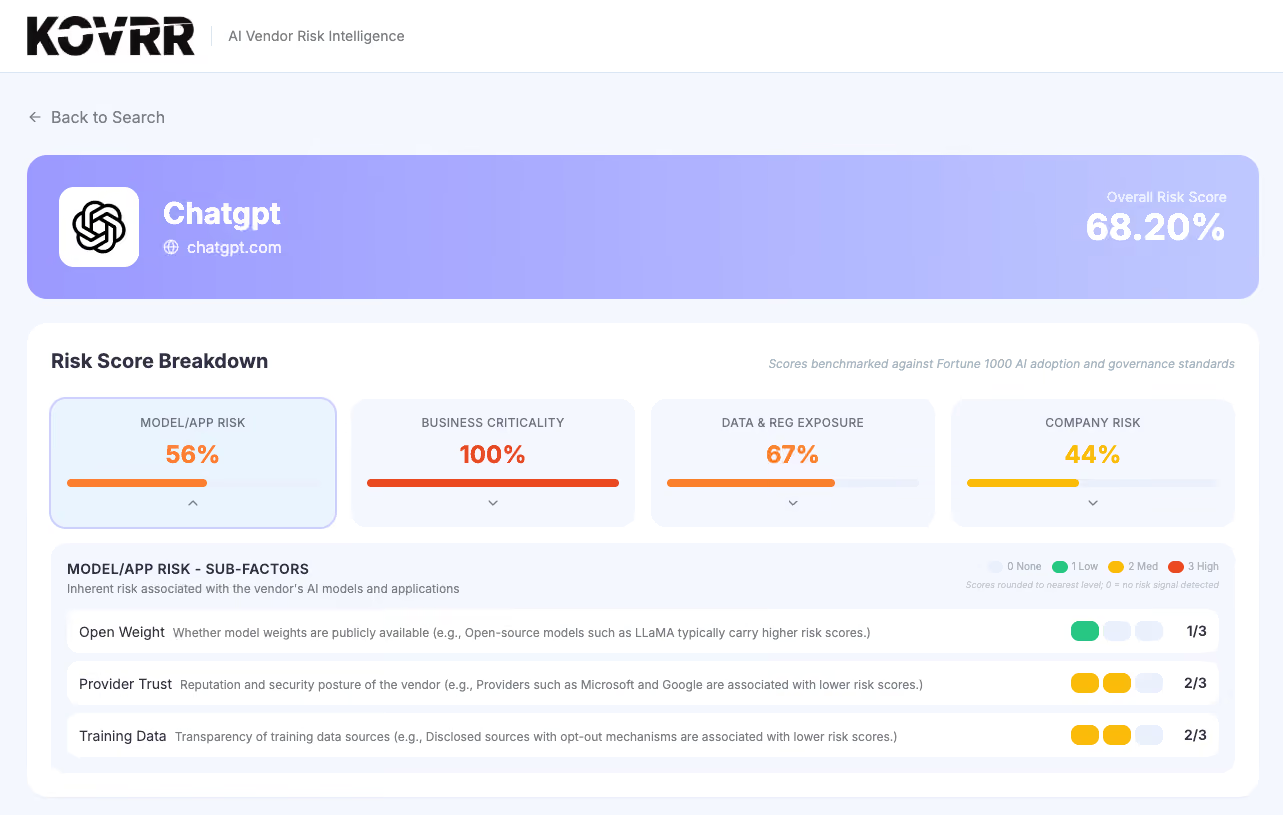
Tools that are sanctioned need to be brought into formal governance with defined data handling requirements, user training, and ongoing monitoring. Tools that are blocked need to be accompanied by approved alternatives where the underlying need is legitimate, because prohibition without substitution consistently produces workarounds. Tools that fall into a gray zone, not formally approved but not formally blocked, need defined escalation paths so that the governance status is resolved rather than indefinitely deferred.
Platforms such as Kovrr's AI Security and Governance Platform support this response through continuous asset discovery that surfaces shadow AI as it appears, risk scoring that classifies each discovered tool by its actual exposure profile, and integration with compliance assessment and financial quantification workflows so that governance decisions are informed by regulatory obligations and financial consequences rather than security team judgment alone.
The Connection Between Shadow AI and AI Agent Security
As organizations deploy agentic AI, shadow AI governance becomes considerably more complex. An agent that has been given access to organizational systems can invoke other AI tools, call external APIs, and interact with data sources in ways that extend far beyond its declared scope. The shadow AI that an individual employee uses affects that employee's work. The shadow AI that an agent invokes can affect every downstream process in the workflows the agent touches.
Effective AI agent security requires the same continuous discovery infrastructure that general shadow AI governance requires, extended to monitor agent behavior at the execution layer.. Organizations that have not solved the shadow AI problem for human users are unlikely to have solved it for autonomous agents, and the consequences of unmanaged agentic AI are proportionally larger given the scale at which agents can act.
Shadow AI Does Not Manage Itself
Shadow AI is not a problem that resolves itself as organizations become more sophisticated about AI governance. It is a dynamic condition that requires sustained detection infrastructure, proportionate governance responses, and continuous monitoring to manage.
The organizations that get this right are not those with the most restrictive AI policies. They are those with the most accurate picture of what AI is actually running across their environment, and the governance infrastructure to make informed decisions about every tool in that picture.
Every shadow AI tool that goes undetected is a risk the organization is carrying without choosing to. Schedule a demo to see how Kovrr surfaces shadow AI across your entire enterprise, including the tools your current processes have never seen.

What is the difference between shadow AI and shadow IT?

Is shadow AI always a security risk?
Can shadow AI be discovered without specialized tools?
What regulatory obligations does shadow AI create?
How common is shadow AI in enterprise environments?
What should organizations do when they discover shadow AI?
Does blocking shadow AI tools solve the problem?
How does shadow AI affect cyber insurance?
What is the financial cost of a shadow AI incident?
How does shadow AI relate to the EU AI Act?