Blog Post
How to Discover, Monitor, and Manage Shadow AI Across the Enterprise
July 19, 2026
Shadow AI is the fastest-growing unmanaged risk surface in most organizations. Employees are adopting AI tools through browser extensions, free-tier SaaS accounts, personal logins, and embedded platform features without involving IT, security, or procurement. The result is an expanding footprint of AI systems that process corporate data, generate business outputs, and create compliance exposure while remaining invisible to the governance program responsible for managing those risks.
Discovering and monitoring shadow AI requires specialized detection infrastructure that operates independently of purchase orders, provisioning records, and employee self-reporting. The tools available in 2026 span several categories, from dedicated AI security platforms that track prompt-level data exposure to SaaS management systems that monitor OAuth grants and identity-based AI access. Choosing the right approach depends on what types of shadow AI your organization faces, what detection gaps your current security stack leaves open, and whether you need point discovery or a connected governance architecture that turns detection into risk reduction.
This article covers the risks shadow AI introduces, the detection methods and tools available, and how to build a monitoring program that keeps pace with the speed at which unauthorized AI enters the enterprise.
What Makes Shadow AI Dangerous?
The risks employees create by using unauthorized AI tools at work are more varied and more severe than most organizations realize. Shadow AI is not just a policy violation. It is an active threat vector that creates financial, regulatory, and operational exposure across several dimensions.
Data Security and Intellectual Property Exposure
Employees unknowingly paste confidential information into AI platforms on a regular basis. Customer records, financial data, source code, strategic plans, internal communications, and proprietary research all flow into AI tools that the organization has never evaluated for data handling, retention, or training practices. Once data enters an unsanctioned AI service, the organization loses control over how that data is stored, who can access it, and whether it is used to train models that serve other customers.
The intellectual property risk is particularly acute. An engineer who uses an unauthorized AI coding assistant may inadvertently expose proprietary algorithms or product architecture. A marketing team that processes competitive intelligence through a free AI tool may be feeding that information into a model that serves competitors.
Regulatory and Compliance Violations
Shadow AI creates compliance exposure that governance teams cannot manage because they cannot see it. Under the EU AI Act, organizations are accountable for ensuring that AI systems they deploy meet applicable requirements. An employee using an unauthorized AI tool for a high-risk function, such as HR screening, customer credit decisions, or medical record analysis, can create regulatory obligations the organization does not know it has. The NIST AI Risk Management Framework (AI RMF), and its Generative AI Profile (NIST AI 600-1) specifically, assume an organization maintains an inventory of its generative AI use, an assumption shadow AI defeats by definition. GDPR violations occur when personal data is processed by AI services without adequate data processing agreements. Sector-specific regulations in financial services and healthcare add further obligations that shadow AI routinely breaches.
Hallucination Laundering and Decision Contamination
When employees use AI tools that the organization does not monitor, the outputs of those tools enter business workflows without any quality control or verification process. AI-generated content, analysis, and recommendations are presented as employee work product, and the AI origin is invisible to downstream decision-makers. This creates a phenomenon sometimes called "hallucination laundering," where inaccurate or fabricated AI outputs are accepted as fact because nobody knows they were AI-generated. The risk compounds when AI outputs inform executive decisions, customer communications, or regulatory filings.
Autonomous AI Agent Risks
As agentic AI becomes more accessible, employees can deploy AI agents that interact with systems, access data, and take actions without human review at each step. An unauthorized AI agent connected to corporate email, calendar, or CRM systems through an employee's personal credentials operates outside the organization's security perimeter while having access to sensitive enterprise data.
How Organizations Detect Shadow AI
Security and IT teams must scan multiple layers of the corporate environment to uncover unsanctioned AI tools. No single detection method catches every type of shadow AI, which is why the most effective programs layer several approaches together.
Browser-Level Telemetry and Endpoint Monitoring
Most shadow AI is accessed through web browsers. Browser-level monitoring detects when employees visit AI service domains, interact with AI-powered browser extensions, or upload data to AI platforms. Endpoint monitoring extends this visibility to desktop and mobile applications that interact with AI services.
Browser-based detection is the broadest and most effective discovery method because it catches AI tools that bypass every other detection layer. An employee using an AI tool through a personal browser profile, accessing a free-tier AI service that does not require authentication, or interacting with an AI-powered browser extension will be invisible to network monitoring, identity systems, and SaaS management platforms. Only browser-level telemetry catches these interactions.
Identity and API Monitoring
Teams audit OAuth tokens, SSO integrations, and API keys to find unauthorized AI tools that have been granted access to corporate data. When an employee authorizes an AI service to access their Google Workspace, Microsoft 365, or Slack account through OAuth, that consent event creates a detectable signal. Identity monitoring surfaces these connections and flags AI services that were never approved through the governance process.
This method is effective for catching AI tools that integrate with enterprise platforms through API connections, but it misses AI tools accessed entirely through a browser without any authentication or API handshake.
Network Traffic Analysis and CASB
Network security tools analyze DNS queries, TLS certificates, and traffic patterns to identify connections to known AI service endpoints like OpenAI, Anthropic, Google AI, and hundreds of smaller providers. CASBs extend this by inspecting traffic between users and cloud services, applying policies to block or restrict data flow to unapproved AI platforms.
Network-level detection casts a wide net across the corporate environment but produces raw traffic data that requires enrichment and correlation to become actionable. It also struggles with AI tools accessed through personal devices on non-corporate networks.
SaaS Management Platforms
SaaS management tools monitor the organization's SaaS estate to identify when AI applications are adopted by employees. These tools discover shadow AI by monitoring corporate email sign-ups, OAuth grants, and usage patterns across personal and work accounts. These platforms are strong for catching AI tools that require account creation or connect to enterprise identity systems.
Data Loss Prevention (DLP)
Endpoint and cloud DLP solutions monitor data flow to detect when sensitive information is being copied, pasted, or uploaded into AI tools. DLP is particularly important for preventing data exfiltration through AI services, even when the AI tool itself has not been formally discovered. Some providers deploy browser extensions and endpoint agents that intercept sensitive data before it reaches an unauthorized AI platform.
Enterprise AI Alternatives
A complementary management strategy involves deploying sanctioned, compliant AI alternatives that reduce the demand for shadow AI. When employees have access to approved AI tools through enterprise licenses with proper data handling agreements, logging, and policy enforcement, they have less incentive to seek out unauthorized alternatives. This approach does not eliminate the need for technical detection because employees will still find niche tools outside the sanctioned stack, but it reduces the volume and risk of shadow AI usage.
Comparing Shadow AI Detection Approaches
Each detection method covers a different portion of the shadow AI surface. Understanding the strengths and blind spots of each approach helps organizations build a layered detection program that minimizes gaps.
- Browser-level telemetry provides the broadest coverage, catching AI tools accessed through personal accounts, free tiers, and browser extensions that other methods miss. It is the only method that detects AI usage that does not involve network traffic signatures, identity system events, or SaaS account creation.
- Identity and API monitoring catch AI tools that connect to enterprise platforms through OAuth or SSO. It is effective for tools that require authentication but misses browser-based AI tools that operate independently of identity systems.
- Network traffic analysis and CASB provide enterprise-wide visibility into connections to known AI endpoints. It covers managed devices on corporate networks but misses AI usage on personal devices, encrypted tunnels, or novel AI services not yet in threat intelligence databases.
- SaaS management platforms excel at tracking AI applications within the SaaS estate and tying usage to specific employees. They miss AI tools that operate outside the SaaS model, such as locally deployed models, browser extensions, and API-based integrations.
- DLP solutions prevent sensitive data from reaching unauthorized AI services regardless of whether the AI tool has been formally discovered. They focus on data protection rather than comprehensive discovery.
The organizations with the strongest shadow AI programs layer browser-level detection with identity monitoring, network analysis, and DLP rather than relying on any single approach. Connected platforms that feed all detection signals into a unified AI asset inventory provide the most complete picture because they correlate signals across methods rather than maintaining separate detection silos.
Moving from Detection to Governance
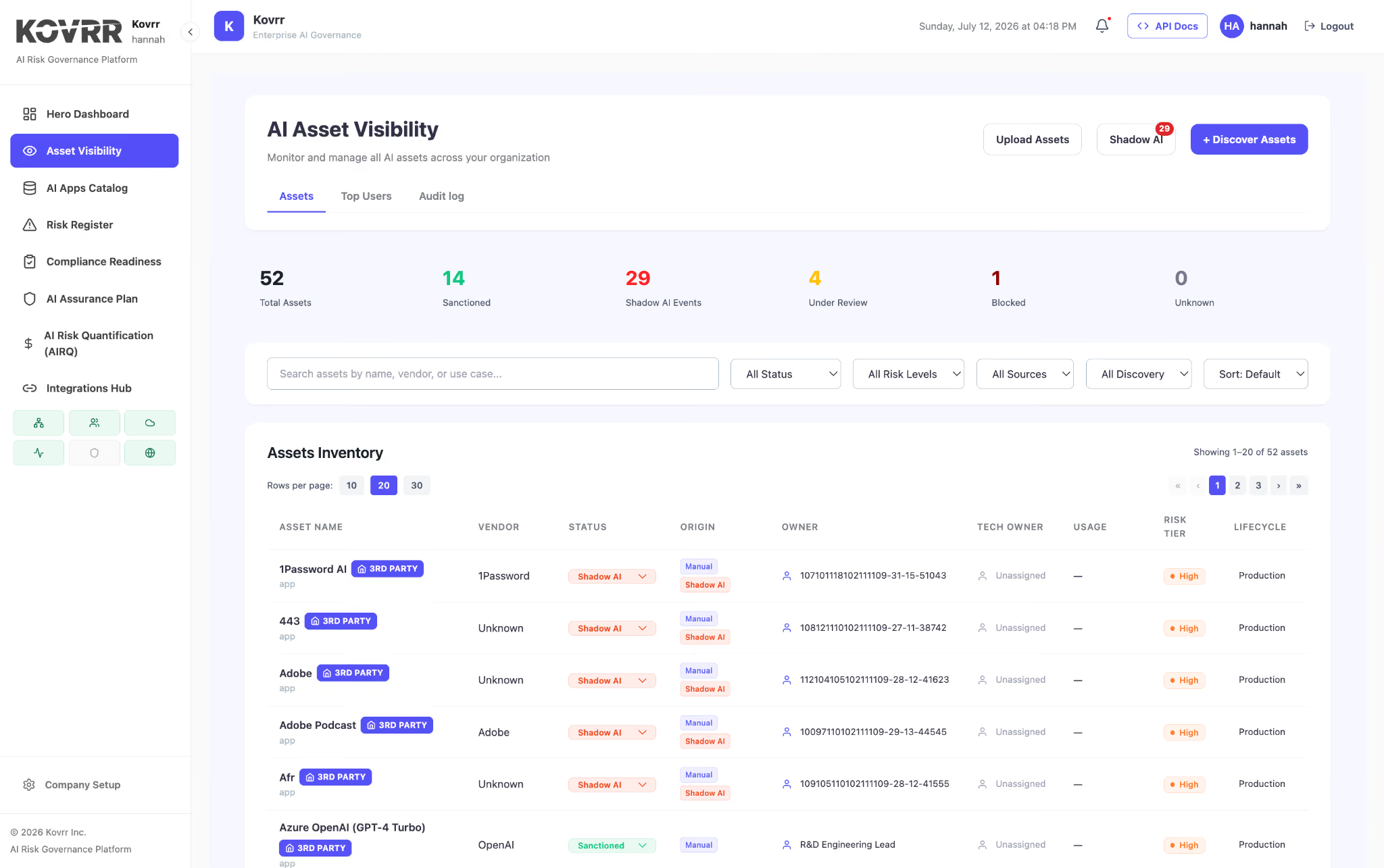
Shadow AI discovery is necessary but not sufficient. Detection that produces a list of unauthorized tools without connecting to risk assessment, compliance mapping, and enforcement creates awareness without action. The organizations that manage shadow AI effectively connect their detection infrastructure to a governance architecture that automates the response.
Kovrr's AI Security and Governance Platform is designed around this connected principle. When a new shadow AI tool is detected, the response flows through the governance architecture continuously and automatically:
- The tool is added to the AI asset inventory with metadata on the business unit, user, data interaction patterns, and risk classification
- The AI risk register updates with the relevant risk scenarios for that tool type, each scored for financial likelihood and impact
- The compliance readiness module checks the tool against applicable frameworks, including the EU AI Act, the NIST AI RMF, and ISO 42001, and flags any obligations
- The risk quantification engine (AIRQ) recalculates the organization's total AI exposure to reflect the newly discovered tool
That continuous loop from detection through governance is what separates a shadow AI discovery exercise from a shadow AI management program. For a deeper look at the risks shadow AI introduces and the financial exposure it creates, read shadow AI explained: what it is, where it hides, and what it costs.
Where Point Solutions Fall Short
Most shadow AI detection tools available today solve one piece of the problem well but leave the rest to manual processes. A dedicated AI security platform may detect which tools are in use but cannot quantify the financial exposure those tools create. A CASB may block data flow to unauthorized AI services but cannot map the compliance implications under the EU AI Act. A SaaS management platform may catalog AI applications but cannot score them against risk scenarios or connect them to a risk register.
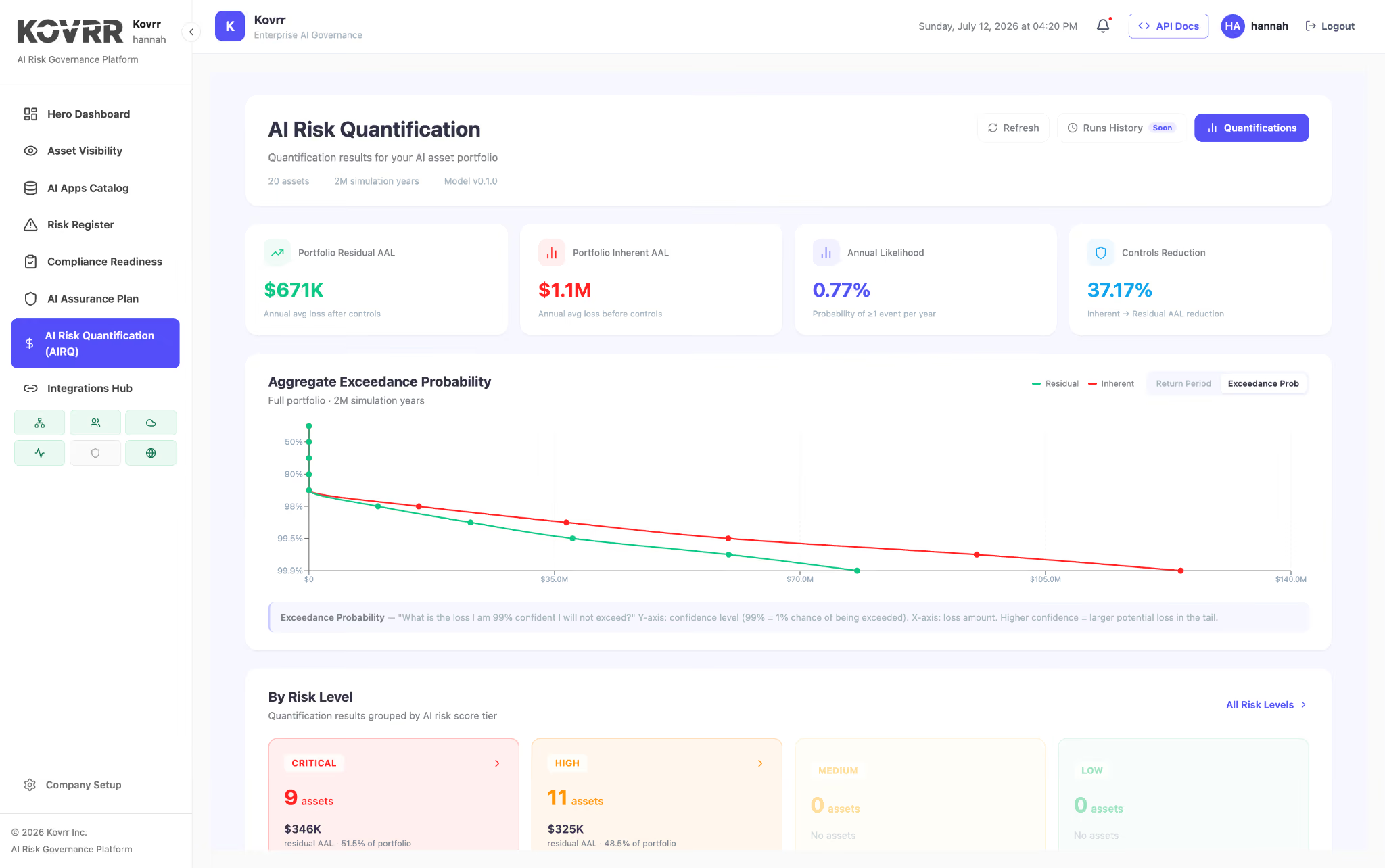
The result is that organizations using point solutions for shadow AI detection still face manual work to bridge detection and governance. They discover a tool, then manually assess its risk, manually check compliance implications, manually update the risk register, and manually report the exposure to leadership. Each manual step introduces delay, inconsistency, and the possibility that the information never reaches the people who need it to make decisions.
Connected platforms that automate the path from detection through risk quantification, compliance mapping, and reporting eliminate those manual handoffs. When the organization's AI exposure changes, every governance output updates simultaneously rather than waiting for someone to manually propagate the information.
Shadow AI Will Not Slow Down. Your Detection Program Needs to Keep Up.
Shadow AI is not a problem that a one-time discovery exercise resolves. New tools appear weekly, existing platforms add AI features through routine updates, and employees adopt and abandon AI tools continuously. The organizations that manage shadow AI effectively invest in detection infrastructure that runs continuously, feeds into a unified asset inventory, and connects directly to the governance workflows that turn visibility into risk reduction.
Point solutions that address one layer of detection, whether network monitoring, identity analysis, or DLP, leave gaps that shadow AI exploits. Connected platforms that layer browser-level telemetry with identity monitoring, network analysis, and enforcement provide the coverage needed to keep pace with how quickly AI is entering the enterprise.
Request a demo to see how continuous shadow AI discovery connects to risk quantification, compliance mapping, and active enforcement in a single governance architecture.

Monitor Shadow AI FAQs
Speak to an ExpertWhat is shadow AI, and why is it risky?

How common is shadow AI in enterprise environments?
Can CASBs and DLP tools detect all shadow AI?
What should organizations do when they discover shadow AI?
How does shadow AI relate to the EU AI Act?
How do you prevent shadow AI rather than just detecting it?