Blog Post
How Organizations Can Assess and Manage AI-Related Risks
July 15, 2026
Organizations assess and manage AI-related risks by establishing a cross-functional governance framework, mapping risks based on impact and financial likelihood, and instituting continuous monitoring that connects AI asset discovery to risk quantification, compliance, and enforcement. The most effective programs treat AI risk management not as a one-time assessment but as a continuous, data-driven discipline that evolves alongside the AI systems it governs.
The standard frameworks for AI risk management, including the NIST AI Risk Management Framework, the EU AI Act, and ISO 42001, all converge on a similar set of principles: identify AI systems in use, assess their risks, implement controls, monitor performance, and report to stakeholders. Where organizations diverge is in how deeply they operationalize those principles. The difference between a mature AI risk program and a compliance checkbox exercise comes down to whether the assessment process produces actionable, quantified insights or just documentation.
This guide walks through the full lifecycle of AI risk assessment and management, from initial discovery through financial quantification and board reporting, with practical guidance on how to build a program that scales.
Step 1. Discover and Inventory All AI Systems
Risk assessment starts with knowing what you are assessing. Most organizations significantly undercount the AI systems operating within their environment because discovery depends on manual processes that miss the fastest-growing categories of AI usage.
A complete AI inventory should include:
- Sanctioned AI tools approved through procurement and deployed by IT
- Shadow AI adopted by employees through free tiers, browser extensions, or personal accounts without IT involvement. Read more about shadow AI, where it hides, and what it costs.
- Embedded AI features activated within existing platforms like Microsoft 365, Google Workspace, Salesforce, and ServiceNow
- Third-party AI deployed by vendors in your supply chain that processes your data
- Autonomous AI agents that interact with internal systems, make decisions, or execute actions on behalf of users
Manual surveys and self-reporting are insufficient for building this inventory. Browser-level telemetry, endpoint monitoring, and network analysis provide the continuous, automated discovery that a credible risk assessment requires. Platforms such as Kovrr's AI Asset Visibility module provide real-time discovery of all AI tool categories listed above, feeding directly into the risk assessment workflow. For a deeper look at how discovery works, read what AI asset discovery is and why it matters for governance.
Step 2. Identify and Categorize AI Risk Scenarios
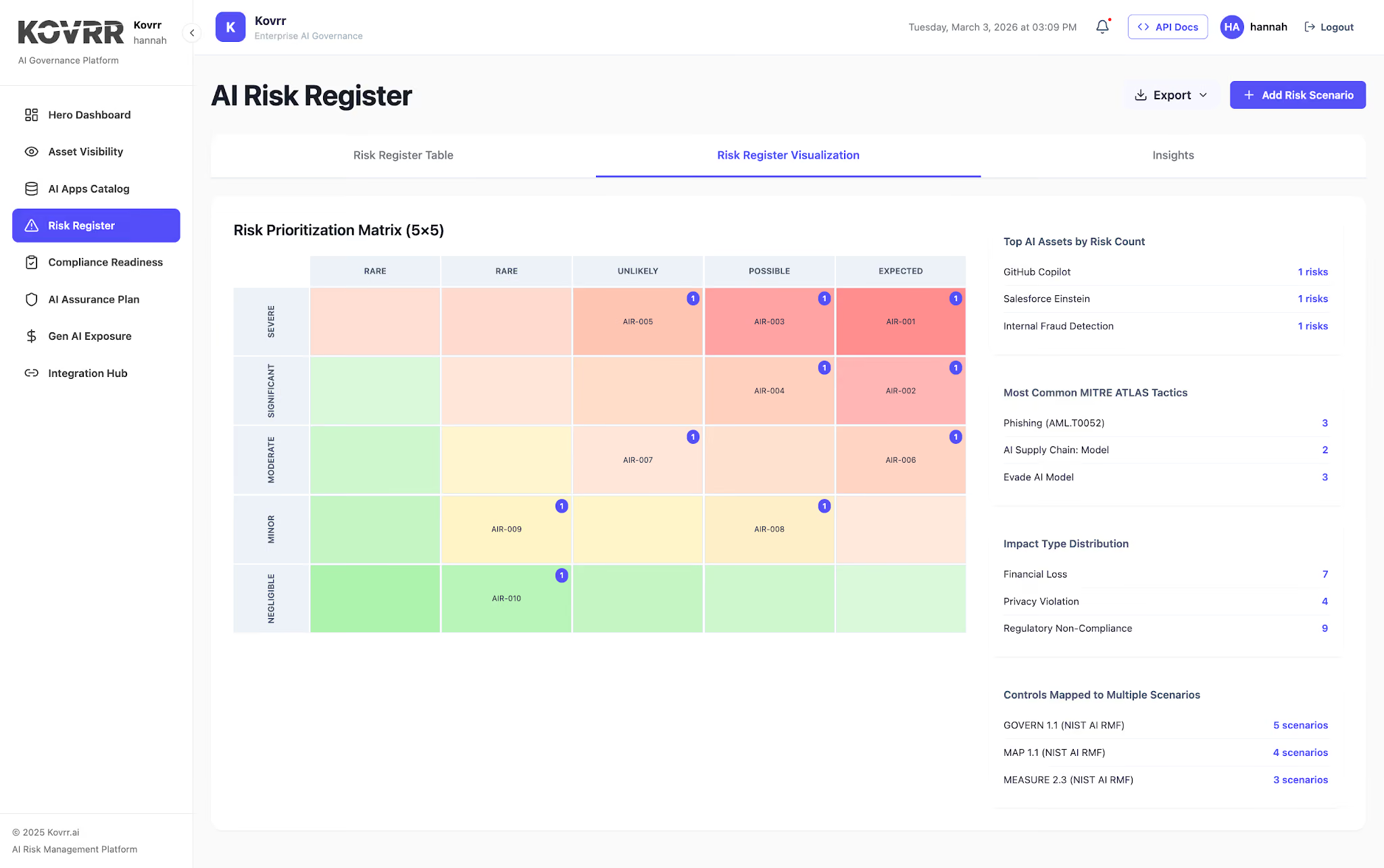
Once you know what AI systems are in use, the next step is identifying the specific risks each one introduces. AI-related risks fall into several categories that traditional enterprise risk frameworks may not cover adequately:
- Technical risks. Model errors, hallucinations, bias in outputs, data poisoning, prompt injection attacks, and performance degradation over time (model drift)
- Data risks. Unauthorized data exposure through AI tools, training data contamination, privacy violations when sensitive data is processed by third-party AI services, and data residency violations
- Regulatory risks. Non-compliance with the EU AI Act, NIST AI RMF, ISO 42001, GDPR, and sector-specific regulations. The EU AI Act in particular imposes strict requirements on high-risk AI systems, with enforcement deadlines approaching in 2026 and 2027
- Operational risks. Business process failures caused by AI-dependent workflows, loss of human oversight, and unintended actions by autonomous AI agents
- Third-party risks. Vendors embedding AI into products that process your data without adequate controls, and supply chain exposure from AI models you did not evaluate or approve
- Reputational risks. Public-facing AI systems producing harmful, inaccurate, or discriminatory outputs
The most effective approach is a scenario-based risk register that catalogs specific AI risk events, assigns each one an owner, scores it for likelihood and impact, and tracks mitigation progress over time. An AI risk register built on scenario-based methodology breaks abstract AI risk into concrete, actionable items that risk teams can manage the same way they manage cyber and operational risk scenarios.
Step 3. Quantify AI Risk in Financial Terms
Qualitative risk assessments that label AI risks as "high," "medium," or "low" give governance teams a starting point but do not provide the precision needed for resource allocation, board reporting, or comparison with other enterprise risks. The step that separates mature AI risk programs from early-stage ones is financial quantification.
AI risk quantification translates scenario-based risk assessments into dollar-value estimates using insurance-grade modeling. For each risk scenario in the register, quantification produces defensible figures for potential loss amounts, likelihood distributions, and annualized loss expectancy. This financial language makes AI risk directly comparable to cyber risk, operational risk, and other categories the board already understands.
Quantification also enables prioritization. When resource-constrained security and risk teams need to decide which AI risks to mitigate first, financial impact provides an objective ranking that qualitative labels cannot. A risk scored as "high" on a qualitative matrix might represent a $50,000 exposure or a $5 million exposure. Those two scenarios require fundamentally different responses, and only quantification tells you which is which.
According to Palo Alto Networks, the foundation of any AI risk management framework is the ability to identify and assess potential risks. Financial quantification builds on that foundation by translating assessment outputs into the business-relevant metrics that drive decisions.
Step 4. Align with Regulatory Frameworks
Regulatory compliance is one of the primary drivers for AI risk management programs, and the framework landscape is expanding rapidly. Organizations need to map their AI inventory and risk assessments against applicable regulations and standards.
The major frameworks organizations are aligning to include:
- EU AI Act. The most comprehensive AI regulation globally, with requirements for risk classification, conformity assessments, transparency obligations, human oversight, and ongoing monitoring of high-risk AI systems. Kovrr's automated EU AI Act compliance module maps enterprise artifacts directly to regulatory articles, producing audit-ready documentation. Learn more about what data is required for EU AI Act compliance.
- NIST AI Risk Management Framework (AI RMF). A voluntary framework from the National Institute of Standards and Technology that organizes AI risk management into four functions: Govern, Map, Measure, and Manage. NIST AI RMF is widely referenced by U.S. organizations and increasingly by international enterprises seeking a structured approach.
- ISO 42001. An international standard for AI management systems that specifies requirements for establishing, implementing, maintaining, and continually improving AI governance within organizations.
- GDPR and data protection regulations. AI systems that process personal data must comply with data protection laws, including requirements for data minimization, purpose limitation, and automated decision-making transparency.
- Sector-specific frameworks. Financial services organizations face additional requirements from regulators like the Monetary Authority of Singapore (MAS), DORA in the EU, and emerging guidelines from U.S. banking regulators.
The key to effective compliance is automation. Manual compliance assessments are time-consuming, error-prone, and outdated the moment a new AI system is deployed. AI compliance readiness platforms that continuously map your AI inventory against applicable frameworks reduce audit preparation time and ensure that compliance status updates automatically as your AI environment changes.
Step 5. Implement Controls and Active Enforcement
Risk identification and assessment are only valuable if they lead to control implementation. AI risk controls fall into two categories: preventive controls that stop risky behavior before it occurs, and detective controls that identify issues after the fact.
Preventive controls include:
- Input/output guardrails that filter harmful, sensitive, or non-compliant content flowing into and out of AI systems
- Browser-level enforcement that blocks access to prohibited AI tools or restricts data uploads to unapproved platforms
- AI agent monitoring that applies adaptive policies to autonomous AI systems operating within the enterprise
- Enterprise AI licensing that standardizes employees on approved platforms where usage is logged, and policies are enforced
- Human-in-the-loop requirements for high-risk AI decisions, ensuring that automated outputs are reviewed before action is taken
Detective controls include:
- Continuous model performance monitoring to detect bias, drift, and degradation
- Anomaly detection through user behavior analytics that flags unusual AI usage patterns
- Audit logging of all AI interactions, including prompt content, data accessed, and outputs generated
- Regular penetration testing and red-teaming of AI systems to identify vulnerabilities before they are exploited
The most effective control architectures connect detection to prevention in a continuous loop. When monitoring identifies a new risk, such as a previously unknown AI tool discovered through browser telemetry, the control framework should automatically update the risk register, recalculate financial exposure through risk quantification, and apply the relevant enforcement policy without manual intervention.
Step 6. Establish Governance Roles and Accountability
AI risk management requires cross-functional collaboration that spans security, IT, legal, compliance, data science, and business leadership. Organizations with effective programs assign explicit governance roles:
- AI Governance Committee or Board. A cross-functional body that sets AI risk policy, defines risk appetite, and reviews risk posture at regular intervals
- AI Risk Owners. Individuals accountable for specific AI risk scenarios in the risk register, responsible for driving mitigation and reporting on status
- AI Compliance Officer. A role responsible for monitoring regulatory developments, mapping organizational practices to applicable frameworks, and coordinating audit preparation. Read more about ensuring institutional AI ownership with the AI compliance officer
- Technical AI Reviewers. Data scientists and engineers responsible for evaluating model performance, testing for bias and vulnerabilities, and validating control effectiveness
The governance structure should be documented and integrated into the organization's broader enterprise risk management (ERM) framework. AI risk should not exist as a siloed program. It should feed into the same risk reporting, escalation, and decision-making processes that the organization uses for cyber risk, financial risk, and operational risk. Learn more about integrating AI risk into enterprise risk frameworks.
Step 7. Report AI Risk to Executives and the Board
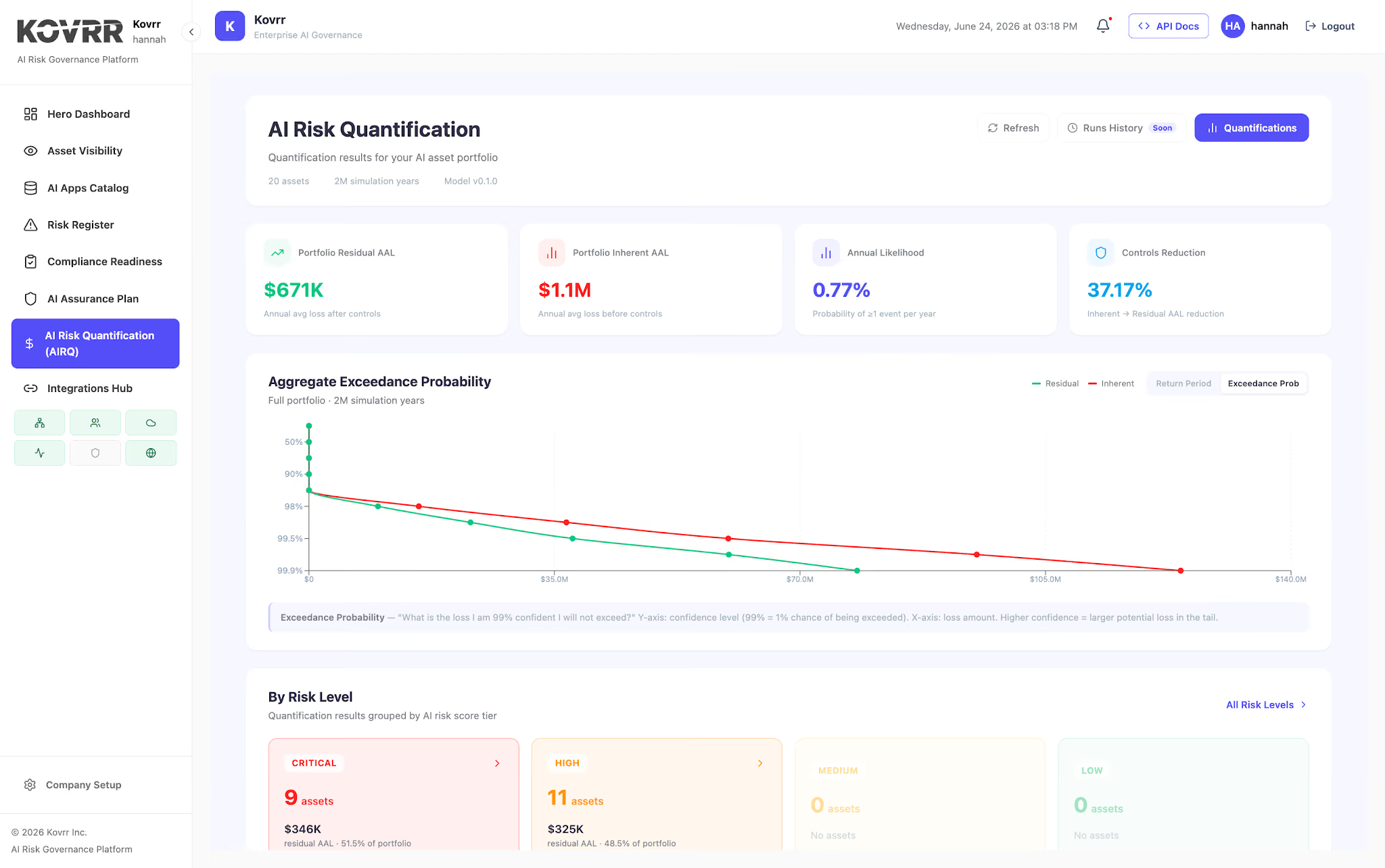
Board-level AI risk reporting should translate technical assessments into financial and strategic terms. Executives do not need a list of every AI tool in the enterprise or a detailed breakdown of model performance metrics. They need answers to three questions: how much financial exposure does AI create, is the organization compliant with applicable regulations, and is the risk posture improving or deteriorating over time.
Effective board reporting on AI risk includes:
- Quantified financial exposure expressed as annualized loss expectancy and worst-case scenario estimates, produced by insurance-grade risk quantification models
- Compliance readiness status against applicable frameworks, showing which requirements are met, which have open gaps, and projected remediation timelines
- Trend data showing how AI asset inventory, risk exposure, and control effectiveness are changing quarter over quarter
- Sanctioned vs. unsanctioned AI usage as a percentage, giving the board a single metric for governance coverage
- Comparison to cyber and operational risk using common financial language, so the board can allocate resources across risk categories based on relative exposure
For deeper guidance, read Communicating AI Risk to the Board.
The Bottom Line on Assessing and Managing AI Risk
Assessing and managing AI-related risks is a continuous, cross-functional discipline that requires organizations to move past qualitative risk labels and into quantified, financially grounded risk management. The organizations that will navigate AI risk effectively are those that connect every step of the lifecycle, from asset discovery through risk quantification, compliance mapping, active enforcement, and board-level reporting, in a single, continuously updated system.
The standard frameworks provide the structure. The difference is in how deeply your organization operationalizes them. Schedule a demo to see how a connected, quantified approach to AI risk management works in practice.
Managing AI-Related Risks FAQs
Speak to an ExpertWhat is the NIST AI Risk Management Framework, and how does it help organizations assess AI risks?

How do you quantify AI risk in financial terms?
What are the biggest AI risks organizations face today?
How often should organizations reassess AI risks?
What is the difference between AI risk assessment and AI risk management?
How does AI risk management connect to enterprise risk management (ERM)?