
Blog Post
What AI Governance Tools Exist in the Market Today
July 13, 2026
AI governance tools are software platforms designed to help organizations manage AI risks, ensure regulatory compliance, and enforce responsible AI use across the machine learning lifecycle. The market has expanded rapidly, and in 2026 it includes tools spanning compliance automation, model observability, data governance, infrastructure security, and integrated risk quantification. Choosing the right tool depends on what problem you are solving first, whether that is regulatory readiness, shadow AI prevention, model performance monitoring, or translating AI exposure into financial terms the board can act on.
This guide breaks down the major categories of AI governance tools available today, names the leading vendors in each category, and explains what capabilities enterprises should prioritize when evaluating platforms. It also highlights where most tools fall short and where the market is heading.
How the AI Governance Tool Market Is Structured
AI governance tools are not a single product category. They span at least five functional areas, and most vendors specialize in one or two of them rather than covering the full spectrum. Understanding these categories is essential for selecting tools that match your organization's maturity and priorities.
The five primary categories are:
- Compliance and risk management platforms that handle policy enforcement, risk assessment, and regulatory mapping
- AI observability and monitoring tools that provide runtime transparency, bias detection, and model performance tracking
- Data-centric governance platforms that manage the data layer underlying AI systems, including data lineage, cataloging, and access controls
- Infrastructure and security tools that focus on stopping shadow AI, securing AI supply chains, and establishing guardrails at the infrastructure level
- Connected AI governance and risk quantification platforms that unify asset discovery, risk quantification, compliance mapping, and active enforcement in a single architecture
Most enterprises will need capabilities from multiple categories. The question is whether you assemble a stack of point solutions or invest in a platform that connects these functions natively.
Category 1: Compliance and Risk Management
These tools focus on policy enforcement, risk assessment, and mapping AI systems to regulatory frameworks like the NIST AI RMF, EU AI Act, and ISO 42001.
Credo AI is one of the more established vendors in this space, focusing on policy-driven compliance and regulatory mapping. Credo AI helps organizations create governance policies, assess AI models against those policies, and generate compliance documentation. It is strongest in organizations that need structured policy management and audit trails for responsible AI programs.
IBM watsonx.governance provides an enterprise-scale platform that connects AI risk management to broader GRC (Governance, Risk, and Compliance) programs. IBM's approach integrates AI lifecycle management with its existing enterprise software ecosystem, making it a natural fit for organizations already running IBM infrastructure. The platform covers model validation, bias detection, and regulatory alignment.
Holistic AI offers independent AI auditing, risk tiering, and compliance assessments. Holistic AI positions itself as a third-party evaluator rather than an in-house governance tool, which makes it useful for organizations that need external validation of their AI systems or an unbiased risk assessment they can present to regulators.
OneTrust AI Governance integrates AI risk and assessments directly into existing privacy and GRC workflows. OneTrust is particularly strong for organizations that already use its privacy management tools and want to extend their existing GRC infrastructure to cover AI. According to Gartner's 2026 reviews, OneTrust is among the top-rated platforms in the AI governance category.
Where compliance tools fall short. Most compliance-focused tools excel at documentation and policy management but do not provide continuous discovery of AI assets, real-time enforcement at the point of use, or financial quantification of AI risk exposure. They tell you whether your known AI systems are compliant but may not catch AI tools you do not know about.
Category 2: AI Observability and Monitoring
These tools operate closer to the technical infrastructure, providing runtime transparency, tracking model performance, and detecting issues like biases or "drift" in production AI systems.
Fiddler AI is a widely used platform for real-time model monitoring, explainability, and bias detection. Fiddler provides dashboards that help ML teams understand why models produce specific outputs and flag performance degradation before it impacts business outcomes.
Arthur AI focuses on full-lifecycle model monitoring for both traditional machine learning and generative AI. Arthur covers model validation, performance tracking, and anomaly detection across the entire model lifecycle from development through production.
Arize AI specializes in LLM tracing, evaluation, and resolving root causes of poor model performance. As generative AI workloads have grown, Arize has become a go-to tool for teams running large language models that need detailed observability into prompt behavior, token usage, and output quality.
Where observability tools fall short. Model monitoring platforms are essential for ML engineering teams, but they operate at the model level rather than the organizational level. They do not typically handle AI asset discovery across business units, regulatory compliance mapping, vendor risk management, or financial risk quantification. An organization can have excellent model observability while still having no visibility into which AI tools employees are using outside of sanctioned systems.
Category 3: Data-Centric Governance
Before governing models, organizations must govern the underlying data. These platforms extend traditional data governance into the AI era by managing data lineage, access controls, and metadata pipelines.
Microsoft Purview is the strongest option for organizations operating within the Microsoft 365 and Azure ecosystem. Purview provides AI governance capabilities for securing AI components within Microsoft's cloud, preventing shadow AI usage through data loss prevention policies, and managing access to AI services at the tenant level.
Collibra AI Governance connects AI governance with enterprise data catalogs and data lineage tracking. Collibra's strength is in organizations with complex data environments where understanding what data feeds which AI models is a primary concern.
Alation helps organizations discover, classify, and track metadata pipelines feeding AI applications. Alation is particularly useful for data teams that need to ensure AI systems are trained on governed, high-quality data sources.
Where data-centric tools fall short. Data governance platforms address an important layer of the AI governance stack, but they focus primarily on the inputs to AI systems rather than the outputs, risks, and organizational usage patterns. They typically do not provide AI-specific risk registers, financial risk quantification, or enforcement at the point where employees interact with AI tools.
Category 4: Infrastructure and Security
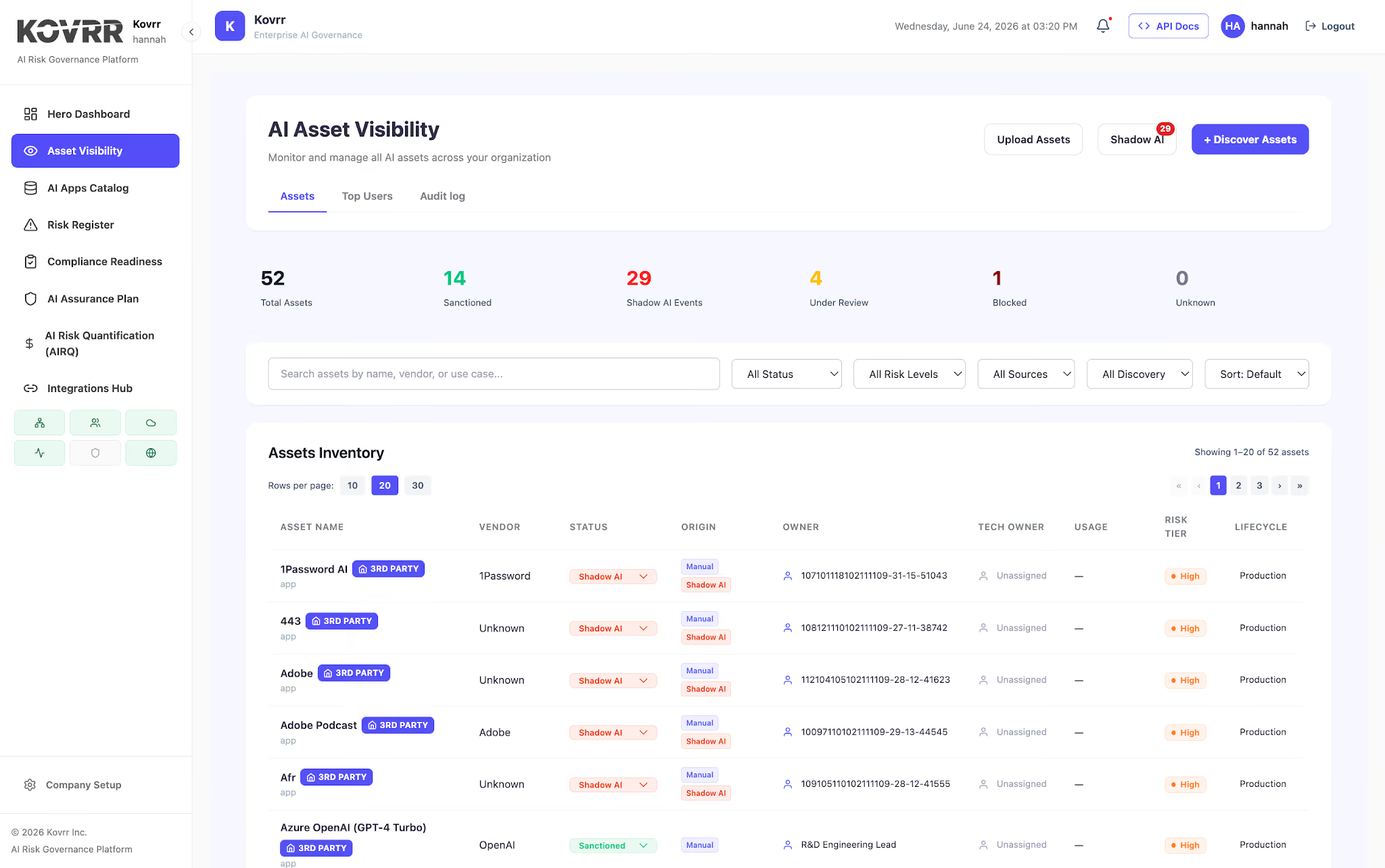
These platforms prioritize stopping shadow AI, securing AI supply chains, and establishing infrastructure-level guardrails that prevent unauthorized AI usage.
Bifrost by Maxim AI acts as an infrastructure-level centralized AI gateway for access management, audit logging, and quality evaluations. Bifrost sits between users and AI services to enforce policies before requests reach the model, making it useful for organizations that want to control AI access at the network layer.
Legit Security / Apiiro focuses on securing the application and software supply chain when building AI-integrated applications. Legit Security is most relevant for development teams that need to ensure AI components embedded in their software products are secure and traceable.
Mend AI provides AI governance visibility by securing AI components across an organization's existing technology stack, with a focus on identifying and remediating vulnerabilities in AI-related code and dependencies.
Where infrastructure tools fall short. Security-focused AI governance tools are strong at preventing unauthorized access and securing the technical layer, but they generally do not address compliance documentation, financial risk modeling, board-level reporting, or the operational governance workflows that risk and compliance teams need.
Category 5: Connected AI Governance and Risk Quantification Platforms
A newer class of AI governance tools takes a fundamentally different approach by connecting asset discovery, risk quantification, compliance mapping, and active enforcement in a single, continuous architecture. Rather than solving one piece of the governance puzzle, these platforms aim to provide a unified view that spans all four categories above.
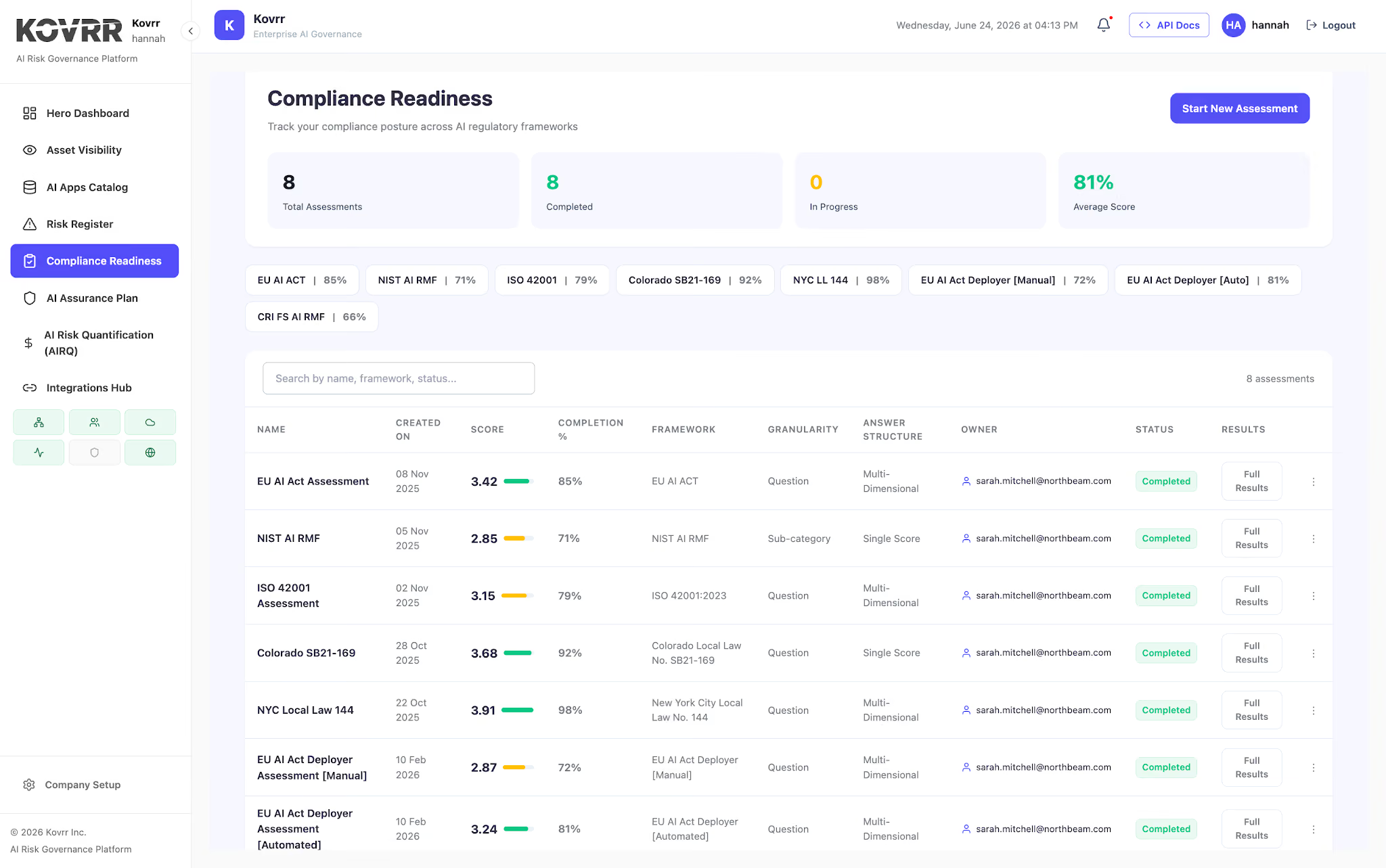
Platforms such as Kovrr's AI Security and Governance Platform represent this connected approach. Kovrr's platform integrates several capabilities that do not exist in other governance tool categories:
- AI Asset Visibility. Continuous, real-time discovery of all sanctioned, shadow, and third-party AI systems across the enterprise, powered by browser-level telemetry and endpoint monitoring. Learn more about why AI asset discovery matters for governance.
- AI Risk Quantification (AIRQ). Insurance-grade financial modeling that translates AI risk scenarios into defensible dollar-value estimates. No other governance tool category provides this capability. AIRQ enables boards and executives to compare AI risk against other enterprise risks using the same financial language.
- AI Risk Register. A scenario-based risk register that catalogs AI-specific risks such as prompt injection, data poisoning, and agent privilege misuse, with each scenario scored for likelihood and financial impact.
- AI Compliance Readiness. Automated compliance assessment against the EU AI Act, NIST AI RMF, and other frameworks, including automated evidence collection that maps enterprise artifacts directly to regulatory articles.
- AI Vendor Risk Catalog. A catalog of 18,000+ AI vendors with risk profiles, enabling organizations to assess third-party AI exposure at scale.
- Active enforcement. Browser-level policy enforcement and AI agent monitoring that reduces risk at the moment of use, not after the fact.
The core differentiator of connected platforms is that when one function detects something new, such as a previously unknown AI tool appearing through browser telemetry, every other function updates automatically. The risk register adds the relevant scenarios. The AIRQ engine recalculates financial exposure. The compliance module checks the tool against applicable frameworks. The enforcement layer applies the relevant policy. That continuous loop eliminates the manual handoffs and data silos that plague organizations using separate tools for each function.
How to Evaluate AI Governance Tools for Your Organization
Selecting the right AI governance tools requires matching capabilities to your organization's specific risk profile, regulatory obligations, and maturity level. The following evaluation criteria can help narrow the field:
- Coverage scope. Does the tool address only one governance function (e.g., model monitoring) or does it connect multiple functions (discovery, compliance, risk quantification, enforcement)? Organizations early in their AI governance journey may start with a single category, but those with mature programs will benefit from connected platforms that reduce integration complexity.
- Discovery capabilities. Can the tool discover AI systems you do not already know about? Tools that only govern known, sanctioned AI systems leave a massive blind spot. Shadow AI discovery through browser telemetry, network monitoring, or endpoint analysis is increasingly essential.
- Regulatory alignment. Does the tool support the specific frameworks your organization must comply with? The EU AI Act, NIST AI RMF, ISO 42001, and DORA all have different requirements. Look for tools that automate compliance mapping and evidence collection rather than relying on manual assessments.
- Financial quantification. Can the tool translate AI risk into financial terms? Board-level reporting requires more than compliance checklists. Financial modeling that produces defensible loss estimates helps executives compare AI risk against other enterprise risks and allocate budgets accordingly. Read more about communicating AI risk to the board.
- Active enforcement. Does the tool stop risky behavior at the point of use, or does it only report on it after the fact? Browser-level enforcement, AI agent monitoring, and real-time policy application are becoming table stakes for organizations with significant AI exposure.
- Integration with existing infrastructure. Does the tool connect to your current GRC stack, SIEM, CASB, and endpoint detection platforms? AI governance should enrich existing workflows rather than creating a parallel monitoring stack.
- Third-party AI visibility. Does the tool monitor AI embedded in your vendor ecosystem? Most governance tools focus on internally deployed AI and miss the significant risk surface created by third-party AI.
The Bottom Line on AI Governance Tools
The AI governance tool market in 2026 is broad but fragmented. Most tools specialize in one or two governance functions, whether that is compliance documentation, model monitoring, data lineage, or infrastructure security. Organizations that rely on point solutions face the challenge of stitching together capabilities across vendors and manually bridging the data and workflow gaps between them.
The most significant development in the market is the emergence of connected platforms that unify AI asset discovery, risk quantification, compliance automation, and active enforcement in a single architecture. These platforms eliminate the manual handoffs that slow down governance programs and provide a continuous, real-time view of AI risk that point solutions cannot match.
For enterprises evaluating AI governance tools, the priority should be selecting a platform that matches your most pressing need today while providing a path to connected governance as your program matures. Schedule a demo to see how a unified approach works in practice.

AI Governance Tools FAQs
Speak to an Expert What is the difference between AI governance tools and traditional GRC platforms?

Do I need multiple AI governance tools, or can one platform cover everything?
Which AI governance tools help with EU AI Act compliance?
What is AI risk quantification, and which tools offer it?
How do AI governance tools detect shadow AI?
Are open-source AI governance tools available?