
Blog Post
What Tools Help Build and Maintain an AI Asset Inventory?
July 9, 2026
Managing an artificial intelligence (AI) footprint has emerged as one of the most complex challenges for modern enterprise security and risk teams. As shadow AI, autonomous agents, and embedded third-party models infiltrate corporate environments, traditional methods of software tracking have broken down. Organizations are quickly realizing that maintaining an accurate inventory is not just an IT best practice. On the contrary, it is the regulatory and operational baseline for all AI security and compliance efforts.
To build a defensible AI governance program, enterprises must move past manual, spreadsheet-driven methods and deploy dedicated technical tools. This article analyzes the current technology landscape, evaluates the core categories of tools capable of building an AI asset inventory, and details the structural requirements needed to transform raw discovery signals into audit-ready governance.
Defining the Foundation: What Is an AI Asset Inventory?
Before evaluating the tool market, it is necessary to establish a precise technical baseline for what an AI inventory platform must actually produce. An AI asset inventory is a centralized, dynamic repository that catalogs every artificial intelligence system, model, component, API, and autonomous workflow operating within or interacting with an enterprise environment.
To satisfy the stringent demands of modern risk management, an enterprise-grade AI asset inventory must capture more than a basic list of application names. It must continuously maintain rich metadata for every discovered asset, including:
- Classification and Risk Tiering: Identifying where the asset falls under frameworks and regulations like the EU AI Act (e.g., Unacceptable, High, Minimal Risk) or internal security classifications.
- Data Lineage and Sensitivity: Tracking what corporate data categories (PII, intellectual property, financial records) flow into or out of the model.
- Operational Dependencies: Mapping the complete AI Bill of Materials (AI-BOM) to understand connections between internal apps, third-party APIs, and model orchestration layers.
- Accountability and Ownership: Assigning clear, auditable technical and business owners alongside defined escalation paths.
Categorizing the AI Asset Inventory Tool Landscape
The market for managing AI infrastructure has split into several distinct tool categories. Each approach views the AI footprint through a different operational lens, whether from an engineering, procurement, or compliance standpoint.
Understanding how these categories differ is essential for selecting an architecture that satisfies both security teams and corporate boards.
1. Compliance and Governance (GRC) Platforms
Traditional Governance, Risk, and Compliance (GRC) tools and dedicated compliance-focused platforms prioritize policy alignment and risk-tiering workflows.
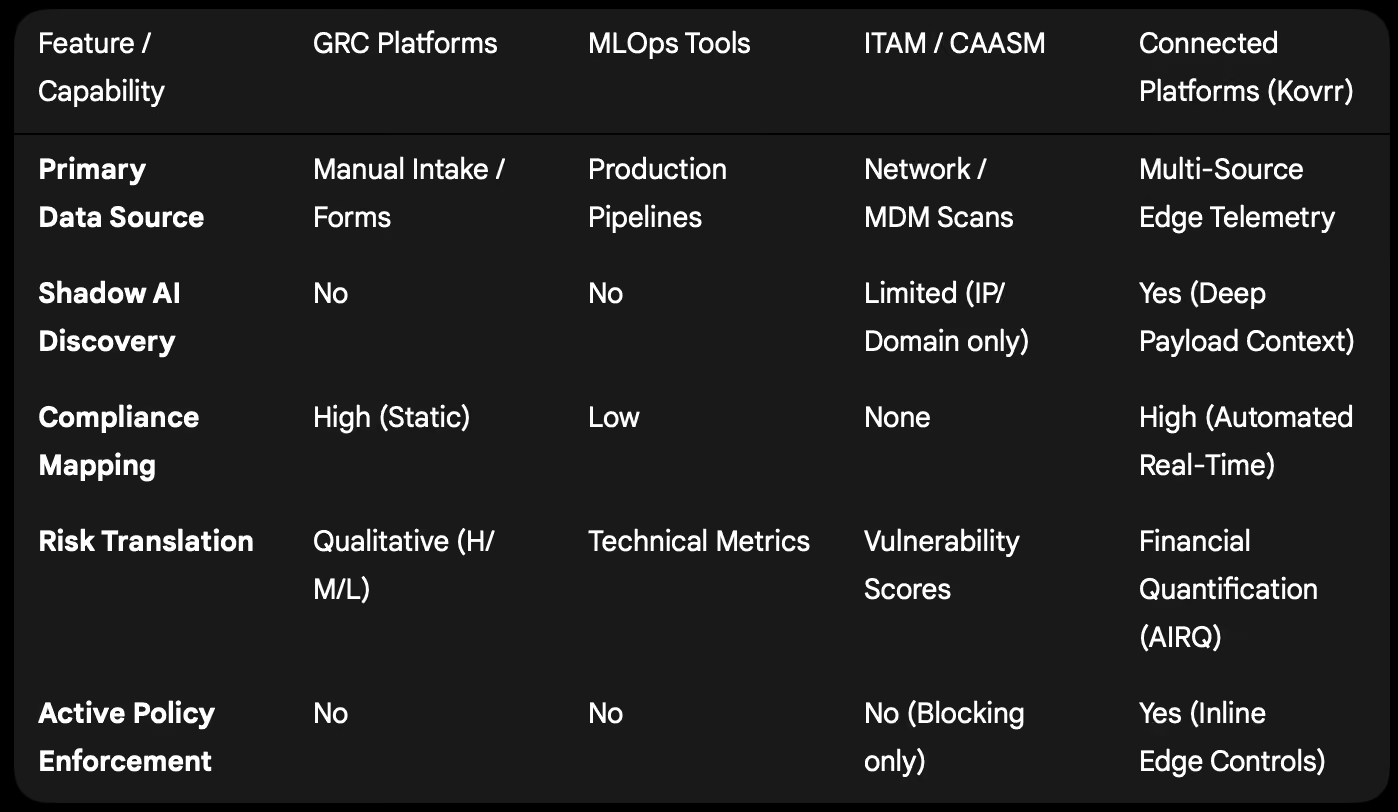
- How They Work: These platforms rely heavily on structured intake workflows, policy catalogs, and automated vendor questionnaires. Before a department deploys a new AI model, a developer must complete a risk assessment form covering data sources, intended users, and potential harms.
- The Limitation: While exceptional for mapping regulatory requirements (like NIST AI RMF or ISO 42001) and documenting manual sign-offs, traditional GRC tools are fundamentally passive. They cannot verify if an unapproved tool is currently being accessed at the browser edge, nor can they capture real-time telemetry.
2. MLOps and Model Observability Tools
Born within data science and machine learning engineering teams, MLOps tools focus strictly on the production lifecycle of internally developed models.
- How They Work: These systems monitor active software pipelines, tracking technical telemetry such as feature drift, prediction distributions, latency, and system degradation. They excel at building highly technical model cards and mapping algorithmic dependencies.
- The Limitation: MLOps tools are completely blind to corporate consumption. They do not see shadow AI web interactions occurring across marketing, sales, or legal teams. Furthermore, they fail to translate engineering vulnerabilities into broader business or financial risk metrics.
3. ITAM and CAASM Infrastructure
IT Asset Management (ITAM) and Cyber Asset Attack Surface Management (CAASM) tools are the traditional defensive workhorses of the corporate IT estate.
- How They Work: These solutions scan networks, endpoints, and cloud infrastructure to inventory active devices, software executables, and cloud instances.
- The Limitation: Legacy asset management tools are built to track static entities like servers and local software packages. They are structurally incapable of parsing fluid, API-driven generative tool interactions, hidden prompts, or the behavioral risk profiles of autonomous AI agents.
4. Connected AI Security & Governance Platforms
Representing the modern evolution of the market, connected platforms unify active security enforcement with passive governance infrastructure.
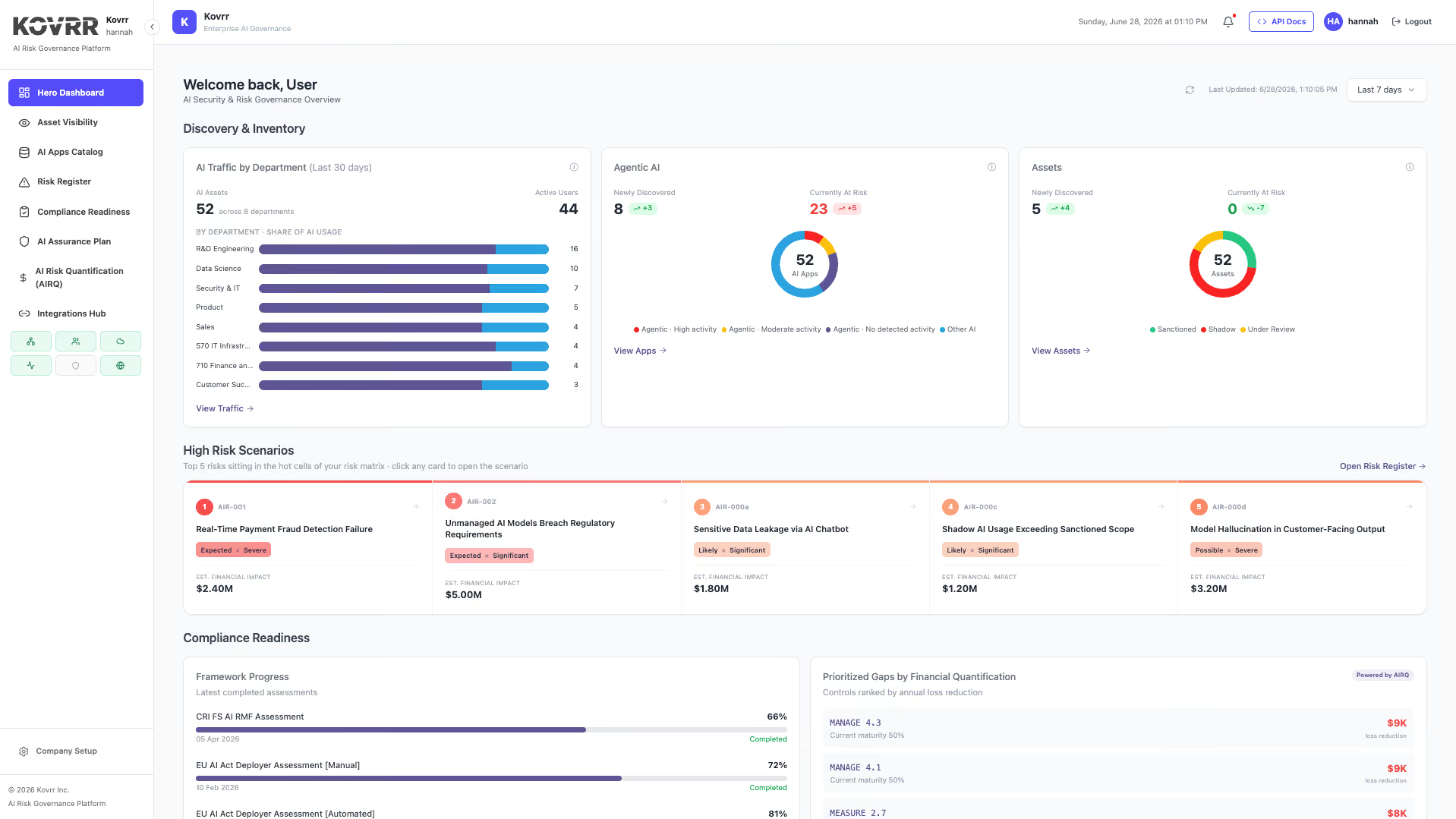
- How They Work: Rather than isolating discovery from compliance, these architectures ingest real-time multi-source telemetry from browser edges, endpoint signals, and network logs. They stream this active data directly into a centralized asset inventory, automatically updating risk registers and frameworks.
- Why They Differ: This category bridges the technical execution layer with the compliance layer. Kovrr’s AI Governance and Security Platform, for example, operates within this space, ensuring that an active control event, such as a user accessing an unsanctioned tool via a browser, instantly and automatically recalculates corporate risk exposure and regulatory compliance postures.
Comparative Matrix: Comparing AI Inventory Approaches
Architectural Checklist: Critical Capabilities of an AI Inventory Tool
When evaluating enterprise solutions to build an inventory and maintain your AI asset visibility, the platform must satisfy three non-negotiable technical criteria:
Continuous, Multi-Source Telemetry
AI adoption operates at machine speed; a developer can tie a core business workflow to a third-party LLM API over a weekend. A tool that relies on periodic network scans or monthly manual reviews creates massive visibility gaps. The platform must continuously ingest data from multiple observation points simultaneously, and most importantly, at the browser edge where human-AI interactions occur.
Dynamic, No-Code Automation
The inventory must function as a self-healing system. When a new shadow AI utility is detected at an endpoint, the platform should automatically create the asset profile, flag its data-sharing permissions, update the centralized risk register, and adjust the organization's compliance readiness maps without requiring a GRC analyst to manually reconcile data sources.
Edge-Level Policy Enforcement
An effective inventory tool cannot simply act as a passive spectator. To prevent material data exposure, discovery must happen in tandem with inline, endpoint-level enforcement. The platform must possess the capability to read prompt data categories locally and apply adaptive controls (such as warn-and-proceed gates) before sensitive assets are transmitted to external servers.
The Connected Architecture Solution: How Kovrr Reinvents the AI Inventory
Kovrr’s AI Security and Governance Platform addresses the core flaw of the current market: the absolute fragmentation of discovery, risk management, and financial reporting tools. Rather than treating the AI asset inventory as a static database, Kovrr embeds it as the engine driving a continuous, connected lifecycle.
Endpoint Telemetry to Live Inventory
The process begins natively at the point of interaction. Kovrr Browser Protect deploys seamlessly via MDM across all corporate browsers. It monitors active prompts locally, using deterministic pattern matching to intercept sensitive enterprise data categories before they leave the endpoint. Every interaction automatically feeds telemetry back to Kovrr's AI Asset Visibility layer, updating the live, centralized inventory of sanctioned, shadow, and third-party embedded models.
Automating the GRC and Risk Register Loop
When an asset profile updates within the inventory, that change cascades across the enterprise risk posture instantly. The discovered asset is immediately evaluated against frameworks within Kovrr's AI Compliance Readiness tool, automatically assigning artifacts and evidence to specific compliance controls. This eliminates manual audit cycles and keeps the corporate risk register continuously validated.
Insurance-Grade Financial Modeling (AIRQ)
Kovrr bridges the gap between technical discovery and executive oversight through its AI Risk Quantification (AIRQ) engine. Drawing on Kovrr’s extensive heritage in cyber risk quantification, AIRQ maps the live state of the AI inventory against insurance-grade financial loss models.
Technical threats, such as training data poisoning, model manipulation, or regulatory non-compliance penalties, are converted into clear business metrics: expected annual loss, worst-case exposure scenarios, and exceedance probability curves. Boards can then prioritize security controls based on precise financial weight rather than subjective, color-coded matrices.
The Regulatory Deadline Mandate (2026–2027)
The transition to automated AI inventory tools is accelerated by rigid global compliance timelines that treat manual spreadsheet tracking as an explicit regulatory violation. Under the finalized roadmap of the EU AI Act, compliance obligations scale rapidly over the next 18 months:
- August 2, 2026: Strict, legally binding high-risk system obligations (Annex III) take effect, requiring comprehensive documentation, risk management systems, and validated logs.
- December 2, 2026: Mandatory provider transparency rules and cryptographic AI content watermarking requirements apply under Article 50(2).
- December 2, 2027: Full enforcement of compliance mandates for standalone high-risk systems across the entire European market.
Platforms that automate evidence collection directly from live asset inventories are the only viable path to maintaining continuous compliance across these milestones.
Beyond Static Inventories
Building a resilient AI governance program requires accepting a simple operational truth: an AI asset inventory is only as valuable as the technical telemetry that feeds it and the business applications that utilize it. Siloed GRC spreadsheets, blind infrastructure scans, and disconnected engineering tools are no longer sufficient to protect the enterprise footprint.
By deploying a connected platform architecture that unifies active edge enforcement, automated inventory updates, and insurance-grade financial risk quantification, organizations can confidently maximize the benefits of AI innovation. Platforms like Kovrr transform the AI asset inventory from a passive compliance checklist into a dynamic, defensive engine built for executive decision-making.
Request a personalized demo today to see how continuous asset visibility, edge-level data protection, and AIRQ work together within a single connected architecture.

Building an AI Asset Inventory FAQs
Speak to an ExpertWhat makes an AI asset inventory different from a traditional IT asset inventory?

Why are manual spreadsheets a compliance liability for AI tracking?
How do connected AI governance tools discover third-party embedded AI?
What role does an AI asset inventory play in passing an EU AI Act audit?
How does Kovrr connect the asset inventory to financial reporting?