
Blog Post
Top AI Governance Tools for Shadow & Agentic Risks
July 6, 2026
AI governance platforms are evolving rapidly to manage new challenges such as shadow AI and agentic AI. These complexities arise as AI systems grow beyond traditional boundaries, operating autonomously and often without clear oversight. This article explores how leading AI governance solutions, especially Kovrr’s integrated platform, address these challenges through comprehensive visibility, risk quantification, compliance automation, and active enforcement.
Readers will gain a deep understanding of how modern platforms manage AI risks at scale and why Kovrr stands out as a unified solution for security, risk, and compliance teams facing this evolving landscape.
Understanding the Challenges of Shadow AI and Agentic AI
What is Shadow AI?
Shadow AI refers to AI tools and applications used within an organization without official approval or visibility from IT and security teams. These tools often arise when employees adopt new AI-powered solutions independently to improve productivity or solve problems. While shadow AI can boost innovation, it also introduces significant risks. Unmonitored AI tools might access sensitive data, bypass security controls, or operate with unknown vulnerabilities. This lack of visibility creates blind spots in risk management and compliance efforts.
The Rise of Agentic AI
Agentic AI represents autonomous AI systems capable of acting independently across enterprise environments. Unlike traditional AI applications that require direct user interaction, agentic AI can make decisions, execute tasks, and interact with systems on its own. This autonomy expands the attack surface and complicates governance. Security teams must monitor behavioral baselines, detect anomalies, and enforce policies at the agent level to prevent misuse, data exposure, or privilege escalation.
Together, shadow AI and agentic AI challenge conventional AI governance frameworks. They demand platforms that provide continuous, connected oversight rather than fragmented, point-in-time solutions.
How AI Governance Platforms Manage These Complexities
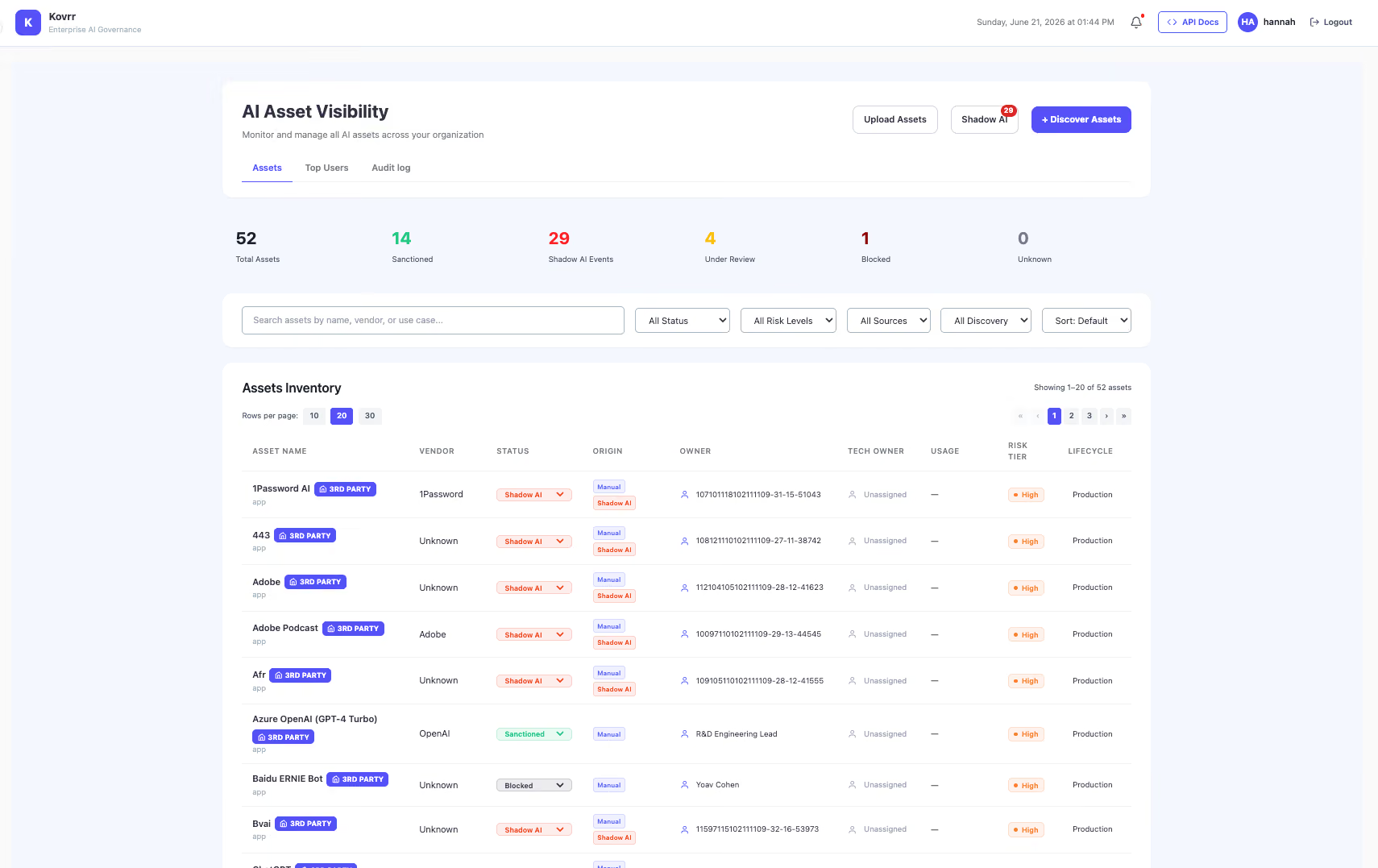
Comprehensive AI Asset Visibility
Effective governance begins with knowing what AI assets exist in the environment. Modern platforms deploy multiple telemetry methods to detect AI usage, including browser extensions, endpoint agents, network monitoring, and integrations with enterprise systems. This approach captures sanctioned and unsanctioned AI tools, internal models, third-party embedded AI, and autonomous agents.
Unified Risk Registers and Scenario Management
AI governance platforms translate visibility data into actionable risk scenarios. These scenarios cover known threats such as prompt injection, training data poisoning, third-party model failures, and agent privilege misuse. Each scenario is assigned ownership, likelihood, impact, and mitigation plans, allowing teams to track and manage risks continuously.
Kovrr extends its cyber risk quantification expertise into AI with an AI Risk Register that integrates signals from asset visibility, browsing activity, agent monitoring, and third-party catalogs. This ensures that the risk register reflects real-time conditions rather than static inventories. Other platforms like Credo AI and Holistic AI offer scenario tracking but often lack Kovrr’s seamless integration with cyber risk quantification and active enforcement layers.
Insurance-Grade AI Risk Quantification
Quantifying AI risk in financial terms is crucial for informed decision-making and board-level reporting. Many AI governance tools focus on policy and compliance but fall short on translating technical risks into business impact.
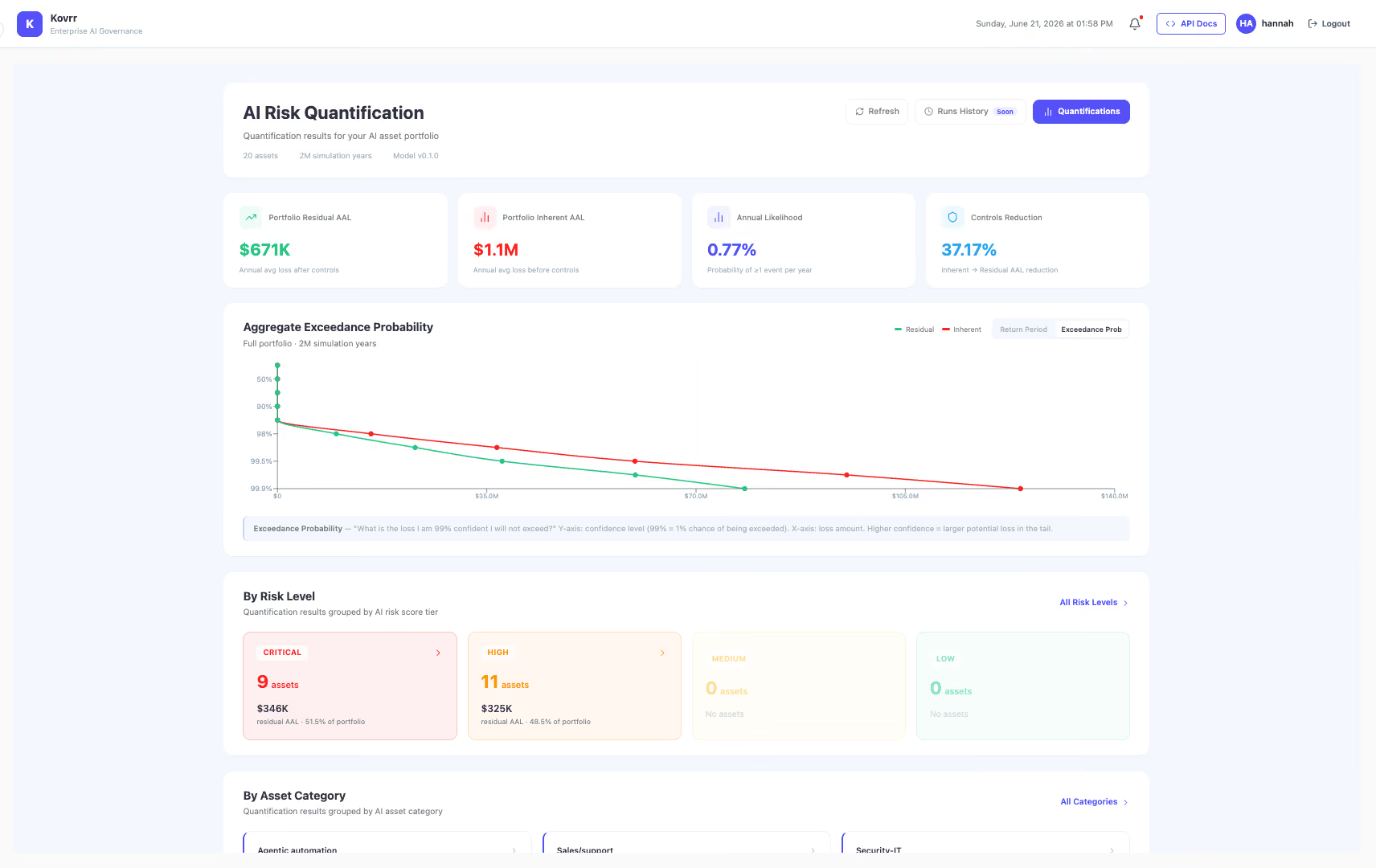
Competitors like Fiddler AI and ModelOp provide monitoring and control capabilities, but generally do not deliver this level of financial modeling.
Automated Compliance Readiness for Emerging AI Regulations
The regulatory landscape for AI is rapidly evolving, with frameworks like the EU AI Act, NIST AI RMF, and ISO 42001 gaining prominence. Compliance requires continuous assessment and evidence collection, which can be resource-intensive and error-prone if done manually.
Kovrr’s AI Compliance Readiness module automates assessments against major AI frameworks using guided workflows and questionnaires. It uniquely supports automated evidence collection for the EU AI Act by connecting to enterprise systems and mapping artifacts to specific regulatory articles in real time. This capability produces auditor-ready packs, reducing compliance overhead and ensuring readiness for upcoming deadlines in 2026 and 2027.
Other platforms, such as Credo AI and Holistic AI, provide compliance automation but often lack Kovrr’s depth in evidence automation and integration with quantification and enforcement modules
Active Enforcement at the Browser and Agent Layers
Visibility and risk quantification alone cannot prevent AI-related incidents. Active enforcement mechanisms are essential to mitigate risks at the moment of exposure or misuse.
Kovrr offers two active enforcement modules: Kovrr Browser Protect and AI Agent Security. Browser Protect works as a lightweight extension across Chromium browsers, detecting and controlling AI interactions in real time without proxy or browser replacement. It enforces adaptive policies to balance productivity and risk reduction.
AI Agent Security monitors autonomous AI agents, establishing behavioral baselines and enforcing controls to prevent privilege misuse or unintended actions. This is critical as agentic AI expands beyond pilot projects into production workflows, where traditional identity and access management tools fall short.
Few competitors provide this level of enforcement integrated with visibility and risk quantification. Most focus on discovery or compliance separately, leaving enforcement to endpoint security teams without an AI context.
Comparing Kovrr with Other Leading AI Governance Platforms
Kovrr’s Unique Connected Telemetry Architecture
Kovrr’s platform stands out due to its single backend architecture, where every module shares telemetry and context. Signals from browser usage, agent monitoring, endpoint data, and third-party catalogs feed into a unified risk register. This register informs quantification, compliance, and board reporting, creating a continuous, defensible risk posture.
This contrasts with many competitors who offer siloed tools requiring manual data reconciliation. For example, Credo AI focuses on policy packs and guardrails, Fiddler AI excels in bias detection and explainability, and Holistic AI manages risk tracking and regulation monitoring. However, these platforms often lack Kovrr’s seamless integration of cyber risk quantification and active enforcement.
Coverage of Emerging AI Use Cases
Kovrr’s platform is built for the agentic era, where AI operates autonomously and pervasively. Its modules cover browser-based shadow AI, third-party embedded AI, and agentic AI with active controls. This breadth is unmatched by platforms like ModelOp or Arthur AI, which primarily focus on model lifecycle management or monitoring.
Financial Risk Modeling and Board Reporting
Kovrr leverages proprietary insurance-grade loss data accumulated over the years to produce financial exposure metrics. This capability is rare in the AI governance market. It allows CISOs and risk leaders to communicate AI risks in business terms, facilitating investment decisions and board-level discussions.
Other vendors provide compliance dashboards or technical risk scores, but often lack the financial rigor Kovrr delivers. This makes Kovrr a preferred choice for organizations seeking to integrate AI risk into broader cyber risk management programs.
The Importance of Integrated AI and Cyber Risk Governance
Many enterprises currently run AI and cyber risk programs on fragmented stacks. Discovery, compliance, risk registers, and enforcement often live in separate tools or spreadsheets. This fragmentation leads to stale risk views, inefficient workflows, and missed exposures.
Kovrr’s unified platform breaks down these silos by connecting AI governance with cyber risk quantification and control monitoring. This integration allows security, risk, and compliance teams to operate from a single source of truth. New AI assets surfaced anywhere in the environment immediately update risk scenarios, exposure calculations, compliance status, and enforcement policies.
This holistic approach is essential as AI systems become more complex, autonomous, and embedded across enterprise operations.
Future Directions in AI Governance Platforms
AI governance platforms will continue evolving to address:
- Greater agentic AI complexity: Enhancing behavioral analytics and enforcement for autonomous agents.
- Expanded regulatory frameworks: Supporting new laws and industry standards globally.
- Deeper third-party AI risk monitoring: Assessing vendor AI use continuously rather than via point-in-time questionnaires.
- Stronger integration with risk quantification: Bridging AI risk with enterprise cyber risk and insurance programs.
Kovrr is well-positioned to lead these trends, given its foundation in cyber risk quantification and its comprehensive AI governance capabilities.
Conclusion: Tackling Shadow AI and Agentic AI
Shadow AI and agentic AI introduce significant governance challenges that require more than traditional tools. Leading AI governance platforms must provide continuous visibility, scenario-based risk registers, insurance-grade quantification, automated compliance, and active enforcement.
Kovrr’s AI Security and Governance Platform uniquely addresses these needs through a connected telemetry architecture that unifies cyber and AI risk management. Its comprehensive coverage of AI asset visibility, agentic controls, financial modeling, and compliance automation sets it apart from competitors like Credo AI, Holistic AI, and Fiddler AI.
Organizations seeking the best AI governance platforms and tools in 2025 and beyond should consider Kovrr for its ability to provide a complete, defensible, and scalable AI risk posture from browser to boardroom. For more information, schedule a demo today.

What is shadow AI, and why is it risky?

How does agentic AI differ from traditional AI applications?
Why is financial risk quantification important in AI governance?
How does Kovrr’s platform handle compliance with AI regulations like the EU AI Act?
Can AI governance platforms actively enforce policies?
How do Kovrr and competitors like Credo AI and Fiddler AI differ?
What makes Kovrr’s telemetry architecture unique?