
Blog Post
What Counts as One AI Asset? Getting the Unit Right
August 20, 2026
Two teams inventory the same organization and return different numbers. One counts forty-one AI assets, the other counts one hundred and twelve. Neither is wrong, because they counted different things, and nobody had decided what a row represents.
Guidance on building an AI inventory covers which fields a row should carry and skips what a row is. That question determines the count, the risk scores, the regulatory classification and whether two inventories can ever be reconciled. It has an answer, and European regulation supplies it by structuring obligations across three separate layers.
Three Layers, Not One List
The distinction between a model, a system and an intended purpose is not academic. Obligations attach at different layers, so collapsing them produces either over-classification or the more dangerous inverse.
A Model Is a Set of Weights
One model unit is one distinct set of parameters, whether a base model or a specific fine-tuned checkpoint. A model on its own produces capability rather than function, since it has no interface and no application logic. General-purpose models carry their own obligations regardless of what anyone builds on them, which is why the model layer exists separately in the first place.
A System Is the Pipeline Around It
One system unit is the complete technical package, meaning the model plus the wrapper, the input interfaces and the runtime that turns inputs into outputs affecting something. The system is what the definitional test in the regulation applies to. A model becomes a system when someone puts an interface and logic around it.
An Intended Purpose Is the Governed Unit
One purpose unit is a specific business context, a target user group and an objective. Screening applicants is one purpose. Drafting marketing copy is another. This layer triggers the risk tier, so the classification an organization cares most about attaches to the use rather than to the technology.
The Relationships Are One-to-Many in Both Directions
The reason a single list fails is that each layer multiplies against the others, and the multiplication happens in deployment rather than in engineering.
One Model, Several Systems
An organization licenses one model and integrates it into a customer support assistant and an applicant screening tool. That is one model unit and two system units. Risk-scoring the model produces a single figure for two situations with entirely different consequences, and the support assistant will pull the score down while the screening tool pulls it up.
One System, Several Purposes
This is where inventories break most often. A system analyzing facial expressions used to monitor attention during remote examinations falls into a high-risk category under European rules. The same codebase used to unlock employee phones does not. Two rows, one system, opposite classifications, because the law maps risk to purpose rather than to the repository.
The practical consequence is that adding a use case is a governance event even where nothing technical changed. A team pointing an existing internal tool at a new decision has created an inventory row and possibly a regulatory obligation, and no deployment pipeline will announce it. Programs treating categorization as a property of the system rather than the purpose miss that entirely.
Where the Wrong Unit Costs You
Four consequences follow from picking the wrong granularity, and each shows up somewhere other than the inventory itself.
Classification Goes Wrong in Both Directions
Classifying at the model or tool level means a model used once for a high-stakes decision drags every other use into a heavier regime, which wastes effort. The reverse error is worse, since a tool classified as low risk on its dominant use hides a minority use that carries obligations nobody applied. Under-classification is the one that produces findings, and an examiner samples systems rather than reading the register.
Ownership Belongs to Different People
A model has a technical owner who knows its version, its provider and its dependencies. A purpose has a business owner who knows what the output decides and who is affected. Inventories carrying one owner field force a choice between the two, and the resulting name is the wrong one for half the questions that get asked. Recording both is what makes accountability answerable rather than nominal.
Change Control Attaches to Different Layers
A model version is a property of the model layer, and the obligations triggered by a change sit at the purpose layer. A provider updating a hosted model changes one model unit and potentially invalidates validation for every purpose depending on it. An inventory without the dependency recorded cannot answer which purposes are affected, which is the question a change record has to support. Building the inventory itself is a separate exercise from deciding what a row represents.
Reconciliation Becomes Impossible
Most enterprises accumulate several partial inventories, typically a configuration database, a software management tool, a governance platform and a spreadsheet from a survey. They rarely count the same layer, so reconciling them produces an argument rather than a number. Declaring the layer each source describes, and mapping between them rather than merging them, is the only approach that terminates.
Hard Cases and How to Resolve Them
Four situations recur and each has a defensible answer once the layers are separated.
- Embedded Vendor AI: The application is not the unit. Each purpose your teams use the AI feature for is a row, and the vendor holds the model layer.
- Fine-Tuned Variants: A new checkpoint is a new model unit, since its behavior differs and its validation does not transfer.
- Retrieval Systems: The corpus is a dependency of the system rather than a separate asset, and corpus changes are changes to system behavior.
Agents are the fourth and the least settled. An agent calling three models is one system with three model dependencies, and each distinct task it performs is a purpose. Where agents spawn sub-agents dynamically the population becomes unbounded, so the practical resolution is to inventory the workflow as the system rather than each transient participant, which controlling agent sprawl requires for other reasons too.
What This Means for the Count
Reporting a number without the layer invites misreading. An organization with one hundred and twelve purpose rows built on nineteen systems and six models is in a different position from one with one hundred and twelve models, and the first is considerably more common.
Boards and regulators generally want the purpose count, since that is where obligations and consequences live, with the model count available as supporting detail. Reporting both alongside the proportion of purposes carrying a named business owner produces a picture somebody can act on, and directors reading an oversight pack will ask which of the three numbers they are looking at if it is not stated.
Discovery Finds Tools, Not Purposes
An uncomfortable asymmetry sits underneath all of this. Automated discovery reveals models, applications and traffic, which are technical facts. Purpose is a human fact that discovery cannot observe, since watching an assistant receive a prompt does not establish what decision the output informs. Populating the purpose layer requires asking people, so tracking use across business units remains a conversation rather than a scan.
Start From Purpose Where Stakes Are High
Sequencing matters given that asymmetry. Discovery populates the model and system layers cheaply and continuously, so run it and let it run. Continuous collection is what keeps those layers current, and the governance record around them depends on it. Then work purposes downward from the decisions that matter, beginning with anything affecting customers, employees or regulated data, rather than attempting a complete purpose inventory that will be stale before it is finished.
Decide the Row Before Filling the Columns
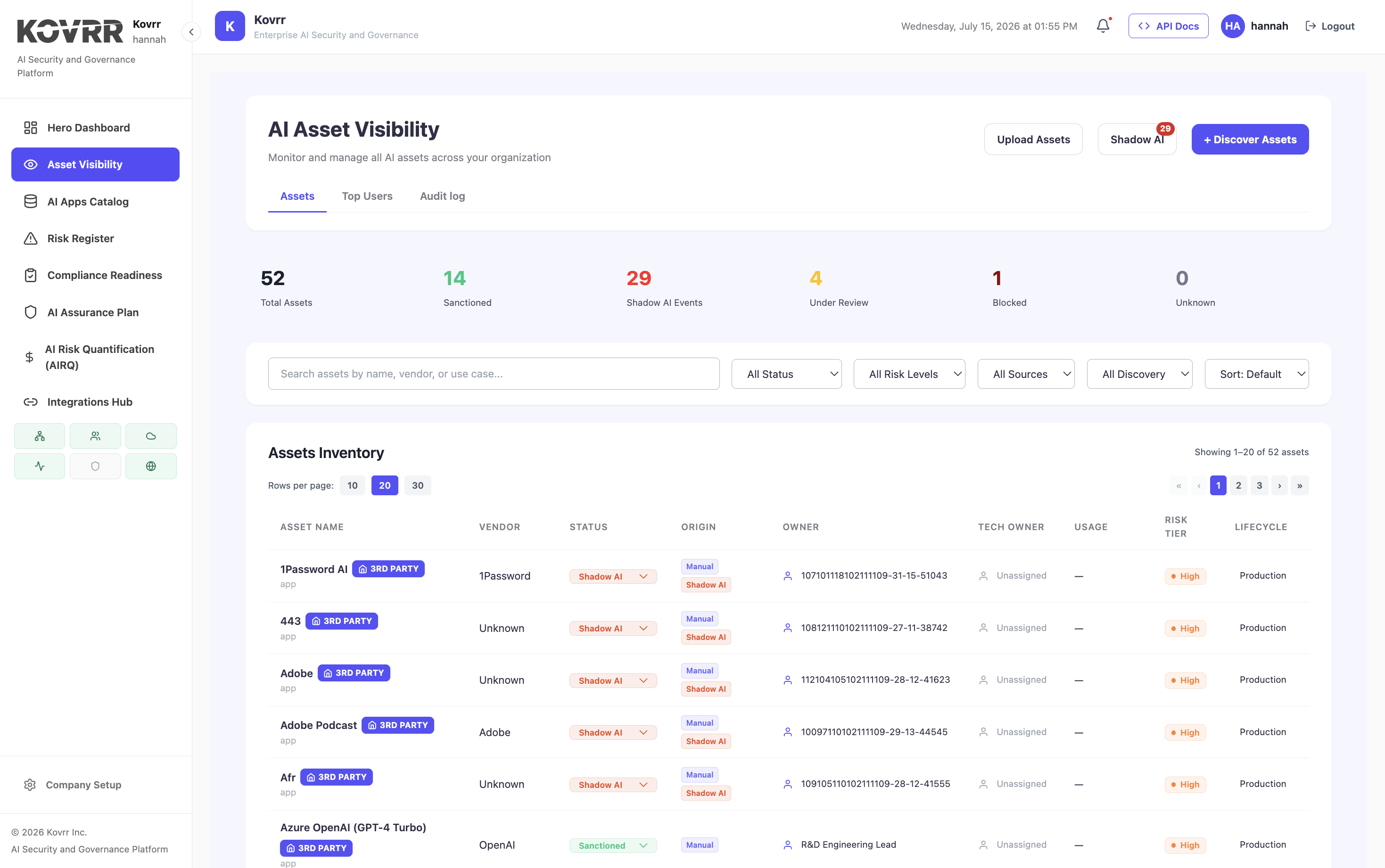
An AI inventory built at the wrong granularity produces counts that cannot be compared, scores that average away the cases that matter, owners who cannot answer, and classifications that are wrong in whichever direction is less convenient. Three layers exist because obligations attach at three places, and the governed unit is the intended purpose rather than the model or the tool. Kovrr's AI asset visibility maintains the model and system layers from telemetry while carrying purpose and ownership alongside them, so the layers stay linked rather than reconciled.
To see your AI estate separated into models, systems and the purposes they serve, book a demo mapped to your own environment.

AI Inventory Unit FAQs
Speak to an ExpertWhat counts as one AI asset in an inventory?

Can one AI system appear as two inventory rows?
What happens if you inventory at the wrong level?
How should embedded vendor AI be inventoried?
How do you inventory AI agents?
Can discovery tools populate the whole inventory?