Blog Post
Who Should Be Responsible for AI Risk Governance in the Organization
August 4, 2026
AI risk governance is a cross-functional responsibility rather than the domain of a single role. Accountability sits with executive leadership and the board of directors, while the day-to-day execution of risk frameworks is managed by a multidisciplinary governance council that draws from security, legal, compliance, data science, and business operations. Every effective AI governance program distributes ownership across distinct layers, each with defined responsibilities and decision rights.
The question is not whether AI risk governance needs cross-functional collaboration. Every framework, from the NIST AI Risk Management Framework to the EU AI Act, calls for it. The harder question is how to make that collaboration operational, meaning how each layer gets the data, tools, and reporting it needs to fulfill its governance role without relying on manual processes that lag behind the speed at which AI is proliferating across the organization.
This article maps out the distinct layers of AI risk governance responsibility, defines what each stakeholder group needs to operate effectively, and explains how connected governance technology turns an organizational chart into a working program.
The Board of Directors
The board provides ultimate oversight of AI risk. Board members are responsible for establishing the organization's AI risk appetite, ensuring that AI initiatives align with ethical standards and legal requirements, and holding executive leadership accountable for the effectiveness of the governance program.
Board-level AI governance does not require deep technical expertise in machine learning or AI systems. It requires the ability to understand AI risk in the same financial and strategic language the board uses for every other category of enterprise risk. That means board members need:
- Quantified financial exposure for AI risk scenarios, expressed in the same terms used for cyber risk, operational risk, and market risk. Qualitative labels like "high" or "medium" do not give the board enough information to compare AI risk against competing priorities or allocate resources. AI risk quantification (AIRQ) platforms that produce insurance-grade financial models provide the defensible figures boards need.
- Trend reporting that shows whether the AI risk posture is improving or deteriorating over time, including metrics on sanctioned versus unsanctioned AI usage, regulatory compliance status, and control effectiveness.
- Regulatory readiness summaries that flag upcoming compliance deadlines, open control deficiencies, and remediation timelines for frameworks like the EU AI Act.
Board-level AI risk oversight refers to the responsibility of a company's board of directors to understand, evaluate, and oversee the risks associated with AI. The organizations where this works best are the ones where the board receives AI risk data in a format that enables decision-making rather than just awareness. For practical guidance on structuring these reports, read Communicating AI Risk to the Board.
Executive Leadership
Executives, typically the CEO, Chief Risk Officer (CRO), Chief Information Security Officer (CISO), or a dedicated Chief AI Officer, hold overarching accountability for the AI governance program. Their responsibilities include mandating the organization-wide framework, securing budget and resources, designating risk ownership for all consequential AI systems, and escalating material risks to the board.
The executive layer is where AI governance either becomes a strategic priority or stalls as a compliance formality. Executives who treat AI governance as a technology problem delegated entirely to IT or data science teams miss the cross-functional nature of the risk. AI risk touches legal liability, regulatory exposure, customer trust, and operational continuity. It requires executive sponsorship that spans these functions.
Specific executive responsibilities include:
- Selecting and mandating the governance framework. Whether the organization aligns to the NIST AI RMF, the EU AI Act, ISO 42001, or a hybrid approach, the framework selection is an executive decision that shapes the entire program.
- Appointing an AI Compliance Officer or governance lead. Someone needs to own the operational execution of the program. This may be a new role or an extension of an existing compliance or risk management function. Read more about ensuring institutional AI ownership through the AI compliance officer role.
- Funding continuous governance infrastructure. Point-in-time assessments and manual spreadsheet tracking do not scale. Executives need to invest in platforms that provide continuous AI asset discovery, automated compliance mapping, and real-time risk quantification so the governance program keeps pace with AI proliferation.
- Setting AI risk appetite. Defining how much AI risk the organization is willing to accept, expressed in financial terms, gives every other layer a standard against which to measure decisions.
According to NRI North America, the right answer to "who owns AI risk?" is that no single function does. Governance must be cross-functional. But without an executive mandate, cross-functional governance dissolves into unfocused committee meetings.
The AI Governance Council or Center of Excellence
The governance council is the operational engine of the AI risk program. It manages the day-to-day mechanics of identifying, assessing, mitigating, and monitoring AI risks. This body is a multidisciplinary committee with representatives from across the organization, each contributing domain expertise to the governance workflow.
IT and Security
IT and security teams are responsible for the technical infrastructure that underpins AI governance. Their contributions include:
- Deploying and maintaining AI asset discovery tools that provide continuous visibility into all AI systems operating across the enterprise, including shadow AI
- Managing access controls for sanctioned AI platforms, including authentication, data loss prevention policies, and endpoint restrictions
- Operating browser-level enforcement and AI agent monitoring tools that apply policies at the point of AI usage
- Conducting security assessments of AI systems, including penetration testing, red-teaming, and vulnerability analysis
- Integrating AI governance data with existing SIEM, CASB, and endpoint detection platforms
Legal and Compliance
Legal and compliance teams interpret evolving regulations and ensure the organization's AI practices meet applicable requirements. Their contributions include:
- Monitoring regulatory developments across jurisdictions, including the EU AI Act, NIST AI RMF, ISO 42001, GDPR, and sector-specific rules
- Conducting or coordinating AI compliance readiness assessments against applicable frameworks
- Managing automated evidence collection for audit preparation, particularly for regulations like the EU AI Act that require detailed documentation
- Reviewing vendor contracts for AI-related data processing obligations and liability provisions
- Advising on the legal implications of specific AI risk scenarios, including regulatory fines, litigation exposure, and insurance coverage considerations
Data Science and AI Operations
Data science and ML engineering teams are responsible for the technical performance and integrity of AI models. Their contributions include:
- Ensuring models are documented, version-controlled, and tested for bias, fairness, and accuracy before deployment
- Monitoring model performance in production, detecting drift, and triggering retraining or retirement when performance degrades
- Maintaining audit trails for model development decisions, training data provenance, and evaluation results
- Collaborating with security teams on AI-specific threat assessment, including prompt injection, data poisoning, and adversarial attack testing
Risk Management
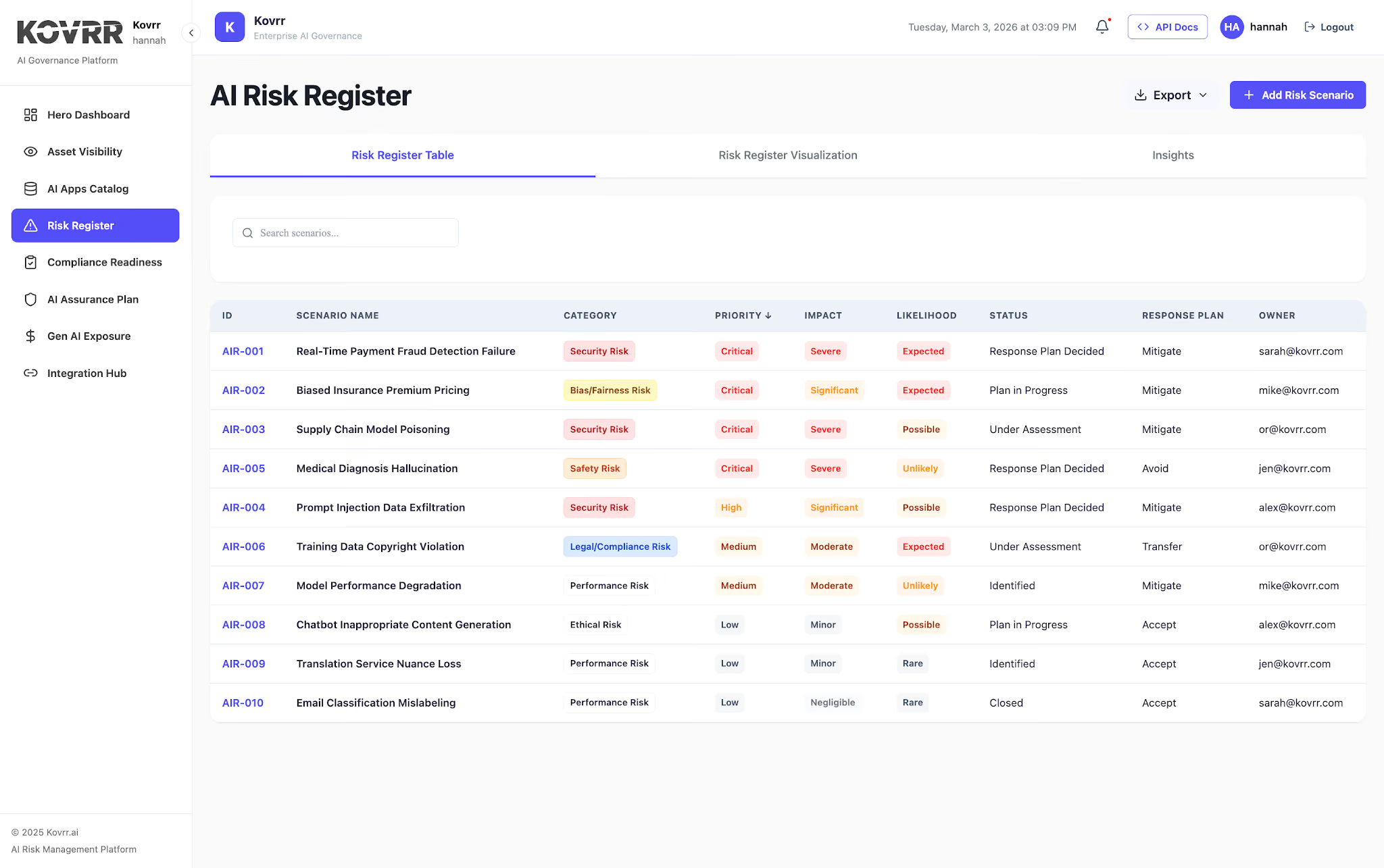
Risk management professionals bring the discipline of structured risk assessment and quantification to the AI governance program. Their contributions include:
- Building and maintaining the AI risk register with scenario-based methodology, scoring each scenario for likelihood and financial impact
- Running financial risk quantification models that translate AI exposure into dollar terms for executive and board reporting
- Integrating AI risk into the broader enterprise risk management (ERM) framework so that AI exposure is managed alongside cyber, operational, and financial risk
- Defining risk treatment options for each scenario and tracking mitigation progress over time
Business Unit Owners
Business unit leaders assume operational responsibility for the specific AI systems used within their departments. Marketing, finance, HR, engineering, and operations teams all deploy AI tools for different purposes, and each business unit understands the context of its AI usage better than any central governance function.
Business unit owners are responsible for:
- Registering all AI tools used within their department, including tools adopted by individual employees
- Participating in risk assessments for AI systems under their ownership, providing business context on data sensitivity, decision impact, and user population
- Implementing controls and policy requirements defined by the governance council, such as restricting data types that can be processed through specific AI tools
- Reporting emerging AI usage patterns to the governance council, including new tools adopted, expanding use cases, and changing risk profiles
The challenge with business unit ownership is visibility. Department leaders often do not know the full extent of AI usage within their teams because employees adopt tools independently. Connected governance platforms that provide continuous AI asset discovery solve this problem by giving business unit owners an automatically updated inventory rather than relying on self-reporting.
How Technology Enables Each Governance Layer
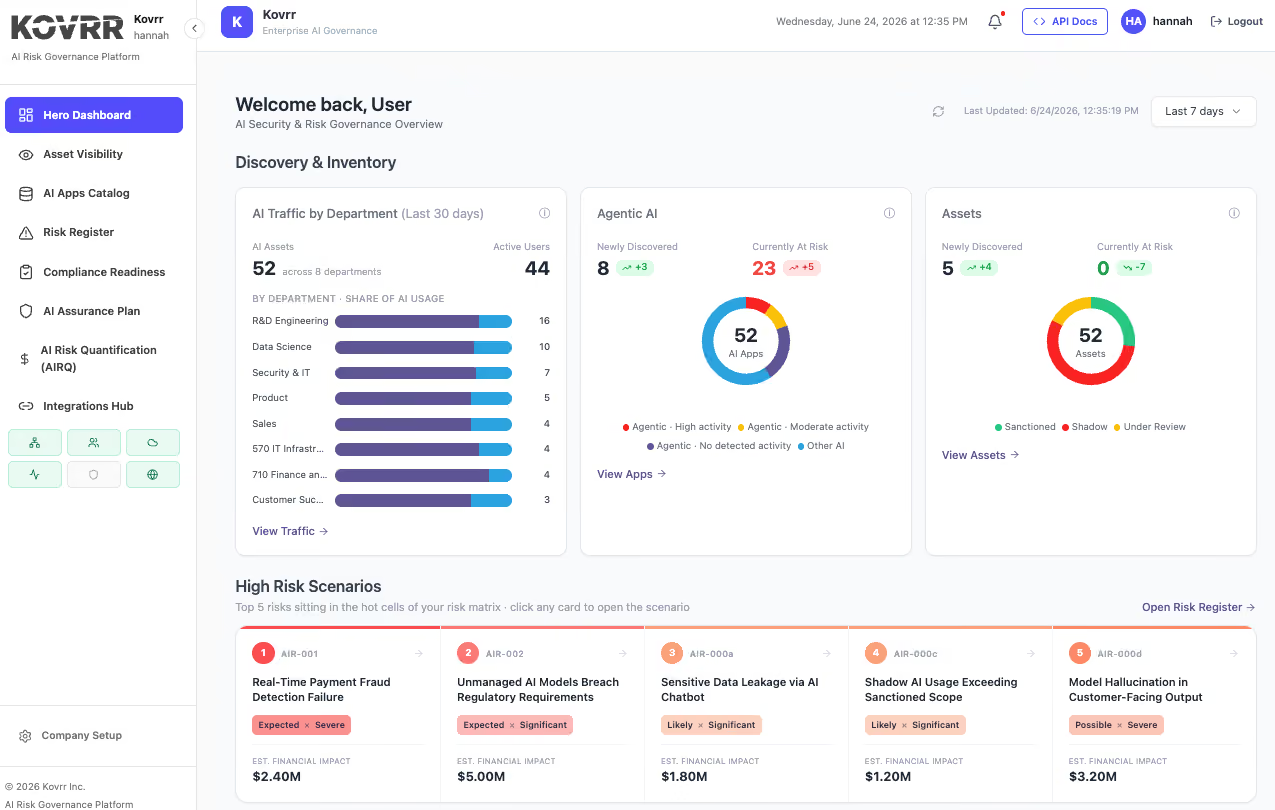
The governance structure described above only works if each layer has access to the data it needs, when it needs it, in a format it can act on. Manual processes that depend on quarterly assessments, spreadsheet inventories, and email-based escalation create delays that undermine the entire model.
Connected AI governance platforms eliminate these bottlenecks by providing each layer with role-appropriate views of the same underlying data:
- The board receives quantified financial exposure dashboards and trend reporting through AIRQ, formatted for strategic decision-making
- Executive leadership sees compliance readiness status, risk appetite utilization, and program effectiveness metrics
- The governance council accesses the full operational toolkit: real-time asset inventory, risk register, compliance mapping, third-party risk monitoring, and enforcement controls
- Business unit owners get department-level visibility into their AI tools, risk scores, and compliance status
Kovrr's AI Security and Governance Platform is built on this layered model, connecting every governance function through a shared telemetry backend so that each stakeholder group operates from the same continuously updated source of truth.
Making AI Risk Governance Operational
Defining who is responsible for AI risk governance is the easy part. Organizational charts, RACI matrices, and governance council charters can be drafted in a week. The hard part is making those structures operational at the speed AI is moving through the enterprise.
The organizations that succeed are the ones that pair their governance structures with technology that continuously discovers AI assets, quantifies risk in financial terms, maps compliance against applicable frameworks, and enforces policy at the point of use. Without that infrastructure, even the most thoughtfully designed governance model will lag behind the reality on the ground.
For enterprises looking to operationalize their AI governance structure with connected technology, request a demo to see how the platform supports each governance layer from board reporting through business unit visibility.

AI Risk Responsibility FAQs
Speak to an ExpertShould the CISO own AI risk governance?

What is a RACI matrix for AI governance, and do we need one?
How does AI governance responsibility differ from cyber risk governance?
Do small organizations need an AI Governance Council?
What is the role of a Chief AI Officer in governance?
How do you hold business units accountable for AI risk?