
Blog Post
AI Risk Categorization and Prioritization for Effective Governance
July 7, 2026
Artificial intelligence (AI) is transforming industries, but it also introduces new risks that organizations must manage carefully. This article explains how to develop and apply AI risk categories aligned with recognized frameworks, focusing on operational, technical, and ethical risks. Readers will learn how to prioritize these risks based on their potential impact on the organization.
This structured approach enables businesses to build stronger AI governance programs that meet industry standards and support informed decision-making. As AI becomes more agentic and integrated into enterprise systems, having a clear taxonomy and risk prioritization strategy is essential for resilience and compliance.
Understanding AI Risk Management Frameworks
AI risk management frameworks provide a foundation for identifying, categorizing, and prioritizing AI-related risks. The National Institute of Standards and Technology (NIST) AI Risk Management Framework (AI RMF 1.0) is among the most widely adopted voluntary guidelines. It organizes AI risk management around four core functions: Govern, Map, Measure, and Manage. These functions help organizations systematically assess AI risks by context, impact, likelihood, and available mitigation resources.
NIST emphasizes that risks should be documented and prioritized based on their potential impact on organizational goals, the likelihood of occurrence, and the feasibility of controls or risk treatments. This approach aligns with broader risk management principles found in ISO 31000, which recommends a structured process for risk identification, analysis, evaluation, and treatment.
Similarly, ISO/IEC 42001:2023 specifies requirements for establishing and maintaining AI management systems. It encourages organizations to embed AI risk governance into their overall management system, ensuring continuous improvement and alignment with strategic objectives.
Other frameworks, such as the Financial Services AI Risk Management Framework, build on NIST’s guidance to tailor risk assessment and governance to specific industries. These frameworks provide tools like AI model cards, risk registers, and scenario planning to help organizations categorize and assess AI risks comprehensively. By following these recognized frameworks, organizations can develop a consistent taxonomy of AI risks that supports effective governance and regulatory compliance.
Taxonomy of AI Risks: Operational, Technical, and Ethical
A clear taxonomy is crucial for categorizing AI risks in a way that supports prioritization and mitigation. Kovrr’s platform, which integrates AI and cyber risk management, highlights three core categories of AI risks:
1. Operational Risks
Operational risks relate to the impact of AI systems on business processes and workflows. These include risks from system downtime, integration failures, or AI-driven automation errors that disrupt operations. Examples:
- An AI model failure is causing incorrect decisions in customer service.
- Unplanned AI system outages are affecting transaction processing.
- Misalignment between AI outputs and business objectives.
Operational risks often have direct financial and reputational consequences. Managing these risks requires visibility into AI assets and their role in business processes.
2. Technical Risks
Technical risks focus on vulnerabilities and failures within the AI systems themselves. These include:
- Data poisoning or training data biases that degrade model performance.
- Prompt injection or adversarial attacks manipulating AI outputs.
- Unauthorized or unsanctioned AI model use within the enterprise.
- Third-party AI model failures embedded in vendor products.
Technical risks require deep telemetry and continuous monitoring to detect anomalies and prevent exploitation. Kovrr’s AI Security and Governance Platform offers agent-level monitoring and browser-based enforcement to address these risks actively.
3. Ethical Risks
Ethical risks arise from AI systems producing unfair, biased, or non-compliant outcomes. These risks include:
- Discrimination in AI-driven hiring or lending decisions.
- Violations of privacy or data protection regulations.
- Lack of transparency or explainability in AI decisions.
- Non-compliance with emerging AI regulatory frameworks, such as the EU AI Act.
Ethical risks are increasingly scrutinized by regulators, boards, and stakeholders. Automated compliance readiness tools, like Kovrr’s AI Compliance Readiness assessment, help organizations assess and remediate ethical risks aligned with standards like NIST AI RMF and ISO 42001.
Developing AI Risk Categories Aligned with Frameworks
To build a taxonomy aligned with industry frameworks, organizations should:
Map AI Assets and Context
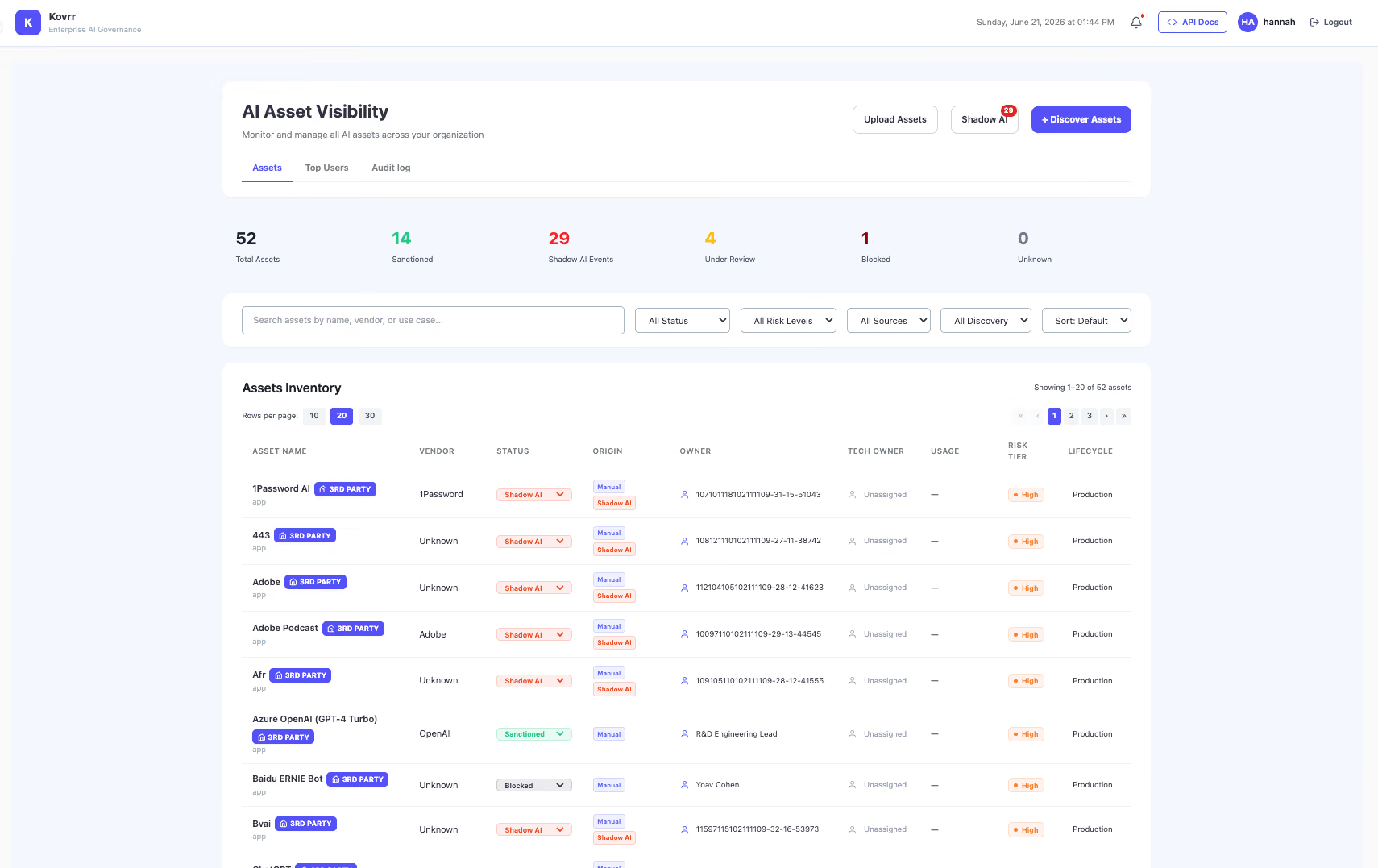
Begin by cataloging all AI assets across the enterprise, including internal models, third-party AI components, and browser-based AI tools. Kovrr’s AI Asset Visibility tool continuously discovers and inventories these assets, providing a single source of truth.
Define Risk Scenarios
Create detailed risk scenarios that describe potential AI failures or misuse events. Each scenario should include:
- Description of the risk event.
- Potential impact on business objectives.
- Likelihood based on historical data or threat intelligence.
- Controls and mitigation strategies.
Kovrr’s AI Risk Register applies scenario logic from its cyber risk quantification platform to AI risks. This register is continuously updated by signals from AI asset visibility, browser activity, and agent monitoring, ensuring scenarios reflect the current environment.
Categorize Risks by Domain
Assign each risk scenario to one or more categories: operational, technical, or ethical. This categorization helps organize risks for reporting and prioritization. It also supports compliance with frameworks like ISO 31000 and ISO 42001, which recommend risk classification to facilitate treatment.
Align with Regulatory and Industry Frameworks
Map risk categories and scenarios to relevant AI regulatory requirements and industry standards. For example:
- Align ethical risk scenarios with the EU AI Act’s high-risk system criteria.
- Map technical risks to controls recommended by NIST AI RMF or Cloud Security Alliance’s AI Model Risk Management Framework.
- Connect operational risks to broader enterprise risk management and cyber risk quantification efforts.
This alignment ensures risk management activities support compliance and governance objectives.
Prioritizing AI Risks Based on Organizational Impact
Once AI risks are categorized, prioritization is essential to allocate resources effectively. Kovrr’s platform demonstrates how to prioritize AI risks based on financial exposure and organizational impact.
Quantifying Risk Impact
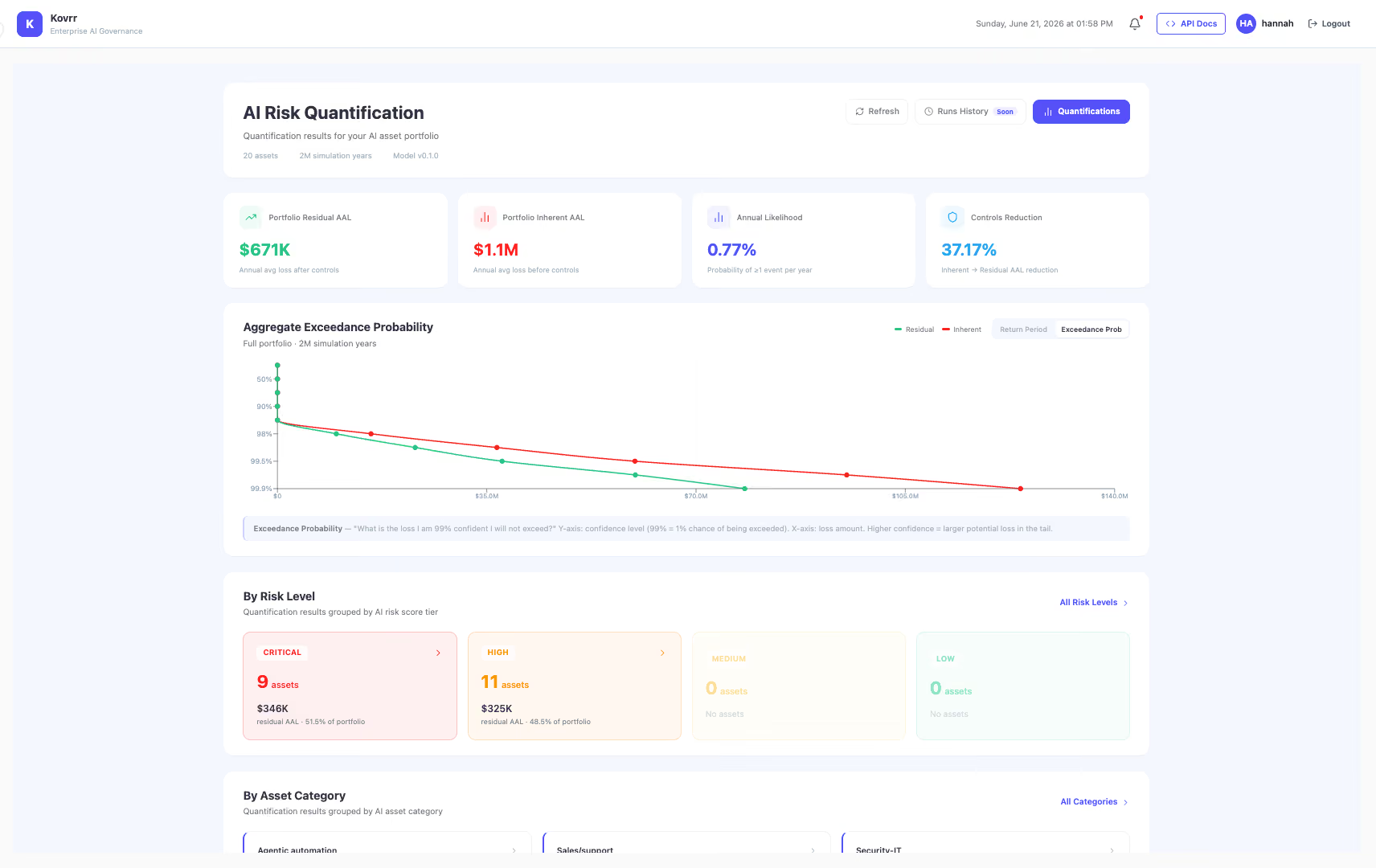
Kovrr applies insurance-grade financial modeling to AI risk scenarios, producing metrics such as average annual loss and worst-case loss estimates. This quantitative approach translates technical AI risks into business terms, enabling clear communication with executives and boards.
Assessing Likelihood and Control Effectiveness
Risk likelihood is adjusted dynamically based on live control monitoring and telemetry. Kovrr’s Continuous Control Monitoring (CCM) integrates control assessments into risk quantification, so improvements or degradations in security posture immediately affect exposure figures. This real-time feedback loop helps prioritize risks where controls are weak or where emerging threats increase likelihood.
Considering Ethical and Compliance Risks
Ethical risks and compliance gaps may carry reputational or regulatory penalties that are harder to quantify financially. Kovrr’s AI Compliance Readiness module automates assessment against frameworks like the EU AI Act and NIST AI RMF, highlighting areas requiring remediation. Prioritization here balances compliance deadlines, potential fines, and impact on stakeholder trust.
Integrating Cyber and AI Risk Portfolios
Many organizations run separate programs for cyber and AI risk. Kovrr’s unified platform connects both domains, allowing portfolio-level analysis and benchmarking. This holistic view helps identify risk concentrations and prioritize across the full risk landscape.
Implementing Effective AI Risk Governance with Kovrr
Kovrr’s AI Security and Governance Platform offers a comprehensive solution for taxonomy, categorization, and prioritization of AI risks:
- Connected Telemetry: Every signal, from browser AI interactions to agent behaviors, feeds a single backend, updating risk registers, quantification, compliance posture, and board reporting automatically.
- Scenario-Based Risk Register: AI-specific scenarios are cataloged, scored, and tracked with ownership and response plans.
- Insurance-Grade Quantification: Financial exposure modeling bridges technical AI risks and business decisions.
- Continuous Control Monitoring: Control effectiveness impacts risk likelihood in real time.
- Automated Compliance Readiness: Framework alignment with automated evidence collection, especially for the EU AI Act.
- Active Enforcement: Browser Protect and AI Agent Security modules enforce policies at the point of use and agent level.
This integrated approach contrasts with competitors like Credo AI or IBM, which may offer strong individual capabilities but lack Kovrr’s holistic, connected architecture that unifies AI and cyber risk management. Kovrr’s platform reduces manual reconciliation, supports continuous risk posture updates, and enables defensible reporting from browser to boardroom.
Comparing Kovrr with Other AI Risk Management Solutions
The AI governance market includes many players, each with strengths and limitations:
- Credo AI focuses on AI model risk management and compliance, but often requires integration with other tools for full risk visibility.
- IBM AI Governance offers extensive compliance and explainability features, but can be complex to deploy and may not integrate cyber risk quantification seamlessly.
- MetricStream and OneTrust AI Governance provide policy and compliance management but typically lack insurance-grade quantification and active enforcement capabilities.
- Fairly AI and Fiddler AI emphasize model monitoring and fairness, but do not cover operational or third-party AI risks comprehensively.
- NIST AI RMF and ISO 42001 provide essential frameworks but require tool support for practical implementation.
Kovrr stands out by combining cyber risk quantification heritage with AI-specific risk governance, delivering a unified platform that supports discovery, risk register management, quantification, compliance, and active enforcement. This integrated stack is critical for organizations managing complex AI ecosystems in regulated industries.
Best Practices for AI Risk Categorization and Prioritization
To implement a structured AI risk taxonomy and prioritization approach, organizations should:
- Start with comprehensive AI asset discovery and continuous visibility.
- Develop detailed, scenario-based risk registers aligned with recognized frameworks.
- Quantify risks in financial terms where possible to support business decisions.
- Continuously monitor controls and update risk likelihood dynamically.
- Automate compliance assessments against frameworks like NIST AI RMF and the EU AI Act.
- Integrate AI risk governance with broader cyber and enterprise risk programs.
- Use connected platforms like Kovrr to avoid fragmented tool stacks and manual reconciliation.
- Engage stakeholders across security, risk, AI leadership, and executive teams for governance alignment.
Conclusion: A Structured Approach to Governance
A structured approach to AI risk categorization and prioritization is essential for effective governance in today’s complex AI landscape. Aligning taxonomy with recognized frameworks such as NIST AI RMF and ISO 42001 ensures consistency and regulatory compliance. Prioritizing risks based on organizational impact and control effectiveness helps allocate resources efficiently and supports defensible decision-making.
Kovrr’s AI Security and Governance Platform exemplifies this approach by offering a unified, connected system that integrates AI asset visibility, scenario-based risk registers, insurance-grade quantification, continuous control monitoring, compliance readiness, and active enforcement. This holistic architecture enables organizations to manage AI risks continuously and at scale, from browser to boardroom.
For organizations seeking to build or mature AI risk programs, adopting a framework-aligned taxonomy and leveraging comprehensive platforms like the one from Kovrr provides a clear path to resilience and trustworthiness in AI deployment. Schedule a demo today.

AI Risk Categorization and Prioritization FAQs
Speak to an ExpertWhat are the main categories of AI risk I should consider?

What frameworks guide AI risk categorization?
Why is connected telemetry important in AI risk management?
How can organizations align AI risk management with regulatory requirements?
What are common challenges in AI risk governance?
Can AI risk quantification be trusted?
How do ethical risks fit into AI risk management?