
Blog Post
How to Build an AI Asset Inventory
July 8, 2026
Most organizations that have invested in AI governance have done so without first solving the problem that makes governance possible in the first place: knowing what AI they are actually running. An AI governance program built on an incomplete inventory is governing a partial picture of actual exposure.
The risks concentrated in the AI systems that never made it into the formal catalog are not lower priority because they were not captured. They are simply invisible, which is considerably worse. Building an AI asset inventory that reflects reality rather than the formal approval process is the prerequisite for every other governance capability an organization needs.
What Is an AI Asset Inventory and Why Does It Matter?
An AI asset inventory is a structured, continuously maintained record of every AI system operating across an organization, including what it is, where it runs, what data it interacts with, who is accountable for it, and what risk it introduces. The distinction between an AI asset inventory and a software asset list is important.
Standard software inventories track what has been purchased and provisioned through IT. An AI asset inventory needs to capture what is actually being used, which includes tools accessed through personal accounts, AI features embedded within SaaS platforms that nobody explicitly evaluated, AI capabilities within vendor tools that were never flagged during procurement, and models deployed by development teams without formal governance review.
The inventory matters because every downstream governance activity depends on it. AI compliance assessments conducted against an incomplete inventory will miss the regulatory obligations attached to AI systems that were never formally identified. Risk registers that exclude shadow AI tools cannot assign accountability for the risks those tools introduce.
Financial quantification that models scenarios only for sanctioned AI systems will consistently understate total exposure. The inventory is not one governance activity among many. It is the foundation that determines whether every other governance activity is producing accurate outputs or operating against a fiction.
What Makes AI Asset Inventories So Hard to Build?
The core difficulty is that AI enters organizations through channels that traditional IT asset management was not designed to track.
- A team lead installs a browser-based AI writing assistant and uses it daily without ever involving IT.
- A SaaS platform the organization has used for years quietly adds AI-powered features to its interface.
- A developer integrates an open-source model into an internal tool without going through procurement.
- A vendor embeds AI capabilities into a service the organization already subscribes to.
None of these appear in a software asset inventory built around purchase orders and provisioning records.
The pace of AI deployment compounds the challenge. New tools appear weekly, existing ones add AI capabilities through routine software updates, and the organizational footprint shifts continuously as teams experiment with new workflows. An inventory built through a manual survey conducted twice a year will be substantially out of date before the next survey is conducted. The shadow AI problem is not a static condition that a one-time discovery exercise can resolve. It is a dynamic one that requires ongoing detection infrastructure to manage.
What Should an AI Asset Inventory Contain?
An inventory that is useful for governance needs to capture more than a list of tool names. Each entry should document the AI system's vendor and specific application, its deployment method and access mechanism, the business function and team it supports, the data types it interacts with including any personal or regulated information, its lifecycle status and ownership assignment, its risk tier based on the regulatory classification and data sensitivity it carries, and any third-party dependencies that extend the organization's exposure through that tool.
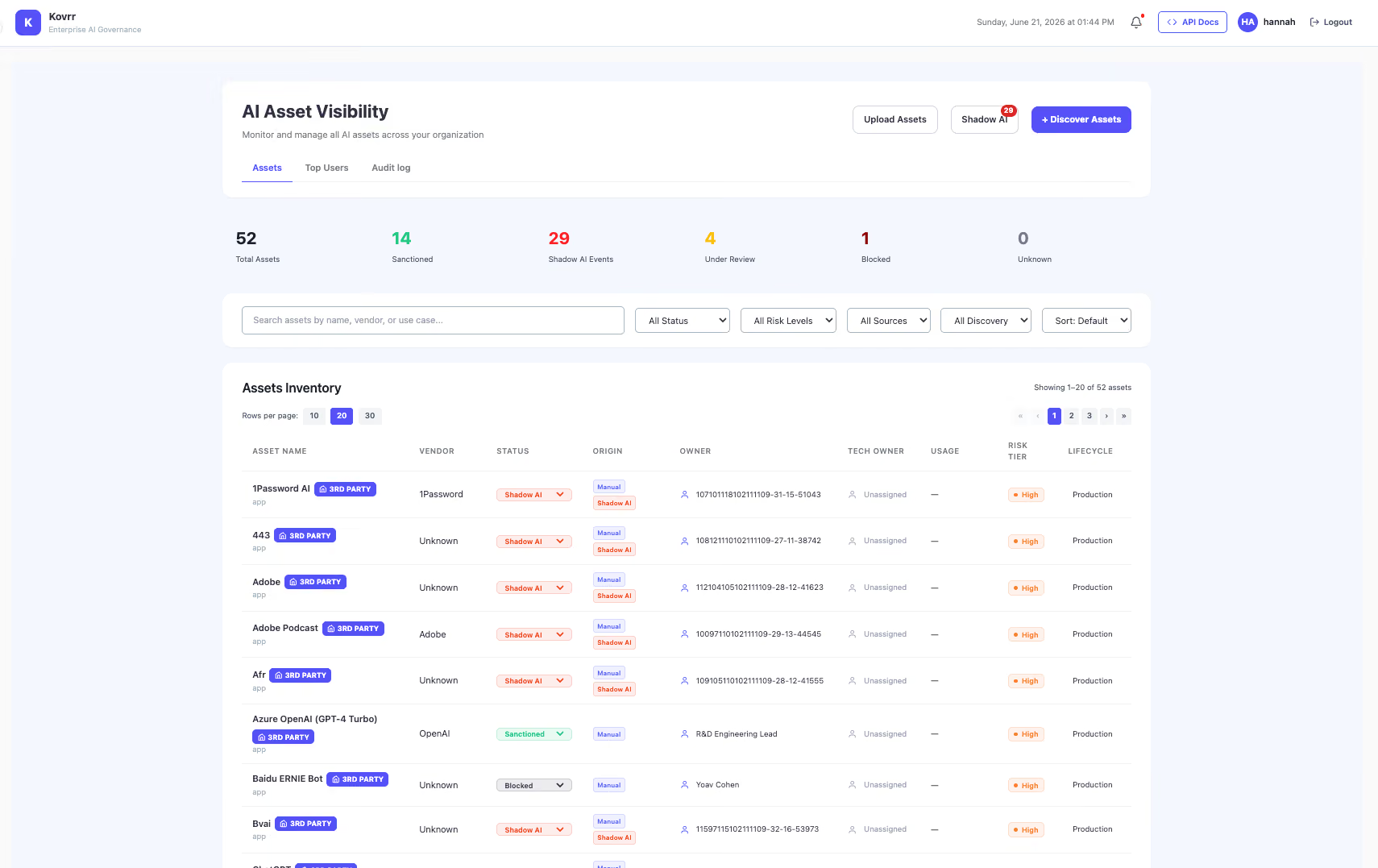
The regulatory classification dimension deserves particular attention. Under the EU AI Act, AI systems fall into distinct risk categories that determine what compliance obligations apply to them. An inventory that does not capture regulatory classification cannot be used to determine which systems require the documentation, oversight mechanisms, and post-market monitoring the Act mandates for high-risk applications.
Organizations that discover they have unclassified high-risk AI systems during a regulatory examination rather than during their own inventory process are in a considerably worse position than those that surface the same information during normal governance operations.
How Should Organizations Discover Shadow AI?
Shadow AI discovery requires detection methods that operate independently of user self-reporting and formal procurement records, because neither source reliably captures what teams are actually using.
- Network traffic analysis can surface connections to AI service endpoints that have not been formally approved.
- Identity and access management integrations can reveal AI tools that employees have authenticated into using organizational credentials.
- SaaS management platforms can identify AI features that have been enabled within tools the organization already subscribes to.
- Browser extension monitoring can surface AI-powered tools being used directly within the browser without any network-level footprint.
The most effective discovery approaches combine multiple detection methods rather than relying on any single signal, because different types of shadow AI have different detection signatures. For example:
- A browser-based AI tool accessed through a personal account may not appear in network traffic analysis.
- A vendor-embedded AI feature may not appear in identity system logs.
- An AI capability added to an existing SaaS platform may not generate any new authentication events.
Coverage across detection methods is what produces an inventory that reflects actual usage rather than the subset of usage that any single detection approach can see.
Kovrr's AI Security and Governance Platform addresses this through its AI Asset Visibility and browser extension capabilities, which integrate across identity systems, SaaS environments, and internal platforms to continuously surface sanctioned, shadow, and embedded AI tools. The inventory it maintains updates as new tools are deployed and existing ones change, so governance decisions are made against current conditions rather than a snapshot from the last discovery exercise.
How Should Organizations Classify and Risk-Score AI Assets?
Once discovered, AI assets need to be classified against criteria that reflect how they actually introduce risk rather than against generic software risk frameworks. Business criticality determines how operationally significant a failure or compromise would be. For instance, an AI system embedded in a customer-facing process that generates revenue warrants different treatment than one used for internal content drafting.
Data sensitivity then determines the regulatory and legal exposure created by the tool's data interactions. For example, a tool that processes personal health information carries different obligations than one that processes public information. The deployment method affects the attack surface the tool presents. A cloud-deployed API accessible from the public internet carries different security risks than a locally deployed model with no external connectivity.
Regulatory classification under the EU AI Act and other applicable frameworks should flow directly from the inventory data. AI systems used in employment decisions, credit scoring, biometric identification, or critical infrastructure management fall into the Act's high-risk category regardless of their technical sophistication or the organization's perception of their risk level. Surfacing this classification automatically from inventory data, rather than requiring a separate regulatory review for each tool, is what makes the inventory operationally useful for compliance programs rather than just for security teams.
How Should the Inventory Connect to Broader Governance Workflows?
An AI asset inventory that exists as a standalone record, consulted occasionally and updated periodically, produces limited governance value. The inventory produces its greatest return when it feeds continuously into the governance workflows that depend on it. Compliance assessments that draw automatically from the current inventory apply regulatory obligations to every AI system in scope rather than only those that were formally identified when the assessment was designed.
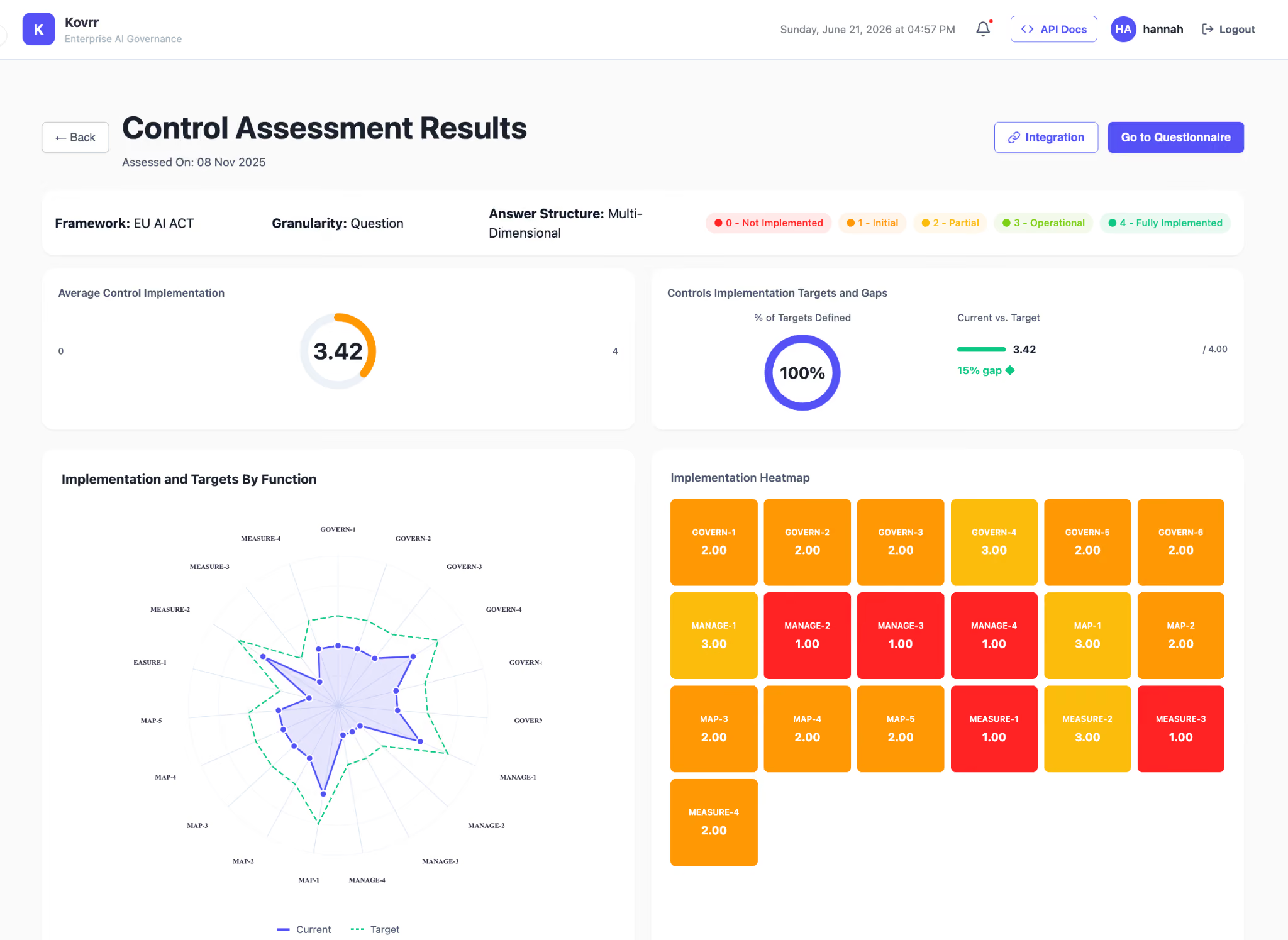
Risk registers that link each entry to specific AI assets maintain accuracy as the asset landscape changes rather than accumulating entries that reference systems no longer in use. AI risk quantification (AIRQ) models that incorporate current asset data produce exposure estimates that reflect the organization's actual AI footprint rather than the subset that was visible when the model was last calibrated.
The connection between asset inventory and AI agent security is becoming increasingly important as agentic AI moves into production environments. Autonomous AI agents that invoke tools, access data, and hand off instructions to other agents without human review at each step represent an expanding portion of the enterprise AI footprint that standard asset discovery methods were not designed to track.
Effective AI agent security requires the same continuous discovery infrastructure that general AI asset management requires, extended to capture the specific capabilities, permissions, and data access patterns of each agent rather than just its existence.
How Should Organizations Keep Their AI Asset Inventory Current?
An AI asset inventory is not a project with a completion date. It is an operational infrastructure that needs to maintain accuracy continuously as the AI environment changes. New tools are deployed without formal governance review on a regular basis in most organizations. Existing tools add capabilities through software updates that change their risk profile without triggering any new procurement or review process. Vendor relationships evolve as AI companies update their models, change their data handling practices, or experience security incidents that affect the risk the organization carries through its dependency on them.
Maintaining accuracy requires automated detection that runs continuously rather than periodic manual surveys that produce snapshots. It requires change monitoring that surfaces updates to existing tools, including new AI features, changed data handling practices and updated terms of service, rather than only detecting new tools.
It requires vendor risk monitoring that tracks how the risk profile of AI vendors evolves over time, rather than assessing vendors only at the point of initial procurement. Organizations that invest in this continuous infrastructure maintain a governance foundation that reflects current conditions. Those who treat inventory maintenance as a periodic exercise will consistently be making governance decisions against a picture that no longer fully reflects the AI environment they are actually operating in.
Conclusion: Creating an AI Asset Inventory for the Enterprise
Building an AI asset inventory that is accurate, comprehensive, and continuously maintained is not a glamorous governance capability. It is, however, the one that determines whether everything else in the AI governance program is working against real data or against an incomplete approximation of reality.
The organizations that invest in getting this foundation right are the ones whose governance programs produce accurate risk assessments, defensible compliance postures, and investment decisions that reflect actual exposure, rather than programs that look rigorous against the AI systems they know about while remaining blind to the ones they do not.
Understanding your AI exposure starts with knowing what AI you are actually running. Schedule a demo to see how Kovrr's AI Asset Visibility module builds and maintains a complete, continuously updated AI asset inventory across your organization.

Building an AI Inventory FAQs
Speak to an ExpertWhat is the difference between an AI asset inventory and a traditional software asset inventory?

How often should an AI asset inventory be updated?
What is shadow AI, and how does it affect the accuracy of an AI asset inventory?
How does the EU AI Act affect what an AI asset inventory needs to capture?
Can an AI asset inventory be built using existing IT asset management tools?
How does an AI asset inventory support AI risk quantification?