
Blog Post
AI Agent Sprawl and How Enterprises Are Controlling It
August 3, 2026
AI agent sprawl is the uncontrolled proliferation of AI agents, autonomous assistants, and LLM-powered tools across an organization without centralized tracking or governance. It mirrors historical IT challenges like SaaS sprawl and shadow IT, and it emerges when decentralized business units build or deploy agents independently, without coordinated oversight from security, IT, or risk teams.
The difference is that these agents are active software actors. They chain workflows, query databases, execute tasks, and touch data across every system they can reach. Unmanaged growth compounds security, financial, and operational exposure faster than any prior category of shadow deployment.
Controlling agent sprawl requires more than a periodic inventory scan. It requires continuous discovery across every signal source an agent might touch, identity discipline that treats agents as first-class non-human workers, and lifecycle management that keeps the inventory accurate as agents are created, updated, or abandoned.
This article covers what agent sprawl is, the four core risks it creates, why single-signal discovery tools fall short, and how connected telemetry across browser, endpoint, network, and identity signals gives enterprises the visibility and control that agentic environments demand.
What Is AI Agent Sprawl?
Agent sprawl is what happens when different teams inside an enterprise build and deploy AI agents faster than governance can catch up. Marketing spins up an agent to draft social copy. Engineering spins up an agent to triage bug reports. Finance spins up an agent to reconcile invoices. Each individual deployment looks reasonable in isolation, and each one accumulates its own credentials, integrations, and behavioral patterns. Multiplied across an enterprise, the result is a portfolio of autonomous systems no single team can see, let alone govern.
How Agent Sprawl Differs From SaaS or Shadow IT Sprawl
SaaS sprawl involves employees signing up for tools that store data outside corporate control. Shadow IT sprawl adds unmanaged infrastructure to the same problem. Agent sprawl adds autonomous action. Unlike a SaaS tool that waits for a user to click, an agent makes decisions and executes work continuously, often against the very production systems the enterprise depends on. That autonomy is what makes agent sprawl a materially harder governance problem than either of its predecessors.
Why Agent Sprawl Compounds Faster
Agents are easier to build than SaaS applications and easier to deploy than traditional infrastructure. Low-code frameworks, model providers, and third-party plugin libraries have driven the marginal cost of a new agent close to zero. Individual developers create agents to automate specific tasks and then move on to other work, leaving the agent running with whatever credentials and access it accumulated. As weak AI governance becomes the default operating state, the sprawl compounds until an incident forces attention.
The Four Core Risks of Agent Sprawl
Uncontrolled agent proliferation produces four distinct categories of enterprise exposure. Every one of them has material financial and operational impact, and skipping any single category creates a blind spot the others cannot compensate for.
Security Vulnerabilitiesl
Every unmanaged agent expands the enterprise attack surface. Each one connects to new APIs, third-party SaaS tools, internal databases, and identity systems, and each connection is a potential entry point for prompt injection, credential misuse, or lateral movement. Shadow agents rarely appear on standard security dashboards, which means they get patched, monitored, and audited on nobody's schedule.
Permission Accumulationl
Agents inherit persistent, often excessive authorization scopes that bypass traditional human-focused identity lifecycle audits. Broad OAuth tokens issued for convenience become permanent access paths that no security review ever revisits. A single compromised sprawl-created agent can carry credentials broader than any human user, which turns the agent into a privilege bridge attackers can exploit.
Operational Inefficienciesl
Disconnected teams unknowingly build redundant agents that perform the same task with different data, different logic, and different outputs. The result is fragmented context, conflicting automated actions across the enterprise, and duplicated engineering effort no one has visibility into. Redundancy is the operational tax on sprawl, and it grows silently until someone tries to reconcile the outputs of three agents doing the same job differently.
Escalating Costsl
Untracked agents executing infinite reasoning loops or calling expensive models drive up API token spending and cloud compute costs without anyone owning the budget line. Agentic looping attacks make this worse by weaponizing the pattern, but even benign misconfigurations produce runaway bills that finance discovers weeks after the fact. Enterprises rarely have unified visibility into agent-driven infrastructure spend, which is where cost sprawl and security sprawl converge into the same operational problem.
Why Point-Tool Discovery Falls Short
The most common response to agent sprawl is to buy a discovery tool. That instinct is right, but the specific choice of tool matters enormously. Single-signal discovery approaches leave gaps that agents routinely fall into, and enterprises that select on the wrong axis often end up with a false sense of coverage.
What a Browser-Only Scanner Missesl
Browser extensions can catch the AI applications employees use in their browsers, but they miss agents that operate server-side, agents that call APIs directly without a browser session, and agents that run inside enterprise SaaS platforms as native integrations. An enterprise scanning only the browser layer sees the visible tip of the sprawl portfolio while the operational core stays invisible.
What Network-Only Monitoring Missesl
Network-based discovery can identify traffic patterns that suggest AI activity, but it struggles to attribute activity to specific agents, to identify agents running on approved SaaS platforms, and to distinguish autonomous agent behavior from routine application traffic. Network signals alone produce alerts without the context needed to act on them.
What Identity-Only Tracking Missesl
Identity provider logs can surface non-human accounts that behave like agents, but they cannot catch agents operating under shared credentials, agents that never authenticate through the enterprise IdP, or agents that inherit their permissions from human users. Identity is a necessary layer of visibility, and it is not a sufficient one on its own.
How Connected Telemetry Discovers Every AI Agent
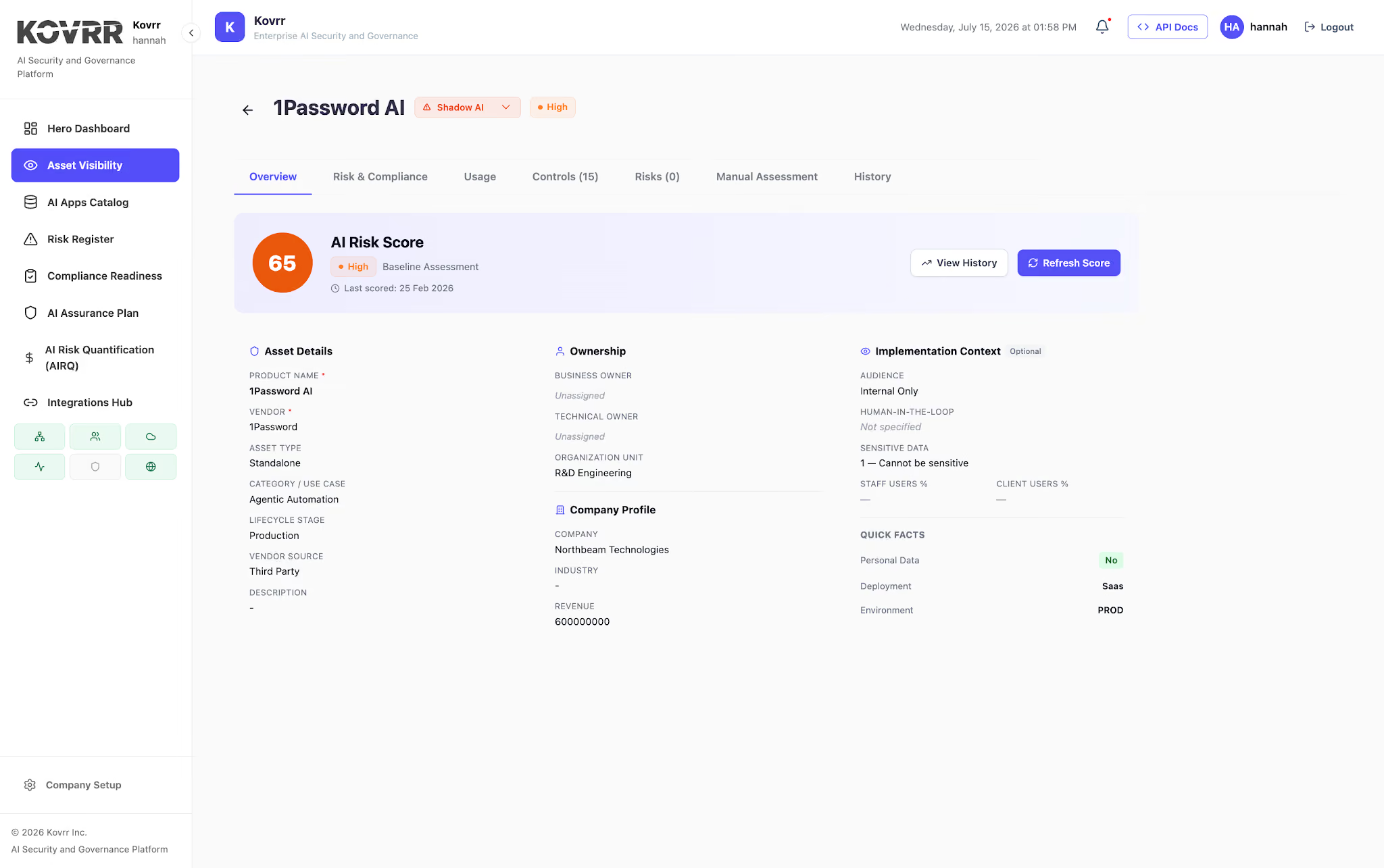
The reason connected telemetry works where point tools fail is that agents leave signals at every layer of the enterprise stack. A single-source tool sees one signal. A platform that fuses signals from every source sees the agent. Connected telemetry is the architecture that makes this fusion operational rather than theoretical.
Fused Signals From Multiple Collection Pointsl
- Browser telemetry: Captures AI activity happening in browser sessions, including shadow tool usage and browser-native agents like Copilot deployments.
- Endpoint and network signals: Surface agents operating server-side, agents calling external APIs, and agents embedded in enterprise SaaS platforms.
- Identity and AI catalog data: Attribute agent activity to specific humans, specific applications, and specific business processes rather than leaving alerts unattributed.
Continuous Rather Than Point-in-Time Discovery
Sprawl is a moving target. Agents are created and abandoned faster than any manual inventory can track, which means point-in-time scans decay the moment they finish. Continuous discovery baselines what normal looks like, catches new agents as they emerge, and flags abandoned agents whose original owners have moved on. This is where the foundation of responsible AI governance gets built.
Attribution That Links Agents to Humans and Systems
- Named-user attribution: Anonymous AI sessions are tied back to the specific humans who initiated them and the specific systems they touched.
- Business-process linkage: Every discovered agent gets mapped to the workflow it supports, so ownership questions have documented answers.
- Automatic AI Risk Register entries: Discovered agents populate the AI Risk Register with context, feeding downstream governance and quantification work without manual data entry.
Building an Agent Sprawl Control Program
Effective sprawl control combines discovery with the operational disciplines that keep the inventory accurate and actionable. Three areas cover the fundamentals.
Establish an Automated Agent Registry
- Dynamic inventory: Use continuous discovery to maintain an accurate ledger of every active agent across the environment.
- Explicit mapping per agent: Document the human sponsor, business purpose, authorized data access, and active integrations for every registered agent.
- Ownership assignment at creation: Require named ownership at the moment of deployment rather than as an audit finding six months later.
Manage Non-Human Identities With Discipline
- First-class agent identities: Assign unique digital identities to agents rather than allowing them to inherit human credentials or shared service accounts.
- Least-privilege scoping per action: Restrict tool and API access to the minimum required for the current task, with time-bound authorization that expires automatically.
- Automatic revocation on anomaly: Suspend credentials immediately when agent behavior deviates from baseline, without waiting for human review.
Formalize Lifecycle Management
- Autonomy tiers by risk: Classify agents by risk profile, with rapid-deployment pipelines for low-impact tasks and multi-step approval workflows for agents that act on production data.
- Regular access reviews: Routinely audit, merge, or deactivate idle and orphaned agents whose original creators have changed teams or left.
- Documented decommissioning: End every agent's lifecycle with an explicit revocation of credentials, removal from the registry, and closure of associated integrations.
Common Mistakes in Controlling Agent Sprawl
Failed sprawl programs follow predictable patterns. Watching for these avoids the traps other enterprises are still discovering.
Discovery and Inventory Mistakes
- Relying on a single signal source: A browser-only, network-only, or identity-only scanner misses the agents that operate outside that layer.
- Static inventories that decay: Point-in-time exports lose accuracy the day they are produced, since agents are created and abandoned continuously.
- No enforcement on unregistered agents: Discovery without enforcement produces a list of shadow agents no one is empowered to shut down.
Governance and Lifecycle Mistakes
- Shared credentials across agents: Reusing service account tokens across multiple agents makes attribution impossible and least-privilege enforcement pointless.
- No decommissioning process: Agents accumulate indefinitely when there is no defined lifecycle, leaving ghost agents with active tokens across the environment.
- Governance without runtime enforcement: Policy documents that specify what agents should not do have no operational effect if nothing at the execution layer blocks the prohibited behavior.
The shadow AI problem becomes materially harder to manage once agents are involved, since the shadow deployments now take autonomous action rather than merely process content. Enterprises that treat sprawl control as a discovery exercise without adding identity, lifecycle, and runtime controls will keep rediscovering the same problems.
Making Agent Sprawl Manageable at Enterprise Scale
Agent sprawl is not going to slow down. Every enterprise moving toward agentic AI will accumulate more agents, more integrations, and more autonomous actions across more systems over the coming quarters. The organizations that control sprawl successfully are the ones that combine continuous discovery across every telemetry source, identity discipline that treats agents as governed non-human workers, lifecycle management that keeps the inventory accurate, and runtime enforcement that stops unregistered agents from operating on critical systems.
Signals from browser, endpoint, network, and identity feed into a single analytical layer, which is what turns sprawl from an unmanageable proliferation problem into a governable portfolio. The same connected telemetry feeds downstream views into the AI Risk Register, governance oversight, and AIRQ (AI risk quantification) that translate agent inventory into decisions the CFO and board can act on.
To see how Kovrr helps enterprises discover, govern, and enforce controls on every AI agent operating across the environment, book a demo of the AI Security and Governance Platform.

AI Agent Sprawl FAQs
Speak to an ExpertWhat is AI agent sprawl?

How do organizations control AI agent sprawl?
Which tools help discover AI agents across the enterprise?
Which platforms provide visibility and control over AI agents?
How does agent sprawl relate to shadow AI?
How does agent sprawl affect regulatory compliance?