
Blog Post
What to Look for in an AI Security Platform for Enterprise Deployment
July 27, 2026
The enterprise AI security market in 2026 is crowded and confusing. Vendors that built their products to use AI for cybersecurity operations now market themselves alongside vendors that built their products to secure AI systems and govern AI usage. These are fundamentally different product categories solving different problems, and conflating them leads to evaluation errors that leave organizations protected against external threats but exposed to the risks their own AI systems introduce.
An enterprise AI security platform, in the strictest sense, should secure the AI systems operating within and around the organization. That means discovering what AI tools employees are using, monitoring how data flows through those tools, enforcing policies at the point of AI interaction, assessing AI-specific risks, mapping compliance against regulations like the EU AI Act and NIST AI Risk Management Framework (AI RMF), and quantifying AI exposure in financial terms the board can act on. Tools that use AI to enhance traditional cybersecurity operations (AI-powered SIEM, AI-driven endpoint detection, AI-assisted SOC automation) are valuable but address a different problem.
This guide defines the functional categories that make up an enterprise AI security platform, establishes the evaluation criteria that separate comprehensive solutions from point tools, compares the leading vendors by capability, and explains where most platforms fall short.
Two Markets Wearing the Same Name
The term "AI security" currently refers to two distinct product categories that buyers frequently conflate:
AI-powered cybersecurity tools use machine learning and AI to improve traditional security operations. CrowdStrike Falcon, Darktrace, and SentinelOne Singularity are leading examples. These platforms apply AI to endpoint detection, network anomaly identification, threat intelligence, and SOC automation. They protect the organization from external threats using AI as the detection and response engine.
AI security and governance platforms protect the organization from the risks that its own AI systems introduce. These platforms discover shadow AI, monitor data flows through AI tools, enforce acceptable use policies, assess AI-specific risks like prompt injection and data poisoning, map compliance against AI regulations, and quantify AI exposure in financial terms. This is the category this guide focuses on.
Some vendors, like Check Point Software, span both categories with modules for traditional threat protection alongside AI-specific governance capabilities. Others, like Wiz, focus on securing AI workloads in cloud environments. The evaluation framework below applies specifically to platforms that secure and govern the organization's AI footprint.
The Three Core Attack Surfaces an AI Security Platform Must Cover
An enterprise AI security platform must secure three core attack surfaces. These surfaces define the minimum scope a platform needs to address:
1. AI Usage Control
AI usage control addresses the shadow AI problem. This surface covers discovering and monitoring all AI tools being used across the organization, whether sanctioned, shadow, or embedded in third-party vendor products. Capabilities in this layer include:
- Shadow AI discovery that automatically identifies unapproved AI tools and APIs being accessed by employees across browser, network, and identity layers
- Data loss prevention for AI that enforces inline prompt redaction, data masking, and upload blocking to prevent sensitive information from reaching unauthorized AI services
- Usage monitoring that tracks which teams use which AI tools, how frequently, and what data types flow through each tool
- Policy enforcement that blocks, restricts, or allows AI tools based on organizational policy, applied at the point of interaction rather than after the fact
2. Application Protection
Application protection covers securing the AI models and LLM applications the organization builds or deploys, defending against the attack classes catalogued in the OWASP Top 10 for LLM Applications and mapped in MITRE ATLAS. This surface addresses:
- Model firewalls that inspect inputs and outputs to detect prompt injection, jailbreak attempts, and adversarial inputs before they reach the model
- Output filtering that prevents models from returning sensitive data, harmful content, or responses that violate organizational policies
- API security for AI service endpoints, including authentication, rate limiting, and abuse detection
3. Agentic Runtime Security
As autonomous AI agents move into production environments, runtime security for agents becomes a distinct requirement. This surface covers:
- Agent behavior monitoring that tracks what actions AI agents take, what data they access, and what permissions they exercise
- Guardrail enforcement that prevents agents from exceeding their authorized scope, escalating privileges, or executing actions without required human approval
- Tool use monitoring that tracks which external tools and APIs agents invoke and whether those invocations comply with organizational policy
Evaluation Criteria for Enterprise AI Security Platforms
Beyond the three attack surfaces, enterprise buyers should evaluate platforms against criteria that determine whether the tool can support a mature governance program or only addresses a narrow slice of the AI security challenge.
Discovery Coverage and Detection Methods
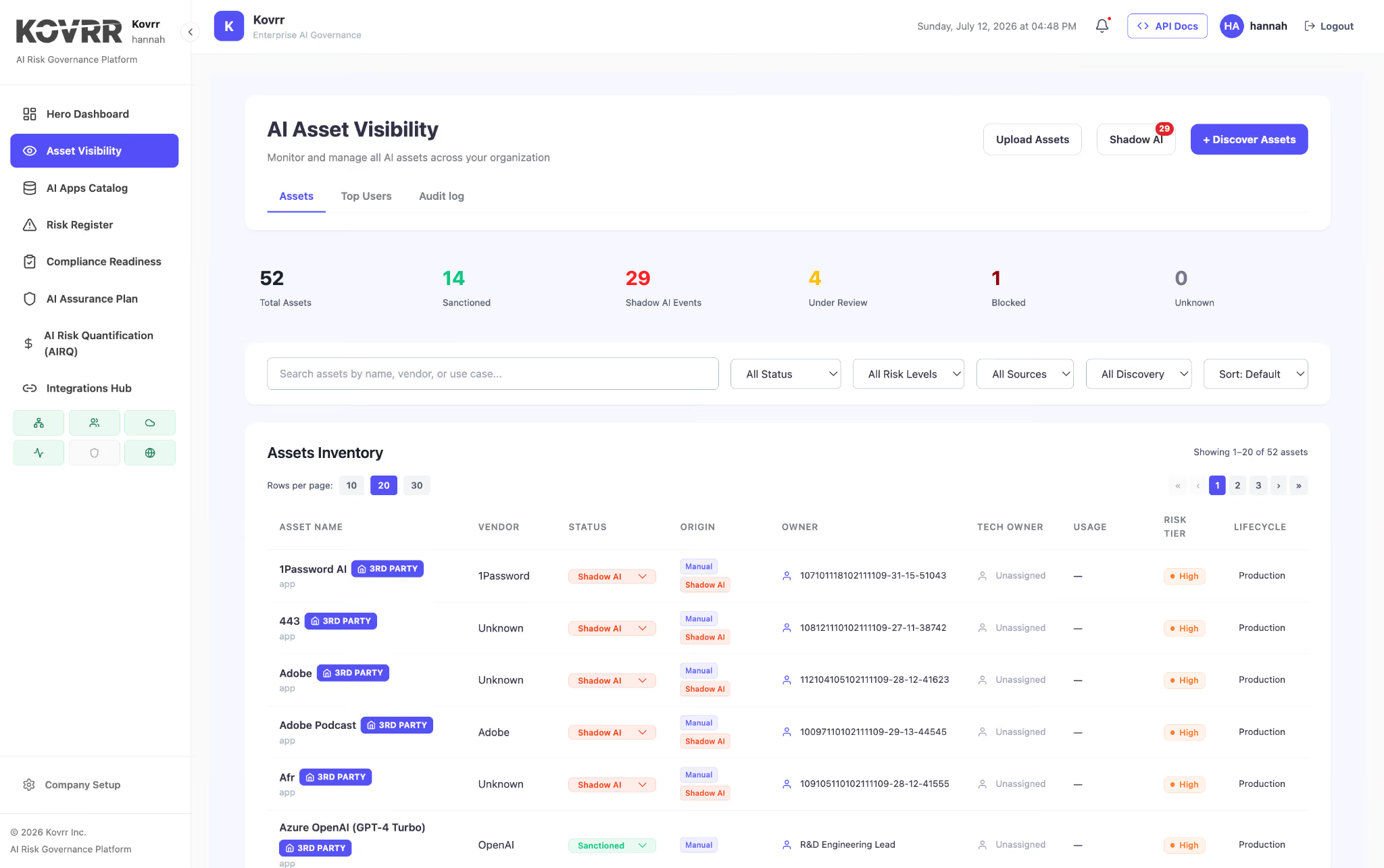
The platform's value starts with what it can see. Evaluate how the platform discovers AI systems:
- Does it detect browser-based AI tools, including those accessed through personal accounts and free tiers?
- Does it monitor OAuth consent grants and SSO integrations to identify AI tools connected to enterprise data?
- Does it analyze network traffic to identify connections to AI service endpoints?
- Does it surface AI features embedded within existing SaaS platforms that were never explicitly evaluated?
- Does it maintain a continuously updated AI asset inventory, or does it produce point-in-time snapshots that go stale?
Platforms that rely on a single detection method will miss portions of the shadow AI surface. The strongest platforms layer multiple detection approaches and correlate signals into a unified inventory. Read more about how AI asset discovery works and why it matters.
Risk Assessment and Quantification
Most AI security platforms provide some form of risk scoring, typically a qualitative rating (high/medium/low) based on the tool's data access, vendor reputation, or security posture. This is useful for initial triage but insufficient for mature governance.
Evaluate whether the platform can:
- Maintain a scenario-based AI risk register that catalogs specific AI risk events with ownership, likelihood, and impact scores
- Quantify AI risk in financial terms using data-driven models that produce defensible loss estimates rather than qualitative labels
- Compare AI risk against other enterprise risk categories (cyber, operational, financial) using common financial language
- Update risk scores dynamically as the AI environment changes rather than requiring manual reassessment
Financial risk quantification is the capability that most sharply differentiates platforms designed for governance from those designed only for security operations. Boards and executives allocate resources based on financial exposure, not color-coded risk matrices.
Compliance Mapping and Evidence Collection
With the EU AI Act enforcement deadlines approaching and NIST AI RMF increasingly referenced as a baseline standard, compliance readiness is an essential evaluation criterion.
Evaluate whether the platform can:
- Automatically map AI assets against applicable regulatory frameworks, including the EU AI Act, NIST AI RMF and its Generative AI Profile (NIST AI 600-1), ISO 42001, and sector-specific regulations
- Collect compliance evidence continuously and produce audit-ready documentation without manual assembly
- Classify AI systems by regulatory risk category (the EU AI Act's high-risk classification, for example) based on inventory data
- Track compliance status over time and surface gaps as new AI systems are discovered or regulations change
Most AI security tools in the market today do not address compliance. They detect threats and enforce policies but leave regulatory mapping and evidence collection to separate GRC tools or manual processes.
Third-Party AI Visibility
The EU AI Act holds deployers accountable for AI systems they use, even when purchased from vendors. Evaluate whether the platform provides:
- A vendor AI risk catalog that scores AI vendors based on their models, data handling practices, and security posture
- Continuous monitoring of third-party AI risk across the vendor ecosystem
- Alerts when vendor AI tools change their capabilities, data handling practices, or risk profiles
Deployment Model and Data Sovereignty
Enterprise buyers evaluating AI security platforms should assess where the platform processes data, what data it transmits to the cloud, and whether it supports deployment models that meet the organization's data residency requirements. According to NeuralTrust's buyer's guide, critical evaluation factors include threat model coverage, real-time versus offline capability, and deployment model with data sovereignty controls.
How Leading AI Security Platforms Compare
The market includes platforms that range from narrow point solutions to broad governance architectures. Understanding where each platform is strongest helps buyers assemble a stack or select a connected platform that covers the full scope.
AI Governance
These platforms focus on discovering AI assets, assessing security posture, and enforcing governance policies across the AI environment.
- Zenity specializes in agentic AI security, combining posture management with runtime controls for autonomous AI agents. Zenity is strongest for organizations deploying AI agents at scale and needing both pre-deployment governance and live execution monitoring.
- Pillar Security provides AI security posture management with a focus on identifying risks across the AI lifecycle, from development through production deployment.
- Holistic AI offers independent AI auditing, risk tiering, and compliance assessments, positioning itself as a third-party evaluator that provides unbiased risk assessments for regulatory contexts.
Shadow AI Discovery and Data Protection
These platforms focus specifically on detecting unsanctioned AI usage and preventing data leakage through AI tools.
- LayerX (acquired by Akamai) provides browser-level security that monitors and controls employee interactions with AI tools through the browser, including DLP capabilities that block sensitive data from reaching unauthorized services.
- Harmonic Security focuses on data protection for AI, tracking sensitive data flows into AI tools and enforcing policies to prevent intellectual property exposure.
- Keep Aware provides browser-based security monitoring focused on detecting and controlling AI tool usage at the endpoint level.
AI Application Security
These platforms protect AI models and LLM applications from adversarial attacks, prompt injection, and data poisoning.
- Lakera Guard provides real-time guardrails for LLM applications, inspecting inputs and outputs to detect prompt injection and other adversarial attacks before they reach the model.
- Meta's Purple Llama is an open-source framework for evaluating LLM safety, providing tools for red-teaming and content guardrail testing that organizations can integrate into their AI development pipelines.
- Prompt Security focuses on securing generative AI applications with inline content inspection and threat detection for LLM interactions.
Connected AI Security and Governance Platforms
A smaller number of platforms aim to connect multiple AI security functions into a unified architecture rather than addressing a single layer.
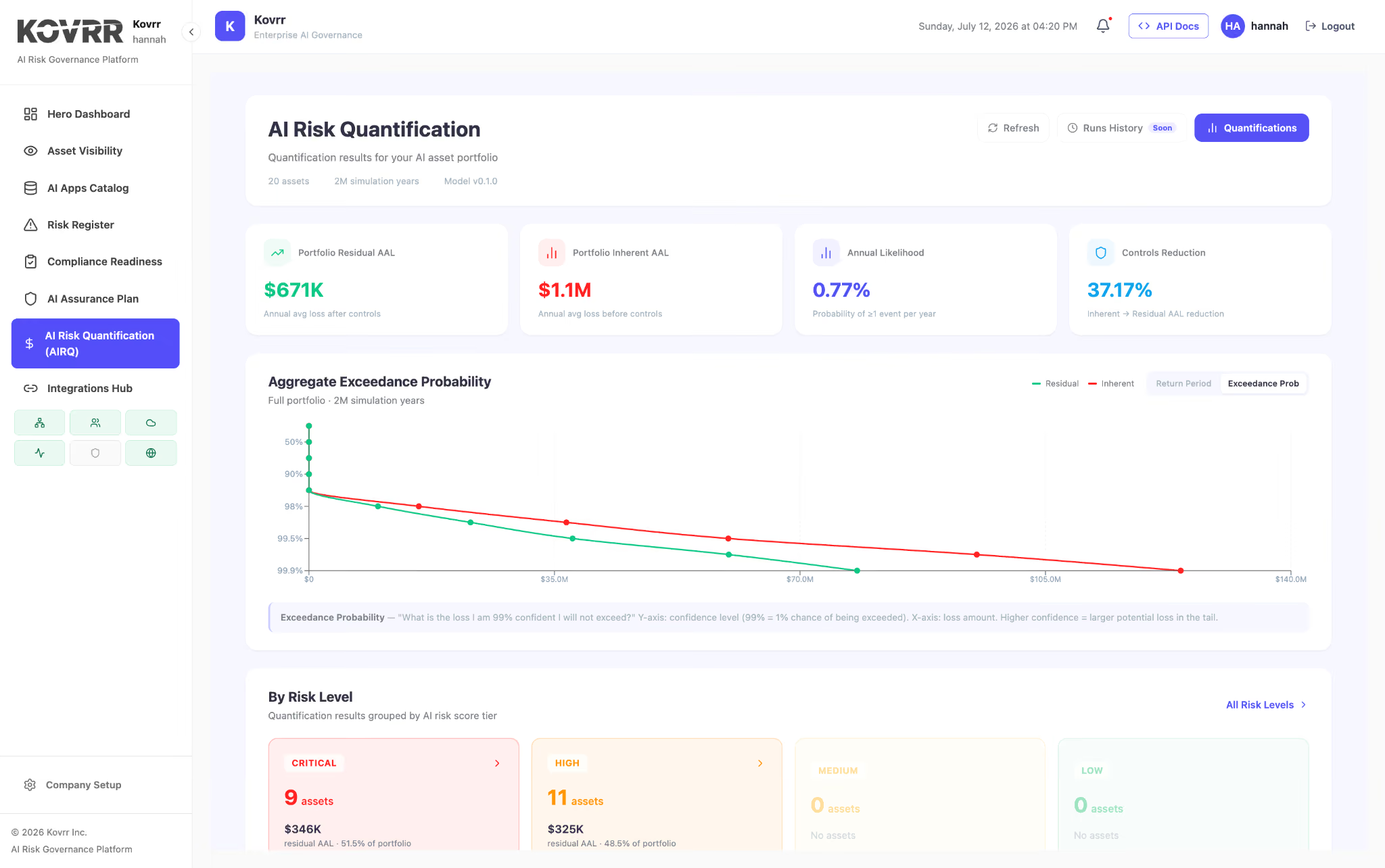
Kovrr's AI Security and Governance Platform takes this connected approach by integrating AI asset discovery, risk quantification, compliance mapping, and governance workflows in a single architecture. What distinguishes Kovrr from point solutions is the connection between functions:
- AI Asset Visibility provides continuous discovery of sanctioned, shadow, and third-party AI across the enterprise
- AI Risk Quantification (AIRQ) translates AI risk scenarios into insurance-grade financial estimates that enable board-level decision-making
- AI Compliance Readiness automates regulatory mapping and evidence collection against the EU AI Act, NIST AI RMF, and ISO/IEC 42001's AI management system (AIMS) requirements
- AI Risk Register maintains scenario-based risk assessments with financial scoring and ownership tracking
- Third-Party AI Monitoring provides continuous vendor risk assessment with an AI apps catalog covering 15,000+ AI vendors.
When the platform discovers a new AI tool, every downstream function updates automatically. The risk register adds relevant scenarios, AIRQ recalculates exposure, compliance checks run against applicable frameworks, and enforcement policies apply. That continuous loop eliminates the manual handoffs that slow down organizations using separate tools for each function.
Where Most AI Security Platforms Fall Short
After evaluating the market across these criteria, several consistent gaps emerge in most platforms:
- No financial risk quantification. The majority of AI security tools provide qualitative risk scores but cannot translate AI exposure into the financial language that boards and executives use for resource allocation decisions. Without quantification, AI risk competes poorly for budget against other enterprise risks that are reported in dollar terms.
- No compliance automation. Most platforms that excel at detection and enforcement do not address regulatory compliance. Organizations using these tools must maintain separate processes for mapping AI assets to EU AI Act requirements, collecting evidence, and preparing for audits.
- Detection without governance integration. Many platforms discover shadow AI effectively but leave the response to manual processes. Detection that does not automatically feed into a risk register, trigger compliance checks, and update financial exposure creates awareness without action.
- No third-party AI visibility. Most platforms focus on internally used AI tools and miss the significant exposure created by AI embedded in vendor products. Under the EU AI Act's deployer accountability provisions, this is a critical gap.
Organizations evaluating AI security platforms should assess not just what the platform detects but what it does with the detection data. A platform that discovers 500 shadow AI tools but cannot quantify their financial exposure, map their compliance implications, or automate the governance response is solving only the first step of a multi-step problem.
Choosing the Right Architecture for Your Organization
The right platform choice depends on where the organization is in its AI security maturity:
Early-stage organizations that need to establish baseline visibility into their AI footprint should prioritize platforms with strong discovery and shadow AI detection capabilities. Getting an accurate picture of what AI systems are in use is the prerequisite for every other governance activity.
Mid-maturity organizations that have basic visibility but need to operationalize governance should prioritize platforms that connect discovery to risk assessment, compliance mapping, and policy enforcement. This is where connected architectures provide the most value by eliminating the manual bridges between detection and governance.
Advanced organizations that have established governance programs and need to optimize for financial risk management and board reporting should prioritize platforms with insurance-grade risk quantification and automated compliance evidence collection. These capabilities transform AI governance from a security function into a strategic risk management discipline. For more on how to communicate AI risk to the board, read our detailed guide.
Every Platform Claim Should Answer One Question
The AI security platform market is full of impressive capability lists. The question that cuts through the noise is simple: when the platform detects a new AI risk, what happens next without a human manually bridging the gap?
If the answer involves exporting data to a spreadsheet, manually updating a risk register, separately running a compliance check, and assembling a board report from multiple sources, the platform is a detection tool, not a governance architecture. The platforms that deliver the most value are the ones where detection, risk assessment, compliance mapping, financial quantification, and enforcement operate as a connected system.
Request a demo to see how a connected AI security and governance platform works from discovery through board-level reporting.

AI Enterprise Deployment FAQs
Speak to an ExpertHow important is real-time monitoring versus periodic scanning?

What security certifications should an enterprise AI security platform have?
Do I need multiple AI security tools, or can one platform cover everything?
How do I evaluate AI security platforms for EU AI Act compliance?
What is AI Security Posture Management (AI-SPM)?
What is the difference between AI-powered cybersecurity tools and AI security platforms?


.png)
