Blog Post
Agent Identity: Why It Matters for AI Security
July 31, 2026
AI agent identity is a unique, digitally verifiable credential assigned to an autonomous AI system that defines who the agent is, what resources it can access, and on whose behalf it is acting. As AI systems move from answering questions to executing real-world actions independently, agent identity has become the new control plane for enterprise cybersecurity. Legacy identity and access management tools were built for humans behind a login screen and static service accounts running deterministic code. Agents fit neither model, which is why more than 90 percent of current IAM systems fall short when they encounter autonomous agentic workloads.
Getting agent identity right is what separates enterprises that can deploy AI agents safely at scale from those that quietly accumulate exposure with every new agent they spin up. This article covers what agent identity is, why legacy IAM cannot handle it, the four core risks agent identity solves, how to manage permissions and access for AI agents, and what to look for in a platform that can operate at the intersection of identity, AI risk visibility, and enterprise governance.
What Is AI Agent Identity?
AI agent identity is a verifiable digital credential architected to handle the non-deterministic nature of autonomous software. It defines what an agent is authorized to do, which resources it can reach, and how its actions trace back to a human principal when the agent operates on delegated authority. Unlike static machine credentials or human login sessions, agent identity is designed to be dynamic, ephemeral, and task-bound, since agents rarely execute the same workflow twice in the same way.
How Agent Identity Differs From Human Identity
Human identities are tied to a specific person, bounded by predictable working hours and known device profiles, and secured through interactive methods like passwords, biometrics, and multi-factor authentication. The security model assumes a human is on the other end of every session, and it depends on the human being able to complete an interactive challenge when access is questioned. Agents cannot complete interactive challenges the way humans can, and they operate around the clock at machine speed, which breaks the assumptions traditional human IAM was built around.
How Agent Identity Differs From Machine Identity
Machine identities are tied to standard applications or service accounts that execute static, deterministic code. A given machine identity performs the same API calls in the same order every time it runs, which makes anomaly detection straightforward and privilege scoping predictable. Agents interpret human goals, plan their own step-by-step logic, chain multiple tools together, and often act on delegated authority from a human user. Their access needs are highly ephemeral and task-bound, which makes standing broad-scope service account credentials a fundamentally poor fit for agentic workloads.
Why Legacy IAM Falls Short for AI Agents
Enterprise identity programs built over the last two decades were designed around users and services with predictable behavior. Agents break the underlying assumptions of both categories at once, which is where legacy IAM starts to fail.
Where Traditional IAM Breaks
- Static credentialing: Legacy IAM issues persistent credentials that agents inherit for every task, rather than scoping access to the specific action underway.
- Session-based assumptions: Traditional access controls assume a bounded session with a beginning and end, while agents operate in continuous execution loops.
- Human-shaped enforcement: Interactive challenges like MFA cannot be applied to autonomous workflows without introducing brittleness or being bypassed entirely.
What Agent Identity Requires Instead
- Dynamic, task-bound scope: Agent identity should grant just-in-time access to the specific resources needed for the current task and revoke them when the task completes.
- Cryptographic delegation: Every agent action should carry a verifiable chain showing which agent executed it, on whose authority, and under what policy.
- Continuous behavior baselining: Agent identity systems need to track normal operating patterns and flag deviation in real time, since agents change behavior as models and tools evolve.
Identity Borrowing and the Confused Deputy Problem
Two of the most common security failures in early agentic deployments come from cutting corners on identity architecture. Both create outsized blast radius, and both are avoidable with the right controls.
Identity Borrowing and Credential Sprawl
When organizations deploy AI agents quickly, they often skip creating a dedicated agent identity and let the agent operate using an employee's human credentials or a broad service account API key. In security logs, the autonomous agent becomes indistinguishable from the human user, which erases the audit trail exactly when accountability matters most.
Credential sprawl compounds the problem, since a single stolen or abused credential now grants access to whatever tools the agent has integrated, which is often more than any individual human user would ever hold. Weak AI governance increases organizational exposure fastest through exactly this pattern, where the shortcut becomes the standard operating procedure before controls catch up.
The Confused Deputy Problem
Because AI agents rely on dynamic reasoning, an attacker can manipulate them through prompt injection or malicious inputs. If the agent has broad, unrestricted access, a rogue prompt can trick the agent into misusing its valid credentials to download a restricted database, delete files, or exfiltrate data across systems.
The agent becomes a "confused deputy" attacking its own organization while using legitimate authorization. Proper identity scoping applies the principle of least privilege at the action level, granting the agent only the exact access required for the current task, which radically shrinks the blast radius when the agent is subverted.
Accountability, Audit Trails, and Ghost Agent Lifecycle
The next two failure modes emerge over time rather than at deployment. Both compound as agentic deployments scale.
The Delegation Chain Problem
AI agents are increasingly making autonomous day-to-day decisions like approving invoices, pulling customer data, or updating records across enterprise systems. When an agent acts erroneously or maliciously, legacy audit logs cannot differentiate whether a human user clicked a button or an AI executed a multi-step background loop.
The result is a gray area where responsibility is technically impossible to establish, which becomes a serious problem the first time a regulator or an incident response team needs to reconstruct what happened. Effective agent identity mandates a strict delegation chain, where every action in the audit trail is explicitly stamped with the agent's unique ID and the originating human user's context, so every autonomous action remains traceable.
Ghost Agents and Abandoned Tokens
Agents are routinely created by developers for quick tasks and then abandoned when the task completes, or the developer moves on. These "ghost agents" leave behind active tokens and persistent access paths that attackers can exploit, and they rarely appear in any enterprise inventory.
The shadow AI problem becomes materially worse when agents are involved, since the abandoned deployments still hold live credentials. Centralized identity governance ensures every active agent has an owner, a documented purpose, and a defined lifecycle, with automatic credential revocation when the agent is deprovisioned.
Best Practices for Managing Agent Permissions and Access
Managing agent permissions well is what turns identity from a policy document into an enforcement layer. Two sets of controls cover the practical fundamentals.
Core Principles for Agent Access
- Least-privilege scoping per action: Grant the minimum access required for the specific action the agent is executing, not the maximum access the agent might ever need.
- Just-in-time credentials: Issue short-lived credentials that expire when the task completes, so a compromised token has minutes of validity rather than months.
- Explicit human-on-behalf-of context: Every credential should carry the human principal the agent is acting for, so delegation is verifiable at execution time.
Runtime Controls That Matter
- Real-time behavior baselining: Continuous monitoring of tool calls, API usage, and data access patterns flags deviation the moment it appears.
- Guardrails on tool chaining: Block sequences of legitimate calls that combine into unauthorized outcomes, even when each individual call is permitted.
- Automatic revocation on anomaly: Suspend agent access immediately when behavior falls outside baseline, rather than waiting for a human to review.
What to Look For in an AI Agent Identity Platform
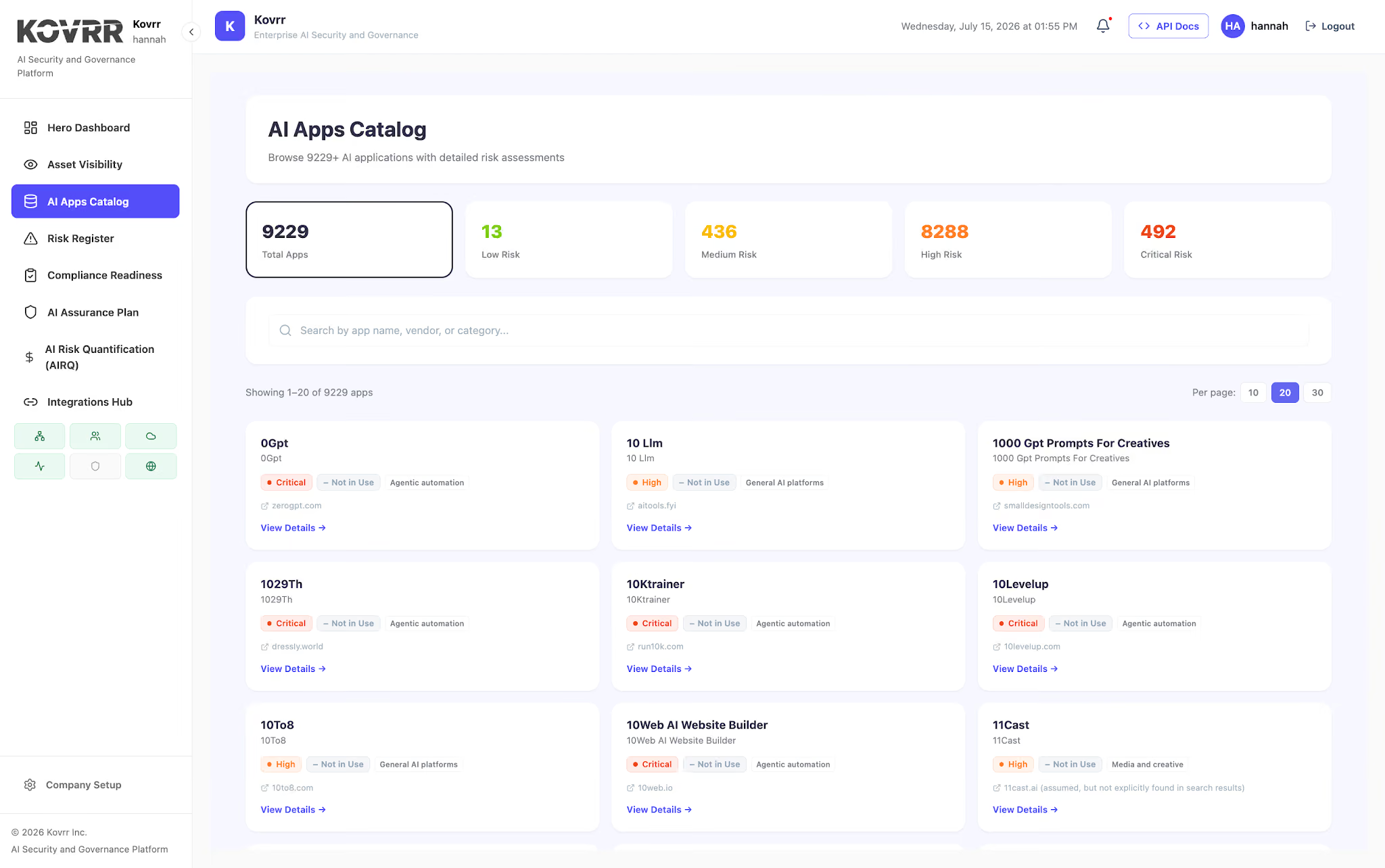
Enterprises evaluating agent identity platforms in 2026 face a rapidly maturing market with meaningful differences in capability. Two lenses cover the most important evaluation criteria.
Baseline Platform Capabilities
- Full agent inventory: The platform should discover every agent operating in the enterprise, including shadow deployments and ghost agents with active tokens.
- Delegation chain tracking: Every agent action should trace back to the originating human principal with a verifiable audit trail.
- Just-in-time credential issuance: The platform should support ephemeral, task-bound credentials rather than requiring standing long-lived tokens.
Enterprise-Grade Differentiators
- Integration with existing IAM stack: The platform should extend the enterprise identity provider rather than replace it, so agent identity operates alongside human and machine identity.
- Quantified risk visibility: Agent identity data should feed into AI risk quantification (AIRQ), so identity-driven exposure translates into a financial number leadership can act on.
- Governance and guardrail layering: Identity should sit alongside runtime guardrails, AI asset visibility, and enterprise governance policy in a single AI Security and Governance Platform rather than existing as an isolated identity silo.
The platforms best positioned to serve enterprise agentic deployments are the ones that treat identity as one control layer within a broader agent security architecture, connecting it to governance oversight, runtime enforcement, and quantified financial exposure.
Making Identity the Anchor of AI Agent Security
Agent identity is where the entire agentic AI security program either holds together or falls apart. Enterprises that get identity right create the traceability, scoping, and lifecycle discipline that every other control depends on, from guardrails to audit to quantification. Enterprises that treat identity as a legacy problem carry the risk that their next incident will involve an agent no one knew was still running, using credentials no one thought to revoke, taking actions no one can attribute.
The organizations moving fastest on agentic deployment in 2026 are the ones building agent identity into the platform layer from day one, alongside governance policy and runtime enforcement.
To see how Kovrr's platform connects agent identity, quantified exposure, and enterprise governance in one operational view, book a demo of the AI Security and Governance Platform.

Agent Identity for AI Security FAQs
Speak to an ExpertWhat is AI agent identity?

Why does agent identity matter for AI security?
How should organizations manage permissions and access for AI agents?
Can traditional IAM tools handle AI agents?
What are the best platforms for managing AI agent identity and access?
How does agent identity relate to shadow AI and ghost agents?