
Blog Post
How AI-Related Security Incidents Should Be Identified and Managed
August 2, 2026
AI-related security incident detection starts with knowing what AI systems are running across the organization. Without a complete, continuously updated inventory of sanctioned, shadow, and third-party AI tools, security teams cannot detect incidents involving systems they do not know exist. From there, effective incident management requires a structured response framework that connects detection to containment, investigation, remediation, regulatory notification, and governance integration.
Traditional cybersecurity incident response playbooks cover many of the foundational mechanics, including detection, triage, containment, and recovery. Where AI incidents differ is in the types of threats involved (prompt injection, data poisoning, model theft, autonomous agent misuse), the detection methods required (browser telemetry, model performance monitoring, AI-specific anomaly detection), and the regulatory reporting obligations that AI-specific regulations like the EU AI Act introduce.
This guide walks through a complete framework for identifying and managing AI-related security incidents, from the detection infrastructure that catches incidents early through the post-incident governance workflows that turn individual events into organizational learning.
Why AI Security Incidents Require a Distinct Approach
AI systems introduce attack surfaces and failure modes that traditional incident response processes were not designed to handle. Several characteristics make AI incidents fundamentally different from conventional cybersecurity events:
- Invisible attack vectors. Prompt injection, data poisoning, and adversarial inputs can compromise AI systems without triggering traditional security alerts. These attacks manipulate the logic of the model itself rather than exploiting infrastructure vulnerabilities that firewalls and endpoint detection tools are built to catch.
- Shadow AI as an unmonitored attack surface. Employees using unsanctioned AI tools create incident exposure that security teams cannot detect through standard monitoring. A data breach caused by an employee pasting sensitive customer records into a free-tier AI chatbot looks nothing like a traditional intrusion. Read more about shadow AI, where it hides, and what it costs.
- Third-party AI as a supply chain risk. Incidents originating from AI models embedded in vendor products may not generate any signal in your own monitoring infrastructure. The compromise happens in the vendor's environment, but your data is affected. Third-party AI monitoring is essential for detecting these incidents.
- Autonomous agent behavior. AI agents with system access can take unintended actions that create security incidents, from unauthorized data access to privilege escalation, without any human initiating the action.
- Regulatory notification triggers. AI-specific regulations create reporting obligations for certain types of AI incidents that go beyond traditional data breach notification requirements.
Organizations that rely exclusively on their existing cybersecurity incident response process for AI-related events will miss incidents, respond too slowly, and fail to meet regulatory obligations.
Phase 1. Building the Detection Infrastructure
Effective AI incident detection depends on three layers of visibility that work together to catch different types of events.
Layer 1. Continuous AI Asset Discovery
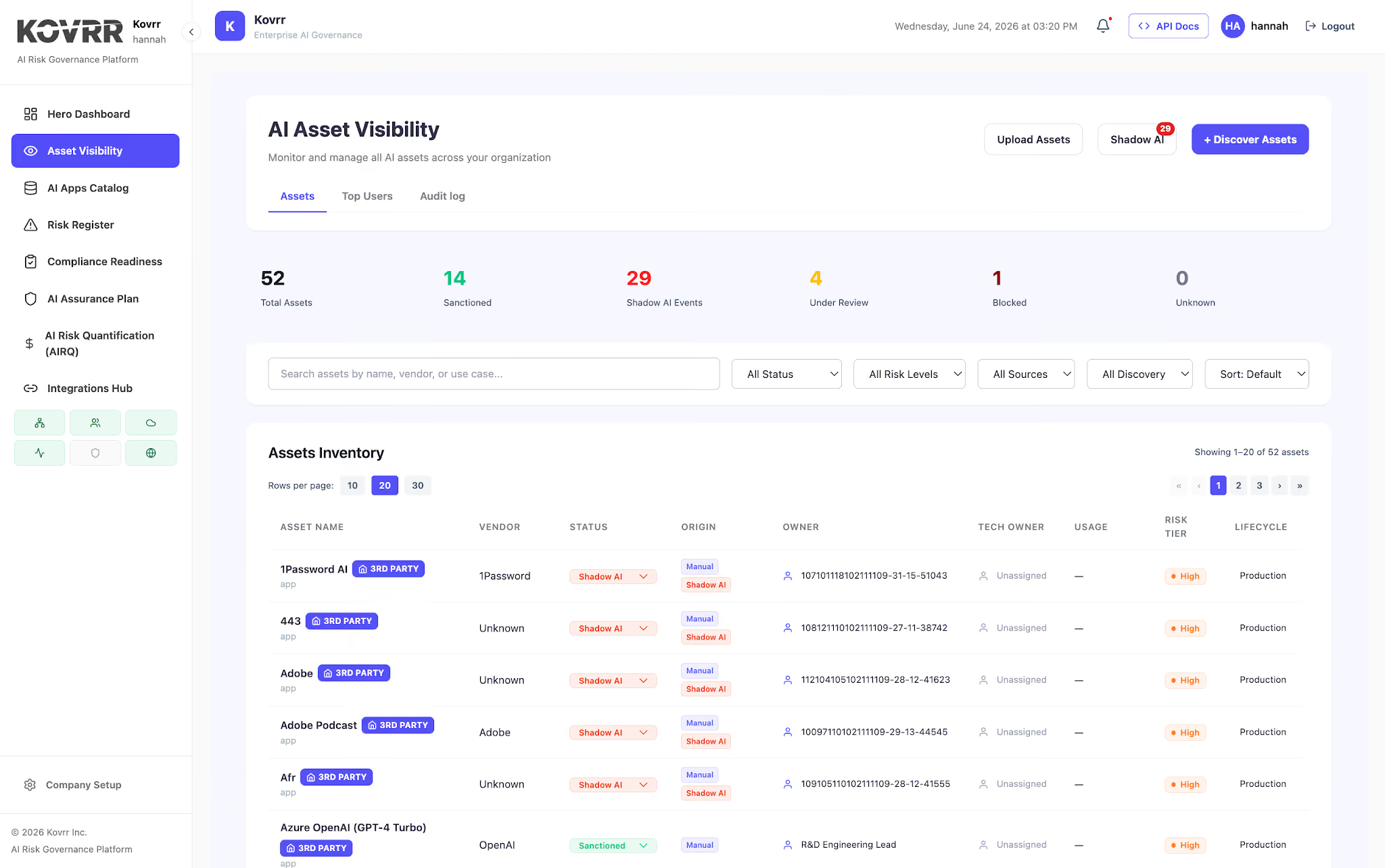
You cannot detect incidents in systems you do not know about. The foundation of AI incident detection is a continuously updated inventory of every AI system operating across the organization. This includes sanctioned tools, shadow AI adopted by employees, AI features embedded in existing platforms, third-party vendor AI, and autonomous agents.
Kovrr's AI Asset Visibility module provides this foundation through browser-level telemetry and endpoint monitoring that discovers AI tools in real time. When a new AI tool appears in the environment, the platform detects it immediately and feeds it into the security monitoring pipeline. That continuous discovery ensures the incident detection perimeter expands automatically as new AI tools enter the organization, rather than lagging behind until the next manual audit. Learn more about how AI asset discovery enables governance.
Layer 2. AI-Specific Anomaly Detection and Monitoring
Once you know what AI systems are running, the next layer monitors those systems for signals that indicate an incident is occurring or has occurred. AI-specific monitoring should cover:
- Data flow anomalies. Unusual volumes of sensitive data being sent to AI services, unexpected file uploads to AI platforms, or data exfiltration patterns through AI tool interfaces
- Model behavior anomalies. Sudden changes in model output quality, unexpected response patterns, or performance degradation that could indicate data poisoning or adversarial manipulation
- Access and authentication anomalies. Unauthorized users accessing AI systems, OAuth consent grants to unfamiliar AI services, or privilege escalation by AI agents
- Policy violations. Attempts to use blocked AI tools, uploads of restricted data types to AI platforms, or AI agent actions that exceed their authorized scope
Browser-level enforcement tools detect many of these signals at the point of interaction. When an employee attempts to upload a sensitive document to an unauthorized AI service, the enforcement layer blocks the action and generates an alert simultaneously, turning what would have been an undetected incident into a prevented one.
Layer 3. Integration with Existing Security Infrastructure
AI incident detection should enrich existing security workflows rather than creating a parallel monitoring stack. This means feeding AI-specific signals into:
- SIEM platforms where AI alerts are correlated with other security events for broader context
- CASB systems that monitor OAuth consent grants and API connections to AI services
- Endpoint detection platforms that flag unusual process behavior related to AI tools
- User behavior analytics that establish baselines for normal AI usage patterns and alert on deviations
The goal is a unified detection pipeline where AI-specific monitoring augments traditional security tools rather than competing with them for analyst attention.
Phase 2. The AI Incident Response Framework
When detection identifies a potential AI security incident, the response framework governs what happens next. AI incident response follows a similar structure to traditional cybersecurity incident response but adds AI-specific considerations at each stage.
Step 1. Triage and Classification
The first step is determining whether the detected event is a confirmed incident, what type of AI system is involved, and what severity level it warrants. AI incident classification should consider:
- What AI system is affected. A sanctioned enterprise AI platform has different risk implications than a shadow AI tool discovered through browser telemetry. A third-party vendor AI system introduces supply chain considerations.
- What data was exposed or processed. Sensitive customer data processed by an unauthorized AI tool has different severity than internal operational data used in a sanctioned AI workflow.
- What actions were taken. An AI agent that executed unauthorized transactions requires more urgent containment than a chatbot that produced biased but non-actionable outputs.
- What regulatory obligations apply. Incidents involving high-risk AI systems under the EU AI Act, personal data under GDPR, or financial data under sector-specific regulations may trigger mandatory reporting timelines.
Step 2. Containment
Containment for AI incidents may involve:
- Revoking access to compromised AI tools or suspending AI agent permissions
- Blocking data flow to affected AI services through browser enforcement or network controls
- Isolating compromised AI models to prevent further damage while investigation proceeds
- Disabling OAuth consent grants that provided AI tools with access to enterprise data
- Notifying affected vendors if the incident involves third-party AI systems
The speed of containment matters significantly for AI incidents because AI systems can process, store, and redistribute data faster than traditional applications. An AI tool that has been processing sensitive data for hours may have already generated outputs, cached content, or trained on the data in ways that are difficult to reverse.
Step 3. Investigation
AI incident investigation should establish:
- Identity. Which user, service account, or AI agent initiated the activity. Understanding whether the incident was caused by an employee's unauthorized AI usage, an AI agent operating outside its authorized scope, or an external attack targeting the AI system determines the remediation path.
- Scope. What data was accessed, processed, or exposed. For AI incidents this includes examining prompt histories, model inputs and outputs, training data that may have been contaminated, and downstream systems that consumed AI-generated outputs.
- Root cause. Whether the incident resulted from a policy failure (e.g., no enforcement preventing data uploads to unauthorized AI tools), a technical vulnerability (e.g., prompt injection exploiting a weakness in the AI model), or an operational failure (e.g., an AI agent granted excessive permissions).
- Impact. What the financial, operational, regulatory, and reputational consequences are. AI risk quantification (AIRQ) platforms can model the financial impact of specific incident scenarios, helping organizations prioritize response actions and inform regulatory disclosures.
Step 4. Remediation and Recovery
Remediation actions depend on the incident type:
- For shadow AI data exposure. Deploy browser-level enforcement to block the specific AI tool, review and update the organization's AI acceptable use policy, conduct data impact assessment to determine notification obligations, and add the tool to the blocked list in the enforcement platform.
- For prompt injection or adversarial attacks. Patch the vulnerable AI system, implement input validation and output filtering guardrails, conduct red-team testing to verify the fix, and review whether similar vulnerabilities exist in other AI systems.
- For AI agent misuse. Revise agent permission boundaries, implement additional human-in-the-loop controls for high-risk actions, and update the monitoring configuration to detect similar behavior.
- For third-party AI compromise. Engage the vendor's incident response team, review contractual obligations for notification and remediation, assess whether to suspend the vendor's AI services pending resolution, and update the vendor risk catalog with the incident data.
Step 5. Regulatory Notification
AI-specific regulations introduce notification obligations that security teams must incorporate into their response process:
- The EU AI Act requires providers and deployers of high-risk AI systems to report serious incidents to relevant authorities. Serious incidents include events that result in death, serious health impacts, disruption of critical infrastructure, or violations of fundamental rights.
- GDPR applies when AI incidents involve personal data of EU residents, triggering 72-hour notification requirements to supervisory authorities.
- Sector-specific regulations in financial services, healthcare, and critical infrastructure may impose additional notification timelines.
Organizations with automated compliance readiness capabilities can quickly determine which regulatory frameworks apply to a given incident and what notification obligations exist, reducing the risk of missed deadlines.
Phase 3. Post-Incident Governance Integration
The most important and most frequently neglected stage of AI incident management is feeding incident data back into the governance program. Every AI security incident generates information that should improve detection, strengthen controls, and refine risk models.
Update the AI Risk Register
Each incident should be mapped to the relevant scenarios in the AI risk register. If the incident matches an existing scenario, update the likelihood and impact scores based on observed data. If it represents a new type of event, add a new scenario to the register. Over time, incident data makes the risk register more accurate and more useful for prioritization.
Recalibrate Risk Quantification Models
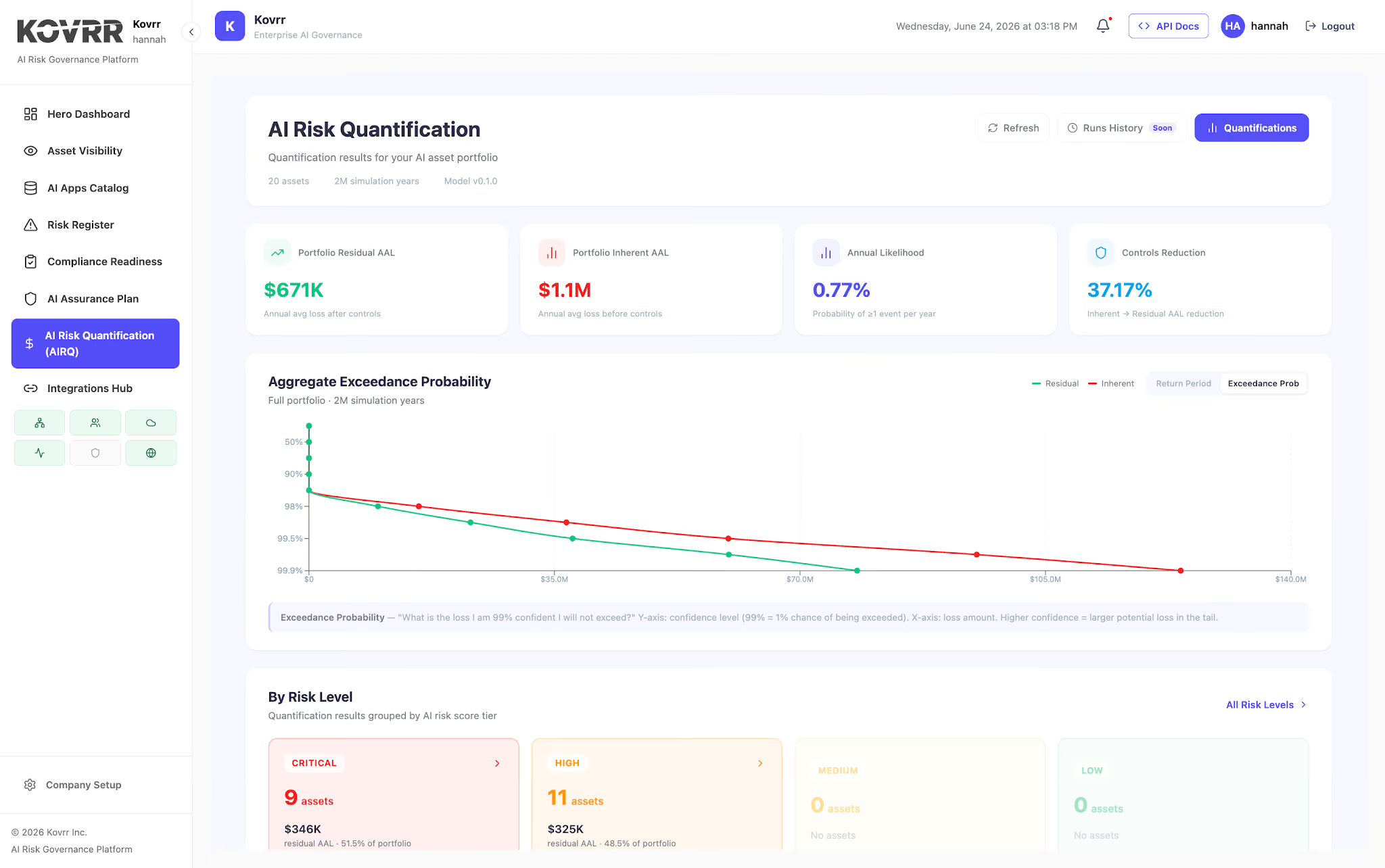
AIRQ tools can show a post-incident financial impact analysis with actual costs compared against the pre-incident modeled estimate, alongside updated annualized loss expectancy figures that incorporate the new data point.
Incident data provides real-world inputs for financial risk quantification. Actual incident costs, including investigation expenses, remediation costs, regulatory fines, business disruption, and reputational impact, should feed back into the quantification models to improve the accuracy of future loss estimates. This creates a virtuous cycle where each incident makes the organization's risk models more precise.
Strengthen Controls Based on Lessons Learned
Every incident reveals a gap in the control environment. Post-incident reviews should identify whether the gap was in detection (the incident was not caught soon enough), prevention (the incident could have been blocked), response (the response was too slow or incomplete), or governance (the AI system was not in the inventory or risk register). Remediation should target the specific gap rather than applying generic improvements.
Report to Executives and the Board
Material AI incidents should be reported to executive leadership and the board with financial impact data, root cause analysis, control improvements implemented, and an assessment of whether the incident indicates a systemic governance gap. Board-level reporting on AI incidents should translate technical details into business impact and governance implications.
Turning Incidents into Governance Intelligence
Identifying and managing AI security incidents effectively requires detection infrastructure that starts with continuous AI asset discovery, extends through AI-specific anomaly monitoring, and integrates with existing security tools. The response framework must account for AI-specific attack vectors, investigation techniques, and regulatory notification obligations that traditional cybersecurity playbooks do not cover.
The organizations that handle AI incidents best are the ones that treat every event as a governance input. Each incident that feeds back into the risk register, recalibrates financial quantification models, and strengthens detection and prevention controls makes the entire governance program more resilient. Incident response is not just about recovery. It is about building an organization that gets harder to compromise over time.
Schedule a demo today to see how connected AI governance infrastructure supports the full incident lifecycle from detection through post-incident governance integration.

Managing AI Incidents FAQs
Speak to an ExpertWhat are the most common types of AI security incidents?

How does AI incident response differ from traditional cybersecurity incident response?
How do you detect AI security incidents involving shadow AI tools?
What regulatory notification obligations apply to AI security incidents?
How should organizations prioritize which AI incidents to investigate first?
Should AI incidents be tracked separately from other cybersecurity incidents?