
Blog Post
AI Agents and MCP: Security Implications
July 29, 2026
The Model Context Protocol has quietly become the connective tissue of enterprise agentic AI. MCP standardizes how AI agents discover, request, and invoke tools, data sources, and external systems, replacing the custom integration code that used to sit between every agent and every backend.
That standardization is what made agents commercially viable at scale. It is also what turned MCP into one of the largest and least-understood attack surfaces in enterprise AI. Every MCP server becomes an autonomous execution endpoint, every tool an agent can call becomes a potential vector, and every dynamic reasoning path an agent takes complicates forensic reconstruction after the fact.
Enterprises deploying agents against MCP need a security approach that spans discovery, guardrails, incident response, and governance integration, not a single-layer identity or network control. This article covers how AI agents interact with MCP, the four categories of security risk that emerge from that interaction, how to implement guardrails for autonomous MCP-connected agents, how to build incident response plans that account for AI agent failures, and where connected telemetry across multiple signal sources changes the operational picture.
What Is the Model Context Protocol? How Do AI Agents Interact With It?
The Model Context Protocol is an open standard for connecting AI agents to external tools, data sources, and systems through a consistent client-server architecture. The agent operates as the MCP client, and the servers expose predefined capabilities like database queries, SaaS integrations, and internal API calls that the agent can invoke on demand. The design eliminates the need for developers to write custom integration code for every combination of agent and backend, which is what enabled the rapid proliferation of agentic deployments over the past year.
The Four-Step MCP Interaction Lifecycle
An agent working through MCP follows a consistent lifecycle regardless of the specific tools involved. First is discovery, where the agent connects to an MCP server and enumerates the available tools, resources, and their input schemas. Second is intent formation, where the agent reasons about the user's goal and identifies which tools it needs to fulfill the task.
Third is function calling, where the agent extracts arguments from context, formats them into structured JSON-RPC requests, and transmits them to the server. Fourth is execution and response, where the server acts as an isolated adapter that runs the code, queries the database, or calls the external API, then streams the result back to the agent's context window for continued reasoning.
Why MCP Expands the Enterprise Attack Surface
Every MCP server the agent can reach becomes part of the enterprise attack surface. Because agents chain multi-step reasoning across many tools, a single compromised MCP server can cascade into unauthorized actions across every system the agent has legitimate access to.
Traditional firewalls and REST API gateways operate on deterministic request patterns, but MCP agents produce non-deterministic action chains that these controls were not designed to inspect. The same structural difference between agents and generative AI that makes agents transformative for productivity is what makes MCP a distinct security discipline rather than a natural extension of existing API security.
The Four Categories of MCP Security Risk
MCP security exposure concentrates in four categories. Understanding all four is a prerequisite to building the controls and incident response playbooks the discipline demands.
Advanced Prompt Injection Attacks
MCP dramatically expands the surface area for indirect prompt injection. An agent that reads a compromised resource through MCP, whether an email, a customer support ticket, or a shared document, can be tricked into executing unauthorized tool commands. When the underlying language model processes the payload, it interprets the malicious instruction as legitimate context rather than as an attack. Rogue MCP servers can go further and use reverse-channel requests to bypass client-side input filters entirely, feeding the agent instructions the local guardrails never see.
Identity Blind Spots and Privilege Escalation
Identity delegation frequently breaks down as agents chain calls across MCP servers. When an agent invokes a secondary tool that invokes a tertiary tool, the original human user's identity often disappears from the audit chain, and security platforms lose the ability to distinguish between a human-initiated action and a rogue agent process.
Many MCP implementations also lack granular row-level or capability-level authorization. An agent granted database access to check inventory levels can inherit broader OAuth tokens that expose financial records or customer PII, which is exactly the category of over-permissioned agent risk most enterprise programs underestimate.
Supply Chain Vulnerabilities and Shadow MCPs
Because developers can stand up community-built or homegrown MCP servers instantly, unvetted "shadow MCPs" proliferate across enterprise environments the same way shadow SaaS tools did a decade ago. Tool poisoning attacks target this exact pattern, where a compromised or malicious MCP server exposes tools whose schemas look benign but whose implementations execute unauthorized code under the hood. The shadow AI discovery discipline extends directly to shadow MCP, since both create the same fundamental problem of ungoverned autonomous action against enterprise systems.
Disappearing Audit Trails
Traditional programmatic APIs are deterministic and produce clean per-event logs. MCP agents chain actions together dynamically based on fuzzy contextual reasoning, which makes tracing the exact sequence of choices, prompt context, and dynamic execution path exceptionally difficult during an incident.
Standard audit tooling captures the individual tool calls but often misses the reasoning path that produced them, which is where forensic reconstruction breaks down. Without persistent audit trails covering both the technical calls and the reasoning context, incident response teams cannot answer the most important post-incident question: why did the agent do what it did?
How to Implement Guardrails for AI Agents Interacting With MCP
Guardrails for MCP-connected agents operate at two layers. The Zero Trust foundation defines the identity and authorization architecture the agent operates within, and runtime enforcement blocks specific behaviors as they attempt to execute.
Zero Trust Foundations for MCP
- OAuth 2.1 with token exchange: Never pass hard-coded static API credentials or master OAuth tokens directly into the agent context; use modern token exchange frameworks to preserve user-session accountability across every MCP hop.
- Just-in-time scoped credentials: Issue short-lived credentials scoped to the specific action underway, so a compromised token has minutes of validity rather than months, and no agent inherits standing broad-scope access.
- Persistent identity delegation: Every MCP call carries the originating human principal's identity so audit trails can reconstruct who authorized what, even across multi-agent chains.
Runtime Enforcement Patterns
- Human-in-the-loop gates: Mandatory approval workflows before an MCP server executes high-impact actions like financial transactions, external communications, or bulk data operations.
- Tool chain constraint enforcement: Runtime controls that block sequences of legitimate calls that combine into unauthorized outcomes, even when each individual call is permitted in isolation.
- Anomaly-triggered kill switches: Automatic revocation of agent credentials and execution halt the moment behavior deviates from baseline patterns, without waiting for human review cycles.
How Incident Response Plans Should Account for AI Agent Failures
Standard incident response playbooks were built for human-driven attacks against deterministic systems. Agentic AI failures break enough of those assumptions to require dedicated updates rather than incremental adjustments.
Why Standard IR Playbooks Fall Short
Traditional playbooks assume the incident timeline is linear and reconstructable from logs. Agent-driven incidents unfold across non-deterministic reasoning paths, dynamic tool chains, and MCP call sequences that no single log source captures fully. Playbooks assume containment means blocking a specific IP or revoking a specific credential.
Agent containment means halting reasoning loops, revoking scoped credentials, and preventing cascade into connected agents that consumed the compromised agent's outputs. Playbooks assume the responsible party is a human attacker. Agent incidents often involve legitimate human principals whose credentials were subverted through the agent, which changes the attribution and remediation workflow substantially.
MCP-Specific Detection and Containment
Detection needs to cover the MCP-specific signals that traditional monitoring misses. Anomalous tool selection patterns, sudden spikes in cross-server call chains, and unexpected reasoning trajectories all indicate potential compromise before the impact fully materializes. Containment requires the ability to revoke MCP-level credentials instantly, halt agent reasoning without corrupting connected systems, and isolate any downstream agents that consumed the affected agent's outputs. The operational focus on preparing for AI-specific cyber events is what turns generic IR readiness into agentic-ready response capability.
Post-Incident Forensics for Non-Deterministic Agents
Reconstructing what happened after an MCP incident requires more than log correlation. Forensic teams need access to the reasoning context, tool selection history, and prompt payloads that drove the agent's decisions. This is where audit trails designed specifically for agentic systems produce meaningfully better forensic outcomes than repurposed application logs.
Programs that build agent-specific audit capabilities into the platform layer from day one produce incident reports that regulators, auditors, and boards can act on. Programs that assume standard application logging will suffice produce incident reports that raise more questions than they answer, which is a failure mode weak AI governance tends to surface only after the first real incident.
The Role of Connected Telemetry in MCP Security
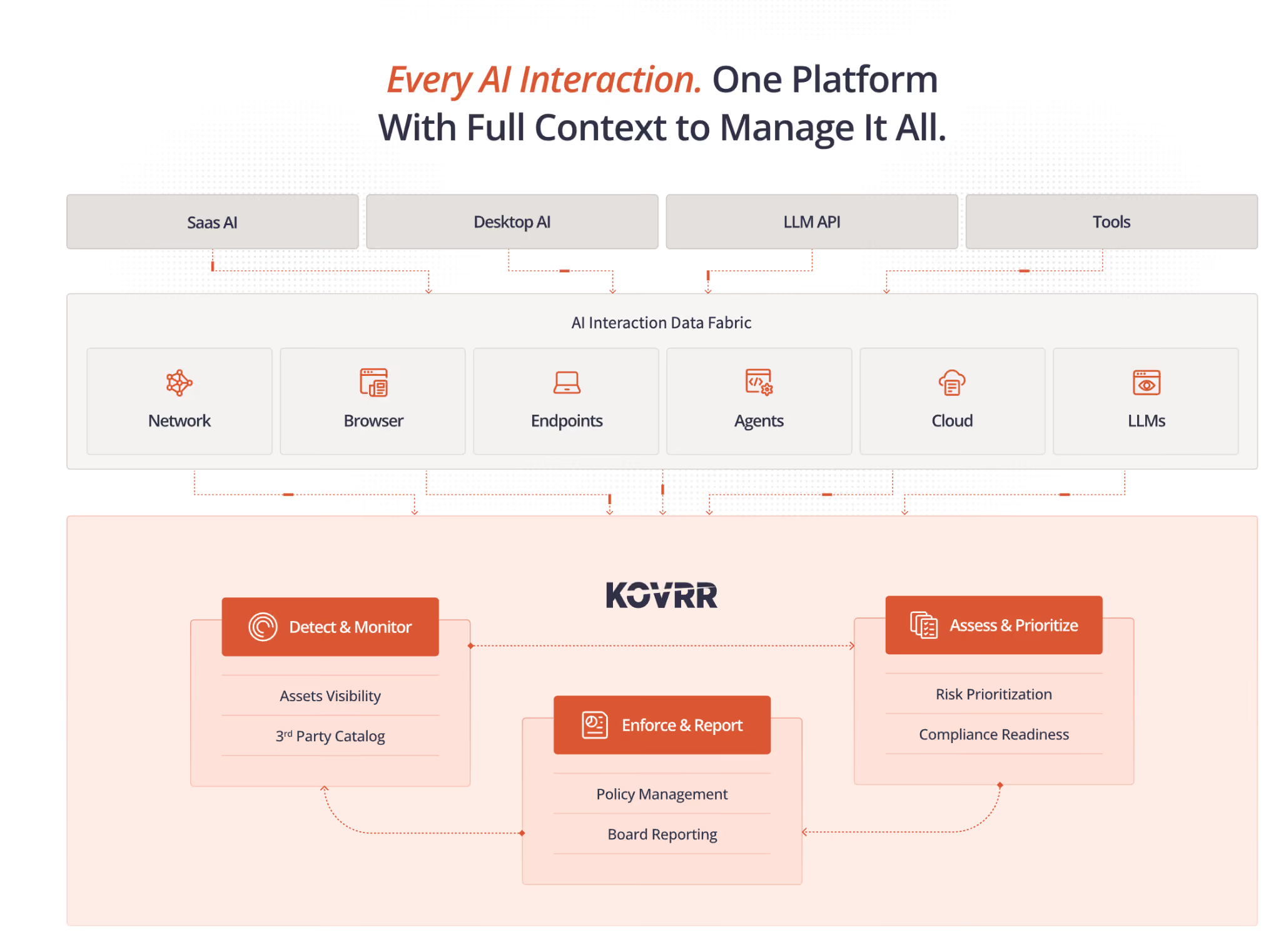
The reason single-tool MCP security approaches fall short at the enterprise scale is the same reason single-tool agent monitoring falls short. Agents leave signals at every layer of the enterprise stack, and MCP-driven actions touch far more of that stack than any point tool can see on its own.
What Single-Signal Tools Miss
An identity-focused MCP security tool sees the token exchange and permission scope but misses the browser session where the initial prompt originated. A network-focused tool sees the JSON-RPC traffic but misses the agent identity and business process context. An endpoint tool sees the local execution behavior but misses the third-party MCP server the agent called. Every point tool sees its own layer well and everything else poorly, which is why enterprises running multiple isolated tools still miss the multi-layer attack chains connected monitoring surfaces immediately.
How Triangulated Signals Catch MCP Anomalies
Connected telemetry ingests data continuously from browser sessions, endpoints, network flows, identity providers, third-party AI catalogs, and MCP server activity into a single analytical layer. That fused signal set produces attribution linking every MCP call back to the originating human principal, the specific business process it supports, and the AI risk register entry that governs the deployment. The same underlying data feeds governance policy enforcement, incident response, and financial exposure quantification without requiring separate integrations for each downstream use.
Common Mistakes When Securing MCP Deployments
Failed MCP security programs follow predictable patterns. Two categories cover most of the traps.
Architecture and Access Mistakes
- Passing static credentials into agent contexts: Long-lived tokens embedded in agent configuration create standing exposure that no runtime guardrail can fully mitigate.
- Deploying without a governed MCP inventory: Programs that let developers stand up MCP servers without centralized registration produce shadow MCP portfolios governance can never fully secure.
- Skipping row-level or capability-level authorization: All-or-nothing access grants ensure that any compromised agent inherits far broader access than any specific task requires.
Operational and Response Mistakes
- Treating MCP monitoring as engineering-only: Signals that never reach security, governance, or incident response teams produce dashboards that catch technical issues but miss policy violations.
- Missing agent-specific incident response playbooks: Generic IR runbooks that assume linear, human-driven attacks fail on the first real agentic incident.
- No integration between MCP security and AI governance: Programs that treat MCP as a standalone security discipline miss the discovery, monitoring, enforcement, and quantification integration that turns individual controls into a coherent program.
From MCP Governance to Governed Autonomous AI
MCP security is not a single-tool purchase. It is a discipline that spans discovery of every MCP server, guardrails that constrain what agents can do through them, incident response plans built for non-deterministic agent failures, and continuous integration with the broader AI governance program.
Enterprises that build all four together create the operating capability to deploy MCP-connected agents at scale with defensible controls, audit trails, and financial exposure figures leadership can act on. Enterprises that treat MCP security as a single-layer identity or network problem discover the missing layers the first time a shadow MCP or a compromised tool chain produces a real incident.
To see how Kovrr connects MCP telemetry, agent identity, governance policy, and quantified exposure into one operational view, book a demo of the AI Security and Governance Platform.

AI Agents and MCP FAQs
Speak to an ExpertHow does connected telemetry improve MCP security compared to identity-only or network-only tools?

How does shadow MCP relate to broader shadow AI risk?
What is prompt injection through MCP and why is it different from standard prompt injection?
How should incident response plans account for AI agent failures?
How do organizations implement guardrails for autonomous AI systems?
How do AI agents interact with MCP and what are the security implications?