
Blog Post
Agentic AI vs. Generative AI: What Enterprises Need to Know
July 16, 2026
Agentic AI and generative AI both build on large language models, but they behave in fundamentally different ways once deployed. Generative AI produces content in response to a specific prompt and then stops. Agentic AI receives a goal, then autonomously plans, decides, and executes multi-step workflows to accomplish that goal, often across systems and tools the enterprise runs. That difference is the difference between an AI that helps a human do work faster and an AI that does the work itself.
For enterprise security, risk, and governance teams, the distinction matters far more than the terminology suggests. Agentic AI introduces a new category of operational and security exposure, requires different controls than generative AI, and demands governance frameworks that account for autonomous action. This article covers the core differences between the two, how they work together in real enterprise deployments, where agentic AI creates new risks, and the difference between AI governance and AI guardrails as enterprises build defensible AI risk programs.
What Is Generative AI?
Generative AI is a category of AI systems designed to produce new content in response to a human prompt. That content might be text, code, images, video, or audio. It works by recognizing statistical patterns across massive datasets and generating outputs that reflect those patterns.
The interaction pattern is reactive. A user submits a prompt, the model processes it in a single inference cycle, and it returns a result. Between prompts, the system is idle. It does not act on its own, does not maintain persistent state across sessions in most deployments, and does not decide what to do next.
Where generative AI creates value in the enterprise is in accelerating human work. Drafting emails, summarizing documents, generating code snippets, producing marketing content, and answering internal knowledge questions are all natural fits. The human remains in the loop for every meaningful decision.
What Is Agentic AI?
Agentic AI describes systems designed to autonomously pursue multi-step objectives with minimal human supervision. Instead of waiting for step-by-step prompts, an agent operates in a continuous loop of perceiving its environment, reasoning about what to do, planning a sequence of actions, and executing those actions through the tools and systems it has access to.
An agent integrates a large language model as its cognitive core but extends the LLM with additional capabilities that generative AI does not require. These capabilities include long-term memory, external tool access through APIs, persistent state across interactions, and coordination with other specialized agents. The result is a system that can take a business goal like "resolve this customer complaint end-to-end" and independently work through every step it takes to accomplish that goal, from database lookups to CRM updates to email sends.
This autonomy is what makes agentic AI transformative, and also what makes it a distinct category of risk from generative AI. An agent that can take real action against real systems is subject to a different threat model, requires a different set of controls, and demands a different governance approach.
The Structural Differences Between the Two
Every enterprise conversation about agentic AI starts with the question of how it actually differs from the generative AI teams already use. Two axes cover most of the distinction: behavior and workflow.
Behavior and Autonomy
- Interaction pattern: Generative AI is reactive and responds to prompts. Agentic AI is proactive and takes initiative to complete goals.
- Output type: Generative AI produces content like text, code, or images. Agentic AI produces action, system orchestration, and end-to-end automation.
- Autonomy level: Generative AI requires human interaction at each turn. Agentic AI coordinates full processes without a human in the loop for every step.
Workflow and Memory
- Task scope: Generative AI handles single-turn tasks or isolated content requests. Agentic AI executes dynamic, multi-step strategies that span systems.
- State handling: Generative AI is stateless and forgets context once a session ends. Agentic AI is stateful and maintains persistent memory across days or sprints.
- Tool integration: Generative AI mostly runs inside its own interface. Agentic AI connects to databases, CRMs, browsers, and external APIs to execute work.
How the Two Work Together in Enterprise Deployment
Agentic AI and generative AI are not competing technologies. In practice, agentic systems use generative AI as a component. The agent handles the reasoning, planning, and orchestration, and calls a generative model whenever it needs to produce content along the way.
A common enterprise pattern looks like this. An agent monitors an incoming customer support queue, identifies complaints that meet specific criteria, retrieves relevant account data, decides on the appropriate resolution, and then calls a generative model to draft the response email. The generative model produces the language. The agent decides when to send it, to whom, and what to do next based on the customer's reply. This layered architecture is where most enterprise value from AI will be realized over the next few years, and it is also where the risk visibility problem becomes acute.
Enterprises that already use generative AI extensively often underestimate how different agentic deployment is from a controls perspective. The security team may have well-established policies for how generative AI can be used. Those policies rarely account for autonomous action, cross-system access, or the accountability questions that agentic AI introduces.
Where Agentic AI Introduces New Risks
The autonomy that makes agentic AI valuable is also what makes it a distinct security and operational challenge. Two categories of risk deserve immediate attention.
Security Risks Unique to Agents
- Prompt injection at scale: A single manipulated input can redirect an agent's entire workflow, not just a single response.
- Excessive permissions: Agents often request broad API and system access to be useful, creating an oversized blast radius when compromised.
- Cross-system exfiltration: An agent with legitimate access to multiple systems can exfiltrate data across boundaries a human user would never cross in one session.
Operational Risks Unique to Agents
- Cascading failures: One incorrect decision by an agent can propagate through downstream systems before any human notices.
- Accountability gaps: When an autonomous system makes a business decision, tracing responsibility becomes materially harder than with human-in-the-loop workflows.
- Silent drift: An agent whose underlying model or guardrails change without notification can quietly begin behaving differently than the risk assessment assumed.
Enterprises deploying agentic AI need governance and prioritization frameworks that account for these categories from day one, since retrofitting controls after an incident is significantly harder than building them in during deployment.
AI Governance vs AI Guardrails: The Key Distinction
Enterprise conversations about agentic AI regularly conflate two very different concepts. Both matter, but they operate at different layers of the stack.
What AI Governance Covers
- Policy and accountability: Governance defines who is responsible for AI decisions, what use cases are approved, and how risk is reported to leadership.
- Regulatory alignment: Governance maps AI deployments to frameworks like the EU AI Act, ISO 42001, and NIST AI RMF.
- Program-wide oversight: Governance operates at the enterprise level, spanning every AI system, every business unit, and every stage of the AI lifecycle.
What AI Guardrails Cover
- Runtime enforcement: Guardrails are the technical controls that stop specific behaviors in real time, applied to a specific model or agent at the point of execution.
- Input and output filtering: Guardrails intercept prompts, outputs, and tool calls to prevent policy violations before they reach users or systems.
- Behavioral boundaries: Guardrails constrain what an agent can and cannot do, regardless of what its underlying model would otherwise produce.
Governance is the strategy. Guardrails are the enforcement layer. A serious enterprise AI program needs both, and treats them as complementary rather than interchangeable. Kovrr's AI Security and Governance Platform is built around this layered architecture, combining governance-level oversight with guardrail-level enforcement so security and risk leaders can operate at both layers from the same platform.
What AI Agent Guardrails Are and Why They Matter
AI agent guardrails are the technical safeguards that constrain what an autonomous agent can do in production. They sit between the agent's decision-making and the real-world systems it can interact with, enforcing enterprise policy at the moment of action rather than after the fact.
Types of Agent Guardrails
- Input guardrails: Filter incoming prompts and data to prevent prompt injection, malicious instructions, and policy-violating content from reaching the agent.
- Output guardrails: Inspect the agent's proposed responses and actions to prevent harmful, biased, or unauthorized outputs from being executed.
- Behavioral guardrails: Constrain what tools, APIs, systems, and data the agent can access, along with the actions it can take on each.
Why They Matter for Enterprise Deployment
- Blast radius control: Guardrails limit the damage an agent can do if compromised, misdirected, or operating outside expected parameters.
- Regulatory compliance: Frameworks like the EU AI Act require documented controls on high-risk AI systems, and guardrails provide the enforcement layer that governance policy references.
- Trust and adoption: Business units are more willing to deploy agentic AI when they can see documented controls on what the system can and cannot do, which speeds up responsible enterprise rollout.
Well-designed guardrails become the primary reason enterprises can deploy agentic AI at scale rather than keeping every use case in a narrow pilot phase. Top AI governance tools for shadow and agentic risks sit at the intersection of visibility, governance, and guardrail enforcement, which is where most enterprise agentic programs will need to operate.
Preparing Enterprise Programs for Agentic AI
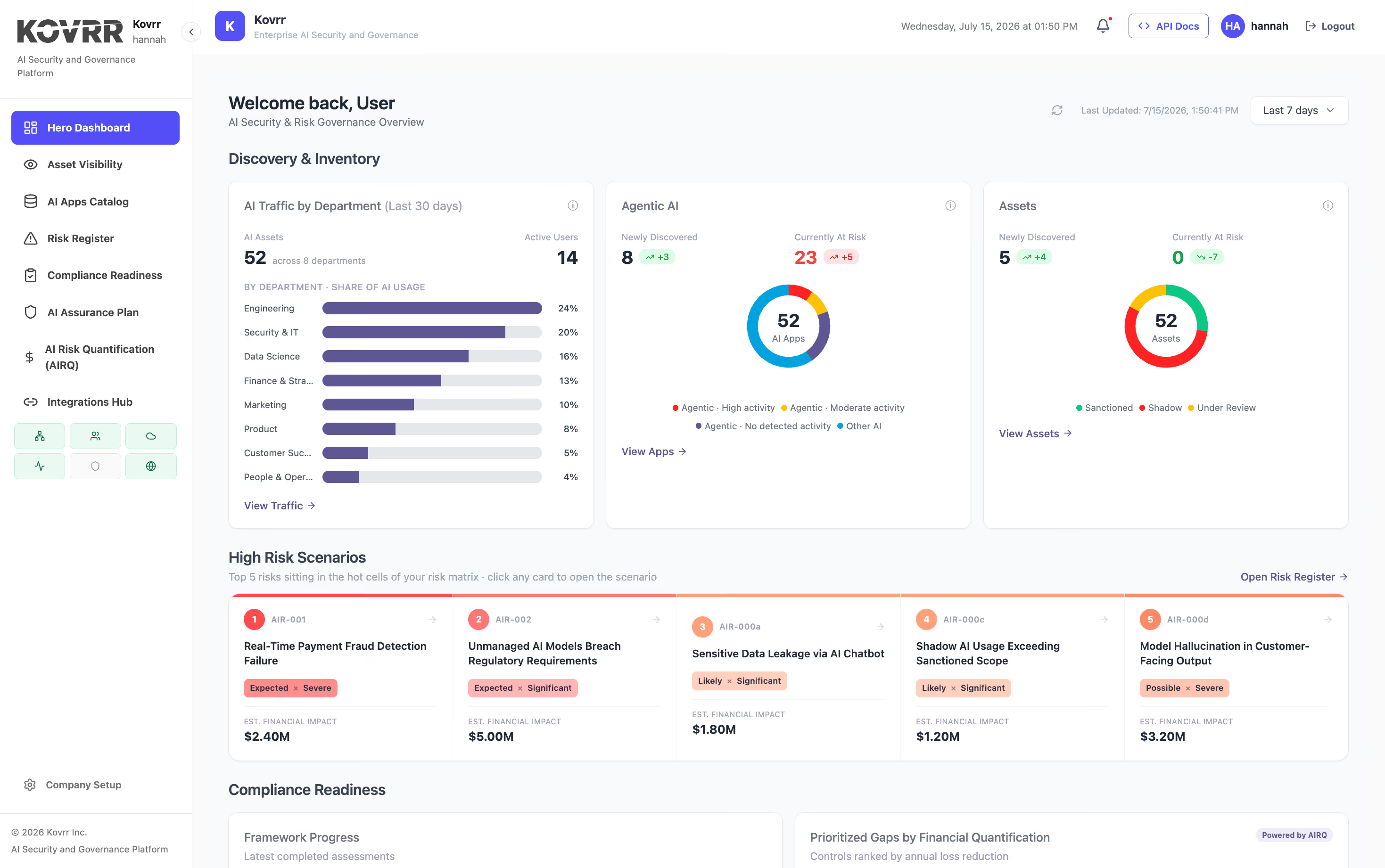
The move from generative to agentic AI is not a technical upgrade. It is a change in the risk profile enterprises are managing. Systems that take autonomous action require governance frameworks that assign accountability, guardrails that enforce policy at runtime, and quantification approaches that translate agentic exposure into the same financial language boards already use for cyber and enterprise risk.
Enterprises that treat agentic AI as a natural extension of their existing generative AI program without adjusting controls will discover the gap the first time an agent makes a decision no one authorized. Enterprises that build the layered stack from the beginning will be positioned to deploy agentic capabilities at scale without inheriting exposure they cannot see or measure.
To see how Kovrr helps enterprises quantify, govern, and enforce controls on agentic AI systems, book a demo of the AI Security and Governance Platform.

Agentic AI vs. Generative AI FAQs
Speak to an ExpertWhat is the main difference between agentic AI and generative AI?

Are agentic AI and AI agents the same thing?
How does agentic AI use generative AI?
What is the difference between AI governance and AI guardrails?
What are AI agent guardrails and why do enterprises need them?
How should enterprises approach the move from generative AI to agentic AI?