Blog Post
The Best Cybersecurity Risk Assessment Tools of 2026
July 30, 2026
Cybersecurity risk assessment has fragmented into distinct categories of tooling, and no single platform covers every dimension enterprise programs need. Governance, risk, and compliance platforms handle framework mapping and audit workflows. Vulnerability management tools scan technical exposure at the infrastructure layer.
Cyber risk quantification platforms produce the financial exposure figures leadership and regulators expect. Free public tools from CISA and NIST provide baseline frameworks for smaller programs and starting points for larger ones. Choosing the right assessment stack means understanding which categories a specific program needs, how the categories fit together, and where the largest strategic leverage sits in the combination.
This article covers the four categories of modern cybersecurity risk assessment tools, what every serious tool should do, how the categories compare on enterprise fit, how to choose between them, why mature programs combine multiple tools rather than relying on any single platform, and where cyber risk quantification (CRQ) sits in the broader assessment stack. For the underlying vocabulary of quantified risk assessment, Kovrr's guide to what CRQ is covers the definitional foundation the strongest assessment programs build on.
The Categories of Modern Cybersecurity Risk Assessment Tools
Assessment tooling breaks into four functional categories. Each solves a distinct problem, and each has different strengths, deployment patterns, and data requirements.
Governance, Risk, and Compliance (GRC) Platforms
GRC platforms consolidate risk landscapes into unified dashboards, mapping controls directly to regulatory frameworks and producing audit-ready evidence. Representative vendors include CyberSaint, MetricStream, ServiceNow GRC, and Archer.
GRC platforms fit enterprises where the primary assessment driver is regulatory obligation, cross-framework compliance mapping, and centralized policy governance. Their weakness sits in the transformation from operational risk data into defensible financial exposure figures, which is where they typically depend on integrations with dedicated quantification platforms.
Vulnerability Management Platforms
Vulnerability management tools scan technical infrastructure for exposed weaknesses, prioritize findings by severity, and support remediation workflows. Representative vendors include Qualys VMDR, Rapid7 InsightVM, and Tenable.io. These platforms produce the raw vulnerability data that feeds broader risk assessment programs and cover cloud, on-premises, container, and endpoint scanning. Their weakness is that vulnerability counts and CVSS severity scores do not, on their own, translate into financial risk metrics that leadership can act on.
Cyber Risk Quantification (CRQ) Platforms
CRQ platforms convert operational security data into dollar-denominated financial exposure figures through probabilistic modeling calibrated against actuarial-grade data. Representative platforms include Kovrr and other purpose-built CRQ vendors. CRQ fits enterprises where the assessment output has to support board reporting, cyber insurance renewal, regulatory materiality analysis, and executive investment decisions. Programs standardizing on CRQ produce assessment output in the same financial language every other category of enterprise risk already speaks.
Free and Public Agency Tools
Public authoritative bodies provide free assessment toolkits that serve as either starting points for smaller programs or foundational frameworks for larger ones. CISA CSET is a desktop tool that walks operators through step-by-step IT and OT assessments. NIST CSF 2.0 templates provide the framework structure that most commercial GRC and CRQ platforms map to. Public tools are rigorous but require manual effort to run at scale, which is why enterprises typically use them alongside commercial platforms rather than as replacements.
What Every Serious Assessment Tool Should Do
Regardless of category, every serious cybersecurity risk assessment tool should support a consistent set of capabilities. Two categories cover the fundamentals.
Analytical Capabilities
- Continuous data ingestion: The tool should pull data from existing security infrastructure automatically rather than requiring periodic manual exports or standalone questionnaires.
- Framework alignment: Native mapping to NIST CSF 2.0, ISO 27001, DORA, and sector-specific frameworks so assessment output supports compliance workflows without duplicate effort.
- Traceable methodology: Every risk score, exposure figure, or maturity rating should be explainable back to specific inputs and calibration decisions when scrutinized by auditors or the board.
Operational Capabilities
- Continuous refresh cadence: Assessment output should update as controls, threats, and business context change, not just during annual review cycles.
- Enterprise integration: Native connections to SIEM platforms, vulnerability scanners, identity providers, and GRC systems so assessment data flows to the tools the enterprise already runs.
- Executive-ready output: Dashboards, reports, and export formats built for board reporting and CFO conversations, not just technical practitioner audiences.
How the Categories Compare on Enterprise Fit
Category selection depends on the specific problem each program is trying to solve. Three lenses cover most enterprise decisions.
Coverage Depth Within a Category
GRC platforms produce broad but shallow coverage across frameworks and policies. Vulnerability management platforms produce deep coverage of technical exposure at a specific infrastructure layer. CRQ platforms produce probability-weighted financial exposure figures that other categories cannot generate. No category is objectively best; the right category depends on what specific assessment output the program has to produce and for which audience.
Integration With Existing Infrastructure
Programs already running mature vulnerability management may benefit most from adding a CRQ layer that translates existing scan data into financial metrics. Programs with mature GRC posture may benefit most from adding vulnerability management depth. Programs with neither may start with public agency tools and layer commercial platforms as the program matures. The approach to cybersecurity risk assessment for in-depth insights covers the sequencing considerations in more detail.
Total Cost of Ownership
Free public tools cost nothing to license but require significant internal effort to run at scale. Vulnerability management platforms carry moderate licensing costs but scale with asset count. GRC and CRQ platforms typically carry higher licensing costs but reduce internal effort meaningfully by automating what would otherwise be manual analytical work. Selecting on license cost alone routinely produces the wrong answer because the underlying labor cost dominates the total.
How to Choose Between Categories
Category choice comes down to the specific outputs the program has to produce, weighted against existing tooling and organizational maturity.
Category Fit by Primary Driver
- Regulatory obligation is the primary driver: GRC platforms fit best, layered with CRQ for financial exposure figures the regulators increasingly expect.
- Board-level exposure reporting is the primary driver: CRQ platforms fit best, layered with GRC for compliance framework alignment and vulnerability management for technical inputs.
- Vulnerability remediation efficiency is the primary driver: Vulnerability management fits best, layered with CRQ to prioritize remediation by financial impact rather than CVSS severity alone.
Category Fit by Program Maturity
- Starting from limited maturity: Free public tools plus a single commercial platform in the highest-priority category, expanded as the program grows.
- Established compliance-focused program: GRC as the anchor with CRQ layered in to produce the financial metrics compliance-only tools cannot generate.
- Mature program moving to enterprise-grade risk management: CRQ as the anchor with GRC and vulnerability management feeding it, producing continuously updated financial exposure at the top of the assessment stack.
Why Modern Programs Combine Multiple Tools
The strongest enterprise cybersecurity risk assessment programs almost never rely on a single tool. As Kovrr CPO Shalom Bublil has argued, no single platform covers every dimension of enterprise cyber risk assessment, and mature programs combine platforms specifically to cover the gaps single tools leave behind. Vulnerability management platforms produce the technical inputs. GRC platforms handle the compliance framework mapping. CRQ platforms turn the combined data into financial exposure figures leadership can act on. Free public tools provide the underlying framework structure.
The combination produces more than the sum of its parts. A vulnerability finding from Qualys becomes actionable when a CRQ platform translates it into dollar-value exposure. A NIST CSF assessment from a GRC platform becomes strategic when continuous control monitoring feeds the maturity data into a CRQ model that produces residual risk figures per scenario.
This layering is what turns cybersecurity assessment from a compliance activity into an operating discipline the board, CFO, and cyber insurance underwriter can all draw on, and it is why cybersecurity maturity assessments enhanced by CRQ produce materially different strategic conversations than standalone maturity assessments.
Where Cyber Risk Quantification Fits in the Assessment Stack
Cyber risk quantification sits at the top of the assessment stack, ingesting data from every category below it and producing the financial output that turns technical assessment into executive-ready risk metrics. Where GRC platforms answer "are we compliant" and vulnerability management platforms answer "what are our technical weaknesses," CRQ answers "how much exposure do we carry in dollars, and where does it come from."
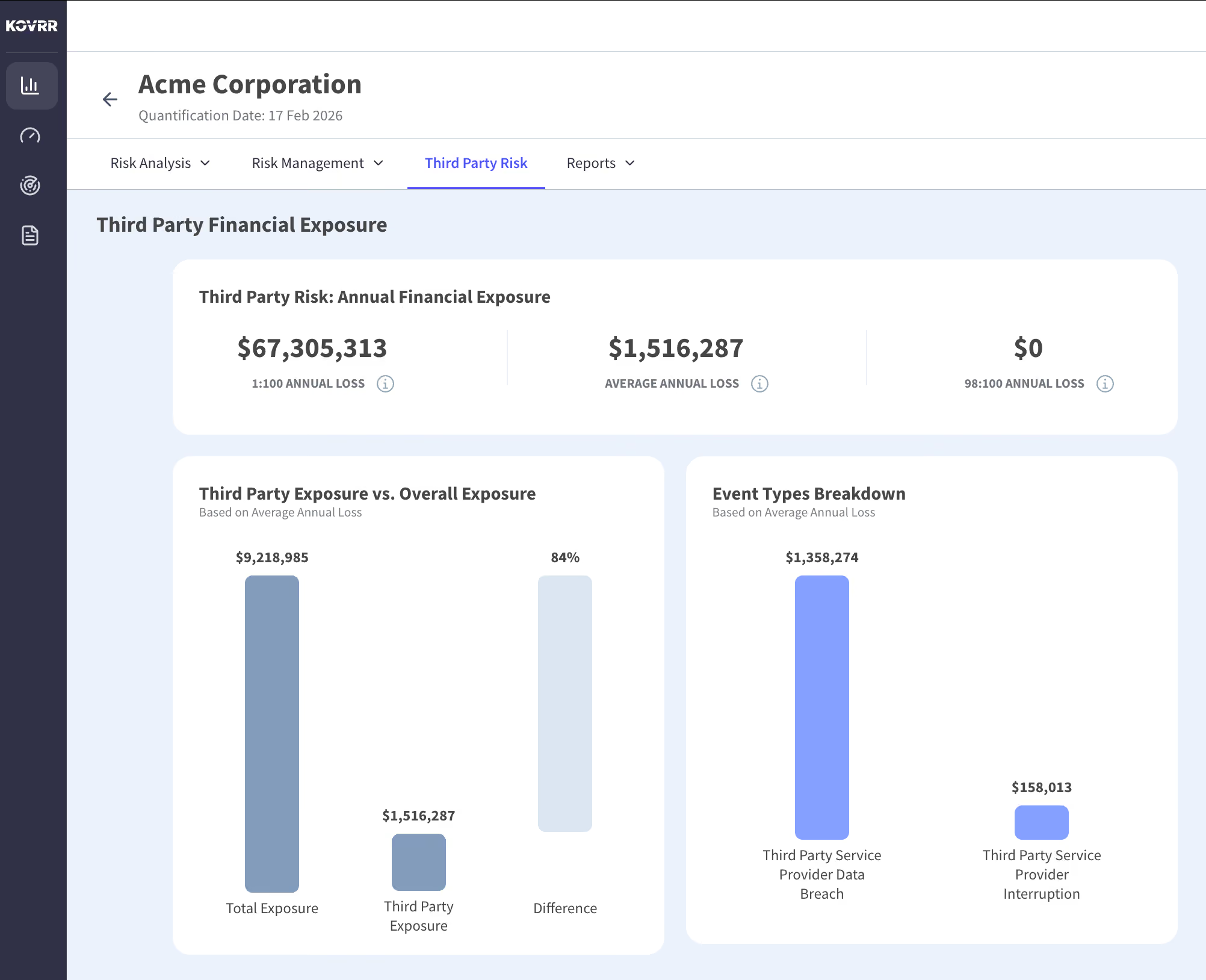
Kovrr's cyber risk quantification platform integrates directly with vulnerability scanners, SIEM platforms, GRC systems, and identity providers to produce continuously updated assessment output. Every material change in the underlying data flows through Monte Carlo simulation running 25,000 trials per quantification to produce stable Average Annual Loss figures, tail exposure at defined confidence intervals, and quarter-over-quarter movement metrics leadership can trust across cycles.
Third-party risk gets assessed with the same rigor as internal risk through the third-party risk product, producing dollar-value exposure per vendor rather than qualitative vendor risk scores that qualitative approaches cannot compare defensibly.
Making Assessment Tool Selection a Portfolio Decision
Selecting cybersecurity risk assessment tools is a portfolio decision, not a single vendor question. The strongest enterprise programs combine GRC, vulnerability management, and CRQ platforms, layered with free public agency tools where they fit, into a coherent assessment stack tuned to the specific outputs the program has to produce.
Programs that build the stack thoughtfully produce assessment output that supports every strategic conversation cyber risk demands, from board reporting to insurance renewal to regulatory disclosure. Programs that select on price or brand recognition alone accumulate overlapping capabilities in some categories and gaps in others, and the gaps become visible when the first serious incident forces attention.
To see how Kovrr sits at the top of the modern assessment stack and produces the financial exposure figures GRC and vulnerability tools cannot generate on their own, book a demo tuned to your industry and existing tooling.

Cyber Risk Assessment Tools FAQs
Speak to an ExpertWhat are the most effective cybersecurity risk assessment tools?

What is the difference between GRC platforms and CRQ platforms?
How should smaller organizations approach cybersecurity risk assessment tooling?
What role does the NIST CSF play in cybersecurity risk assessment tools?
Why do most mature programs combine multiple assessment tools?
How does third-party risk fit into cybersecurity risk assessment?