
Cybersecurity Metrics That Actually Land in the Boardroom
The seven cybersecurity KPIs every CISO should present to the board, and the technical metrics to leave out.



Cybersecurity Metrics for the Board FAQs
Speak to an Expert to Learn MoreWhat cybersecurity metrics should be reported to the board?
The most valuable cybersecurity metrics for the board are those framed in financial and business terms rather than technical detail. Kovrr recommends seven: event likelihood paired with financial exposure, risk posture over time, business loss impact scenarios, cybersecurity ROI, third-party cyber risk exposure, cyber insurance coverage optimization, and industry cyber risk benchmarks. Together they give directors the context to evaluate cyber as an enterprise risk alongside credit, market, and operational risks. See more from CISOs on the boardroom metrics that resonate loudest.
Why do boards struggle with technical cybersecurity reports?
Boards of directors are tasked with governance, strategic oversight, and protecting shareholder value. When CISOs report on blocked firewall pings, patch cadences, or CVE counts, directors have no framework to evaluate the information. The metrics don't map to decisions the board can make. Reframing cybersecurity in financial and business terms bridges the gap and turns cyber into a topic the board can actively govern. Recent mega-breaches like M&S and Qantas have shown what happens when board-level cyber ownership is missing.
How often should CISOs report cybersecurity metrics to the board?
Industry leaders recommend substantive cyber briefings at least quarterly, with an annual deep-dive into overall risk posture. Reporting cadence should stay consistent across quarters so directors build literacy over time and can meaningfully track progress against key metrics. Kovrr's Board-Ready Cyber Risk Summary is designed to support this quarterly rhythm with consistently structured, decision-ready insights.
What is cyber risk quantification and how does it help board reporting?
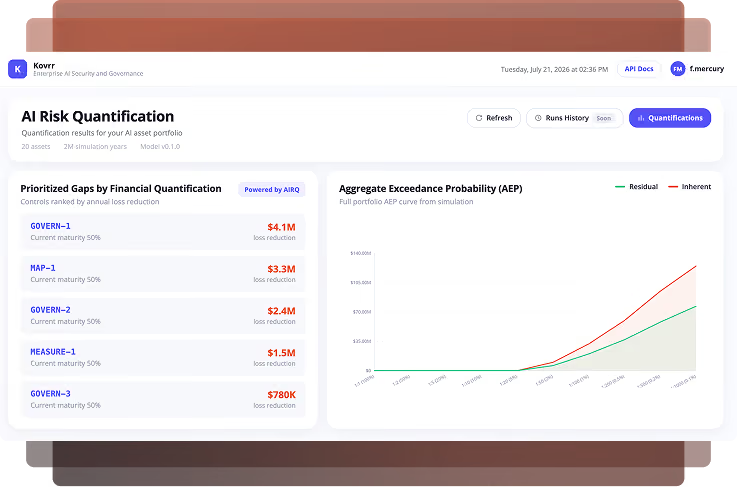
Cyber risk quantification, or CRQ, translates cybersecurity data into financial exposure figures the board can act on. Instead of qualitative labels like "high" or "critical," CRQ produces dollar-based estimates of potential losses, likelihood of specific events, and the financial return of security investments. This lets CISOs justify budgets, prioritize initiatives, and speak the board's language of risk and business impact.
How do you show cybersecurity ROI to the board?
Cybersecurity ROI is best communicated through scenario modeling that ties a specific control or investment to a reduction in financial exposure. Using CRQ, CISOs can say, for example, that a $1M investment in a particular control reduces overall financial exposure by $5M. This turns cybersecurity budget conversations from opinion-based to evidence-based.
What is the difference between operational cybersecurity metrics and board-level metrics?
Operational metrics track the day-to-day effectiveness of the security program: patch rates, intrusion attempts blocked, mean time to detect and respond. Board-level metrics measure enterprise-level cyber risk in business terms: financial exposure, insurance adequacy, third-party risk, and alignment with strategic objectives. Both are important, but boards should focus on the strategic layer.

