
Blog Post
What to Require Before Trusting an Agent Risk Figure
September 9, 2026
Putting a number on an autonomous system is harder than putting one on a data breach, because the usual inputs are missing. There is almost no incident history, the agent's behavior is not fully specified in advance, and the population of comparable events is too small to compute a rate from.
Several methods now claim to do it. What follows is what a method has to be able to do before its output deserves weight, which is a different question from how the calculation works.
Does It Enumerate the Action Set or Accept a Description?
The first and most decisive test. A method taking a sentence about what an agent can do has produced an estimate of the sentence rather than the agent.
An enumerated action set lists every tool, interface, database permission and webhook the agent is technically authorized to invoke, derived from the grants themselves rather than from a design document. Those diverge quickly, because agents accumulate access across tasks and the description written at deployment describes the first task. A method working from the description is assessing an agent that existed months ago.
How Would You Check This?
Ask where the action list came from. An answer naming an identity provider, a tool registry or a gateway configuration is derived. An answer describing a workshop with the engineering team is declared, which is a legitimate starting point and should be labeled as one, since enumerating what each agent holds is the prerequisite the method inherits.
Does It Bound by Reversibility as Well as Reach?
Two agents with identical reach can differ by an order of magnitude in consequence, and a method scoring only reach ranks them the same.
Writing a database row is usually recoverable. Sending an email is not. Publishing to a customer-facing channel is not recoverable in any useful sense once read. A funds transfer may be reversible within a window that closes. A method treating those as equivalent units of reach has discarded the variable that determines what an incident costs.
What Should the Matrix Contain?
Reversibility against scope, where scope means whether an action affects one session, the organization, or people outside it. The four corners behave completely differently, and an agent holding irreversible actions with external scope is the population worth assessing first regardless of how many actions it has in total, which classifying actions before an incident sets out.
Does It Account for the Delegation Chain?
An agent's effective reach includes whatever the agents it can invoke can reach, so a method assessing agents individually understates by however much the chain adds.
The point matters more than it sounds, because chains are common and shallow assessments are the norm. An agent with three narrow tools that can invoke a second agent holding broad database access has the broad access, functionally. The permission model may not show it, since the second agent's grants belong to the second agent, and the effective set is the union rather than the intersection.
How Deep Should the Method Go?
Far enough to reach the end, which most methods cannot because the chain is dynamic. Where depth cannot be enumerated, bounding it by configuration is the workable substitute, since an agent that cannot invoke another agent has a knowable reach. Separation of duties across a chain is what makes the bound real rather than nominal.
Is the Frequency Term Honest?
The credibility test, and the one most methods fail quietly. There is no base rate for most agent-specific failure modes, and a method producing a confident annual likelihood for one has asserted something unavailable.
Some mechanisms borrow legitimately. An agent compromised through credential abuse behaves like credential abuse generally, which is among the better-evidenced categories in conventional loss data. A supply chain path has precedent in package and registry attacks. Those can carry an adjusted base rate.
Goal hijack, memory poisoning and emergent coordination cannot. The available evidence is a handful of demonstrations and disclosed incidents, which supports a range rather than a figure. A method stating which of its frequency inputs are borrowed and which are judgment is more trustworthy than one presenting them in the same notation.
What Does the Honest Version Look Like?
Bounded rather than estimated. Running the calculation at plausible extremes and reporting the range says what is known. Where even the extremes are unavailable, pricing what recovery would cost substitutes an observable quantity for an unobservable one, which pricing recoverability rather than probability applies to a related problem.
Does It Distinguish Detection Latency From Prevention?
Blast radius is bounded by what an agent completes before something stops it, so detection time is a term in the calculation rather than a separate operational concern.
A method assuming instant detection understates, because nothing detects instantly. One assuming no detection overstates, because agents operating in loops do eventually trip volume or behavioral thresholds. The useful version takes measured detection latency for that environment and multiplies it by the rate at which the agent acts, which produces a bounded action count rather than an unbounded one.
Why Does That Change the Ranking?
Because it favors agents in observed environments over agents with narrow permissions in unobserved ones. An agent with broad access under continuous monitoring may rank below one with modest access nobody watches, which is counterintuitive and follows directly from the arithmetic.
Does the Output Compose With Other Risk?
The last requirement and the one that determines whether the figure gets used. An agent-specific score that cannot be compared to anything else produces a ranking within agents and no basis for deciding between agent work and everything else competing for the same budget.
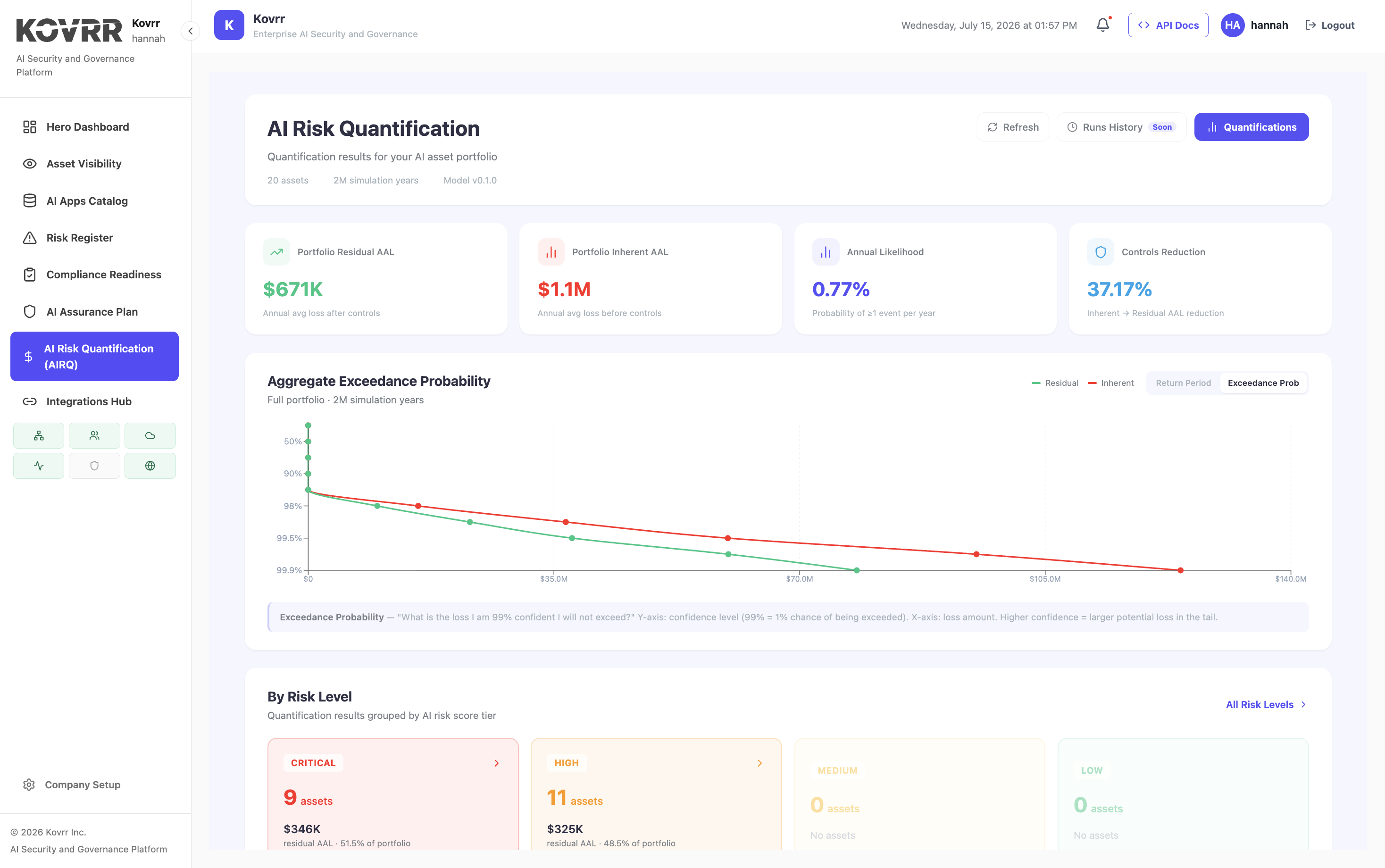
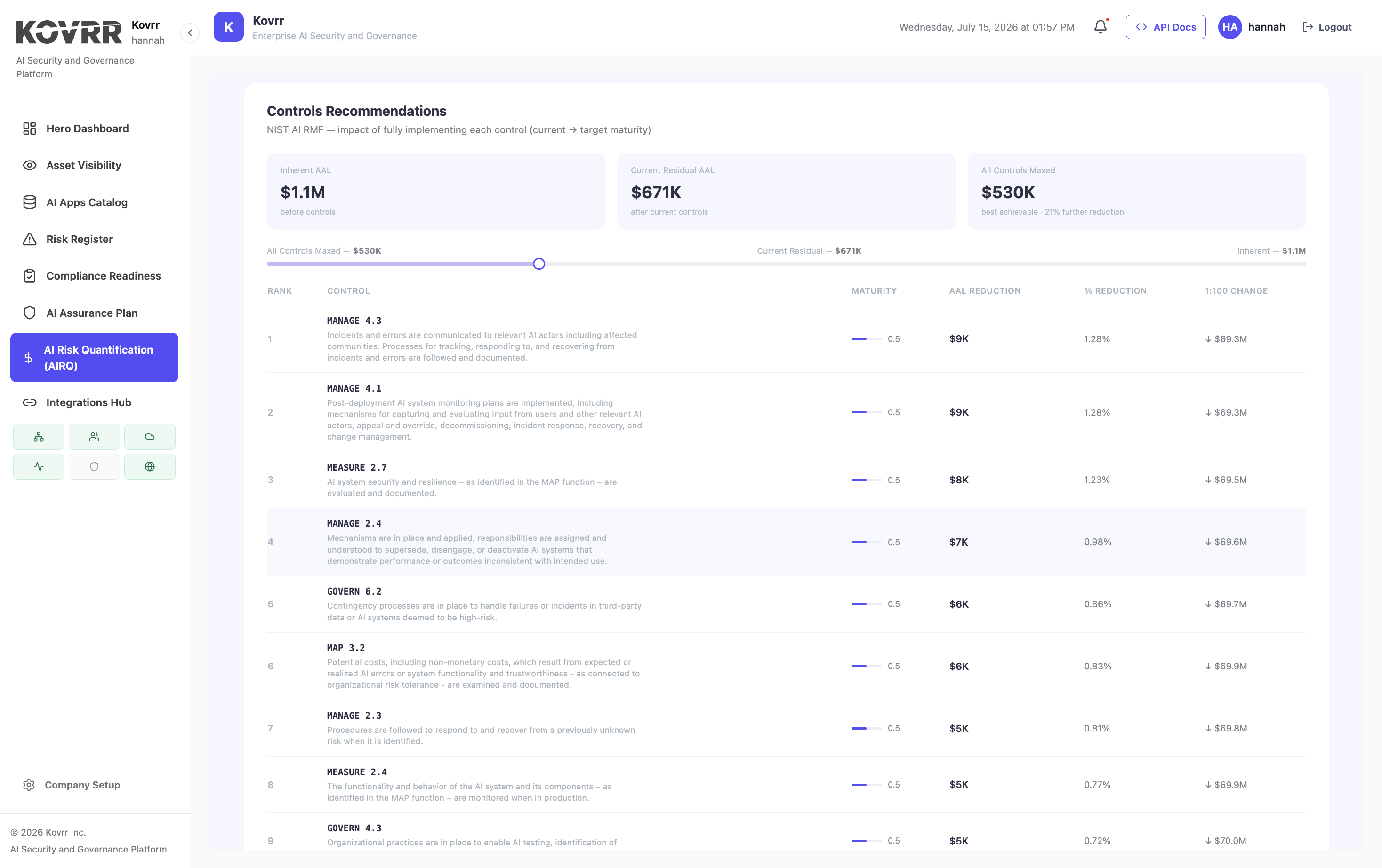
A figure expressed in currency sits alongside cyber, operational and credit exposure in the format a board already reads. A score out of ten does not, whatever its internal rigor. The conversion therefore matters more than the sophistication of the model producing it, and AI risk quantification, or AIRQ, has to reach a unit that composes rather than one that ranks.
What Should the Output Look Like?
A ranked list with the reasoning attached, since a score with no ordering supports no decision and an ordering with no reasoning cannot be challenged.
The useful artifact names the agents in order of exposure, states what drives each position, and identifies which single change would move it most. An agent ranking first because of one irreversible action with external scope is a different remediation from one ranking first because it holds forty tools, and the ranking alone does not distinguish them.
Who Should Be Able to Disagree With It?
Somebody who is not a machine learning engineer, which is the practical test of whether the reasoning was exposed. A figure resting on an asset value, an assumed detection latency and a reversibility classification can be argued with on any of those three. One resting on a proprietary score cannot be argued with at all, and a reviewing function that cannot evaluate what it reviews performs administration rather than challenge.
How Often Should It Be Rerun?
On change rather than on schedule, since agent exposure moves when a tool is added, a permission widens or a chain gains a hop, and none of those happens on a quarterly cadence. A figure produced once at approval describes the agent as deployed rather than as it now operates, which is why an AIRQ run belongs on a change trigger.
What Can No Method Do?
Three things, and a method claiming any of them is overselling.
- Verify its own inputs: The action set and control state are supplied, and a method adds no independent confirmation that either is accurate.
- Anticipate adaptation: Frequency is estimated from what has happened, and an adversary who finds one path closed takes another.
- Price a novel mechanism: A failure mode with no precedent has no rate, and assigning one produces a number with the appearance of the others.
An AI Interaction Data Fabric addresses the first by deriving the action set from observed activity rather than from a declaration, which narrows the input problem without removing it. The other two are limits of the approach rather than of any particular product, and what a modeled figure cannot tell you covers the general case.
Judge the Inputs, Not the Model
Methods for quantifying autonomous system risk differ less in their arithmetic than in what they require before the arithmetic runs. An enumerated action set derived from the grants themselves rather than described in a document. Reversibility alongside reach, since two agents with the same access differ by whether their actions can be undone. The delegation chain, because effective reach is the union across it. A frequency term that says which inputs are borrowed and which are judgment. Detection latency as a term rather than an assumption. Then an output in a unit that composes with other enterprise risk. Kovrr's AI data fabric derives the action set from observed activity, which is the input the rest depends on.
To see agent exposure modeled from observed activity rather than from a declared permission list, book a demo mapped to your own estate.

Agent Risk Quantification FAQs
Speak to an ExpertWhat is the most important requirement of an agent risk method?

Why does reversibility matter as much as reach?
How does the delegation chain affect the calculation?
How should a method handle frequency with no base rate?
Why is detection latency part of the calculation?
What can no quantification method do?
.png)