
Cyber Loss Data / Actuarial Data
Cyber loss data, sometimes called cyber actuarial data, is the empirical record of past cyber events and their financial impacts, used as the foundation for probabilistic modeling of future cyber losses.
Why Loss Data Matters
Cyber risk quantification is a modeling exercise, and models need calibration data. Loss data provides that calibration: real-world observations of what cyber events actually cost, how frequently they occur, and how impacts vary by industry, size, and control posture.
Without loss data, quantification collapses into expert opinion. With it, models can be tested against empirical reality and refined over time.
What Loss Data Actually Contains
High-quality loss data includes event type (ransomware, BEC, data breach, and so on), industry and geography of the affected organization, direct incident costs, indirect impacts (business interruption, reputational damage), duration of impact, and contextual information about the event and the environment.
The data is scarce. Enterprises rarely disclose loss data publicly, so aggregated datasets often combine regulatory disclosures, insurance claims data, litigation records, and specialized loss data providers.
Loss Data and Modeling
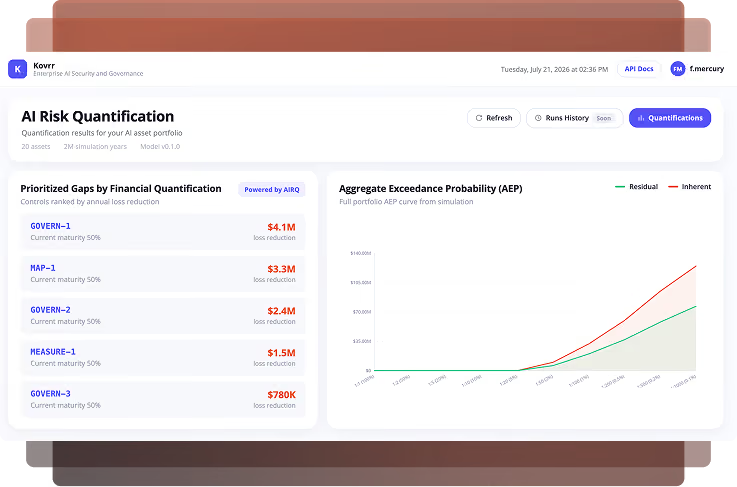
Loss data drives the frequency and severity distributions in Monte Carlo simulations that produce Loss Exceedance Curves. Models calibrated against strong loss data produce more defensible outputs than models built on assumption alone.
How Kovrr Approaches Cyber Loss Data
Kovrr maintains one of the largest cyber loss and event datasets used in commercial CRQ, drawing on multiple curated sources and updating continuously. That data is what allows Kovrr's CRQ Platform to calibrate models to observed reality rather than assumption. See what is cyber risk quantification (CRQ).
Related Terms


Turn Cyber Risk Into Financial Exposure the Board Can Act On
Security leaders are being asked to defend budgets, prioritize controls, and report cyber risk in the same terms as every other enterprise risk. Kovrr's CRQ Platform models loss scenarios, benchmarks control performance, and gives the C-suite a defensible view of where cyber sits on the balance sheet.