

Monte Carlo Simulation
Monte Carlo simulation is a computational technique that runs many synthetic scenarios drawn from probability distributions, producing a full distribution of possible outcomes, foundational to modern cyber risk quantification.
How Monte Carlo Works for Cyber
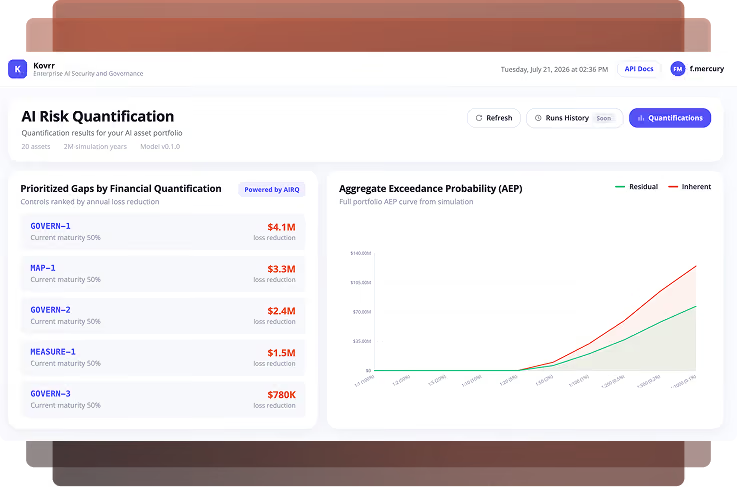
Rather than producing a single expected value, Monte Carlo runs thousands or millions of synthetic years, each drawing from probability distributions for event frequency and loss magnitude. The aggregate of those synthetic years is the modeled loss distribution, from which the Loss Exceedance Curve, AAL, and other outputs are derived.
The approach captures uncertainty explicitly. Instead of pretending we know exactly how often ransomware will hit or exactly what it will cost, Monte Carlo represents that uncertainty as distributions and lets the aggregation produce a defensible view of the range of outcomes.
Why Monte Carlo Beats Point Estimates
Cyber losses are heavily skewed. Most years produce moderate losses. A small fraction produce catastrophic tail losses that dominate long-run outcomes. Point estimates like ALE collapse this shape into a single number, losing the tail information that matters most for board and risk decisions.
Monte Carlo preserves the shape. That is why boards and CFOs increasingly expect Monte Carlo-based CRQ outputs rather than point-estimate frameworks.
Monte Carlo Calibration
The quality of Monte Carlo output depends on the distributions used as inputs. Distributions calibrated against real-world cyber loss data produce more defensible outputs than distributions built on expert opinion alone. This is why loss data quality has become a central differentiator among CRQ approaches.
How Kovrr Approaches Monte Carlo Simulation
Kovrr's CRQ Platform runs Monte Carlo simulation calibrated against one of the largest curated cyber loss datasets in the industry. See Monte Carlo cyber event simulation for detail on the methodology.
Related Terms


Turn Cyber Risk Into Financial Exposure the Board Can Act On
Security leaders are being asked to defend budgets, prioritize controls, and report cyber risk in the same terms as every other enterprise risk. Kovrr's CRQ Platform models loss scenarios, benchmarks control performance, and gives the C-suite a defensible view of where cyber sits on the balance sheet.