

Financial Exposure Modeling
Financial exposure modeling is the discipline of translating operational, technical, and security data into probabilistic estimates of financial loss, enabling risk decisions to be made in dollar terms rather than qualitative ratings.
What Financial Exposure Modeling Produces
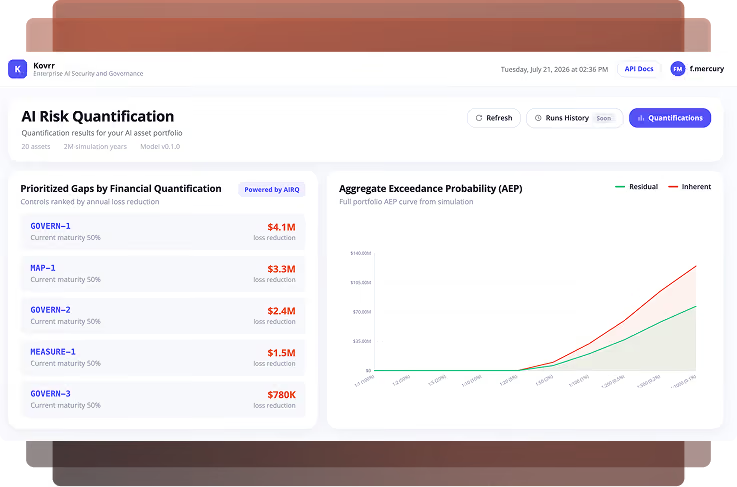
The output is a loss distribution, typically expressed as a Loss Exceedance Curve with associated point figures (AAL, 1:100, 1:250). Individual scenarios have their own distributions that aggregate into the enterprise view, and the model responds to changes in exposure and controls with corresponding changes in the loss distribution.
Why Financial Exposure Beats Qualitative Risk Rating
Qualitative ratings do not answer the questions boards, CFOs, and cyber insurers ask. How much loss are we exposed to? How does that compare to our tolerance? What does this control investment save us? Financial exposure modeling answers all of these directly.
See how to translate cyber risk into financial terms the CFO understands.
What Feeds Financial Exposure Models
Inputs typically include real-world loss data for calibration, organization-specific exposure data (revenue, assets, data holdings, geographic scope), control posture data from continuous monitoring or assessment, and scenario definitions relevant to the specific business context.
How Kovrr Approaches Financial Exposure Modeling
Kovrr's CRQ Platform produces enterprise-level financial exposure calibrated against one of the largest curated cyber loss datasets in the industry. See what is cyber risk quantification (CRQ).
Related Terms


Turn Cyber Risk Into Financial Exposure the Board Can Act On
Security leaders are being asked to defend budgets, prioritize controls, and report cyber risk in the same terms as every other enterprise risk. Kovrr's CRQ Platform models loss scenarios, benchmarks control performance, and gives the C-suite a defensible view of where cyber sits on the balance sheet.