
Cyber Risk Quantification, Explained by Our CEO
The difference between describing cyber risk and actually managing it, walked through in plain terms.



Cyber Risk Quantification FAQs
Speak to an Expert to Learn MoreWhat is cyber risk quantification (CRQ)?
Cyber risk quantification, or CRQ, is the process of translating cyber exposure into concrete financial terms. Instead of relying on qualitative labels like "high" or "critical," CRQ produces dollar-based estimates of potential losses, the probability of specific events occurring, and the financial return of security investments. This gives security leaders, executives, and boards a common language to make informed decisions about cyber risk.
How does cyber risk quantification work?
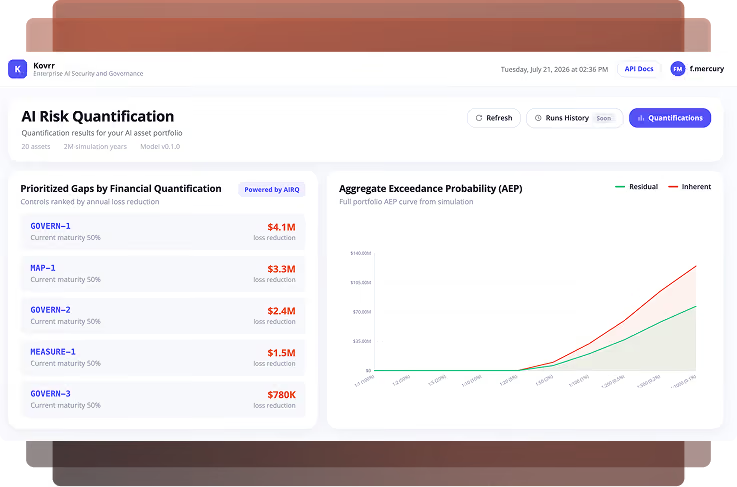
CRQ combines an organization's security posture, threat landscape, controls, and industry profile with insurance-grade loss models built from years of real claims data. Kovrr's platform runs a Monte Carlo simulation that models the year ahead 25,000 times, testing thousands of synthetic cyber events against your specific assets and defenses. The output includes average annual loss, worst-case exposure at extreme probability levels, and the events and attack vectors driving those numbers.
Why does CRQ matter for the board?
Boards are tasked with governance, strategic oversight, and protecting shareholder value. When cyber risk is expressed only in technical terms, they have no framework to evaluate it. CRQ translates cyber exposure into financial language that maps to how boards already think about credit, market, and operational risk. That shift changes the conversation from speculation to decision-making
How is CRQ different from a cybersecurity risk score?
A security score tells you how your posture compares to peers. CRQ tells you what your exposure is actually worth in financial terms. Scores are useful for benchmarking; quantification is what enables real budget allocation, prioritization, and board reporting. The two work together, but only quantification supports decisions about resource allocation and risk transfer.
Is CRQ a one-time exercise?
No. CRQ works best as a continuous process. Kovrr's platform includes continuous control monitoring, which feeds live security posture data into the quantification engine. As the environment changes, the numbers update, keeping cyber risk figures current for budgeting, prioritization, and board reporting throughout the year.
How can CRQ improve cybersecurity investment decisions?
CRQ shows which risks carry the greatest potential financial impact and which security investments would reduce that exposure the most. Instead of spreading effort across every possible vulnerability, organizations can focus on the scenarios that matter most. This leads to better prioritization, stronger resilience, and a more defensible business case for every dollar of security spend.

