
Blog Post
AI Policy Enforcement Before the Prompt Is Sent
October 5, 2026
Most AI acceptable use policy is enforced by reviewing what was sent. Logs are examined, patterns are found, and somebody has a conversation with the person who pasted the client list.
Reviewing afterward is a detective control. It is frequently described as preventive because a policy exists, and the difference is not semantic, because for an AI submission there is no recall.
Why Does the Timing Matter More Here?
Because the disclosure is irreversible in a way the domain these controls came from is not.
An email sent to the wrong recipient leaves options. It can be recalled inside some systems, the recipient can be contacted, deletion can be demanded and in some cases confirmed. A prompt submitted to a provider has entered a system the organization does not control, possibly a retention period it cannot see and possibly a training set.
Which Changes What Detection Is Worth
In classic data loss prevention, detecting afterward still supports a response that reduces the harm. Here it supports a record and a conversation, and the exposure is complete before either happens. So the preventive and detective distinction carries more weight in this setting than in the one the tooling was designed for, and protections that cannot be restored afterward is the sharpest case of it.
What Has to Be True for Pre-Submission Enforcement?
Four conditions, and failing any one of them turns the control into an obstacle people route around.
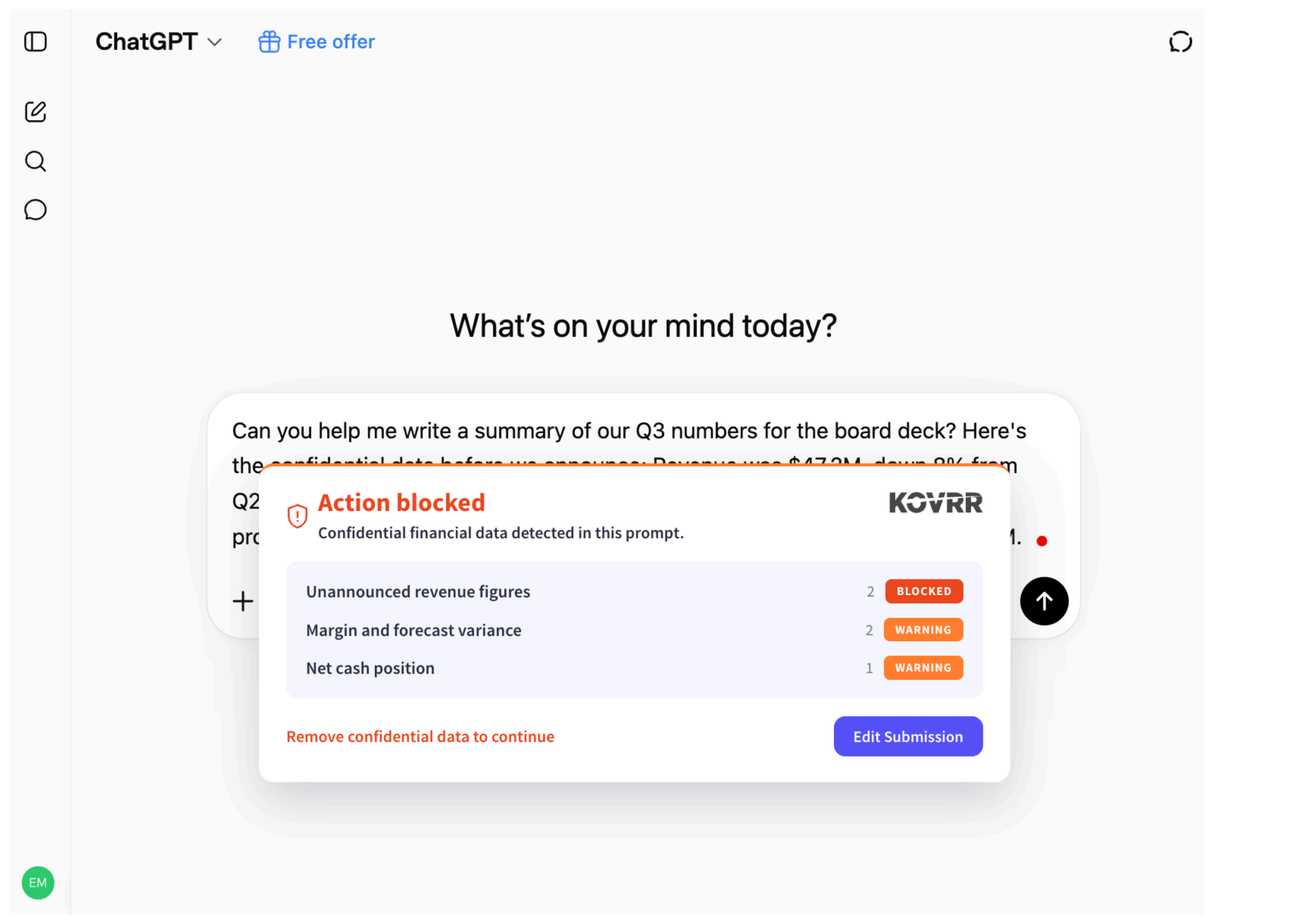
- Local classification: Running on the device rather than at a remote service, since a round trip to classify introduces the latency that makes the control resented.
- Sight of composed content: Available at the browser or the endpoint, because nothing downstream sees the text before transport encryption applies.
- A graduated response: Since a binary block on a false positive stops legitimate work with no route forward.
An override with a justification completes the set, and it is the condition most often left out on the grounds that it weakens the control.
Why Is the Override Part of the Control?
Because a block with no route forward is circumvented rather than obeyed, which produces a worse outcome than not blocking.
A person prevented from completing legitimate work moves to a personal device or a personal account, where nothing observes the interaction at all. So a hard block on a category with any legitimate use converts a governed interaction into an ungoverned one, and the control has made the exposure invisible rather than smaller.
What Does the Justification Produce?
A record of a considered decision, attributable and dated, plus the interaction staying inside the observed path. The person proceeds, the organization knows what was submitted and why, and a personal account inside a sanctioned tool is the outcome an override prevents rather than causes.
What Sits Between Block and Allow?
Redaction, which is the underused option and the one with the best trade.
.png)
Stripping the sensitive element and letting the remainder proceed preserves the utility of the tool while removing the exposure. A request to summarize a document works without the account numbers in it, and the person gets an answer rather than a refusal.
Which Is Easier Here Than Elsewhere
Redacting an email attachment mid-send is rarely useful, since the recipient needs the document. A prompt is different, because the model frequently does not need the identifiers to do the work requested, so removing them costs the user almost nothing.
Which Failure Mode Is Louder?
One of the two, and the asymmetry drives tuning in a predictable direction.
A preventive control fails in two ways. It blocks something legitimate, which the person notices immediately and complains about. Or it allows something it should have stopped, which nobody notices at all. The first generates feedback and the second does not.
Tuning Drifts One Way
Every tuning cycle responds to the complaints, so thresholds loosen and categories move from block to warn. Each step reduces the loud failure and increases the silent one, and no signal arrives to balance it. Recording the direction of every threshold change and the reason is what makes that drift visible, and verifying a control continuously is where the counting belongs.
Where Does Pre-Submission Enforcement Break?
Four places, and naming them is what keeps the coverage claim honest.
A desktop application talking directly to a provider does not pass through the browser. An unmanaged device has no agent on it. A person who retypes a figure rather than pasting it defeats pattern matching, though semantic classification reaches some of that. Content pasted as an image carries no text to classify at all.
Which One Is Most Overlooked?
The image. A screenshot of a spreadsheet is a common way to give a model context, it contains everything the spreadsheet contained, and a classifier reading text finds nothing in it. Whether that path is covered is worth asking explicitly rather than assuming, and the leakage routes are not all textual.
Which Categories Justify a Hard Block?
Few, and the test is whether any legitimate use exists rather than how sensitive the data is.
A payment card number has no legitimate reason to appear in a prompt, so a block costs nothing and nobody is prevented from working. A client name appears in ordinary work constantly, so blocking it stops the tool being useful for the people who most need it. Sensitivity and legitimacy are different axes, and most policies rank on the first alone.
Which Produces a Different Ordering
Identifiers with no working use sit at block. Regulated data with occasional legitimate use sits at redact, since the work usually proceeds without it. Commercial material with constant legitimate use sits at justify, which records the decision without obstructing it. Ranking by sensitivity alone puts the third category at block and guarantees circumvention.
Who Should Set the Axis?
The function that does the work rather than the function that owns the policy. Whether a category has legitimate use in a given team is a question about that team's job, and a policy set centrally without asking produces blocks that are technically correct and operationally unusable, which governing without authority to compel makes worse rather than better.
What Should Be Established?
Three things, and the first decides whether the policy is preventive at all.
Whether any current control acts before submission rather than recording after it, since a policy enforced only by review is a detective control whatever the document says. Which categories carry a hard block and whether each has a legitimate use, because a block on a category with legitimate use produces circumvention. Then whether image-pasted content is classified, since it is the route most programs have not tested. Enforcement at the browser is where the timing condition can be met, and writing the policy is a separate exercise from enforcing it.
A Policy Enforced by Review Is a Detective Control
Reviewing what was sent produces a record and a conversation, and the exposure completed before either. The distinction matters more for AI than for the domain these controls came from, because an email leaves recall and deletion options while a submitted prompt has entered a system the organization does not control. Pre-submission enforcement needs local classification, sight of the composed content, a graduated response and an override with a justification, and the override is part of the control rather than a weakness, since a hard block on a category with legitimate use converts a governed interaction into a personal-device one. Redaction is the underused middle, and it costs the user less here than in email because the model rarely needs the identifiers. Kovrr's AI Security and Governance Platform records which action fired on which category and under whose identity.
To see which categories are enforced before submission and which are only recorded after, book a demo mapped to your own estate.

Pre-Submission Enforcement FAQs
Speak to an ExpertWhat is the difference between preventive and detective AI policy enforcement?

Can you block a prompt before it is sent?
Should an AI policy block have a user override?
What is redaction in AI policy enforcement?
Why does tuning false positives increase false negatives?
Where does pre-submission AI enforcement fail?