Blog Post
Assessing Third-Party AI Vendor Risk Before It Becomes a Problem
August 5, 2026
Every SaaS tool your organization onboards now carries a hidden layer of AI risk. The chatbot on your CRM, the transcription service your sales team runs, the code assistant embedded in your IDE. Each one processes company data through models you did not build, in ways your vendor questionnaire was not written to catch. Traditional third-party risk management was designed to evaluate infrastructure, access controls, and data handling. It was not designed to answer whether a vendor's foundational model provider retrains on your prompts, whether a fine-tuned model drifts silently after deployment, or whether an autonomous agent can be manipulated through prompt injection.
Assessing the security risk of a third-party AI vendor means treating the vendor as a dynamic data engine rather than a static software product. The evaluation happens across four pillars, runs through a repeatable workflow, and continues after the contract is signed. Organizations that skip any of these layers inherit exposure they cannot see and cannot quantify.
Why Traditional Vendor Risk Programs Miss AI-Specific Exposure
A standard SOC 2 questionnaire tells you a vendor has documented change management. It does not tell you whether the vendor's LLM provider changed foundational models last Tuesday and reset their safety guardrails in the process. A conventional data processing agreement tells you where data is stored. It does not tell you whether your inputs left the tenant to train a public model.
AI introduces exposures that live outside the categories most third-party risk programs measure. Prompt injection can turn a benign customer support agent into an exfiltration channel. Training-data leakage can surface confidential inputs in another tenant's outputs weeks later. Model drift can quietly degrade the accuracy of decisions your teams already act on. None of these show up on a standard security review, which means the risk register you present to the board understates what the organization is actually carrying.
The Four Pillars of AI Vendor Security Assessment
A defensible assessment covers data governance, model security, compliance evidence, and access architecture. Each pillar answers a question traditional vendor reviews leave open.
Data Governance and Training Policies
Start with the data question, because it is the one most vendors bury in an addendum. Confirm in writing that company inputs, prompts, outputs, and any derived embeddings are excluded from training public or cross-customer models. Verify retention windows and demand deletion timelines that match your own data policies rather than the vendor's default.
Check where data is processed, not just where it is stored, since inference often runs in a different region than the disclosed hosting location. Ask whether the vendor supports zero-retention modes for sensitive workflows, and whether that mode is available on the tier you are actually purchasing.
Model Security and Architectural Transparency
Ask the vendor how they test for prompt injection, jailbreaks, and adversarial inputs. A serious answer references red-teaming schedules, OWASP Top 10 for LLMs, and specific guardrails against toxic outputs, hallucinated code, and leaked source material. Push for architectural transparency about the underlying foundational models, the fine-tuning approach, and any retrieval-augmented components that pull from external sources at runtime. Vendors who cannot explain their model supply chain cannot secure it.
Compliance and Certification Evidence
Traditional certifications remain necessary but no longer sufficient. Verified SOC 2 Type II and ISO/IEC 27001 reports cover foundational security hygiene. For AI-specific assurance, look for ISO/IEC 42001 certification, alignment with the NIST AI Risk Management Framework, and readiness for the EU AI Act enforcement timeline (February 2, 2025; August 2, 2025; December 2, 2026; December 2, 2027). A vendor that already maps its controls to these frameworks has done the internal work. One that offers vague promises about future certification has not.
Identity, Access, and Integration Controls
AI SaaS tools tend to request expansive permissions because they need to read, write, and orchestrate across other systems to be useful. Evaluate whether the application supports granular role-based access control, whether OAuth scopes can be limited to specific databases, and whether the vendor integrates with your identity provider through SAML 2.0 or OIDC with enforced MFA. Map the data flow before the tool goes live so you can catch oversharing before it becomes a breach headline.
A Practical Assessment Workflow
Pillars describe what to look at. A workflow describes how to actually get through a queue of vendor requests without becoming the bottleneck. Four steps carry most organizations from ad hoc reviews to a repeatable program.
First, inventory and tier every AI vendor entering the environment, then rank them by business criticality and sensitivity of data processed. Second, send an AI-specific supplement to your standard vendor questionnaire that asks about training exclusion, fine-tuning practices, and adversarial testing. Third, verify evidence independently through certifications, penetration test summaries, and reference calls rather than accepting marketing claims. Fourth, route the technical review to someone who understands AI systems, since a generalist security reviewer will miss the questions that matter most.
The output of this workflow feeds a live AI risk register that tracks each vendor's residual risk, control coverage, and remediation status. Without that central record, findings get lost across email threads and the next audit starts from zero.
Contractual Guardrails That Hold in Practice
Verbal assurances collapse the moment a vendor is acquired or their model provider changes terms. Contracts hold. Four clauses do the heaviest lifting.
A strict prohibition on using your corporate data or prompts to train the vendor's models. A mandatory 30-to-90-day written notice before changes to model weights, guardrails, system prompts, or foundational model providers. Preserved rights to audit AI security controls and data handling workflows on at least an annual basis. A 24-to-72-hour incident notification SLA covering data breaches, model manipulation, bias incidents, and prompt injection compromises. These are the terms that give your program leverage when something goes wrong, and they are the terms vendors negotiate hardest against, which tells you exactly how much they matter.
Continuous Monitoring Instead of Point-in-Time Review
An AI vendor security posture from six months ago tells you nothing about today. Foundational models update, guardrails change, subprocessors are added, and the risk profile moves with them. A modern program monitors vendor telemetry continuously, tracks regulatory changes as they land, and flags material product updates before the security team hears about them from a business user.
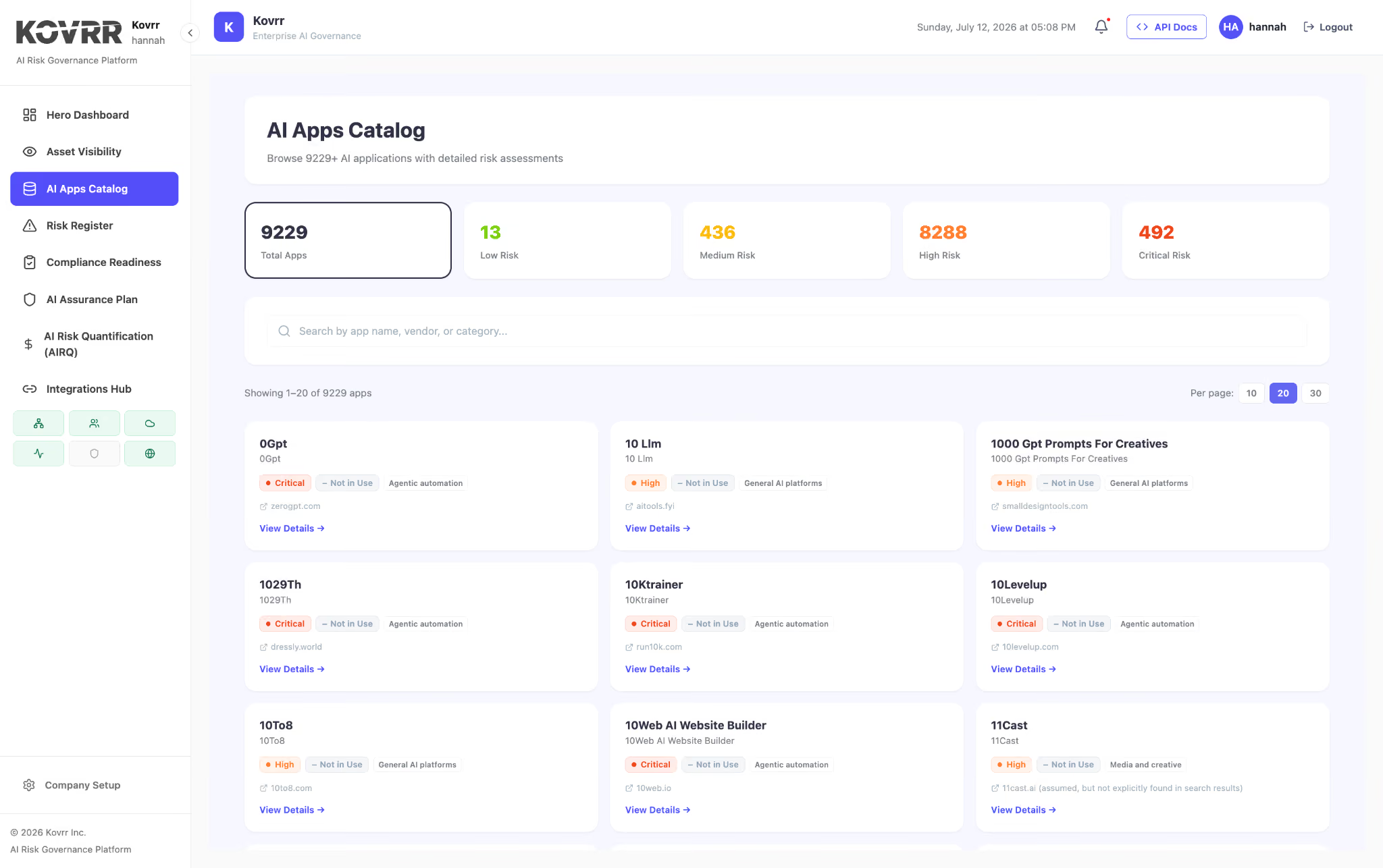
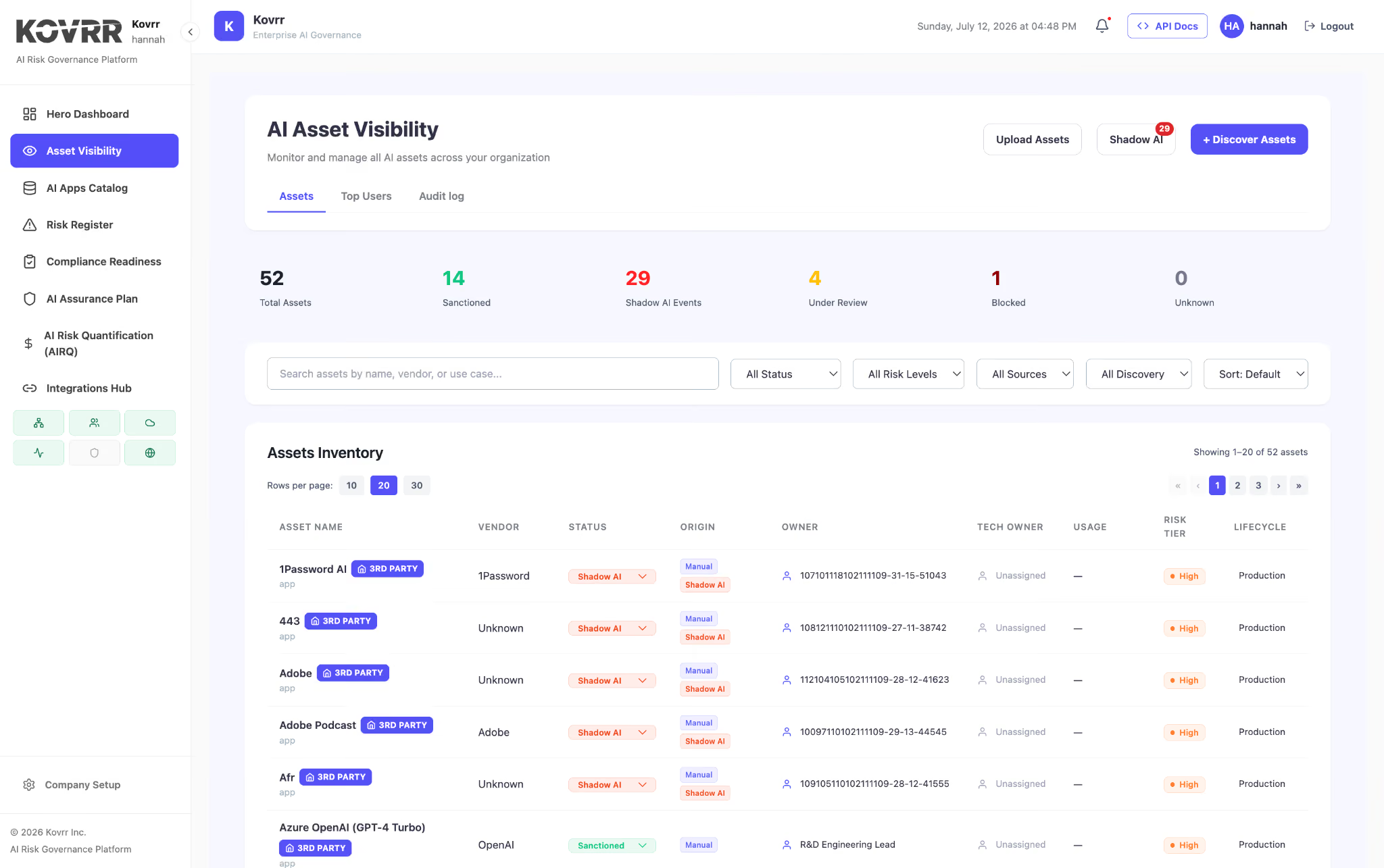
Continuous monitoring also catches the vendor changes that never get announced. A model provider swap on the backend. A new region added for inference. A feature rollout that quietly expands what the tool can read from your systems. Platforms such as Kovrr's AI Security and Governance Platform connect vendor telemetry, discovered AI assets, and quantified risk into a single view so security leaders can act on movement rather than react to it.
Where Fourth-Party Risk Hides
Most AI SaaS tools are wrappers. A note-taking assistant runs on OpenAI. A customer support agent calls Anthropic. A code review tool routes prompts through a third foundational provider entirely. Your direct vendor is the third party. The model provider is the fourth party, and their risk becomes yours the moment your data crosses that boundary.
Fourth-party assessment starts with subprocessor disclosure. Require your vendor to name every underlying AI provider, every embedding service, and every retrieval component that touches your data. Verify that each subprocessor meets the same security baseline you demanded from the vendor. Track when the vendor changes subprocessors, since a silent swap can move your data into a jurisdiction your compliance team never approved.
Bringing the Assessment Program Together
Third-party AI vendor risk is a governance problem before it is a security problem. Every tool onboarded without a rigorous review compounds the exposure the organization carries into its next audit, its next board report, and its next regulatory examination. A program that inventories vendors, evaluates them across the four pillars, enforces contractual guardrails, and monitors them continuously turns AI vendor sprawl from a blind spot into a managed portfolio. The vendors are not going to slow down. The assessment program has to move at their pace.
To kick your third-party AI vendor risk assessment into gear and ensure that you’re not exposing your organization to a level of exposure it hasn’t adequately accounted for, schedule a demo today to learn more about Kovrr’s AI Security and Governance Platform.

Assessing AI Vendor Risk FAQs
Speak to an ExpertWhat makes third-party AI vendor risk different from traditional third-party risk?

Which certifications should we require from AI vendors?
How do we handle vendors who use foundational model providers like OpenAI or Anthropic?
What contractual clauses matter most in AI vendor agreements?
How often should AI vendors be reassessed?
Can you assess AI vendors before they are formally onboarded?