
Blog Post
How to Justify Cybersecurity Investments to Executive Leadership
August 5, 2026
Most cybersecurity investment requests get rejected for a single reason. The business case speaks the language of security instead of the language of finance. CISOs walk into the CFO conversation with vulnerability counts, patch rates, and framework maturity scores. The CFO walks in expecting dollar-denominated risk reduction, return on investment, and comparisons against every other capital request competing for the same budget. When the two languages fail to line up, the funding conversation stalls and cybersecurity gets treated as a cost center rather than a strategic risk portfolio.
Effective cybersecurity investment justification requires translating technical risk reduction into financial outcomes the CFO already knows how to evaluate. That translation runs through cyber risk quantification (CRQ), which converts technical exposure into probability-weighted loss figures and turns proposed controls into measurable dollar-value risk reduction.
This article covers why most cybersecurity business cases get rejected, the metrics executive leadership weighs, the ROSI framework that produces defensible dollar-denominated business cases, how to structure the presentation, the executive blind spots to preempt, and how CRQ powers every step of the justification. For the foundational vocabulary underneath, Kovrr's guide to what cyber risk quantification is covers the methodology in depth.
Why Most Cybersecurity Business Cases Get Rejected
Executive leadership sees dozens of investment requests every budget cycle. Marketing wants growth capital. Product wants engineering headcount. Operations wants infrastructure upgrades. Each request competes on the same axis: expected return per dollar invested, translated into financial impact leadership can compare across categories. Cybersecurity requests that show up in that same financial language compete on equal footing. Requests that stay in technical language get set aside, deferred, or approved at reduced scope.
The Translation Problem
Technical metrics belong on the CISO's dashboard. Patch rates, mean time to detect, and framework maturity scores measure the security team's operational work, and they belong in security team performance reviews. They do not, on their own, tell the CFO how much cyber risk the enterprise is carrying in dollars, how the proposed investment will move that number, or whether the investment produces a higher return than any of the alternatives on the same budget line. Every layer of translation the CFO has to do between technical metrics and financial outcomes is a layer where confidence in the request erodes.
The Comparison Problem
Cybersecurity budget requests get evaluated against every other capital request the CFO is considering. When the security team cannot express its request in the same financial language marketing, product, and operations use, the request loses the comparison by default. This is why the expanding role of the CFO and board in cyber risk management has made financial fluency a job requirement for CISOs rather than an optional skill for security leaders who want to punch above their weight.
The Metrics Executive Leadership Weighs
Executive investment decisions rest on a small number of financial metrics that stay consistent across every category of capital request. Cybersecurity requests that produce these metrics compete on the same terms as every other line item on the budget.
Financial Impact Metrics
- Quantified risk reduction in dollars: The specific decrease in Average Annual Loss the investment produces, backed by defensible modeling rather than analyst opinion.
- Return on Security Investment (ROSI): The ratio of dollar-value risk reduction produced per dollar spent, calculated using the standard ROSI formula covered in the next section.
- Payback period: The time in months required for the cumulative risk reduction to exceed the total cost of the investment.
Strategic Alignment Metrics
- Business enablement impact: How the investment supports a specific business initiative like a new product launch, geographic expansion, or major customer contract that depends on demonstrated security posture.
- Regulatory exposure reduction: Specific compliance obligations the investment addresses under SEC disclosure rules, DORA, NYDFS, or sector-specific frameworks that carry material regulatory penalty risk.
- Insurance renewal impact: Measurable effect on cyber insurance premium, retention, or coverage terms at the next renewal cycle, which is what makes cyber insurance coverage optimization a business case anchor rather than an afterthought.
The ROSI Framework: A Six-Step Calculation
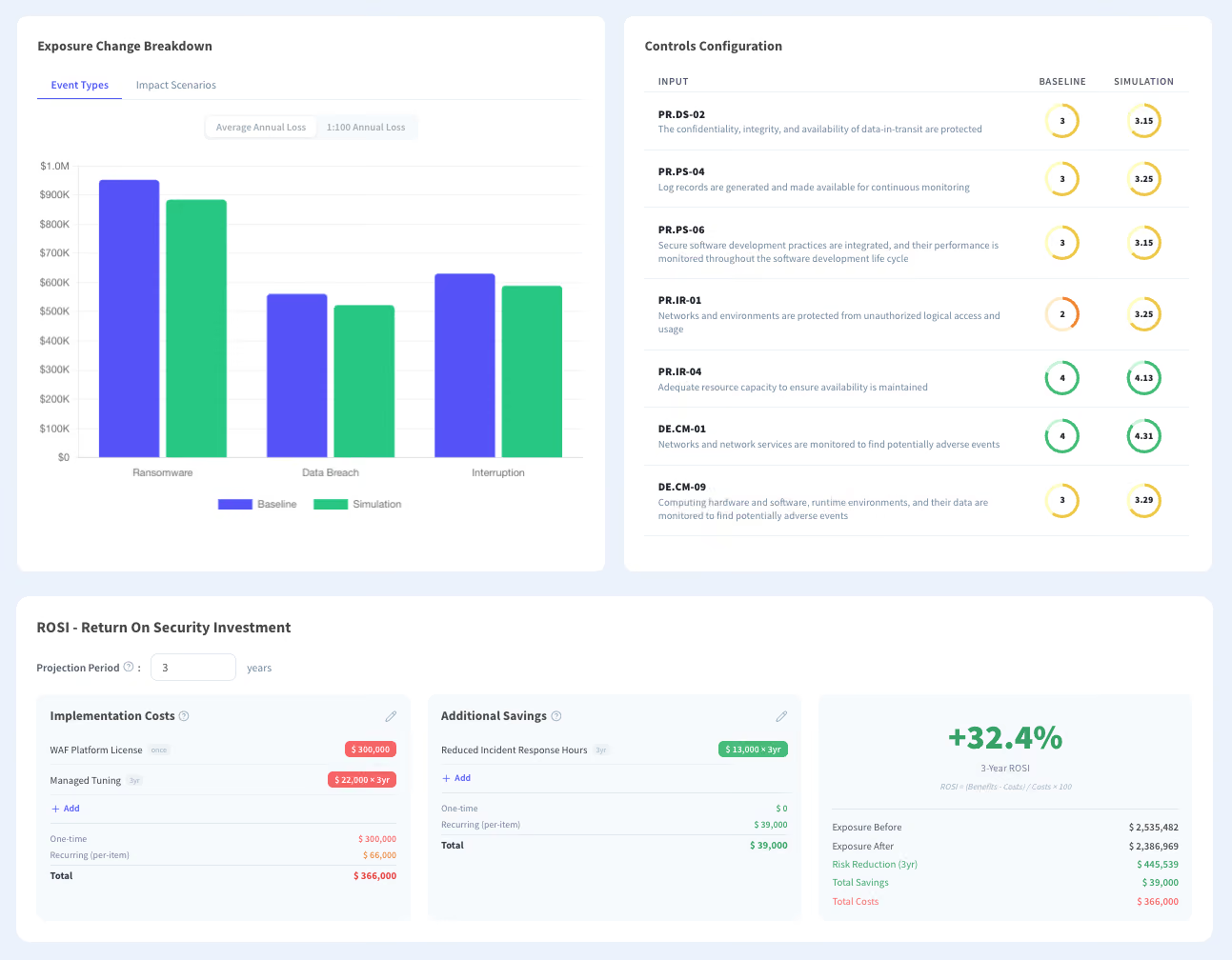
The Return on Security Investment framework produces the dollar-denominated business case executive leadership expects. Every serious CRQ program follows this six-step calculation, and every credible cybersecurity investment request should show the work.
Steps 1 Through 3: Calculate Baseline Exposure
- Determine Asset Value (AV): Calculate the total monetary value of the data, system, or business process at risk, weighted by revenue dependency and customer trust impact rather than IT replacement cost.
- Estimate Exposure Factor (EF): Estimate the percentage of asset loss expected if the specific threat scenario occurs, drawing on incident data and comparable industry outcomes.
- Calculate Single Loss Expectancy (SLE): Multiply Asset Value by Exposure Factor to determine the financial impact of a single occurrence of the threat.
Steps 4 Through 6: Convert to Annual ROSI
- Estimate Annualized Rate of Occurrence (ARO): Determine how frequently the threat scenario is expected to occur within a year, calibrated against actuarial-grade claims data and threat intelligence.
- Calculate Annualized Loss Expectancy (ALE): Multiply Single Loss Expectancy by the Annualized Rate of Occurrence to produce expected yearly exposure from the specific threat.
- Apply Mitigation Ratio and Subtract Solution Cost: Multiply ALE by the percentage of the threat the proposed control blocks, then subtract the full solution cost including software, hardware, labor, and ongoing maintenance to arrive at ROSI.
Programs running this calculation for every proposed investment build a portfolio of defensible business cases the CFO can evaluate against each other and against non-cyber alternatives, which is where modern cyber risk modeling delivers its largest strategic value.
How to Structure the Business Case Presentation
The calculation produces the numbers. Presentation is where those numbers either close the funding decision or get set aside for the next quarter. Three structural moves separate business cases that get approved from ones that stall.
Lead With the Dollar Figure
The first slide of the business case should show the expected ROSI, the payback period, and the movement in Average Annual Loss the investment produces. Everything else supports these three figures. Technical detail, framework mapping, and vendor comparison belong in the appendix or the follow-up conversation, not on the opening slide. The top strategies to demonstrate cybersecurity's value in the boardroom apply directly to the CFO conversation as well as the full board conversation.
Compare Against Alternatives
Executive leadership approves investments in comparative context, not in isolation. Every business case should present at least two alternative uses of the same capital and show the ROSI comparison across all three. This positions cybersecurity as one option in the portfolio rather than a special category exempt from normal capital allocation discipline, and it lets the CFO make a decision rather than accept or reject a single request.
Show Trend Data Over Time
A one-time ROSI figure tells the CFO the story of a single transaction. Trend data across quarters tells the story of a program producing sustained financial value. Business cases that connect to continuous budget justification and prioritization workflows rather than one-off requests produce compound trust with executive leadership across renewal cycles.
Executive Blind Spots to Preempt
Every business case has to preempt a small number of predictable executive objections. Handling them proactively signals financial sophistication and speeds up the approval cycle.
The Compliance-Is-Security Assumption
- The blind spot: Meeting regulatory requirements is often assumed to constitute adequate security.
- The preempt: Show specific residual exposure that survives compliance-level controls, with dollar-value estimates for the incremental risk the proposed investment addresses.
- The evidence: Reference specific breach cases where the affected organization was compliant with the applicable frameworks at the time of the incident.
The Insurance-Is-Enough Assumption
- The blind spot: Cyber insurance is often treated as a substitute for cyber controls rather than as coverage for residual risk.
- The preempt: Show that insurance sublimits, exclusions, and retention structures leave measurable residual exposure that controls have to address.
- The evidence: Reference specific claim denials or sublimit caps that produced material out-of-pocket loss for peer organizations in the same industry.
The Efficiency-Over-Investment Assumption
- The blind spot: Existing security spend is often assumed to be underutilized, so additional investment is unnecessary.
- The preempt: Show the specific residual risk that current controls do not address, quantified in the same dollar terms the proposed investment produces.
- The evidence: Reference the Decision Simulator or comparable what-if modeling that shows the incremental risk reduction from the new investment beyond what current controls already produce.
Where Cyber Risk Quantification Powers the Justification
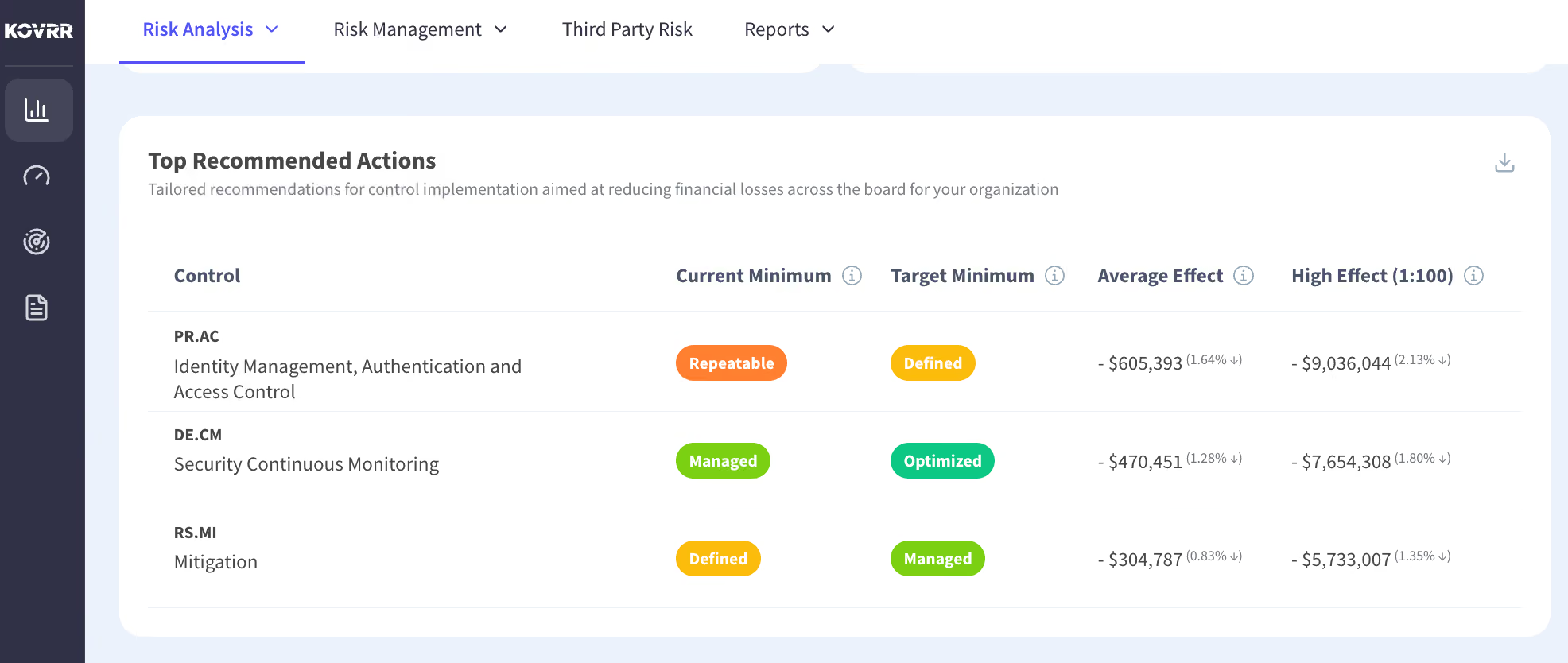
Cyber risk quantification is the operational foundation that makes every step of the justification defensible. Without CRQ, the ROSI calculation runs on estimates that reasonable people can dispute. With CRQ, the ROSI calculation runs on probability distributions calibrated against actuarial-grade data that reasonable people cannot dispute without producing counter-evidence at the same level of rigor.
Kovrr's cyber risk quantification platform produces the underlying inputs every business case needs. Asset value calculations weighted by business criticality. Exposure factor estimates calibrated against real incident outcomes. Frequency inputs drawn from insurance claims data. Monte Carlo simulation running 25,000 trials per quantification to produce stable output. The Decision Simulator models the impact of proposed controls on projected exposure before the investment is made, converting the business case from a forecast into a comparison across specific mitigation options, which is documented in depth in the decision simulation approach.
Making the CFO Conversation an Ongoing Discipline
Cybersecurity investment justification is not a one-time event. It is a recurring conversation that repeats every budget cycle, every board meeting, and every incident retrospective. CISOs who treat justification as an occasional presentation lose ground to peers who operationalize the discipline.
CISOs who run continuous CRQ, produce ROSI figures for every meaningful control decision, and connect their investment portfolio directly to the enterprise risk register and board reporting workflows build compounding credibility with executive leadership across cycles. The security teams moving fastest on this in 2026 are the ones who have made justifying tech purchases a repeatable operational discipline rather than an annual budget-season exercise. To see how
Kovrr's platform produces the underlying quantification, ROSI calculations, and decision modeling that support continuous executive justification, book a demo tuned to your industry and control posture.

Justify Cyber Investments FAQs
Speak to an ExpertHow can I justify cybersecurity investments to executive leadership?

What is Return on Security Investment (ROSI)?
What metrics do CFOs and boards actually care about for cybersecurity?
How does cyber risk quantification support investment justification?
How do you address the "compliance equals security" blind spot in a business case?
How often should CISOs bring investment business cases to executive leadership?