
Blog Post
How to Prioritize Cyber Risks: Deciding Where to Focus First
August 6, 2026
Every enterprise security program faces the same fundamental question. Given a long list of possible cyber risks and a limited budget of engineering hours, security controls, and executive attention, which risks should get worked on first? Getting the answer right determines whether the security team allocates its resources against the exposures that matter most or spreads effort across everything and produces meaningful progress on nothing. Getting it wrong quietly accumulates unaddressed exposure until an incident forces attention, at which point the prioritization conversation happens under conditions no one wants.
Effective cyber risk prioritization requires evaluating threats based on their financial and business impact combined with their likelihood of occurrence, rather than relying on technical severity alone. This is the discipline that turns cyber risk quantification (CRQ) from a reporting exercise into an operating tool that drives real allocation decisions week over week.
This article covers why traditional prioritization approaches fall short, the four layers of data every serious prioritization program needs, how to compare cyber risks using quantified financial exposure, the risk-response framework that closes the loop from ranked risk to action, the common mistakes prioritization programs make, and how CRQ powers continuous prioritization at enterprise scale. For the underlying vocabulary of cyber risk quantification, Kovrr's guide to what CRQ is covers the definitional foundation this article builds on.
Why Traditional Cyber Risk Prioritization Falls Short
Most enterprise security teams still prioritize risks using qualitative severity scales, CVSS scores on vulnerabilities, or subjective risk matrices with red-yellow-green cells. Every one of these approaches produces the same failure mode. Security teams end up with hundreds of "critical" or "high" items competing for attention, no defensible way to compare across them, and no way to explain to executive leadership why one investment was chosen over another.
As Yakir Golan has argued, evaluating threats by technical severity alone systematically misdirects security resources toward risks that look severe on paper but produce minimal actual business exposure.
The core problem is that qualitative prioritization compares severity scores that were never designed to be compared. A "high" CVSS score on an internal test system and a "high" CVSS score on a customer-facing payment platform look identical on the risk register. In reality, the financial exposure differs by orders of magnitude. Quantitative prioritization solves this by converting every risk to a common denominator that reflects actual business impact rather than abstract technical rating.
The Four Layers of Cyber Risk Prioritization Data
Serious prioritization programs draw on four distinct layers of data. Each layer answers a different question, and all four have to be present for the final ranking to hold up under executive scrutiny.
Layer 1: Asset Inventory and Business Value
The first layer catalogs every system, application, database, cloud environment, and third-party dependency the enterprise operates, weighted by the business value it supports. This means revenue dependency, customer trust impact, and regulatory exposure rather than IT replacement cost. An outage on a customer-facing revenue system carries materially different exposure than an outage on an internal reporting tool, even if both look identical from a technical asset perspective.
Layer 2: Threat Landscape and Frequency
The second layer identifies the specific threat scenarios each asset faces and estimates how frequently each scenario is expected to occur. Frequency estimates draw on claims data, incident history, threat intelligence, and industry-specific loss data. Programs that build frequency estimates from internal history alone almost always underestimate low-frequency high-severity events, which is where the biggest exposure sits.
Layer 3: Control Effectiveness and Residual Risk
The third layer measures how effective the current control stack is at reducing each threat scenario's frequency and impact. This is the difference between inherent risk (before controls) and residual risk (after existing controls). Prioritization that ranks by inherent risk produces a list of theoretical bad outcomes. Prioritization that ranks by residual risk produces a list of exposures the current program has not yet solved, which is what security leadership actually needs to allocate against.
Layer 4: Loss Magnitude Modeling
The fourth layer models the financial impact of each scenario if it materializes. Loss magnitude combines direct costs like incident response and system recovery, regulatory penalties from applicable frameworks, litigation exposure, revenue impact from operational downtime, and reputational damage on customer acquisition and retention. Modeling all four categories produces the total loss picture that supports modern cyber risk modeling at enterprise scale.
How to Compare Cyber Risks Using Quantified Financial Exposure
Comparing cyber risks defensibly means converting every risk to a common quantitative denominator. Three specific outputs support the comparison directly.
The Metrics That Enable Direct Comparison
- Average Annual Loss (AAL) per scenario: The expected annualized financial exposure from each specific threat scenario, calculated from frequency and severity distributions.
- Tail loss at defined confidence intervals: The 1-in-100 or 1-in-200 loss figure for each scenario, which captures the catastrophic-outcome exposure that AAL alone misses.
- Risk reduction per dollar of control investment: The Return on Security Investment ratio for each proposed mitigation, which converts ranked risks into ranked investments.
The Views That Support Prioritization Decisions
- Loss Exceedance Curve per scenario: The full probability distribution of annual losses, detailed in the Loss Exceedance Curve guide, which shows where the tail sits for each risk.
- Portfolio aggregation: Rolling up per-scenario exposure into enterprise-level views that show which risks contribute the most to total loss potential.
- Quarter-over-quarter movement: Trend data showing which risks are moving in the right direction and which are accumulating exposure, so prioritization stays responsive to real-world change.
The Risk-Response Framework: Mitigate, Transfer, Avoid, Accept
Once risks are ranked, the response decision follows a standard four-option framework. Choosing the right response for each risk is what turns prioritization from an analytical exercise into an operational decision the security team can execute against.
Mitigate
Mitigation uses security controls to reduce either the likelihood or the impact of a threat scenario. This is the default response for risks where cost-effective controls exist and the residual exposure after controls falls within organizational tolerance. The Decision Simulator models the expected effect of proposed mitigations before implementation, so mitigation decisions rest on projected outcomes rather than assumptions.
Transfer
Risk transfer moves financial exposure to a third party through cyber insurance or contractual indemnification. Transfer is the right response when controls have been maxed out, but residual exposure remains materially higher than tolerance. Programs that treat cyber insurance coverage optimization as an active portfolio decision rather than an annual renewal ritual extract materially more value from insurance investments than programs that treat coverage as fixed.
Avoid
Avoidance eliminates a risk by discontinuing the activity that produces it. Retiring a legacy system, exiting a specific geography, or declining to pursue a specific customer segment all constitute risk avoidance. Avoidance is rarely the right answer for risks that come from core business activities, and it is often the right answer for risks from marginal activities where the exposure exceeds the business value.
Accept
Acceptance means acknowledging the risk and choosing not to invest against it. Acceptance is appropriate when the risk falls within organizational tolerance, when the cost of mitigation exceeds the expected loss reduction, or when the risk is genuinely outside the enterprise's ability to influence. Documented risk acceptance in the cyber risk register is materially different from undocumented risk acceptance, which is what most programs are actually doing when they defer prioritization decisions indefinitely.
Common Prioritization Mistakes
Failed prioritization programs share a small number of predictable failure modes. Two categories cover most of them.
Data and Modeling Mistakes
- Prioritizing by inherent risk instead of residual risk: Ranking by exposure before controls produces a list of theoretical bad outcomes rather than the risks the program has not yet solved.
- Using CVSS scores as the sole prioritization input: CVSS captures technical severity but not business impact, which is why vulnerability lists ranked by CVSS routinely misdirect resources.
- Treating every "critical" as equally critical: When hundreds of items share the same severity label, the label itself has lost information, and any prioritization built on it is arbitrary.
Process and Governance Mistakes
- Prioritizing once per year: Cyber risks change continuously as controls, threats, and business processes evolve, so annual prioritization decays fast and stops driving real decisions between refreshes.
- Skipping the response decision: Programs that rank risks without explicit mitigate-transfer-avoid-accept decisions produce lists that never become work items.
- Missing the executive translation: Prioritization output that stays in technical language never enters the budget conversation, so the risks stay unaddressed regardless of how carefully they were ranked.
How CRQ Powers Continuous Prioritization
Cyber risk quantification is the operational layer that turns prioritization from an annual event into a continuous operating discipline. Every element of the four-layer data model requires quantified inputs, and every element of the ranking output requires defensible dollar-denominated exposure figures.
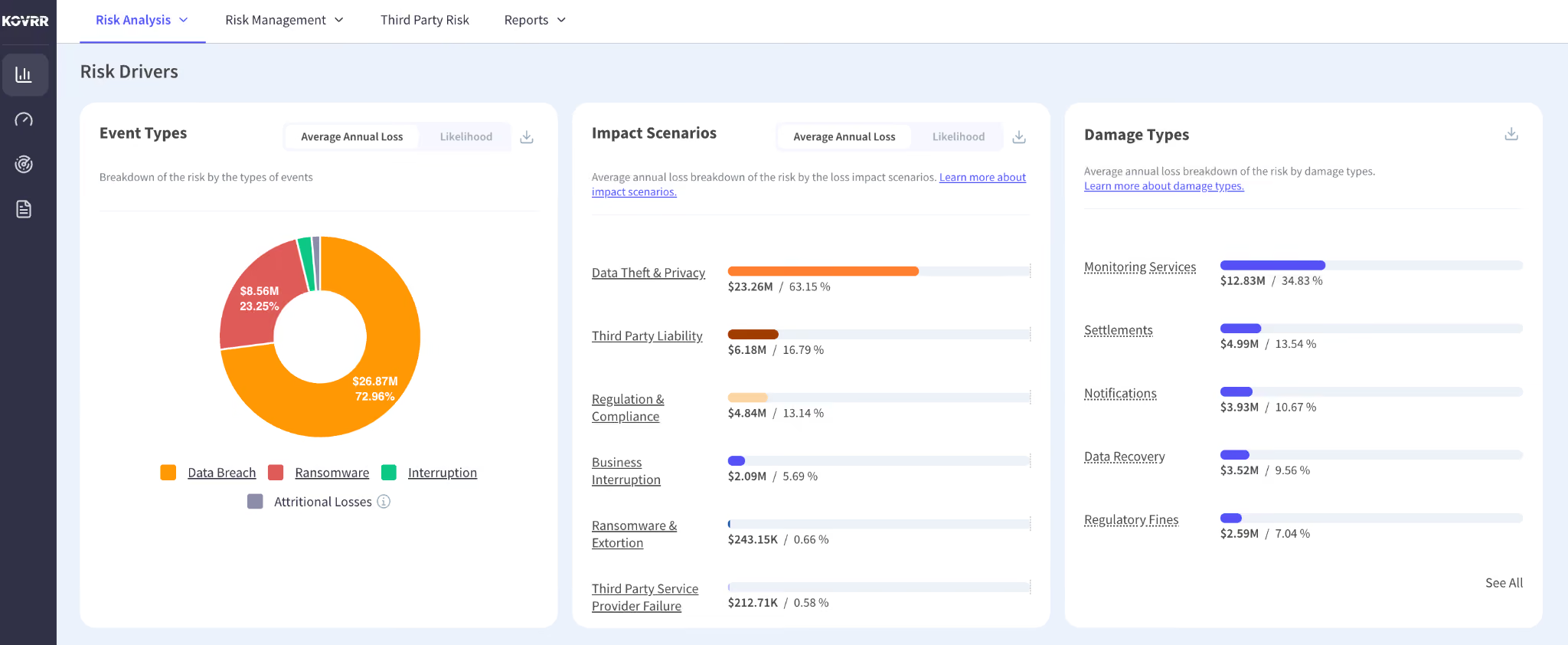
Kovrr's cyber risk quantification platform produces the four layers automatically. Asset inventory with business criticality weighting. Threat scenario libraries with frequency inputs anchored to actuarial-grade claims data. Control effectiveness modeling that produces residual risk figures per scenario. Loss magnitude modeling covering direct, regulatory, litigation, and indirect impact categories. The output is a continuously updated ranked list of enterprise cyber risks measured in dollars, refreshed as controls, threats, and business posture change, so prioritization stays live rather than snapshotting once a year.
Making Prioritization an Ongoing Operating Discipline
Cyber risk prioritization is not a document security teams produce annually and file with the audit committee. It is a continuous operating discipline that runs every week, updates every material change in the environment, and drives real allocation decisions across security engineering, control investment, and executive-level budget conversations. Programs that treat prioritization as a live operating output built on quantified financial exposure allocate their limited resources against the risks producing the most actual business impact.
Programs that treat prioritization as an annual filing exercise spread effort across everything and produce measurable progress on nothing. The organizations moving fastest on this in 2026 are the ones combining continuous CRQ, ranked residual exposure per scenario, and explicit mitigate-transfer-avoid-accept response decisions into a repeatable weekly operating cadence tied to cybersecurity budget justification.
To see how Kovrr's platform produces the quantified, continuously updated risk portfolio prioritization required, book a demo tuned to your industry and control posture.

Prioritizing Cyber Risk FAQs
Speak to an ExpertHow can I compare different cyber risks to decide where to focus first?

What is the difference between inherent risk and residual risk for prioritization?
Why are qualitative risk matrices insufficient for enterprise prioritization?
What is the mitigate-transfer-avoid-accept framework?
How often should cyber risk prioritization be updated?
How does CRQ improve prioritization compared to traditional risk assessment?