
Blog Post
Why AI Review Cannot Keep Up With the Decision
September 21, 2026
That human review becomes a bottleneck as agents scale is now widely observed. Five or ten agents working in parallel produce more decisions than one reviewer can evaluate, and under queue pressure the review degrades into approval without examination.
The usual response is to move up a level, reviewing intents and boundaries rather than individual outputs. The move is sound and it leaves the question that decides where oversight can sit at all, which is whether a person could have evaluated the decision in the time available even with an empty queue.
What Is the Prior Question?
Not whether the reviewer looked, but whether looking was possible. Those have different answers and different remedies.
A review that happened too quickly to be real is a capacity problem, solved by fewer reviews, more reviewers or a narrower scope. A review that could not have been substantive at any staffing level is a design problem, because the decision resolves faster than a person can form a judgment about it. The first is fixable by resourcing and the second is not.
Which Decisions Fall Into the Second Category?
Anything where the consequence arrives before a person could evaluate the input. An agent selecting a route, adjusting a parameter or choosing which record to read next resolves in milliseconds, and a human placed at that point adds latency and no judgment. Inserting a review there produces a control that exists on a diagram and cannot function.
How Do You Tell the Two Apart?
Compare two intervals, both of which are measurable rather than estimated.
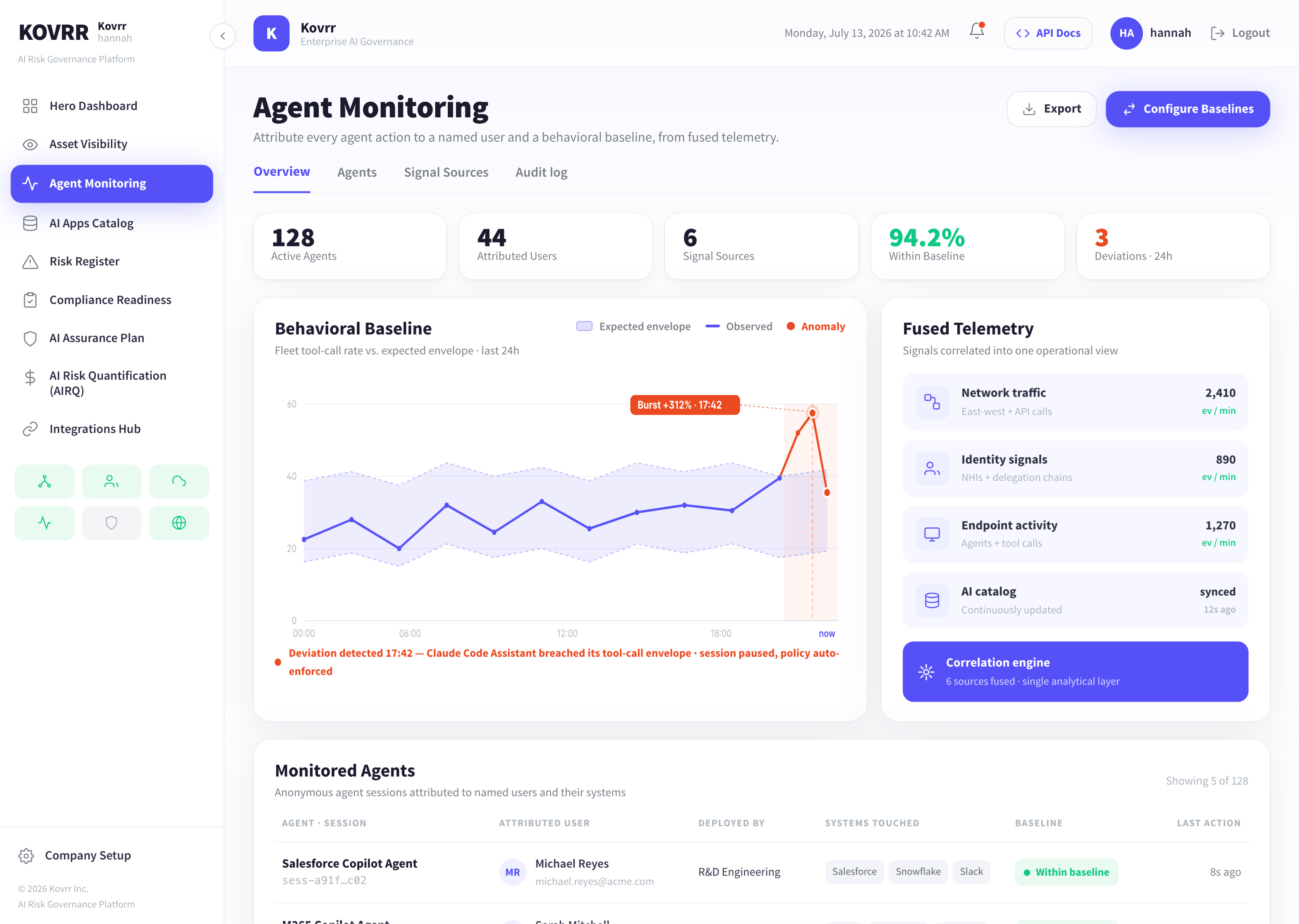
The first is how long the agent takes from producing a candidate action to committing it, which is observable from telemetry. The second is how long a competent person needs to understand the action well enough to accept or refuse it, which is establishable by asking somebody to do it a few times and timing them.
What Does the Comparison Produce?
Three outcomes. Where the human interval fits inside the agent interval, synchronous review is viable. Where it does not but the action is reversible, supervision after the fact with an override is the honest arrangement. Where it does not and the action is irreversible, the design has to change rather than the staffing, and classifying actions by reversibility is the input that decides which.
Why Does the Chain Make This Worse?
Because the intervals compound in one direction and the review does not.
A single agent producing one action gives a reviewer whatever time that action takes. A chain where one agent's output feeds the next means the consequence of an early decision materializes several steps later, so a reviewer at step one is evaluating something whose effect they cannot yet see, and a reviewer at step four is looking at an outcome already determined upstream.
Where Should the Review Point Sit?
At the last moment the outcome is still preventable, which is frequently neither the beginning nor the end. Reviewing the first step approves an intent with unknown consequences and reviewing the last one confirms a result, so the useful position is wherever the chain's effect becomes determinate and an intervention still stops it, which separation of duties across a chain helps locate.
What Does a Regulator Expect?
Oversight by people who can act on what they see, which is a stronger requirement than a review step existing.

European rules on high-risk systems require human oversight by competent people with the authority to intervene, which builds in both capability and standing. A reviewer who lacks the time to evaluate has not been given the capability, so a design where review was structurally impossible does not satisfy the requirement even where every record shows an approval.
The Record Can Be a Liability
An approval log showing consistent sub-second sign-offs on consequential decisions documents that review was nominal. It is worse than no log, since it evidences the failure precisely and dates it, and whether a review occurred at all is the measurement that surfaces it before somebody else finds it.
What Replaces Review Where It Cannot Work?
Constraints set in advance, which is the only mechanism that operates at machine speed.
Where a decision resolves faster than judgment, the governable properties are which actions are available at all, how far each can go, how often it can repeat and whether it can be undone. Those are decided once by people with time to think, enforced continuously without anyone present, and they produce evidence in the form of a configuration rather than a click.
Which Is a Different Kind of Evidence
An approval record says a person considered this instance. A constraint record says nobody could have exceeded this boundary, which is a stronger claim about a population of decisions and a weaker claim about any single one. For high-volume machine-speed activity the first is unavailable and the second is checkable.
How Should the Oversight Cost Be Compared?
Against the exposure the review removes rather than against the alternative of no oversight, which is where most of these decisions get made badly.
A synchronous review adds latency to every action and catches whatever proportion of bad actions a person can identify in the time available. Where the proportion is low because the interval is short, the review costs throughput and removes little. Comparing the two directly turns an architectural argument into an arithmetic one, and the rate that decides whether oversight pays is the missing input.
Which Rate Is Missing?
How often the reviewer refuses. A review point that has never rejected anything is either positioned where nothing goes wrong or unable to tell, and both readings argue for moving it. The figure is available from any approval system and almost nobody reports it.
Which Oversight Mode Fits Which Decision?
Three modes exist and the choice follows from the interval comparison rather than from a policy preference.
Synchronous approval, where the agent pauses and waits, fits high-consequence irreversible actions and nothing else, because it costs latency on every instance. Asynchronous supervision, where agents execute while a person monitors and retains an override, fits high-volume reversible work. Fully autonomous operation under enforced policy fits latency-sensitive execution where any human delay destroys the utility.
What Goes Wrong in Practice?
Synchronous approval gets applied to the second and third categories because it looks like the safest option. The result is a queue, a reviewer who approves without reading, and an audit record showing oversight that did not happen. Choosing the weaker mode deliberately produces a more honest position than choosing the strongest one and having it degrade.
Can a Decision Move Between Modes?
Yes, and it should. An action can start under synchronous approval while its behavior is being learned, then move to supervision once the refusal rate shows the reviewer is rarely intervening. An AI data fabric that records the refusal rate over time is what makes that transition evidence-based rather than a decision somebody makes when the queue gets long.
What Should Be Measured This Month?
Three intervals and one rate, all obtainable without new tooling.
How long each agent takes from candidate action to commitment. How long a person needs to evaluate one properly, timed rather than assumed. Where in each chain the outcome becomes determinate. Then the refusal rate at every existing review point. An AI Interaction Data Fabric supplies the first and third from observed activity, and the second and fourth are exercises somebody can run in an afternoon.
Ask Whether Looking Was Possible
The bottleneck argument is correct and it addresses capacity, which is fixable by resourcing. The prior question is whether a person could have evaluated the decision at all in the time the architecture allows, and where the answer is no, no amount of staffing helps. Comparing the agent's decision interval against the human evaluation interval sorts the two, and both are measurable rather than debatable. In a chain the useful review point is wherever the outcome becomes determinate while intervention still works, which is rarely the first step or the last. Where review cannot function, constraints decided in advance are the only control that operates at machine speed, and they produce a stronger claim about a population of decisions than an approval log does about any one. Kovrr's AI Security and Governance Platform records what each agent could do and how fast it acted, which is what the comparison needs.
To see agent decision intervals alongside the oversight points placed against them, book a demo mapped to your own estate.

AI Oversight Timing FAQs
Speak to an ExpertWhat is the prior question to the review bottleneck?

How do you tell a capacity problem from a design problem?
Why does a chain of agents make this worse?
Does a review that could not function satisfy a regulator?
What replaces review where it cannot work?
Which measurement is usually missing?