Blog Post
The CIO Answers for AI They Never Approved
November 1, 2026
When an AI system misfires inside a large company, the question that follows is who was responsible for it. The answer usually lands on the CIO, and frequently the CIO had no part in choosing, approving or deploying the thing that failed.
This gets described as a governance problem, which undersells it. Governance implies a process that exists and performs badly. What has happened is more structural, since the authority to introduce AI has dispersed across the business while the answerability for it stayed in one office.
Who Approved the AI the CIO Answers For?
Frequently nobody in IT, and the surveys are consistent on this.
Schellman's 2026 State of AI Governance report, fielded among 525 professionals involved in evaluating, deploying or governing AI, found that 42% name the CIO or head of IT as primarily responsible for AI purchasing decisions. That makes the office accountable by default. Meanwhile a Dataiku and Harris Poll survey of 685 CIOs across eight countries found that 84% say employees are building AI agents and applications faster than IT can govern them, and 60% have no central governance layer spanning their enterprise applications and environments.
Those two findings describe one position. The office that answers for AI is not the office where most AI now originates.
Responsibility and Authority Sit in Different Places
The same Dataiku research found CIOs divided on who is primarily responsible when an agent causes harm, with answers spread across shared teams, central IT, the data or AI function and the security and compliance side, none of them commanding more than a quarter of responses. Thoughtworks reached a similar reading in its 2026 global CIO survey, describing authority over AI as already divided across central IT, business units, executive leadership and dedicated AI roles, with accountability not always aligned to responsibility.
An executive who is answerable for something they cannot authorize is in a position no amount of diligence resolves. The work is to change what they can see and measure, since changing who decides is mostly not available.
Why Pulling Approval Back Into IT Fails
Because the decisions dispersed for a reason, and the reason has not gone away.
A marketing team picks an AI writing tool because it understands its own workflow. A finance analyst enables a feature inside software the company already licensed. Neither routed through IT, and neither was behaving badly. Reasserting central approval over every one of those choices produces a queue, and a queue produces workarounds, so the practical result of tightening the gate is usually less visibility rather than more.
The position worth aiming at is different. Let the decisions stay where they are, and make what results observable enough that somebody can answer for it.
What Changes the Position?
Knowing what exists, where each thing came from, who owns it and what it would cost if it went wrong.
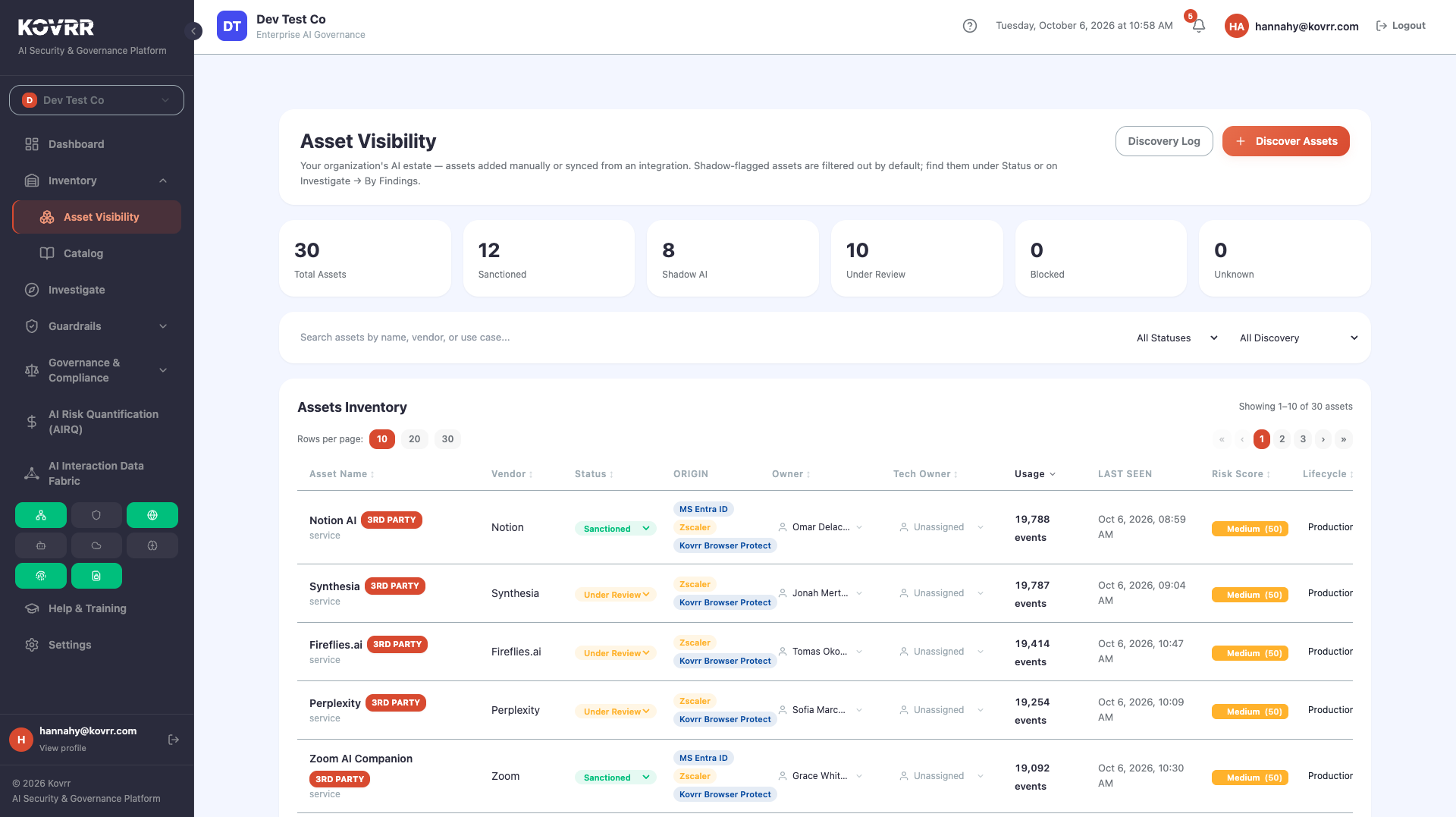
An inventory that records sanctioned, shadow and under-review as three separate states rather than two tells a CIO something an approval list cannot. So does a discovery origin per asset, since an entry seen by the identity provider, the network layer and the browser at once is established rather than asserted. AI asset discovery is the part of this that runs continuously rather than at audit time.
Business Owner and Technical Owner Are Rarely the Same Person
Recording them as one field is how accountability stays stuck in one office. The team that chose a tool and depends on it daily is the business owner. The person responsible for its configuration, its credentials and its connections is the technical owner. Keeping the two apart on every asset is what allows a CIO to hand a specific question to a specific person rather than carrying all of it.
Where This Gets Settled With the Board
In a number, and most programs are not producing one.

Schellman found only 54% of organizations report AI governance regularly to their board or executive leadership, and just 36% of boards regularly discuss third-party AI risk despite how much AI now arrives embedded inside vendor platforms. A CIO reporting a count of tools is giving directors something they cannot weigh against anything else on the agenda. AI risk quantification puts the exposure in the same units as the other items a board reviews, which is the condition for it being discussed rather than noted.
Confidence Runs Ahead of Readiness
The same research found 74% of organizations believe they could pass an AI compliance audit today while 27% describe their governance as fully mature, and 90% have already allocated funding. Money is not the constraint. The distance between what leaders believe and what an auditor would find is the thing a CIO carries personally, and it closes through evidence rather than through budget.
What a CIO Can Establish This Quarter
Four things, none of which require taking approval rights back.
- A real inventory: every AI system touching corporate data, including the ones inside software already licensed, with the surface that detected each one recorded alongside it.
- Named ownership on both sides: a business owner and a technical owner per asset, so a question about any one of them has a destination.
- Exposure in financial terms: one figure the board can compare against the other risks it reviews, updated as the estate changes rather than annually.
- Evidence that survives a request: the records an auditor would ask for, collected continuously, since 74% believing they are ready and 27% being ready is a documentation problem.
Those four move a CIO from answering for AI they never approved to answering about it with specifics. A live inventory maintained as posture rather than as a document is what keeps the first one true a month after it is built, and assigning AI risk ownership across an organization covers how the second gets agreed.
Answerable Without Being the Approver
The CIO carries AI that originated elsewhere, and the research says plainly why. Most organizations name the office as primarily responsible for AI purchasing while most AI arrives through business units, embedded vendor features and employees building their own agents. Authority dispersed and answerability did not follow it. Recentralizing approval pushes usage out of sight rather than bringing it back, so the available move is to make the estate observable, name an owner on both the business and technical side of each asset, and state the exposure in a figure the board can weigh. Kovrr's AI Security and Governance Platform maintains that inventory continuously and quantifies what sits inside it.
To see an AI estate inventoried by origin and quantified in financial terms, book a demo with our AI risk experts.

CIO AI Accountability FAQs
Speak to an ExpertWhy are CIOs accountable for AI they did not approve?

Should AI approval be centralized back into IT?
Who is responsible when an AI agent causes harm?
What should a CIO record about each AI asset?
How often is AI governance reported to boards?
Are enterprises ready for an AI compliance audit?