
Blog Post
How to Turn Cyber Risk Insights Into Concrete Mitigation Decisions
July 31, 2026
Every mature cyber program eventually hits the same wall. Security teams collect enormous amounts of telemetry, threat intelligence, and control data, and yet the conversation with the CFO about what to fund next still feels like an argument about opinions rather than evidence. The reason is not that the data is missing. The reason is that the data has not been translated into the format executive leadership uses to make investment decisions, which is financial exposure in dollar terms tied to specific business scenarios.
Turning cyber risk insights into concrete mitigation decisions requires four moves executed together: quantifying the exposure in financial terms, prioritizing scenarios by residual risk, comparing control investments by their dollar-for-dollar impact, and presenting the trade-offs to leadership in a form they can act on.
This article covers why insights get stuck at the data stage, how to transform cybersecurity data into risk metrics, the four-step framework from insight to decision, how the Decision Simulator makes trade-offs visible, and how to justify cybersecurity investments to executive leadership using the same language finance already uses for every other risk category.
Why Cyber Risk Insights Get Stuck at the Data Stage
Most enterprise cyber programs produce more data than any human team could act on. Vulnerability scanners generate thousands of findings per week, threat intelligence feeds fire off alerts by the hour, and framework maturity assessments produce hundreds of control-level scores at every review cycle. The volume is not the problem. The problem is that none of it, on its own, tells leadership what to fund next.
The Disconnect Between Security Telemetry and Decision-Making
Raw security data lives in the operational language of the SOC. Vulnerability counts, patch rates, and maturity scores tell the security team what to work on today. They do not tell the CFO which of three competing investment proposals produces the largest dollar-value risk reduction, and they do not tell the board whether the exposure has moved in the right direction over the past quarter. Every layer of translation between operational data and executive decisions is a layer where insight gets lost, which is why cyber budgets so often get argued rather than modeled.
What Leadership Needs to Move From Insight to Action
Executives and boards need three things security telemetry alone cannot provide. They need financial exposure figures they can compare against other enterprise risks, they need investment options ranked by return on risk reduction, and they need trend data that shows whether the program is working. Programs that translate insight into these three artifacts move from operational cost centers to strategic investment portfolios, which is what modern cyber risk modeling makes possible.
Transforming Cybersecurity Data Into Risk Metrics
The translation from raw data to decision-ready metrics is the discipline that separates high-functioning cyber programs from ones that produce dashboards no one uses. Two categories of transformation cover the fundamentals.
Types of Raw Data to Quantify
- Threat and control telemetry: Vulnerability scan output, control maturity assessments, incident data, and third-party risk signals all become inputs to a probabilistic model.
- Business context data: Asset criticality, revenue dependencies, data classification, and third-party dependencies convert raw findings into business impact estimates.
- Historical loss and claims data: Insurance industry claims history and industry-specific incident data anchor the frequency and severity inputs to real-world outcomes.
Metrics That Support Decisions
- Average Annual Loss (AAL): The expected annualized cyber exposure, expressed in dollar terms comparable to any other enterprise risk category.
- Loss Exceedance Curve: The full probability distribution of potential annual losses, explained in deciphering the Loss Exceedance Curve.
- Return on Security Investment (ROSI): The dollar-value risk reduction produced per dollar of control spending, which is the metric budget conversations actually run on.
The Four-Step Framework From Insight to Decision
Effective translation of insight into decision runs through four distinct stages. Each one produces an output the next stage depends on, and skipping any single step breaks the chain.
Translate Insight to Financial Value
Quantify the exposure in dollar terms using probabilistic modeling. Kovrr's engine runs 25,000 Monte Carlo trials per quantification against calibrated frequency and severity distributions, producing a full loss distribution rather than a point estimate. Every scenario the security team is worried about becomes a dollar figure the CFO can reason about, and every proposed control becomes measurable against its financial contribution.
Prioritize by Residual Exposure
Rank scenarios in the cyber risk register by residual risk after existing controls, not by inherent risk before controls. Inherent risk lists every possible bad thing. Residual risk shows what the program has not yet solved, which is the list executive leadership actually needs to see. Prioritization based on residual exposure focuses investment on the risks the current control stack has not adequately reduced.
Map Mitigations to Frameworks
Align every proposed mitigation to NIST CSF 2.0 or ISO/IEC 27001 subcategories so the security investment story ties directly to the frameworks auditors, regulators, and boards already recognize. Framework mapping is also what makes maturity movement over time visible, which is essential for the trend view leadership expects at quarterly reviews.
Assign Ownership and Track KPIs
Every mitigation needs a named owner, a documented deadline, an allocated budget, and a defined success metric. Insights that never make it to a named human owner do not become decisions. The expanding role of the CFO and board in cyber risk management has raised the stakes on this discipline, since accountability now flows through the same channels finance and enterprise risk already report on.
How the Decision Simulator Makes the Trade-Offs Visible
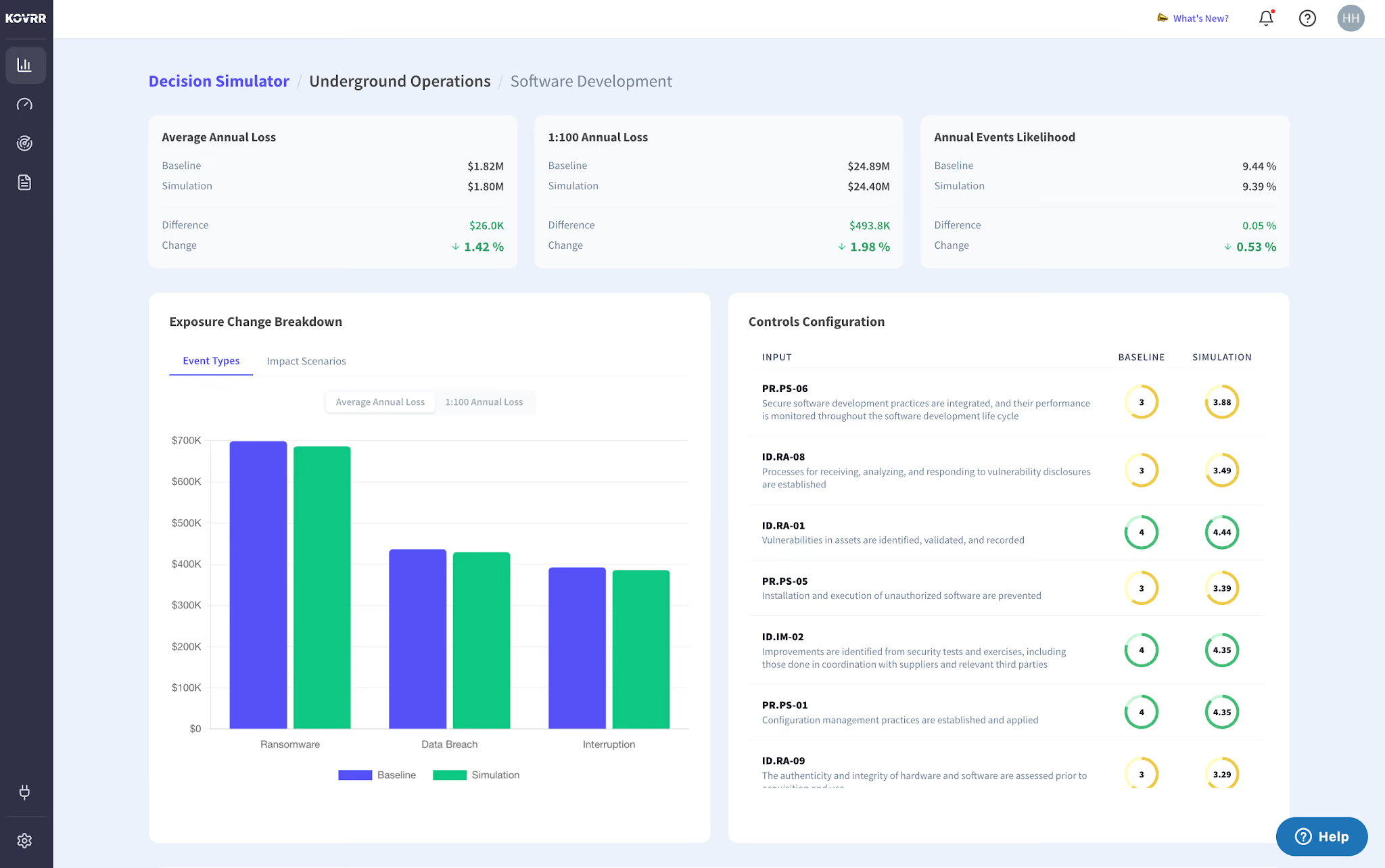
The hardest part of translating insight into decision is comparing competing investments in a way leadership can trust. Two proposed controls with the same price tag can produce dramatically different risk reduction, and without a modeling engine that quantifies both, the comparison collapses into opinion.
What-If Modeling of Control Investments
Decision Simulation applies the same probabilistic model the platform uses for the baseline quantification, but runs it with proposed controls in place. The output shows the AAL and tail loss the organization would carry after each investment, letting security and finance teams compare options against each other and against doing nothing.
Comparing Dollar-for-Dollar Risk Reduction
The Decision Simulator produces a straight ratio: dollars of risk reduction per dollar of control investment. That ratio is what turns a control comparison from "which one sounds better" into "which one produces the highest return." The comparison holds across categories, so endpoint detection can be evaluated against identity hardening against third-party risk controls using the same denominator.
Feeding Decisions Into the Risk Register
Once a control decision is made, the modeled outcome flows back into the cyber risk register as the projected residual risk after implementation. This creates a closed loop where every decision made from the risk register updates the register itself, so the next quarterly review shows movement rather than a snapshot.
Justifying Cybersecurity Investments to Executive Leadership
The final translation is from decision to funding approval. Executive leadership sees dozens of investment requests every budget cycle. Cyber requests that show up in the same financial language as every other request compete on equal footing. Requests that stay in technical language lose.
What Executives Want in a Business Case
- Quantified risk reduction: A defensible dollar figure showing the AAL or tail loss reduction the investment produces, tied to the underlying model that generated the number.
- Comparison to alternatives: A ranked list of the investment against other options in the portfolio, so leadership sees the choice rather than a single ask.
- Movement over time: A projection of how the residual exposure changes quarter over quarter after the investment is made, showing the trend line finance already looks for.
How to Present the ROI
- Lead with the dollar figure: Open the business case with the expected risk reduction and the payback period, not the technical detail behind either.
- Anchor to enterprise risk categories: Position cyber investment alongside other enterprise risk investments so leadership sees where cyber sits in the total risk portfolio.
- Tie to strategic priorities: Connect the investment to specific business initiatives, regulatory obligations, or insurance renewal outcomes rather than framing it as a standalone security purchase.
The budget justification and prioritization approach that ties every request to quantified risk reduction is what makes cybersecurity investment defensible in front of finance leaders, and maximizing ROI for the cybersecurity program becomes an achievable goal rather than a slogan.
Common Mistakes When Translating Insights Into Decisions
Failed translations follow predictable patterns. Two categories cover most of the traps.
Mistakes at the Analysis Stage
- Presenting inherent risk instead of residual risk: Executives cannot prioritize an inherent risk list because it does not reflect what the existing control stack has already solved.
- Reporting counts instead of dollars: Numbers of vulnerabilities, patches, or alerts tell the SOC what to work on, but they tell leadership nothing about financial exposure.
- Missing business context on assets: Technical risk ratings without business-value context force every risk to appear equally important, which produces no useful prioritization.
Mistakes at the Decision Stage
- Comparing controls on features rather than risk reduction: Feature comparisons produce vendor debates, while risk-reduction comparisons produce investment decisions.
- Skipping trend projections: A point-in-time exposure figure without a projected trend line gives leadership no way to evaluate whether the investment moves the number.
- Not connecting decisions back to the register: Decisions that never update the underlying risk register decay fast, since the next review cycle starts from stale data.
The pattern across all six mistakes is the same. Insights that stop short of being translated into financial trade-offs never become decisions, and decisions that never flow back into the operational record never produce measurable improvement in the ongoing cybersecurity performance management that leadership expects to see.
From Continuous Monitoring to Continuous Decision-Making
The maturity progression is straightforward. First, the organization collects security telemetry. Then it aggregates the telemetry into risk metrics. Then it translates the metrics into financial exposure. Then it uses financial exposure to compare control investments. Then it turns those comparisons into funded decisions that update the underlying risk register.
Programs that complete the full chain run cyber as a portfolio management discipline, allocating capital toward the exposures that matter most and tracking whether the allocation is producing the expected results. Programs that stop at any step earlier keep producing data and losing the decisions the data was supposed to support.
To see how Kovrr's Decision Simulator and CRQ platform turn cyber risk insights into concrete mitigation decisions leadership will approve, book a demo tuned to your industry and control posture.

Turning Cyber Risk Into Action FAQs
Speak to an ExpertHow can I turn cyber risk insights into concrete risk mitigation decisions?

How can I justify cybersecurity investments to executive leadership?
How can I transform cybersecurity data into risk metrics?
What is the difference between inherent risk and residual risk?
How does the Decision Simulator support cyber investment decisions?
How does justifying tech purchases with CRQ differ from a traditional business case?