
Blog Post
Model Deprecation Runs on the Provider's Calendar
August 27, 2026
Most changes to a hosted model arrive without warning. Deprecation is the exception, and it is the one an enterprise can plan for, because it comes with an announcement and a date.
The date belongs to the provider. Notice periods are set by the economics of freeing compute for newer architectures rather than by how long a customer needs to revalidate, and for organizations with formal change control the two are frequently incompatible. Knowing the window before it opens is what separates a scheduled migration from an emergency one.
The Windows Are Shorter Than Change Cycles
Published notice commitments vary considerably by provider and by tier, and the differences matter more than the averages.
Generally available models from the larger platforms typically carry a minimum of around six months. Some production tiers commit to as little as sixty days. Preview and experimental models can be withdrawn with a few weeks of notice, and specialized variants sit somewhere between. Managed gateway services generally align to ninety days while restricting new access considerably earlier. Against a typical model lifecycle of twelve to eighteen months, deprecation is a recurring event rather than an exceptional one.
Read the Tier, Not the Vendor
The commitment attaches to the service tier rather than to the company, so the same provider can offer six months on one endpoint and a fraction of that on another. Anything built on a preview endpoint carries the shortest window available, which is a reasonable trade for experimentation and a poor one for a production workflow that quietly became permanent. An inventory is what surfaces those before a notice does.
The Successor Is Not a Drop-In
Migration gets scoped as a version string change and is rarely that. Three failure modes recur and all of them surface in testing rather than in documentation.
Structured output breaks first. Prompts producing reliably parseable responses on one model can return formats that fail schema validation on its successor, which turns into request errors rather than degraded quality. Refusal behavior moves next, since alignment thresholds differ between generations and a prompt that ran cleanly for a year can start declining to answer. Token accounting changes third, because tokenizer differences alter how much fits in a context window, producing truncated outputs and unexpected cost movement.
None of This Is Visible Without a Suite
Each of those is discoverable in an afternoon with a fixed evaluation set and invisible without one. Organizations that maintain a suite treat migration as a test run, and organizations that do not discover the differences in production during a compressed window. The same suite answers whether a prior assessment still holds after any provider change. Recording the model version alongside every test result is what makes the comparison possible, which records that survive an audit sets out in more detail.
Regulated Workloads May Not Fit the Window
This is the conflict that catches governance functions and it has no technical fix. An organization required to revalidate a model before deploying it into a consequential decision has a process measured in weeks or months, covering testing, documentation, independent review and sign-off.
A sixty day notice period against a revalidation cycle of comparable length leaves no margin, and any slippage means either running past the deprecation date or deploying without completing the process. Neither is acceptable, and the choice arrives late because nobody compared the two durations in advance.
Compare the Two Numbers Before You Commit
The check is simple and rarely performed. For each system supporting a regulated decision, record the provider's committed notice period and your own revalidation duration, then look at the difference. Where the second exceeds the first, the options are negotiating a longer commitment, moving that workload to a tier with a longer window, or accepting that a deprecation will force an exception. All three are manageable decisions in advance and poor ones under deadline. Contractual terms are where the first option gets settled, and third-party terms agreed before signature are far easier to obtain than afterward.
Fine-Tuning Is Where the Cost Concentrates
Custom models built on a base architecture retire when that architecture does. Providers do not carry fine-tuning weights forward to a new generation, so the work has to be redone rather than migrated.
Redoing it means locating the training data, confirming it is still usable and still licensed for the purpose, rerunning the process against a model with different characteristics, and revalidating the result. Teams that fine-tuned two years ago frequently find the dataset has drifted or the person who assembled it has left. Where retrieval and prompting can achieve the outcome instead, they transfer between models and fine-tuned weights do not, which is a design decision with a recurring cost attached.
Reduce the Cost Before the Notice Arrives
Three measures lower what a deprecation costs, and all of them have to be in place beforehand.
- No Hardcoded Model Strings: Route calls through an internal layer so a replacement is a configuration change rather than an edit across every consumer.
- Maintain an Evaluation Suite: A fixed set of cases with recorded expected behavior turns migration testing into a run rather than a project.
- Keep a Validated Alternative: A second model already tested against that suite converts a migration into a switch.
Monitoring provider announcements completes it, and it is the step most often left to whoever happens to read the release notes. Treating deprecation notices as a feed that reaches a named owner, rather than an email someone forwards, is the difference between a nine month runway and a six week one.
What to Record Per System
Four fields make a deprecation notice a scoped task rather than an investigation.
The exact model and version each system calls, since a system recorded as using a provider rather than a model cannot be assessed against a notice. The service tier, because that determines the window. Whether fine-tuning is involved, which changes the cost by an order of magnitude. The revalidation duration for that system completes it, so the comparison against the notice period can be made immediately. Holding these against the model layer rather than the tool is what allows one notice to be resolved into a list of affected systems in minutes.
Concentration Cuts Both Ways
Standardizing on one model across many systems makes each deprecation a larger event, while spreading across several providers multiplies the number of notices to track. Neither is wrong, and the choice should be made deliberately with the migration cost in view rather than falling out of procurement decisions made separately, which is the same reasoning behind concentration assessed across a portfolio.
The Only Change With a Date on It
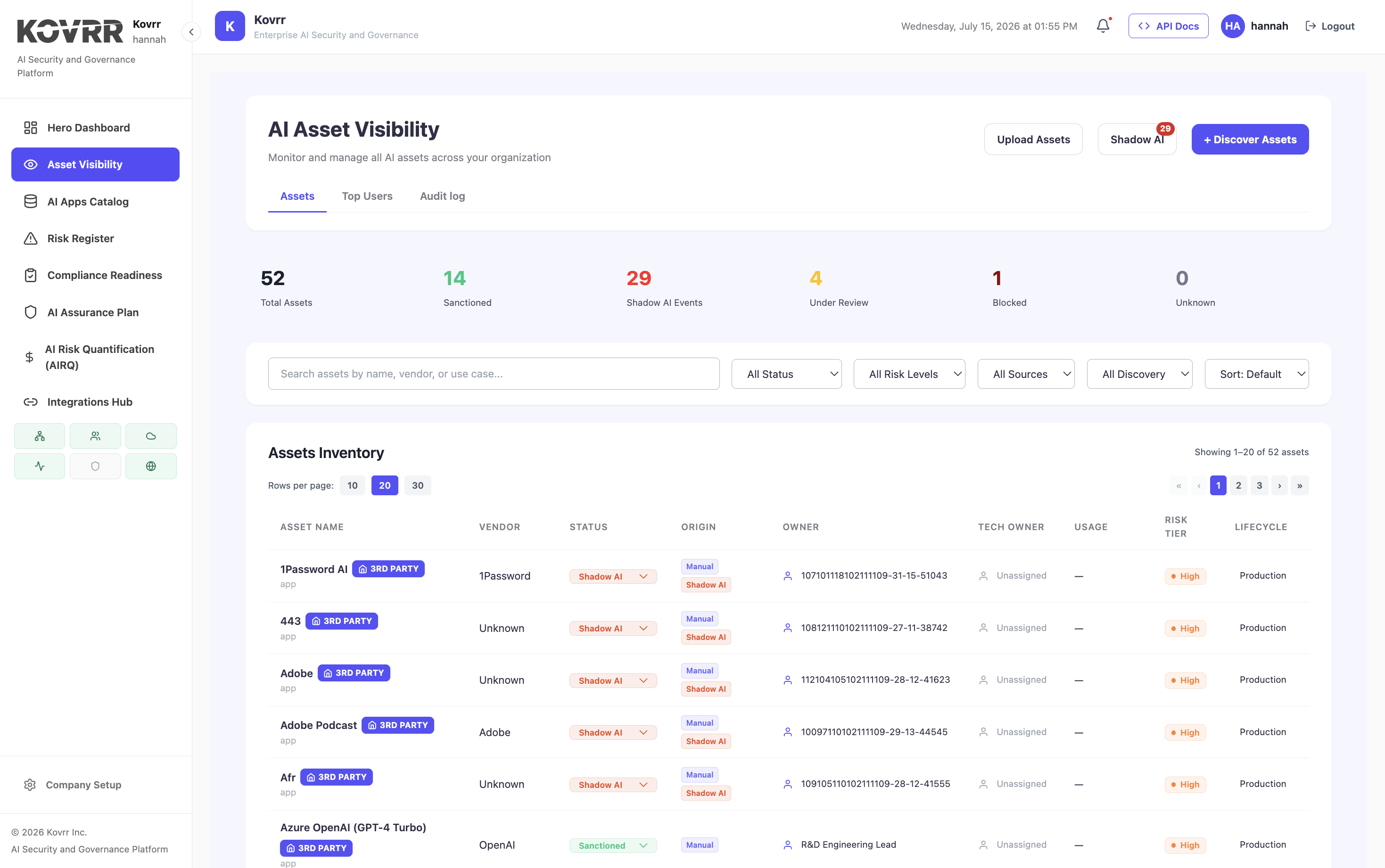
Silent model updates arrive without warning and deprecation does not, which makes it the one provider-side change an organization can plan against. The planning has to happen before the notice, because the window is set by the provider's compute economics rather than by anyone's revalidation calendar, and for regulated workloads the two can be incompatible. Recording model version, service tier, fine-tuning dependency and revalidation duration against each system turns an announcement into a scoped task. Kovrr's AI asset visibility holds that record, which is what makes the comparison available on the day the notice lands.
To see which of your systems depend on which model versions and how quickly each could be moved, book a demo mapped to your own estate.

Model Deprecation FAQs
Speak to an ExpertHow much notice do providers give before retiring a model?

Why isn't the successor model a drop-in replacement?
What happens to fine-tuned models when the base is retired?
Why is deprecation a problem for regulated systems?
How do you reduce the cost of a forced migration?
What should be recorded to prepare for deprecation?