
Blog Post
Real-Time AI Security Monitoring: Why One Assessment Expires
August 17, 2026
A penetration test on a web application stays broadly valid until someone changes the application. An assessment of an AI system starts expiring immediately, because the system changes without anyone at your organization touching it. The same prompt can return a different answer tomorrow, and the provider can revise the model underneath you without notice.
That property is specific to AI rather than inherited from general security practice, and it is the honest argument for continuous monitoring here. The weaker version of the argument, that periodic assessment leaves intervals uncovered, applies to any control tested annually. What follows covers the AI-specific mechanisms, what they do to an assessment result, and where point-in-time testing still earns its place.
Three Ways the System Changes Without You
Each mechanism produces a different kind of invalidation, and only one of the three resembles anything in traditional software.
Output Is Not Deterministic
Identical inputs can produce different outputs across sessions, so a single test run establishes that one path through the model behaved acceptably rather than that the behavior is bounded. A prompt injection attempt blocked on the first try may succeed on the fifth, and multi-turn attacks are invisible to single-turn testing entirely. Assessment results in this domain are samples from a distribution rather than measurements of a state.
The Provider Revises the Model
Third-party model providers adjust, fine-tune and replace models on their own schedule, and those changes can alter how a system responds to inputs your safety testing was built around. A guardrail validated in March can weaken in April with no change to your prompt, your configuration or your code. Model drift covers the gradual version, and silent version changes are the abrupt one, which is why the provider's release notes belong in a monitoring feed rather than an inbox.
Retrieval Changes the Inputs
Systems using retrieval augmentation take their behavior partly from a document store that changes continuously. Adding a document changes what the model can say, and a document containing instructions changes what it might do, which is the mechanism behind indirect prompt injection. Assessing the model without assessing the corpus tests half the system, and the half that changes more often is usually the corpus.
What This Does to an Assessment Result
The practical consequence is that an AI security assessment has a shorter and less predictable shelf life than the certificate it produces suggests. Treating it as a durable statement invites the specific failure where nothing in the environment changed and the behavior did.
A Passed Test Is Evidence About the Runs You Made
Reporting that a system passed adversarial testing is accurate and narrower than it sounds. The defensible claim is that a stated number of attempts across stated categories did not succeed on a stated date against a stated model version. Recording those four qualifiers turns a binary result into something that can be compared later, and it is the same discipline that makes a record that supports comparison rather than decorative.
Guardrails Need Their Own Regression Testing
A guardrail is code plus model behavior, and only the first half is under your control. Running the same adversarial suite on a schedule, rather than once before launch, converts guardrail validation into regression testing and surfaces the case where a provider change loosened something. Guardrails that were validated once and never retested are the most common quiet failure in a deployed AI system.
What Continuous Means Here
The term covers several distinct activities that get sold together, and separating them clarifies what a given product does.
- Inline Interception: Inspecting prompts and responses in the request path, which can block but adds latency to every call.
- Behavioral Observation: Watching volume, destinations and patterns against a baseline, which detects without blocking.
- Scheduled Adversarial Testing: Re-running attack suites on a cadence, which catches provider-side changes nothing else sees.
Most products do one of the three well and describe all three. Inline enforcement suits credential and regulated-data categories where a block is defensible. Behavioral observation suits agents, where the concern is a sequence of actions rather than a single request, and monitoring agent behavior in production depends on having a baseline to depart from. Scheduled testing is the one most programs omit, because it looks like duplicated effort until a provider update proves otherwise.
Coverage Depends on Where It Sits
A gateway sees traffic routed through it and nothing else, so an employee using a consumer assistant in a browser is outside its view. Browser-level telemetry sees that interaction and not an API call from a backend service. Neither placement covers the whole estate, which is why asset visibility determines what monitoring can reach before any product decision is made, and unsanctioned AI use sits outside most inline architectures by construction.
The Search Term Covers Two Unrelated Products
Anyone researching this hits an ambiguity worth naming, because it wastes evaluation cycles. Real-time AI security monitoring describes both the practice of monitoring AI systems for security problems and the practice of using AI to monitor conventional security telemetry.
The second category is mature and populated by established detection and response vendors. The first is newer and populated by runtime defense products aimed at prompt injection, data leakage and unauthorized tool calls, alongside posture products that discover models and pipelines across cloud environments. A shortlist assembled without separating the two ends up comparing a network detection platform against a prompt firewall, and sorting the market by what each tool was built to do is the only way that comparison becomes useful.
Posture and Runtime Answer Different Questions
Posture management asks whether the configuration is correct. Runtime monitoring asks whether the behavior is acceptable right now. A correctly configured system can behave unacceptably and a misconfigured one can behave fine, so the two are complements rather than substitutes. Where posture management stops reaching is roughly where runtime monitoring has to begin.
What Point-in-Time Still Does Well
The contrarian case has a limit, and pretending otherwise weakens it. Several things are better answered by a scheduled assessment than by a monitoring feed.
Depth Requires a Window
Adversarial testing that runs for days, red teaming that involves human creativity, and formal documentation for a conformity assessment all need a bounded exercise rather than a continuous one. Regulatory obligations are also periodic by design, since an audit examines a defined scope on a defined date. Continuous monitoring feeds those exercises rather than replacing them.
Trends Need Comparable Snapshots
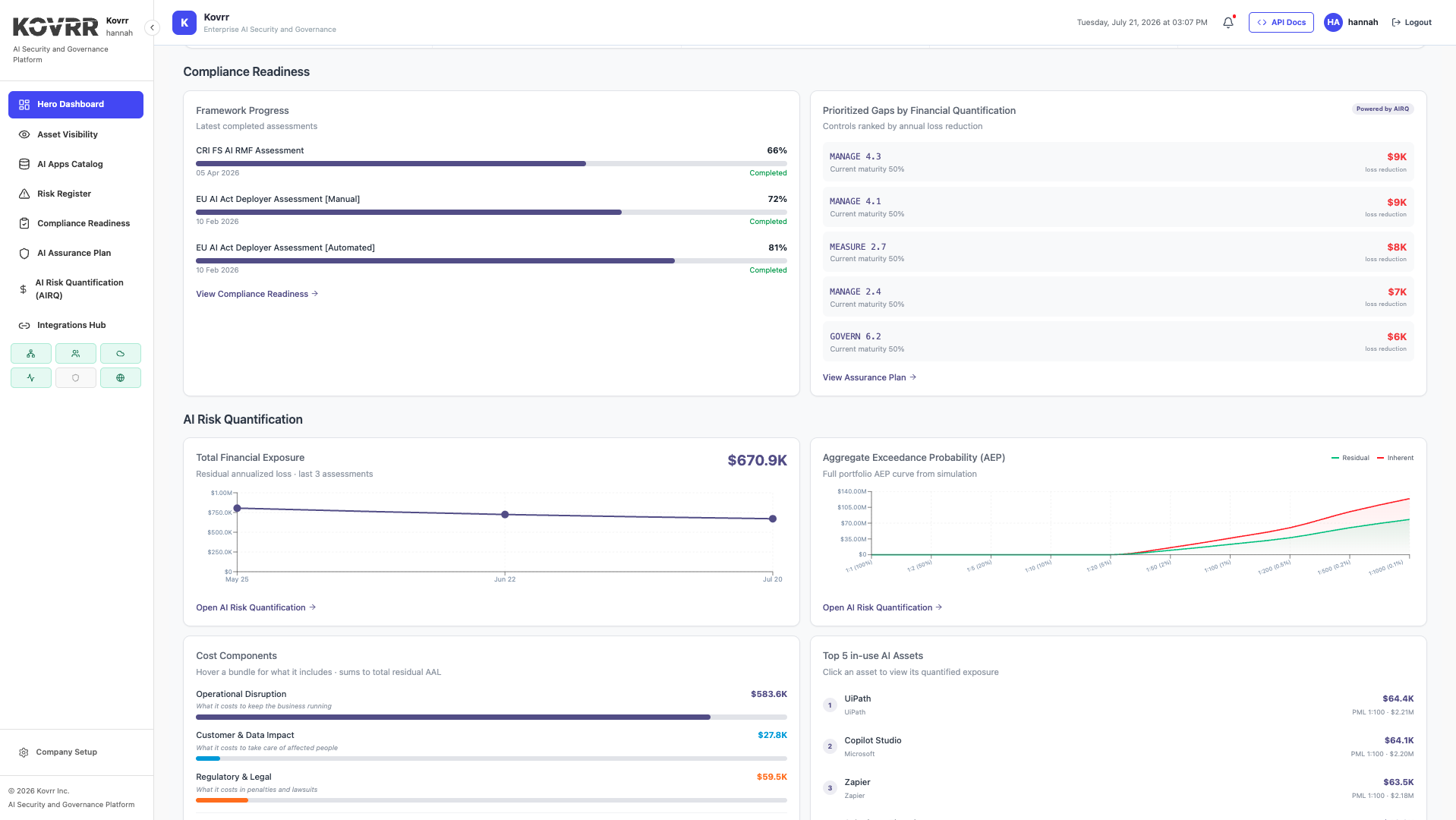
A continuous feed produces a stream and a board needs a series, so the useful reporting artifact is the same measurement taken on a schedule. Programs monitoring continuously and reporting quarterly get both, and directors asking whether the position improved need the second form regardless of how the underlying data is collected.
Assembling the Monitoring Set
Four items cover most of what an AI deployment needs watched, and they come from different places rather than from one product.
Provider change notifications matter first, because a model version change invalidates prior testing and arrives without a corresponding change in your environment. Guardrail regression results come second, run on a cadence against the same adversarial suite. Behavioral baselines per system and per agent come third. Retrieval corpus changes come fourth, since a document added to a store is a change to system behavior. Recording all four against the asset rather than in separate tools is what makes an incident reconstructable, which is where incident identification tends to fail for AI systems.
Attribution Is the Hard Part for Agents
Monitoring an agent means resolving which agent, acting under whose delegated authority, took a given action. An agent operating with a human's credentials appears in logs as that human unless machine identity is resolved separately, and agent identity is the prerequisite rather than a refinement. Sequence matters more than single events here, since the concerning pattern is usually a chain of individually permitted actions.
Assessment Results Have a Shelf Life
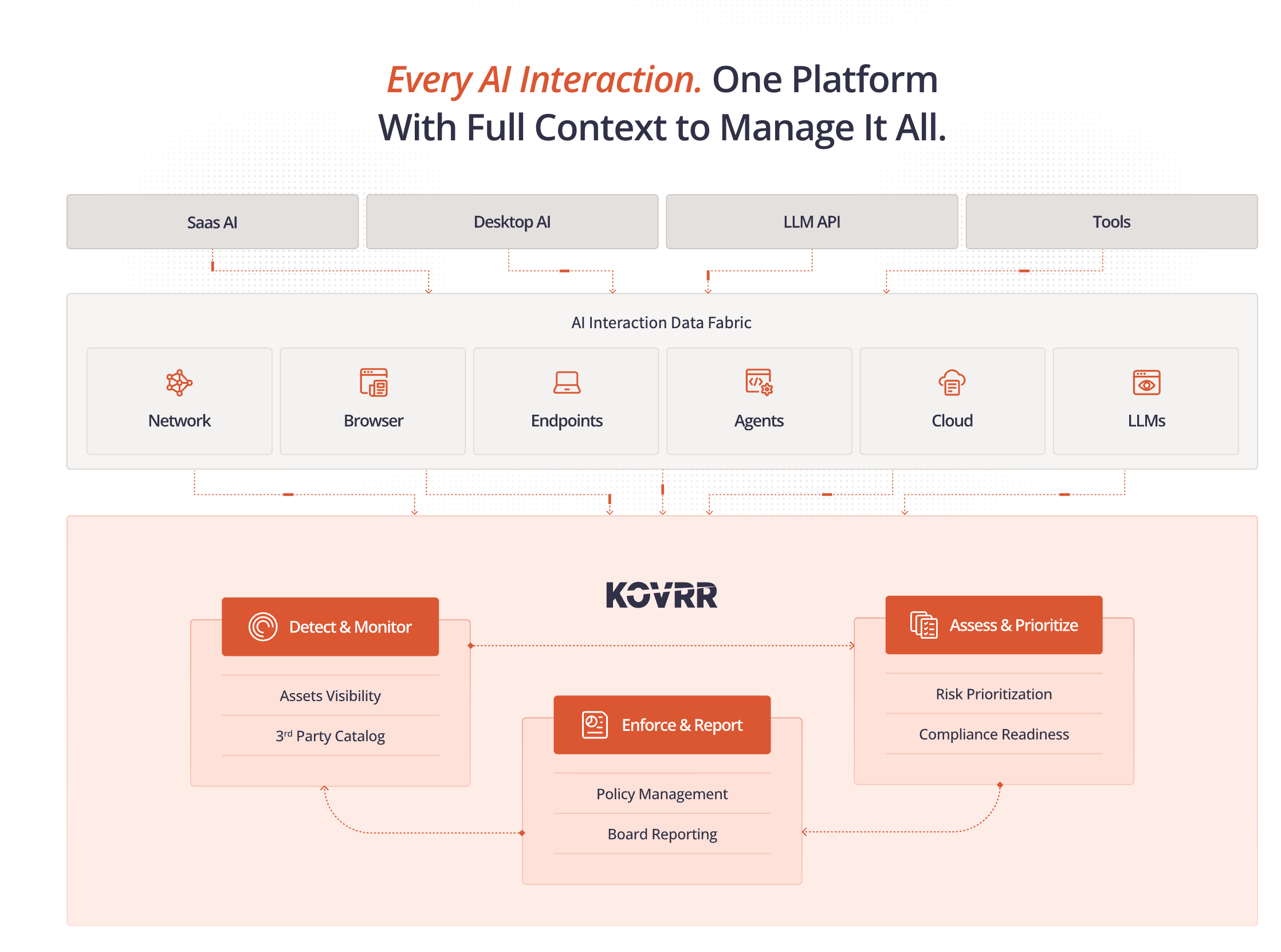
The argument for continuous monitoring of AI systems does not rest on general security principles. It rests on three properties of the technology, being non-deterministic output, provider-side changes you do not control, and retrieval corpora that move beneath a validated configuration. Any of the three can invalidate an assessment while your environment sits unchanged. Recording model version, test date, attempt count and category alongside every result is the minimum that makes a later comparison possible, and Kovrr's AI Security and Governance Platform keeps that record against a live inventory rather than a point-in-time questionnaire.
To see which AI systems in your environment have been assessed, when, and against which model version, book a demo mapped to your own estate.

Real-Time AI Monitoring FAQs
Speak to an ExpertWhy is point-in-time AI security assessment insufficient?

What does real-time AI security monitoring cover?
Why do searches for this return unrelated products?
How is runtime monitoring different from AI security posture management?
Is point-in-time assessment ever the right approach?
What should be in an AI monitoring set?