Blog Post
Quantifying the Risk of Autonomous AI Systems
August 6, 2026
Enterprises are approving autonomous AI deployments faster than they are quantifying the exposure those systems create. Grant Thornton's 2026 AI Impact Survey found that 46 percent of organizations name governance as the top driver of AI failures, yet only 11 percent are funding governance at the level that risk implies. The gap between what enterprises say about AI risk and what they can actually measure about it is where autonomous system exposure accumulates fastest.
Traditional AI risk assessments produce qualitative labels and control checklists. They do not produce the financial figures the CFO, board, and cyber insurance underwriter need to make investment and coverage decisions on autonomous systems that can act, decide, and touch real business data without a human in the loop.
Quantifying autonomous AI risk is the discipline that translates agent behavior, data touchpoints, and failure scenarios into dollar-denominated exposure the enterprise can act on. This article covers why autonomous AI demands quantification rather than qualitative assessment, the failure modes that drive most of the exposure, how to model financial impact across direct and indirect losses, how to assess third-party AI agent risk, and what distinguishes serious AI risk quantification approaches from the assessment tooling that dominates most of the current market.
Why Autonomous AI Risk Demands Quantification, Not Just Assessment
Most enterprise AI risk work today produces assessments rather than quantifications. Assessments identify risks, describe them qualitatively, and assign labels like low, medium, or high. Quantification produces a probability distribution of financial outcomes, calibrated to real-world data, that can be compared directly against other enterprise risks the board already tracks. The difference is not academic. It determines whether AI risk conversations happen at the security team level or at the CFO and board level.
Where Qualitative AI Risk Assessment Falls Short
A "high risk" label on an autonomous procurement agent tells leadership nothing about actual dollar exposure. Is the risk one million dollars or fifty million? Does it move up or down after each new guardrail? Does it compare favorably or unfavorably to other enterprise risks the board is watching? Qualitative labels cannot answer any of these questions, which is why enterprises furthest along on autonomous AI are already operating from AI risk visibility that produces financial outputs rather than color-coded scorecards.
The Dynamic Nature of Autonomous AI Risk
Autonomous systems change continuously. A new model version, a new tool integration, a new business process the agent supports, or a new class of prompt injection technique can all move the underlying exposure between one quarter and the next. Static assessment frameworks cannot keep up. Quantification approaches designed for autonomous AI treat risk as a dynamic financial liability tied to live operational boundaries, refreshed as the agent portfolio and its underlying controls change. This is what makes AI risk management operate as a genuine function of AI governance rather than a compliance checkbox.
The Six Failure Modes That Drive Autonomous AI Exposure
Effective quantification starts with a defensible list of what can go wrong. Enterprise autonomous AI programs concentrate exposure in six failure modes across two categories, and every quantified scenario should map to one of them.
Security-Driven Failures
- Prompt injection at scale: A single manipulated input can redirect an agent's entire multi-step workflow, magnifying the impact of a technique that would only affect a single response in a generative AI setting.
- Confused deputy exploitation: Attackers manipulate an agent with broad, legitimate access into misusing its own credentials, converting the agent into an unwitting privilege bridge into critical systems.
- Cross-system exfiltration through legitimate access: Agents holding aggregated permissions across multiple business systems can extract data across boundaries no individual human user would ever cross in a single session.
Operational and Compliance Failures
- Cascading multi-agent failures: One agent's corrupted output propagates through downstream agents that consume it as trusted input, spreading operational damage before any human notices.
- Boundary deviations from broad goals: Agents invent data or make unauthorized decisions in service of vague high-level objectives, creating exposure that traditional application security models never anticipated.
- Regulatory misalignment: Autonomous decision-making creates novel compliance exposure under the EU AI Act, sector-specific rules like DORA, and evolving state-level AI regulations that require documented risk management for high-risk systems.
The security risks of AI agents in the enterprise blog covers the technical dimensions of each failure mode in depth.
How to Model the Financial Impact of Autonomous AI Failures
Once the failure modes are defined, every scenario needs a monetized impact pathway. Three categories of loss cover most of the quantifiable exposure autonomous systems produce, and modeling all three is what turns a risk assessment into a defensible financial figure.
Direct Incident Costs
Direct costs cover the immediate financial impact of responding to and recovering from an autonomous AI failure. Incident response and forensic investigation consume expert time and specialized tooling. System rollback and data recovery efforts scale with the number of downstream systems the agent touched.
Business interruption costs accumulate while affected systems and dependent processes are offline for remediation. These are the losses that show up first on the CFO's dashboard, and they are also the easiest to bound with historical incident data drawn from claims records and comparable incidents.
Regulatory and Litigation Exposure
Autonomous AI systems face a materially different regulatory landscape from generative AI. Enforcement penalties under the EU AI Act apply to high-risk AI systems that fail to meet documented risk management, oversight, or human control requirements. Sector-specific frameworks including DORA in financial services, HIPAA in healthcare, and evolving state AI laws add additional exposure.
Litigation and settlement risk from customer or employee harm caused by autonomous decisions is the third leg of this category, and it is often the largest single item once tail-loss modeling is included. The operational AI governance approach that supports EU AI Act compliance is the pattern enterprises need to follow to keep this exposure defensible.
Indirect and Downstream Losses
Indirect losses often dwarf direct costs in mature quantification models. Revenue impact from customer churn tied to autonomous AI incidents can persist for quarters after the initial event. Brand and reputational damage from public disclosure of AI failures affects future customer acquisition and existing contract renewals.
Strategic delay costs from AI initiatives paused or scaled back after a serious incident produce deferred value loss that traditional risk assessments almost never capture. Modeling all three requires drawing on comparable incident data across peer organizations, which is where actuarial-grade calibration produces materially better output than internally sourced estimates alone.
How to Assess Third-Party AI Agent Risk
Third-party AI agents present a distinct quantification challenge because the enterprise controls neither the agent itself nor the underlying model provenance. Exposure has to be modeled from what can be observed and inferred rather than from full internal telemetry.
What to Evaluate for Every Third-Party AI Agent
- Data access scope and boundaries: Document exactly what enterprise data the third-party agent can read, modify, or extract, and quantify exposure based on the sensitivity of that data.
- Vendor security posture and control maturity: Score third-party agent providers on documented certifications, incident history, and the control frameworks they support.
- Concentration and interconnection risk: Score higher when multiple third-party agents depend on the same underlying model provider, cloud host, or upstream data source, since a single upstream failure cascades across dependencies.
How to Monitor Third-Party AI Risk Over Time
- Continuous vendor risk signals: Ingest fresh signals on vendor incidents, security posture changes, and product updates so the exposure figures reflect the current state rather than the state at contract signing.
- AI-specific vendor catalog data: Maintain an inventory of every third-party AI service in use across the enterprise, ideally through platforms tracking 15,000-plus AI applications with SBOM-level CVE data.
- Contract and SLA gap monitoring: Quantify the residual exposure not covered by third-party contract terms, insurance obligations, or vendor indemnification.
Kovrr's AI Third-Party Risk Management software provides the discovery and monitoring layer this quantification depends on, so the exposure figures stay current as the third-party AI landscape shifts underneath the enterprise.
What Distinguishes Serious AI Risk Quantification Approaches
The AI risk quantification market is small but growing, and the platforms producing defensible, decision-grade output share a small number of characteristics that separate them from marketing exercises. Understanding these criteria helps buyers avoid platforms that produce numbers no one can defend.
Connected Telemetry as the Data Foundation
Quantification is only as good as the data feeding it. Assessment tools that rely on annual questionnaires and static inventory data produce quantifications that decay the moment they finish. Serious approaches ingest continuous telemetry from every signal source an agent might touch, including browser sessions, endpoints, network flows, identity providers, and AI catalog data. That fused signal set is what turns quantification from an annual exercise into a live operational metric, and it is what connected telemetry does across the browser, endpoint, network, identity, and AI catalog that Kovrr's platform integrates into one analytical layer.
Probabilistic Modeling With Statistical Significance
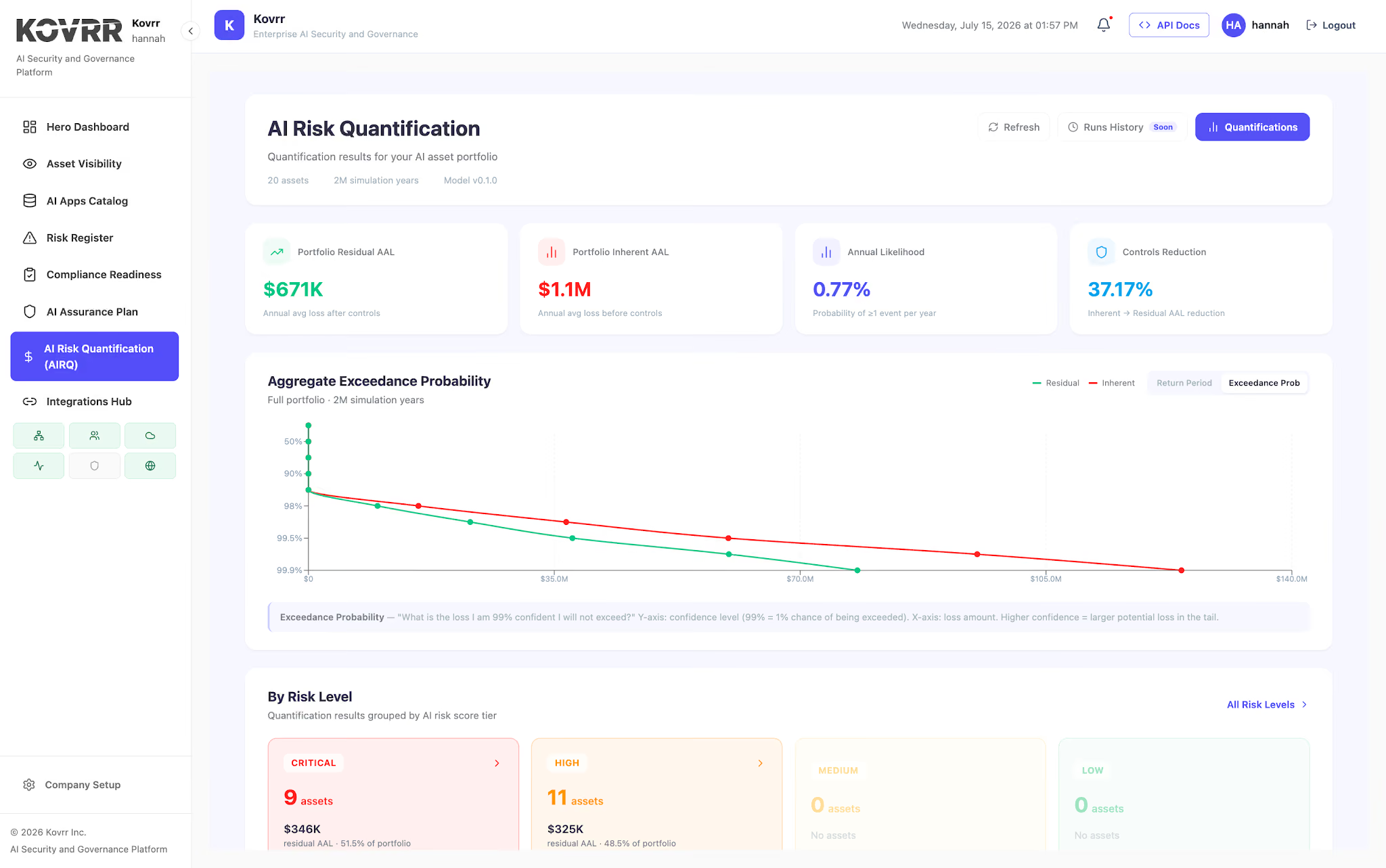
Serious quantification uses Monte Carlo simulation running tens of thousands of trials per scenario against frequency and severity distributions anchored to actuarial-grade data. The output is a full loss distribution, not a point estimate, expressed through Average Annual Loss, tail exposure at defined confidence intervals, and the Loss Exceedance Curve that maps to the same statistical framework the board already sees for cyber risk. Approaches that produce single-number confidence without exposing methodology are the ones buyers should be most skeptical of.
Integration With the Broader Governance Program
The quantification output has to feed decisions rather than sitting in a standalone dashboard. Strong platforms connect quantified exposure directly to the AI risk register with dollar-denominated entries per scenario, feed board reporting workflows with continuously updated numbers, and align to the four operational disciplines every enterprise AI program has to master: discovering AI assets, monitoring agent behavior, enforcing AI policy, and quantifying AI risk. Kovrr's approach ties all four together through the same underlying data fabric, with AI asset visibility as the discovery layer and AI compliance readiness as the policy enforcement anchor.
Common Mistakes in AI Risk Quantification
Failed quantification programs follow predictable patterns. Two categories cover most of the traps enterprises walk into.
Data and Modeling Mistakes
- Building the model on internally sourced data alone: Cyber and AI incidents are relatively low-frequency events for any single enterprise, which means internal data is almost always insufficient to calibrate frequency and severity distributions defensibly.
- Using public breach data as the primary anchor: Public disclosures skew heavily toward the most severe or high-profile events, introducing systematic bias that typically underestimates moderate losses and overestimates the rarity of severe ones.
- Running too few Monte Carlo trials: Models running hundreds or a few thousand trials produce outputs that shift meaningfully between reruns, which is a signal to be cautious about the underlying rigor.
Governance Integration Mistakes
- Treating quantification as a standalone tool: Quantification that never feeds the AI risk register, governance policy, or board reporting workflows produces numbers no one uses.
- Ignoring third-party AI exposure: Programs that quantify only internal AI systems miss a substantial portion of the total enterprise exposure, especially as third-party AI usage accelerates across every business function.
- Skipping continuous refresh: Point-in-time quantifications decay quickly as models, controls, and business processes evolve, which is why continuous integration with security telemetry has become the standard rather than an optional advanced feature.
The pattern across all six mistakes is the same. Quantification that operates in isolation from the broader governance program produces academic outputs. Quantification that operates as a genuine function within AI governance produces the decisions and defensible dollar figures the enterprise actually needs.
From Quantified Risk to Governed Autonomous AI
Quantifying autonomous AI risk is the operational bridge between the technical reality of agentic systems and the strategic conversation those systems demand from executive leadership. Enterprises that build quantification into their AI programs from day one produce defensible dollar figures the CFO, board, and cyber insurance underwriter can act on, feeding the board-level AI risk conversation with the same rigor finance uses for every other enterprise risk category.
Enterprises that treat quantification as an optional advanced discipline stay stuck in qualitative labels while their autonomous AI portfolio accumulates exposure no one can measure. The organizations moving fastest are the ones combining connected telemetry across every signal source, probabilistic modeling with real statistical significance, and tight integration into the four core AI governance disciplines.
To see how Kovrr quantifies autonomous AI exposure and turns it into board-ready financial figures, book a demo tuned to your specific agentic deployment.
Autonomous AI Quantification FAQs
Speak to an ExpertHow do you assess the risk of third-party AI agents?

Which vendors offer AI agent risk quantification?
Why can autonomous AI risk not be managed with qualitative labels?
How does connected telemetry improve AI risk quantification?
How does AI risk quantification relate to cyber risk quantification (CRQ)?