Blog Post
The Best AI Governance Platforms for Financial Services in 2026
October 21, 2026
Most governance platform comparisons written for financial services lead with the EU AI Act high-risk regime. For a bank deploying credit scoring today, that is the obligation furthest from biting, and the ones already in force get less attention than they deserve.
The criteria below follow the provisions rather than the subject areas, with dates attached, because the sequence they arrive in decides what a platform has to do first.
Which Obligations Are Already Live?
Three, and the newest is barely six months old.
Model Risk Guidance Was Rewritten in 2026
SR 26-2, issued 17 April 2026, supersedes and replaces the 2011 guidance that served as the reference for fifteen years, along with the 2021 anti-money laundering statement. The Federal Deposit Insurance Corporation joined the Federal Reserve and the Comptroller of the Currency in issuing it, making it tri-agency where its predecessor was not.
What Changed in Substance
The revised guidance emphasizes a risk-based approach tailored to an organization's model risk profile and to the size and complexity of its operations, recognizing that practices appropriately vary. It states it is most relevant to banking organizations above thirty billion dollars in total assets, which gives smaller institutions a different starting position.
The Two European Provisions Already Applying
The literacy duty under the AI Act has applied since 2 February 2025 and attaches to being a provider or deployer rather than to any risk tier. The transparency obligations in Chapter III Section 4 have applied since 2 August 2025. Neither waits for the high-risk regime.
When Do the High-Risk Obligations Arrive?
December 2027 for the systems a bank is most likely to run, which is later than most planning assumes.
The Provision
Article 113(c) defers Chapter III Sections 1, 2 and 3, with the exception of Article 6(5), to 2 December 2027 for systems classified as high-risk under Annex III, and to 2 August 2028 for those classified under Annex I.
Why That Matters for Selection
A platform chosen on its high-risk conformity tooling is being chosen for an obligation more than a year out, while the duties biting today are model risk governance, literacy and transparency. Both matter and they do not arrive together, so the evaluation should weight what is live.
Which Systems Does Annex III Catch?
Fewer than the subject area suggests, and the exclusions are as load-bearing as the inclusions.
Credit Scoring Is Named
Annex III, point 5(b) covers AI systems intended to evaluate the creditworthiness of natural persons or establish their credit score. The classification follows intended purpose rather than the technique, so a simple model and a complex one land identically.
Fraud Detection Is Excluded
The same point carries an express exception for AI systems used to detect financial fraud. A bank's fraud model and its credit model therefore sit in different categories under one Annex point, which is the sort of distinction a platform classifying by business function will miss.
Insurance Pricing Is Separate
Point 5(c) covers risk assessment and pricing for natural persons in life and health insurance. General insurance lines are absent, so a composite insurer carries the obligation on part of its book and not the rest.
What Should the Platform Do With Third-Party Models?
Treat them as in scope, since both the American and European regimes say so in different language.
The Model Risk Position
Model risk guidance has long extended to vendor and third-party models rather than only to those built internally. A purchased AI system is a model somebody else developed and the institution still owns the risk, which makes vendor documentation an input to validation rather than a substitute for it.
The Operational Resilience Position
For European financial entities, information and communication technology third-party arrangements carry register and contractual requirements of their own, independent of whether AI is involved. What a register of information surfaces applies to an AI provider the same way it applies to any other critical supplier.
What to Ask a Vendor
Whether the platform records a model's provenance and the validation performed on it, separately from recording that the system exists. An inventory entry naming a vendor is not a validation record.
What Separates Platforms on These Criteria?
Four capabilities, each tied to a provision rather than to a feature category.
Per-Regime Tracking With Dates
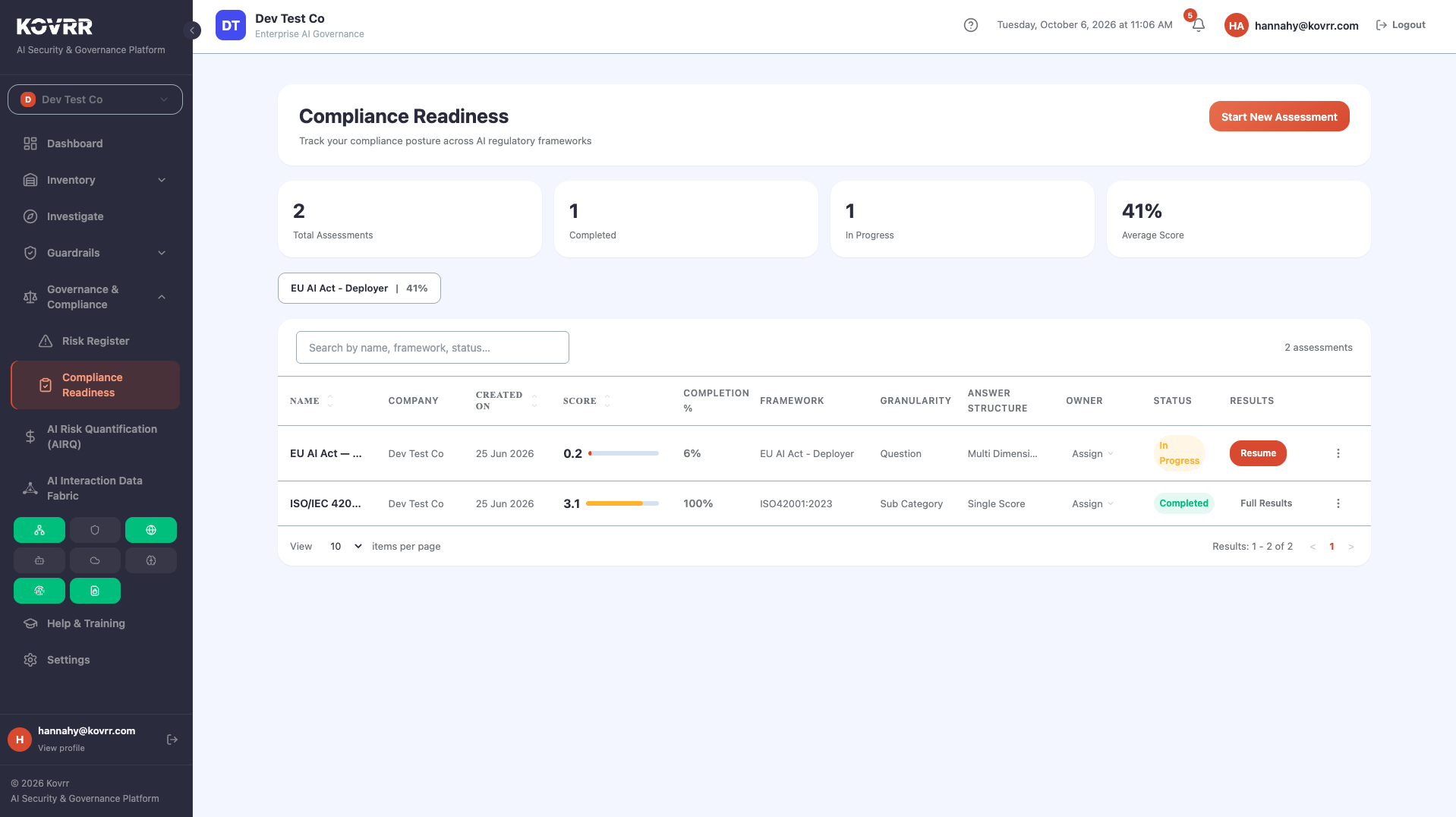
Whether readiness is tracked separately per regime with its own completion position, so an obligation live today is visibly distinct from one arriving in December 2027. A single compliance score merges them and hides the sequence.
Classification by Intended Purpose
Whether the platform classifies against the Annex wording, including its exceptions, rather than by business function. The fraud carve-out is the test case, since a product that cannot separate fraud detection from credit scoring will misclassify a common pair.
Validation Records Alongside Inventory
Whether the system holds evidence of what was validated, by whom and when, which is what model risk examination asks for and what an inventory alone cannot answer. Readiness assessed per requirement shows which obligations existing records already cover.
What Is the Sector-Specific Loss Mechanism?
Supervisory consequence rather than a fine, which behaves differently from the penalties most AI governance content describes.
How It Lands
A model risk finding at examination produces a matter requiring attention, a remediation commitment and supervisory attention that persists across cycles. The cost is the remediation program and the constraint on activity while it runs, rather than a single sum.
Why That Changes the Figure
A penalty is a one-time amount and a supervisory constraint accrues for as long as it stands, which makes duration the term carrying the exposure. A consequence that accrues daily behaves the same way in a different regime.
What Should an Evaluation Establish?
Three things, in the order the obligations arrive.
Whether the platform tracks the three live duties separately from the deferred ones, since a merged score cannot show the sequence. Whether classification follows the Annex wording including its exceptions, tested against a fraud model and a credit model. Then whether validation evidence sits alongside the inventory, because that is what a model risk examination asks for. Kovrr's AI Security and Governance Platform records which sources produced each piece of evidence, and the general platform comparison covers the criteria that apply outside this sector.
Follow the Dates, Not the Subject Area
Three obligations already bind a bank running AI, and the newest is the April 2026 revision to model risk guidance, which replaced a reference that had stood for fifteen years and added the deposit insurer to the agencies issuing it. The AI Act literacy duty has applied since February 2025 and the transparency obligations since August 2025. The high-risk regime that dominates the conversation does not reach Annex III systems until 2 December 2027. Within Annex III, credit scoring is named while fraud detection is expressly excluded and only life and health insurance pricing is covered, so a platform classifying by business function will put systems in the wrong categories. The use case rather than the sector sets the rules.
To see readiness tracked per regime with the live obligations separated from the deferred ones, book a demo mapped to your own estate.


Financial Services AI Governance FAQs
Speak to an ExpertWhich AI obligations already apply to financial services firms?

When do EU AI Act high-risk obligations apply to credit scoring?
Is fraud detection a high-risk AI system under the EU AI Act?
Does the EU AI Act cover insurance pricing?
Do model risk expectations cover AI systems bought from vendors?
What is the loss mechanism for AI governance failure in banking?