

Cyber GRC
Cyber GRC is the discipline of governing cybersecurity, managing cyber risk, and demonstrating compliance across an organization, sitting inside broader enterprise GRC but with cyber-specific frameworks, controls, and reporting.
What Cyber GRC Covers
Cyber GRC brings together three connected workstreams. Governance defines the accountability, policies, and oversight structures for cyber. Risk management identifies, assesses, and prioritizes cyber risks in enterprise terms. Compliance demonstrates conformance to regulatory, contractual, and internal-policy requirements.
The three workstreams share infrastructure. A single documented control can support governance (evidence of policy execution), risk management (mitigating a specific risk), and compliance (satisfying a regulatory requirement) simultaneously.
Why Cyber GRC Is Its Own Discipline
Enterprise GRC exists as a broader function, but cyber GRC has developed distinct methods and tools because cyber risk moves faster and has different characteristics than most other enterprise risks. Cyber-specific frameworks (NIST CSF, ISO 27001, DORA), cyber-specific regulations (SEC Cyber, DORA, NIS2), and cyber-specific quantification (CRQ) all sit inside cyber GRC.
See Kovrr's Cybersecurity GRC capability.
Cyber GRC and Quantification
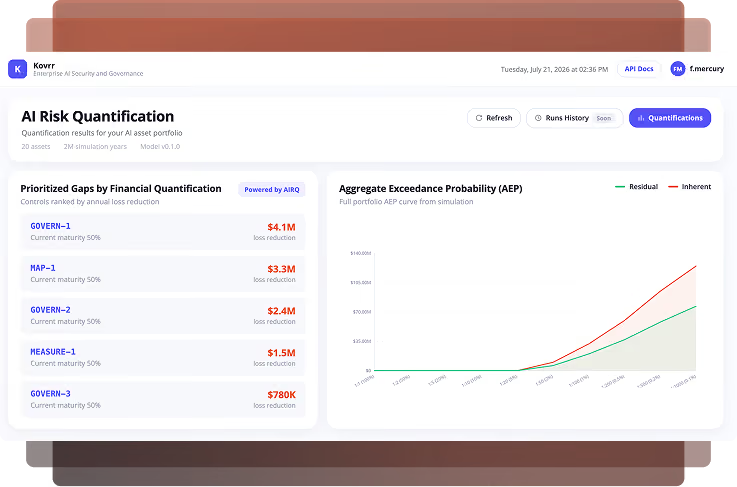
Modern cyber GRC increasingly runs on quantified data rather than qualitative ratings. The move to CRQ reshapes what cyber GRC reports look like, how prioritization decisions get defended, and how program maturity gets measured.
How Kovrr Approaches Cyber GRC
Kovrr's Cybersecurity GRC capability operationalizes cyber GRC across the risk register, control monitoring, framework mapping, and board reporting, with CRQ as the underlying data layer. See Cyber Risk Register.
Related Terms


Turn Cyber Risk Into Financial Exposure the Board Can Act On
Security leaders are being asked to defend budgets, prioritize controls, and report cyber risk in the same terms as every other enterprise risk. Kovrr's CRQ Platform models loss scenarios, benchmarks control performance, and gives the C-suite a defensible view of where cyber sits on the balance sheet.