

Security Program Maturity
Security program maturity describes how established, consistent, documented, and effective an organization's cybersecurity program is, typically measured against defined maturity models like NIST CSF Implementation Tiers.
What Maturity Actually Measures
Maturity captures the sophistication of the program itself: how repeatable its processes are, how well documented its practices are, how consistently it improves, and how integrated it is with enterprise risk management. It is a descriptive vocabulary rather than a performance measure.
A mature program has consistent practices across the enterprise, documented processes, defined roles, measurement and feedback loops, and continuous improvement. An immature program has ad hoc practices, inconsistent implementation, and limited visibility.
Common Maturity Models
Widely used models include NIST CSF Implementation Tiers, CMMI-based cybersecurity maturity models, DoD's CMMC framework for defense contractors, and various vendor-specific models. Each has its own vocabulary, but they share common underlying concepts.
Maturity vs. Posture vs. Exposure
Maturity, posture, and exposure describe different things. Maturity describes how established the program is. Posture describes how well it is performing at a moment. Exposure describes the financial consequence. Mature programs typically have better posture and lower exposure, but the relationship is not automatic.
Maturity in Quantified Reporting
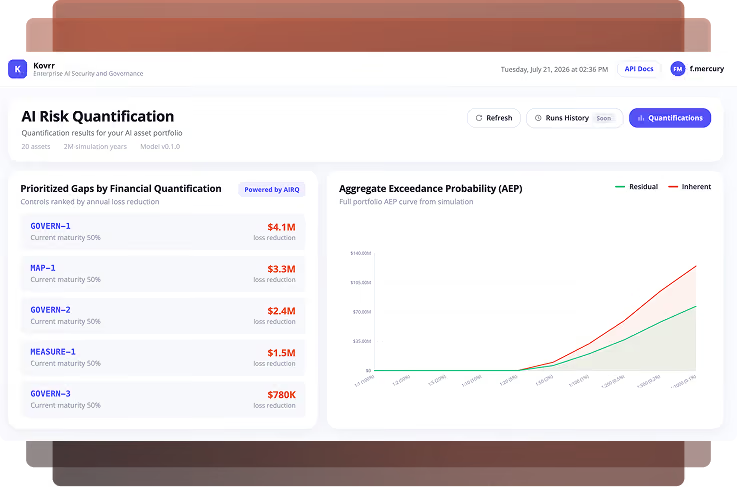
Modern programs increasingly report all three dimensions: maturity for describing program state, posture for current performance, and quantified exposure for financial impact. Boards use the combination for oversight decisions.
How Kovrr Approaches Security Program Maturity
Kovrr's Cybersecurity Maturity Assessments Enhanced by CRQ capability integrates maturity assessment with quantified exposure, so both descriptive maturity and financial impact are visible in the same view.
Related Terms


Turn Cyber Risk Into Financial Exposure the Board Can Act On
Security leaders are being asked to defend budgets, prioritize controls, and report cyber risk in the same terms as every other enterprise risk. Kovrr's CRQ Platform models loss scenarios, benchmarks control performance, and gives the C-suite a defensible view of where cyber sits on the balance sheet.